China Offers Reward for Information About Recent Self-Immolations

By Karen Diep
Impunity Watch Reporter, Asia

BEIJING, China – On Thursday, authorities offered up to a $32,000 reward for information revolving around the series of self-immolations in China’s Tibetan-inhabited region, Gannan.  Furthermore, authorities anticipate awarding $7,7000 for information regarding planned immolations.

The most recent self-immolation. (Photo Courtesy of BBC)

According to BBC, Chinese authorities issued a notice stating that the immolations have “seriously impacted social stability and harmony as well as people’s ability to live and work.”

The note further stated, “Anyone who reports and informs the legal authorities on the people who plan, incite to carry out, control and lure people to commit self-immolation will be awarded 50,000 yuan.”  Furthermore, anyone is able to provide information regarding the “black hands,” those behind four recent self-immolations, will be receive 200,000 yuan.

Since February 2009, approximately 60 ethnic Tibetans, many of whom were nuns and monks, have committed self-immolation to protest China’s rule in Tibet.  Moreover, the recent “black hands” incident occurred near the Labrang monastery.

As China’s dominant ethnic group, Han, moves into historically Tibetan areas, countless Tibetans accuse the Chinese government of eroding their culture and suppressing their religious freedom.

“This fourth self-immolation in the space of a week underlines that protests in Tibet are continuing and intensifying. We can only expect this to continue until Tibetans are granted the freedom they demand,” shared Free Tibet’s Stephani Brigden.

On Wednesday, the government attributed the exiled Tibetan Buddhist leader and Nobel Peace Prize winner, the Dalai Lama, for promoting self-immolation.  However, according to AFP, the Dalai Lama has not denounced such acts and prefers to remain “neutral.”


For further information, please see:

Examiner – China offers rewards for information about immolations – 26 Oct. 2012

Hindustan Times – Self-immolation: China police offer reward for info on “planned” suicides – 26 Oct. 2012

AFC – China offers rewards to expose Tibetan immolations – 25 Oct. 2012

BBC – Tibet immolations: China offers rewards for information – 25 Oct. 2012


Syrian Truce Unstable

By Emily Schneider
Impunity Watch Reporter, Middle East

DAMASCUS, Syria – The agreed upon cease-fire in Syria for Eid al-Adha fell apart Saturday with bombings and outbreaks of violence across the country. Each side has accused the other of breaking the truce.

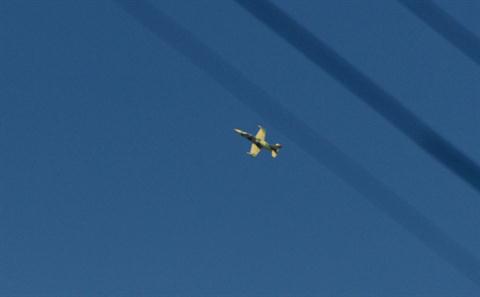
A Syrian warplane flies over Aleppo earlier this month. (Photo courtesy of AFP)

The government accepted the cease-fire proposed by Lakhdar Brahimi, an international envoy that has been trying to negotiate a peace deal. However, the government did say that it reserved the right to resume military activity to respond to any so-called terrorist gangs.

On Friday, the first day of the four day Muslim Feast of Sacrafice,  the level of violence throughout the country seemed to lessen. Demonstrators walked the streets in the larger numbers than had been feasible for weeks. Activists said that there were planes circling above the crowds, but they did not fire any weapons.

But by Saturday, almost every violent hot spot reported resumed hostilities. The most outrageous disturbance of the truce occurred when a warplane fired missiles into a residential building in Arbeen, a suburb of Damascus. That attack killed eight men, according to the Syrian Observatory for Human Rights.

Although that attack has not been confirmed yet, it marks the first aerial attack since the truce began Friday morning. In pictures posted on Facebook, the residential building was shattered and a large crater filled with rubble was clearly visible.

“There is a clear breach of the truce,” Ahmad Kadour, an Idlib activist, said. According to him, government convoys of reinforcements were moving up the road to Wadi al-Deif, the site of a military base and fighting the day before.

In Aleppo, an activist who uses the nickname Abu al-Hassan claimed government tanks had resumed shelling in areas around the airport. Other activists said that towns around Aleppo and Idlib were shelled as well.

Residents in the central city of Homs sad there was no sign that  the fighting was diminishing.

“There are regime snipers shooting at us from several fronts, and the city remains under siege, as it has been for 141 days,” activist Abu Bilal said. “This siege alone is considered a military operation, so with or without the truce, this criminal regime obviously does not care.”

SANA, the official news source of Syria, and the Syrian Observatory for Human Rights both reported firefights between government forces and the opposition in the eastern city of Deir al-Zour. Multiple car bombs exploded near a military headquarters and in front of the Syriac Orthodox Church. At least five people were killed. Airplanes also shelled Deir al-Zour, activists said.

Although, there were areas where there was no fighting.

“It kind of depends on the area…it has been calm over here” said Iyas Kadoni, a civil-society activist from Saraqib, near Aleppo. He said that area was much quieter than other areas, like Homs.


For further information, please see:

CNN – Reports of Renewed Fighting Unravels Temporary Syrian Truce – 27 October 2012

Daily Star – Syrian Warplanes Stage 1st Airstrike Under Truce – 27 October 2012

SANA – Gatilov: Armed Opposition in Syria Has Thwarted Eid al-Adha Truce – 27 October 2012

NY Times – Syrian Protestors Emerge Amid Clashes and Bombing During a Holiday Cease-Fire – 26 October 2012


Nasrin Sotoudeh Named Co-Recipient of Sakharov Prize

By Justin Dorman
Impunity Watch Reporter, Middle East

TEHRAN, Iran – The Sakharov Prize is one of the top honors awarded to those annually for their contributions to human rights and freedom of thought. Previous winners include figures like Nelson Mandela and Aung San Suu Kyi. This year the award was given to Nasrin Sotoudeh and a fellow Iranian, film director, Jafar Panahi.

Nasrin Sotoudeh has been on a hunger strike since October 17th in reaction to harassment against her family. (Photo Courtesy of Iranian)

Nasrin Sotoudeh is a member of the Defenders of Human Rights Centre and is a jailed attorney who previously was known for defending children facing the death penalty, prisoners of conscience, human rights activists, and child victims of abuse. Currently, she is serving a six-year sentence for “acting against national security” and “spreading propaganda against the regime.” Many believe her arrest to be completely arbitrary and understand her imprisonment to be part of the Iranian government’s plan to suppress human rights lawyers.

Sotoudeh has been imprisoned since September 2010. For much of her detainment she was held in solitary confinement and tortured in attempts to make her confess. During this time she was kept away from her family and lawyer. Sotoudeh is no longer in solitary confinement, however, she is still often denied contact with her family.

“The conditions of detention imposed on Nasrin Sotoudeh are unacceptable and clearly aim at imposing additional punishment on her for her human rights activities,” stated Souhayr Belhassen, President of the International Federation for Human Rights.

Sotoudeh was caught writing her legal defense on a tissue, and ever since she has been denied face-to-face meetings with her family. Now she can only see her thirteen-year-old daughter and five-year-old son from behind a glass wall.

Authorities have taken other measures to punish the Sotoudeh family. One action they took was to change her visiting day from Sunday to Wednesday without proffering and real reason. The authorities have also placed travel bans on Nasrin’s daughter and husband and have held the husband in jail, overnight, for peaceful protests of his wife’s detention.

Ann Harrison, Deputy Director of Amnesty International’s Middle East and North Africa programme believes that, “[b]y harassing the family members of prisoners solely in order to stop their legitimate public campaigning, the Iranian authorities are trampling wholesale on their international human rights obligations.”

In reaction to the harassment her family was facing, Sotoudeh began a hunger strike on October 17th which still continues. She wrote to her children in a letter, “I know that you require water, food, housing, a family, parents, love, and visits with your mother. . . However, just as much, you need freedom, social security, the rule of law and justice.”

For further information, please see:

Amnesty International – Health Fears for Imprisoned Sakharov Prize Winner in Iran – 26 October 2012

Daily Beast – Iran’s Crackdown on Human Rights Lawyers – 26 October 2012

Guardian – Nasrin Sotoudeh and Director Jafar Panahi Share top Human Rights Prize – 26 October 2012

Iranian – Nasrin Sotoudeh: Prisoner of the day – 22 October 2012

Police Admit Faults in Marikana Massacre

By Ryan Aliman
Impunity Watch Reporter, Africa

PRETORIA, South Africa – On Monday, the police admitted that they may have been at fault in the August 16 shooting involving strikers who worked for a mine owned by the platinum giant Lonmin in the Marikana area.

Striking miners carrying the coffin of one of the victims in the Marikana Massacre.(Photo courtesy of AFP/File, Rodger Bosch)

In a statement issued during a public inquiry, the South African Police Service (SAPS) said that some of its officers either overreacted or mistakenly shot at protesters in response to “friendly-fire”.

“The response of some police officers may have been disproportionate to the danger they faced from the group of more than 200 armed protesters,” the opening statement read. “The police officers are prepared to accept that they may have been responding to ‘friendly fire’, believing it to be fire from the protesters,” it added.

The SAPS statement was delivered by the SAPS lawyer, Ishmael Semenya, to a commission examining the evidence surrounding the events of what is now dubbed as “the Marikana massacre”. The commission, headed by Judge Ian Farlam, is currently investigating the role of the SAPS, along with trade unions and Lonmin authorities, in the incident.

Described by the South African media as the single most lethal use of force by South African security forces against civilians since 1960 and the end of the apartheid era, the August 16 shooting resulted in the death of  36 miners, 2 police officers, 4 other unidentified persons and the injury of 78 other workers and police.

The SAPS also admitted that the number of police officers deployed at Marikana was “insufficient” to control the crowd of approximately 3000 angry miners, many brandishing traditional weapons, machetes and sticks as they protested for higher pay. Semenya insisted, however, that the police officers merely acted in self-defense when “the situation got out of control”. “The use of lethal force was the last possible resort. There was no murderous intent from the part of the police service,” he told the commission.

Dumisa Ntebeza, the lawyer for the victims’ families, refuted Semenya’s statement by contending that “no less than 14 of the striking miners were shot from behind, many in the back or in the back of the head.” “This evidence, which we understand is unlikely to be contradicted, is wholly inconsistent with the claims of necessity that the SAPS will advance,” Ntebeza asserted.

Meanwhile, on Tuesday, a crime scene technician admitted that the SAPS may have lost some of the evidence collected from the scene. He admitted that the police may have missed some cartridges and bullets, adding that the SAPS has yet to finalize its ballistic reports.


For further information, please see:

AFP – S. Africa police admit possible mistakes in Marikana deaths – 23 October 2012

Mail and Guardian – Cop admits some evidence from Marikana shooting may be lost – 23 October 2012

Al Jazeera – Police admit ‘overreacting’ at Marikana – 22 October 2012

Business Day Live – Marikana: ‘No murderous intent’ on part of police – 22 October 2012

SABC News – Marikana Mineworkers were Shot in the Back – 22 October 2012

The Telegraph – Marikana massacre ‘could have been avoided’ – 22 October 2012


Police Find Eight Tortured Bodies Dumped Near Mexico City

By Mark O’Brien
Impunity Watch Reporter, North America

MEXICO CITY, Mexico — Authorities discovered eight dead bodies dumped along the streets of a Mexico City suburb on Thursday.

A police spokesperson said found the bodies in Ecatepec, a poor suburb north of the capital city.  Six of the bodies—five men and one woman—appeared to have been severely beaten.

“They were all naked and showed signs of torture,” police spokesperson said.  “It also appeared their throats had been cut.”

The other two bodies, both men between the ages of 18 and 22, died from gunshot wounds on another street.  So far, police have not identified the bodies or any suspects in what police called two separate crimes.

“Both incidents are being investigated by the homicide prosecutor’s office, which immediately assigned personnel to conduct the corresponding investigation,” the Mexico state Attorney General’s Office said, according to Global Post.

Fox News Latino reported that investigators believe the killings were linked to organized crime because of the way the victims were murdered.  The news organization quoted city officials as saying no messages were left with the bodies.

Fox News Latino also quoted city officials as saying two of the bodies had ropes around their necks, and all of them had “tattoos on different parts of their bodies.”

Since Mexico began cracking down on drug cartels six years ago, more than 60,000 people have died in violence linked to drug trafficking.  The Associated Press reported that Mexico City had been predominantly free of that violence, although it was slowly making its way there.

In September, Mexico deployed troops to Nezahualcoyotl, an eastern suburb, when fighting between two drug cartels spilled into the streets.

Reuters reported that the number of drug war deaths kept by the Mexican newspaper Reforma “is on course to suffer its heaviest death toll this year since [President Felipe] Calderon launched his offensive, at a time when the national count has erased somewhat.”

Ecatepec is home to both incoming President Enrique Pena Nieto and incoming State of Mexico Governor Eruviel Avila.  Both are members of the Institutional Revolutionary Party (PRI), which governed Mexico between 1929 and 2000.  As Reuters reported, “[c]ritics accused the PRI of turning a blind eye to the drug trade while in power.”

But Nieto, who will be sworn in this December, has pledged to continue the national crackdown on organized crime.  Until last year, he governed the State of Mexico, where both Nezahualcoyotl and Ecatepec are located.

For further information, please see:

Global Post — Mexico Violence: 8 Bullet-Ridden Bodies Found on Outskirts of Mexico City — 26 October 2012

Fox News Latino — Police Find 6 Bodies in Central Mexico — 25 October 2012

Reuters — Eight Bodies Found Dumped in Mexico City Suburb — 25 October 2012

Seattlepi.com — 8 Bodies Found on Outskirts of Mexico’s Capital — 25 October 2012