PILPG and Case Western Reserve University School of Law
By Alexandra Sandacz
Impunity Watch Reporter, Europe
ATHENS, Greece – As Greece feels the effects of Europe’s debt crisis and simultaneously experiences a 25 percent unemployment rate, the number of hate crimes increased.

For example, on September 17, 2012, Ali Rahimi was attacked by 15 individuals. He recalled, “I told them that I am from Afghanistan, and they said that it is time for me to go back to my country.”
Currently, there is a roughly 800,000 to 1 million undocumented migrants that now live in Greece, which has a population near 11 million.
Nikos Demertzis, a professor of political sociology at the University of Athens, described the crisis as, “We have a major socioeconomic crisis in which several hundred thousand Greeks are losing ground, and you have a rising number of immigrants in Greece, many illegal. This is creating a volcanic situation where all the classic parameters for the flourishing of a far-right force like Golden Dawn are present.”
Relying on the recent national frustration with unemployment and immigrants, political party, Golden Dawn, campaigned on a platform of ultra-nationalism and fierce anti-immigrant policies. Along with a growing popularity, Golden Dawn won 18 seats in parliament during June’s national election, becoming the fifth largest political party in parliament.
Golden Dawn campaigned with one major caveat: for Greeks only.
Ilias Panagotiaros, a Golden Dawn politician and a member of Greek parliament, said, “We have to protect 10 million Greeks that are suffering from the very bad economy and from the killings, rapes, shootings and everything else that all illegal immigrants are doing to this country.”
Consequentially, since the party took a seat in national office, many supporters have been accused of various violent attacks, such as the stabbings and beatings of immigrants, ransacking an immigrant community center, smashing market stalls and breaking the windows of immigrant-owned shops.
Judith Sunderland from Human Rights Watch states, “Something must happen quick. Xenophobic hate crimes have reached an alarming proportion in Greece. Victims are often actively discouraged from filing complaints, told by police officers that it is not worth their while or that they should fight back themselves. And many migrants fear that they could be locked up themselves because of their legal status.”
As a result of the numerous assaults against immigrants, Athens is recommending to create stricter penalties against hate crimes, which could include a minimum three-year prison sentence.
For further information, please see:
NBC World News — Hate crimes increase, extreme right strengthens as Greece economy sinks – 22 October 2012
The Washington Post — Anti-immigrant Golden Dawn rises in Greece – 20 October 2012
SETimes — Greece to crack down on hate crimes – 2 October 2012
The New York Times — Right-Wing Extremists’ Popularity Rising Rapidly in Greece – 30 September 2012
By Ali Al-Bassam
Impunity Watch Reporter, Middle East
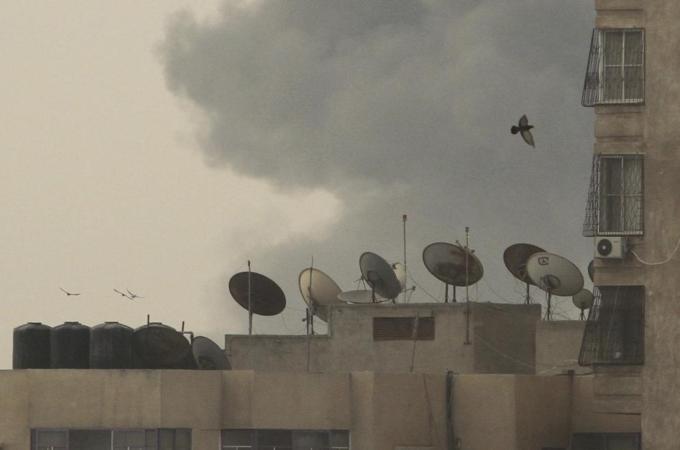
DAMASCUS, Syria — On Sunday, Human Rights Watch (HRW) announced that new evidence emerged proving that the Syrian air force used cluster bombs near a main highway that runs through the town of Maaret Al Numan, where a major confrontation between Syrian and rebel forces recently took place. Rescuers said that the attack killed at least 49 people, 23 of them were children.

Medics and rescuers said that two housing complexes and a mosque, where many woman and children had taken refuge, were among the wreckage. Among those killed is a 9 month old baby.
Non-governmental groups say that up to 40 percent of the bomblets failed to explode and that 98 percent of the victims are civilians, including children who mistake them for toys.
Rebels responded to airstrikes by opening fire from heavy machine guns mounted on pickup trucks. One rebel said “[i]t doesn’t matter if we die. We must shoot down these planes.”
The Syrian Observatory for Human Rights said that the air force’s targets included a rebel camp near the town of Wadi Deif, where there is a major storage facility for heavy armor and fuel.
The Observatory accused the military of also dropping cluster bombs on the town of Saraqeb, north of Maaret Al-Numan. The military has denied using cluster bombs, insisting that it does not possess them.
Syrian activists have posted videos online showing cluster munition remnants in and around towns located in the Northern governorate of Idlib, Homs governorate, and Lattakia governorate. The bomb canisters show damage and wear markings produced by being mounted and dropped from aircrafts. Residents from the towns of Taftanaz and Tamanea also confirmed to HRW that helicopters dropped cluster bombs on or near their towns on October 9.
One resident from the Taftanaz told HRW that Syrian forces had shelled the town for the past six weeks, and that on October 9, a helicopter “dropped a [bomb] and as it fell it broke into half and released smaller [bomblets]…” The strike hit a field of olive trees near the local airport, no casualties were reported. The resident also reported seeing around 30 unexploded bomblets after inspecting the site.
In Tamanea, one resident reported that around noon on October 9, a low flying helicopter “released a [bomb]… that split open between two schools, Intermediary and Elementary, very close to each other…” The resident also said that “The [bomblets] that exploded were the ones that hit the ground on the tip; we collected the ones that didn’t explode, their tip didn’t touch the ground.”
Meanwhile, the Observatory reported that at least 130 people were killed nationwide on October 15, including three children, when the army shelled the town of Abu Kamal on the Iraqi border.
For further information, please see:
Gulf News — Cluster Bombs hit Town as Syria Envoy due — 19 October 2012
Al Arabiya — Damascus Denies Using Cluster Bombs as U.S. Urges Syria Neighbors to Survey Airspace — 16 October 2012
Human Rights Watch — Syria: New Evidence Military Dropped Cluster Bombs — 14 October 2012
Kuwait Times — Cluster Bombs hit Syrian Town – 49 die as Jets Hammer Rebel-Held Town
By Margaret Janelle R. Hutchinson
Impunity Watch Reporter, South America
BOGOTÁ, Colombia – United Nations Human Rights experts published an open letter today voicing serious concerns that constitutional amendments currently before Congress would enable members of the military or police forces (Fuerza Pública) to avoid prosecution for substantial violations of human rights and international humanitarian law.

The proposed amendments pertain to articles 116, 152 and 221 of Colombia’s Constitution. According to the 11 experts who signed the letter, the modifications would essentially allow the Fuerza Pública to self-police, at least at the initial critical stages of investigations.
The constitutional reform project would expand the jurisdiction of military or police tribunals, giving them the power to investigate, process and decide on cases of human rights violations, which, according to the experts, should be under the authority of the ordinary criminal justice system.
According to the letter, “[S]uch a reform would represent a historic setback to the progress achieved by the State of Colombia in the fight against impunity and respect and guarantee of human rights.”
Notably, the criminal military justice institutions would not gain jurisdiction over crimes of genocide, crimes against humanity and the crime of enforced disappearances. However, military and police courts would be competent to investigate, process and judge a long list of other violations of international human rights and humanitarian law, including war crimes; arbitrary detention; cruel, inhuman or degrading treatment; and other violations such as violence against the person and mutilation; taking of hostages; outrages upon personal dignity, including humiliating treatment; and the obligation to treat persons taking no active part in the hostilities humanely in all circumstances, without any distinction on grounds of ethnicity, religion or faith, sex, birth or wealth, or any other similar criteria, prohibited by virtue of common article 3 of the 1949 Geneva Conventions. These courts could also have jurisdiction over crimes committed by private security forces.
Paramilitary groups were set up in the 1980s by rich landowners looking for protection from rebels. But as they pushed back insurgents, the militias often massacred people on suspicion that they had colluded with guerrillas.
Over the last decade, scores of members of Colombia’s Congress have been jailed for links to paramilitary groups, and new accusations and cases continue to arise six years after the militias officially demobilized in a government-run process.
Thousands of people have been killed and millions more displaced in 50 years of war between the Colombian government and leftist guerrillas, whose grievances include the unequal distribution of land.
Negotiators from the government and Revolutionary Armed Forces of Colombia (FARC) have agreed to meet in Cuba in mid-November to start what are likely to be thorny peace talks aimed at patching together an end to the conflict, both sides said in Norway on Thursday after initial talks.
For further information, please see:
Chicago Tribune – Colombian forces could skirt prosecution, U.N. experts warn – 22 October 2012
Colombia Report – Colombian constitutional reform ‘undermines justice’: UN – 22 October 2012
KUNA – UN experts call on the authorities to reform the military criminal justice in Colombia – 22 October 2012
United Nations Human Rights – Open letter by Special Procedures mandate-holders of the Human Rights Council to the Government and representatives of the Congress of the Republic of Colombia – 22 October 2012