First Private Abortion Clinic Opens in Northern Ireland Amid Protests

By Madeline Schiesser
Impunity Watch Reporter, Europe

Belfast, Northern Ireland – On Thursday, Northern Ireland’s first private abortion clinic opened its doors in Belfast, despite protest.  The Marie Stopes sexual- and reproductive-health clinic will offer abortions and other services within the strict laws of Northern Ireland, where abortion is illegal except when the life or long-term health of the mother is in danger.

Pro-life protestors, including those of the Catholic and Protestant faith, lined up in front of the Marie Stopes clinic on Thursday in Northern Ireland. (Photo Courtesy of Irish Times)

Several hundred pro-life protestors lined the street in front of the clinic in pouring rain, to object to its opening.  In particular, Catholics and Protestants were well represented among the crowd, according to the Guardian.  The Catholic Demonstrators sang hymns and recited the Rosary while the Protestants waved posters.

Ciara Coyle, a protestor from Derry said that she believed abortion was wrong “no matter what the circumstances”.   She asserted that there was not a demand in Northern Ireland for abortion services and that “Northern Ireland is a pro-life country, like the whole of Ireland, and we will continue to make our stand against this baby-killing clinic.”

The pro-life protestors later cheered when Bernadette Smyth, spokeswoman for the pressure group Precious Life, predicted their campaign would “run Marie Stopes out of Ireland”.

Most pro-choice activists in Belfast elected to avoid the potential confrontation of a counter-protest.  However, one lone pro-choice campaigner demonstrated, despite attempts to shout her down.

Danni Stanfield, 21, a local student, held up a homemade sign, stating “Been in the situation? Only then does your opinion count.”

She explained, “Many of the people here today who are pro-life, if they were in that situation themselves they might take a different point of view. . . . I am not saying to women who get pregnant unplanned should have an abortion but rather that they be allowed that choice.”

Although Northern Ireland is part of the United Kingdom, its abortion laws are much stricter than those in the rest of the U.K.  In the U.K., a woman may receive an abortion within the first 24 weeks of a pregnancy, provided that continuing the pregnancy carries a greater risk than termination to the physical or mental health of the woman, and that she has the permission of two (one in an emergency) doctors.  Exceptions can be made for extenuating circumstances past the 24 week limit.

However, in Northern Ireland, a woman only has the first 9 weeks of a pregnancy to receive an abortion.  Such abortions may only be performed medically (i.e. chemically, not surgically).

Currently, about 40 abortions are performed in Northern Ireland each year for medical reasons, and about 1000 Irish women travel to Britain or Europe to receive abortions.

By contrast in the Republic of Ireland, abortion is illegal.  An unborn child is considered an Irish citizen with full rights under the Irish constitution.  There is concern in the Republic that if abortion availability increases in Northern Ireland, women will be more likely to cross the border and receive abortions.

The Marie Stopes clinic has already begun to see backlash to its presence.  Northern Ireland Attorney General John Larkin has invited the Stormont Justice Committee to investigate the operations of the Belfast clinic.

Representatives of the clinic have stated they will only provide abortions within the bounds of the law.

Activists are hopeful that the new clinic is a sign Ireland is moving forward, even as some, such as commentator Chris Ryder, suggest that Irish society is unfortunately “groping its way towards the modern era.”

For further information, please see:

Irish Times – Northern Ireland: ‘Groping its way Towards the Modern Era’ – 20 October 2012

BBC News – Marie Stopes: Call for Investigation into Belfast Abortion Clinic– 18 October 2012

BBC News – Protesters at Marie Stopes Private Abortion Clinic in Belfast – 18 October 2012

GlobalPost – Ireland’s First Abortion Clinic Opens, Draws Protesters – 18 October 2012

The Guardian – Anti-abortion Activists Protest at Belfast Clinic Opening – 18 October 2012

The Guardian – Anti-abortion Activists Protest at Opening of Belfast Marie Stopes Clinic –18 October 2012

Syrian Revolution Digest – Saturday 20 October 2012

A Policy or A Eulogy?


Anymore delays and the world will have to come up with a eulogy for Syria rather than a policy. But even then, one’s still has to wade in blood to attend the burial ceremonies. The fact that the world has chosen to turn its back on us does not mean that it will not be sucked, back first, into the developing black-hole.


Saturday October 20, 2012


Today’s Death toll: 123. The Breakdown: Toll includes 6 women and 5 children: 67 in Damascus its Suburbs (including 14 in Saqba and 10 in Arbeen), 19 in Aleppo, 14 in Deir Ezzor, 9 in Homs, 7 in Idlib, 4 in Daraa, and 3 in Hama.(LCC)


Other Developments: LCC counted 70 points of indiscriminate shelling of civilian targets including 8 shelled by fighter jets, and 5 with TNT barrels. Meanwhile, the FSA reported clashing with loyalist forces in 14 locations, carrying out 7 operations against regime loyalist positions.


News


Special Reports


Locals in eastern Turkey, bearing the brunt of the fallout from Turkey’s involvement in Syria, believe Ankara is merely a pawn in US plans to foment conflict in the region.


Leading from the front against Assad, Hezbollah, and Iran, Wissam al-Hassan was an American ally.


BEIRUT (AP) — Syria has a long and tumultuous history of meddling into Lebanese affairs. For much of the past 30 years, the seven-times-smaller Lebanon has lived under Syrian military and political domination.


The blend of poverty, religious piety and anger could define the future of Aleppo, and perhaps the rest of Syria, if the rebels take over the country’s largest city, which is also its economic engine. They may be tempted to push their own version of Islam, which is more fundamentalist than what is found in the city. Their bitterness at the business class may prompt them to seek ways of redistributing the wealth.


THE government of Syria, trying to contain a rapidly expanding insurgency, has resorted to one of the dirty tricks of the modern battlefield: salting the ammunition of anti-government fighters with ordnance that explodes inside rebels’ weapons, often wounding and sometimes killing the fighters while destroying their hard-found arsenals.


Reporting from inside Syria is becoming increasingly difficult for foreign journalists. But all forms of media – particularly Syrian state TV – are strictly controlled to serve the interests of the regime, and Syria currently ranks 176th out of 179 countries in the International Press Freedom Index. BBC Monitoring’s Mike Linstead explains how social media sites are becoming the new battleground for control of news and information as pro-government and anti-government activists use the internet to get their side of the conflict across.


Syria as a nation-state is crumbling…. The United States and Europe, in partnership with key regional states, must play a larger part in stemming the increasingly dangerous dimensions of the Syrian conflict. The reluctance of the United States to pursue difficult – but likely more effective – policy options, as well as the obvious divisions within the international community, are making a bad situation worse. This paper puts forward five policy principles to help revitalize the partnership between Syrians fighting for change and their supporters in the international community.


Op-Ed


Assad’s aggression is an expression of his contempt not just for Turkish Prime Minister Erdogan but, in addition, the United States. He sees, on the one hand, Iran rallying all the members of its alliance network in the region (Hezbollah, Iraqi Shiite militants, and Iraqi Prime Minister Nouri al-Maliki) to prop him up and to isolate their common adversary, Turkey. On the other hand, Assad sees the US leaving its Turkish ally and the Syrian opposition alone in the cold.


Ammar Abdulhamid & Khawla Yusuf: The Shredded Tapestry: The State of Syria Today


Video Highlights


Leaked video shows pro-Assad militias celebrating around the burnt out remains of an activist from Douma Suburb, Damascus http://youtu.be/cpLoOqJOO20


Another leaked video, this one from Deir Ezzor City, shows how pro-Assad militias carry out their sweep operations, including intimidation of local civilians and random arrests http://youtu.be/bxXSeExN6Sk


A third leaked video shows a raid against a local field hospital. Pro-Assad militias interrogate and abuse the wounded asking to be shown where the guns are hidden. “Tell us where the guns are if you want to get out of here alive, otherwise you are all dead.” They focus their abuse especially on the man with a beard and a shaved moustache who is obviously a Salafi  http://youtu.be/t5T6usMTN8c


Sbeineh, Damascus: children among the dead http://youtu.be/RXOt5zbZiH0


Aleppo City: street battled continue in several locations: Salaheddinehttp://youtu.be/enPjkAKEa84


In Maraat Al-Nouman, Idlib Province: the pounding of the liberated city with fighter jets and TNT barrels continues http://youtu.be/Hgm9YSIPI0E


In Tal Abyad, Raqqah Province, a new Islamist fighting brigade is formed: The Grandchildren of the Prophet http://youtu.be/_Vh4MxVV2IA


UN Demands Sudan to Investigate Ambush on UN Peacekeepers

By Ryan Aliman
Impunity Watch Reporter, Africa

KHARTOUM, Sudan – UN Secretary-General Ban Ki-Moon has demanded the government of Sudan “to conduct a full investigation” of the attack on the African Union-United Nations Mission in Darfur (UNAMID) last Wednesday.

One of the 16 vehicles targeted. (Photo courtesy of Business Day Live)

The ambush of the UNAMID convoy left one peacekeeper, Private Vincent Mthuthuzeli van der Walt, dead. Two others were wounded, namely, Corporal Kabelo Ronald Sebe and Private Thabiso Sydwell.

In a statement issued through his spokesman, Martin Nesirky, the Secretary-General also urged the government “to ensure the perpetrators are brought to justice”. “The secretary general expresses his condolences to the government of the Republic of South Africa, UNAMID and to the family of the fallen peacekeeper,” added Nesirky.

Moreover, the 15 members of the UN Security Council denounced the assault on the peacekeepers who all had South African nationality. “We strongly condemn Wednesday’s armed attack in North Darfur on a UN convoy comprised of military, police and civilian staff, including two human rights officers,” stated Ravina Shamdasani, the spokesperson for the Office of the UN High Commissioner for Human Rights (OHCHR), during a press conference in Geneva. The UN Security Council reminded the Sudanese Government that it was responsible for the protection of all the staff and members of the peacekeeping mission.

The attack on the peacekeeping operation comes after Sudan leaders attempted to make amends with South Sudan. Both countries recently ratified a deal that settles some of the unresolved issues from the 2005 peace deal that ended Sudan’s civil war.

According to the Department of International Relations and Co-operation, the UNAMID peacekeepers were on an “assessment mission” of 16 vehicles led by a deputy force commander. The convoy was on its way to Hashaba North in Kutum district to “follow up reports” on growing unrest in the area. Violence and ethnic hostilities in Hashaba have been on the rise since August this year when a local officer was murdered during a carjacking heist. As the UNAMID group was reaching its destination, it was attacked by unidentified assailants armed with automatic weapons and mortars.

Reports show that this is the second ambush this month involving UNAMID peacekeepers. The first one happened on October 2 where four Nigerian peacekeepers were killed in an attack near El-Geneina, in West Darfur state.

In total, 43 peacekeepers have been killed since the establishment of UNAMID in December 2007. UNAMID, whose mandate is to “protect civilians and monitor human rights violations”, remains to be the largest peacekeeping operation in the world with more than 22,000 international troops and police officers and an annual budget of about $1.4 billion.


For further information, please see:

Independent Online – Call for probe into SA man’s death in Sudan – 19 October 2012

United Press International – Sudan criticized after peacekeeper killed – 19 October 2012

UN News Centre – UN human rights office calls on Sudan to investigate attack on convoy that killed peacekeeper – 19 October 2012

Al Jazeera – UN demands probe into Darfur mission attack – 18 October 2012

Independent Online – Dead SA peacekeeper named – 18 October 2012

United Press International – Peacekeepers ambushed in Darfur – 18 October 2012

United Press International – 1 Peacekeeper Killed, 3 Wounded in Darfur – 17 October 2012

The Nation – Ambush kills four Darfur peacekeepers – 04 October 2012


Zimbabwe Suffers From Food Shortage

By Heba Girgis
Impunity Watch Reporter, Africa

HARARE, Zimbabwe—At the United Nations on Friday, a United Nations official in charge of humanitarian affairs recognized the growing food insecurity emergency in the southern region of Africa. The United Nations deputy humanitarian chief said that food shortages are “a chronic problem” in southern Africa. The chief also noted that more than 5.5 million people in a total of eight countries need aid this year, which is a 40 percent increase compared to last year.

Zimbabwe is No Stranger to Food Shortages as the Country Has Suffered From Droughts for Over Ten Years. (Photo Courtesy of IOL News)

Deputy Humanitarian Chief Catherine Bragg concluded a five-day visit to the south African region where she noted that this “chronic problem” is due to the impact of recurrent natural disasters including droughts and floods and the rising cost of food.

Bragg said, “Regional food production has been weakened by recurrent disasters. In Lesotho, about a third of the population does not have enough food to eat or sell. In Zimbabwe, 1.6 million people are expected to be food insecure and many families are selling their own livestock to cope with this dire situation. “ About 10 years of seizures of commercial farms has completely disrupted food production in Zimbabwe, which is a former regional breadbasket of Africa. USAID estimates that Zimbabwe produces about half of the two million metric tons of cereal necessary to feed the country’s entire population.

The people who are most affected by this are the people in the rural areas, which are located in the drier regions of the country. Zimbabwe however, is not real stranger to the devastation of drought. Since the early 1980s, the country has suffered from insufficient rain more than a dozen times, even though during the first 10 years of its independence, Zimbabwe has generally been able to meet its food requirements and avert famine while dealing with several serious droughts.

Despite the country’s efforts, the climate change became more dangerous. Zimbabwe’s rainfall became even more erratic between 2003 and 2012.

To try to ameliorate these struggles, Bragg has called on countries and partners in the region in order to strengthen their efforts to work as a team to promote disaster preparedness and to tackle this issue of food insecurity.


For further information, please see:

IOL News – UN: Southern Africa Shortages Worsen – 21 October 2012

Boston.com – UN: Southern Africa Food Shortages Worsen – 20 October 2012

The Windsor Star – UN Humanitarian Official Says Southern Africa Shortages 40 Percent Worse in 2012 – 20 October 2012

All Africa – Food Security in Crisis – 19 October 2012

Protesters Clash with Police after Intelligence Official’s Funeral

By Emily Schneider
Impunity Watch Reporter, Middle East

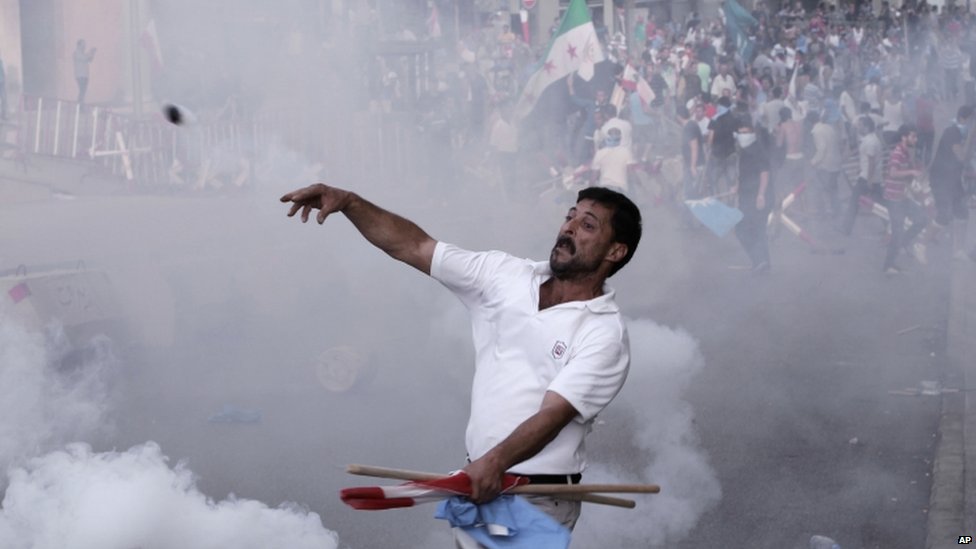
BEIRUT, Lebanon – After the funeral of Brig. Gen. Wissam al-Hassan this Sunday, a throng of protesters took to the streets of Beirut to demonstrate their anti-government rage.  Police fired warning shots and tear gas into the crowd, but dozens of dissidents rushed towards police lines as the mob circled the Prime Minister’s office.

A protester hurls a stone at security forces in Beirut. (Photo courtesy of BBC News)

A large crowd gathered in Beirut’s center square after the funeral to listen to a series of political speeches. At the addresses’ conclusion, the assembled mass began a push towards the prime minster’s office. According to reports, people in the horde were hurling sticks and stones and carrying flags. Protesters chanted for the dismissal of Prime Minister Najib Mikati.

They believed that the Syrian government was responsible for the bomb that caused Hassan’s death. According to CNN, Mikati is a “billionaire supported by Syrian ally Hezbollah.”  Although Syria condemned the blast immediately after it happened, many Lebanese remain skeptical about the neighboring regime’s role in the bombing.  Some saw Hassan’s death as an assassination mirroring those that took place in 2005, when the assassinati0n of then-Prime Minister Rafik Hariri sparked the end of Syria’s occupation of Lebanon. His demise was soon followed by the deaths of several more high-level Lebanese officials, most of whom were known to have anti-Syrian sentiments.

Mikati offered to resign from his position on Saturday. But after President Michel Suleiman asked him to stay place for the good of the nation, he rescinded the offer.

“I have always respected and admired al-Hassan, who has done great things for Lebanon,” Mikati explained to reporters on Saturday. “To hold me personally responsible for the assassination is unfair.”

Other officials disagreed with him, including former Prime Minister Fouad Siniora.  “This government is responsible for the assassination of [a] martyr [al-Hassan] and his companion martyrs, therefore, this government must leave,” Siniora told the crowd on Sunday.

A prominent opposition Minister of Parliament, Ahmad Fatfat, told the BBC’s Newshour programme that the possibility of the situation in Syria spilling into Lebanon is a real danger.

“What Mr. Assad is trying to do now is transfer his problem to all the countries around Syria – to Turkey, to Lebanon, to Iraq, to Jordan, and Lebanon is the most fragile in this story,” Fatfat said.  “And maybe Assad will do what he can to transfer Lebanon into a hell situation so he can think later on that what is going on is a general war in the Middle East and not a revolution in Syria.”

Many attendees of Hassan’s funeral waved the light blue flag of the Sunni-based opposition Future Party, while others carried Lebanon’s national flag.  These visible differences symbolized internal tensions that are mounting within the Lebanese public. Those allied with Sunni coalitions have been critical of what they believe is the Lebanese government’s closeness with the Syrian regime.

“We came for Lebanon’s future to show that we will not be scared,” said one of the mourners.

For further information, please see:

Al-Arabiya – Angry Protestors Storm Lebanese Government HQ, Call for PM to Quit – 21 October 2012

BBC –Beirut funeral for Wissam al-Hassan Followed by Clashes– 21 October 2012

CNN – Violence Erupts After Lebanese Intelligence Chief’s Funeral – 21 October 2012

The Daily Star – Calm Returns After Police, Protestors Clash in Beirut – 21 October 2012

The Daily Star – Siniora Demands Cabinet Resign at Hassan’s Funeral – 21 October 2012