Fate of 11 Prisoners Sentenced to Death on Drug-Related Charges Unknown; International Community Should Not Relent Pressure Calling on the Islamic Republic of Iran to Halt Executions

16 October 2012 – Justice for Iran, Iran Human Rights and Iran Human Rights Documentation Center join to express their continuing concern about the fate of Saeed Sedighi and ten other individuals who have been sentenced to death by the Islamic Republic of Iran on drug-related charges and whose executions were scheduled to be carried out last week.

While international pressure, including a statement from UN Special Rapporteurs calling for a halt to the executions, seems to have at least temporarily prevented the implementation of the death sentences, the current whereabouts of these prisoners are unknown.

On Wednesday, October 10, the World Day against the Death Penalty, reports surfaced that Saeed Sedighi, Abbas Namaki, Mohammad Ali Rabiei, Hamid Rabiei, Ali Darvish, and six other individuals would be executed at Evin prison the following day.  The announcement followed joint action by several NGOs on World Day against the Death Penalty calling on the UN Office on Drugs and Crime and donor countries to cease funding the Islamic Republic of Iran’s anti-drug trafficking programs, which results inhundreds of executions of prisoners convicted on drug-related charges each year.

The executions were then postponed from Thursday, October 11 to Saturday, October 13 but due to efforts by NGOs to publicize the news of these executions, widespread media coverage of the executions including interviews with Sedighi’s mother and brother and timely international action from UN Special Rapporteurs, subsequent reports indicated that the executions were not carried out.

The efforts of NGOs, family members of the prisoners and the international community to bring attention to this issue should be commended.  While the imprisonment of political prisoners and other prisoners of conscience in Iran has previously been the focus of sustained international campaigns calling for their release, the campaign to halt the execution of the eleven prisoners marks the first time executions for drug-related offenses have been personalized, and that the profiles of the individuals involved has been elevated to a matter of significant international concern.

However the effort to halt the execution of these eleven prisoners is not over.  While it appears that the executions have at least temporarily been stayed, Majid Sedighi—the brother of Saeed Sedighi—who was just released after being detained last Thursday, October 11 for his interviews with Farsi media outlets that broadcast outside of Iran, indicates that the eleven prisoners, although not executed, are currently being held in Ward 7 of Evin prison.  No one has been in direct contact with the prisoners—family members have not been able to speak to their loved ones and lawyers have not had access.  With no official indication of the location and status of the eleven prisoners, they can be executed at any time.

In light of the above, Justice for Iran, Iran Human Rights and the Iran Human Rights Documentation Center call on relevant UN bodies, including the United Nations Office of the High Commissioner for Human Rights, and the international community to intervene to save the lives of these eleven prisoners. Although the temporary stay of the executions is encouraging, the fate of these prisoners is far from definite—and the international community should not waver in its focus in calling for the immediate halt of these executions and a moratorium on the death penalty in Iran.

For further information please contact:

Shadi Sadr
Executive Director of Justice for Iran
Email: shadi.sadr@justiceforiran.org

Mahmood Amiry-Moghaddam
Spokesperson of Iran Human Rights
Email: mail@iranhr.net
Phone: +47 91742177

Gissou Nia
Executive Director
Iran Human Rights Documentation Center
Email: gnia@iranhrdc.org
Phone: +1 203 654 9342

ICTJ World Report – October 2012 Issue 17

ICTJ World Report

Peruvian President Guilty Of Death Squads Seeks Pardon

By Brendan Oliver Bergh
Impunity Watch Reporter, South America

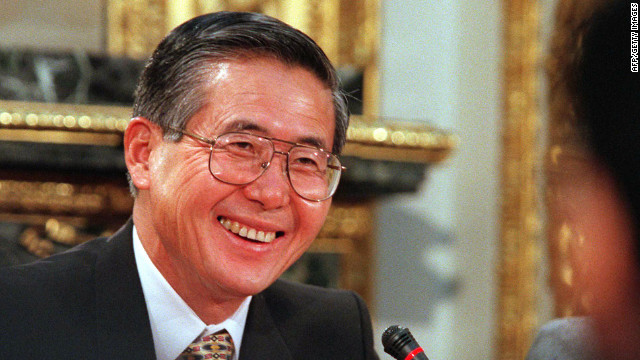
LIMA, Peru – The family of former Peruvian President Alberto Fujimori has requested a humanitarian pardon from his extended sentence due to health problems.

Peruvian President Alberto Fujimori Seeking Medical Pardon. (Photo Courtesy of CNN)

His family has requested that his four concurrent sentences be commuted due to complications from mouth cancer and resulting lesions that may not have healed properly.

The former President led Peru from 1990-2000 and is credited with the dismantling of the terrorist group the Shining Path as well as reining in destabilizing hyperinflation. His administration is not without blemishes as his authoritative leadership included the operation of death squads that killed citizens and corruption. His third presidential candidacy election was constitutionally challenged and it was only by a large corruption scandal that ex-President Fujimori was finally brought down from power.

After being brought down, Fujimori fled to Japan, who refused to extradite him. Declared “morally unfit to govern” by the Peruvian congress, he returned to Chile in 2005 where he was placed under house arrest and extradited to Peru in 2007.

By 2009, special tribunals had convicted him and found him guilty of multiple human rights scandals and sentenced him for a number of charges. His largest sentence? 25 years for authorizing the operation of death squads that killed or disappeared numerous citizens.

Human Rights Watch has requested that the President of Peru take great care in determining whether or not to grant the medical pardon. While well within the wheel house of political powers weld by the President. The Peruvian Constitution requires that any pardons need to be in accordance with international treaties ratified by Peru. And international law dictates that the duty to investigate and punish perpetrators of human rights abuses cannot be undermined by pardons and immunities. Without extreme care, a pardon even for medical care could come off as contrary to human rights law and the international community.

While the request to pardon the former president is being analyzed by a commission “without any ‘politization’ and impartially” the former Health Minister, Luis Solari has raised concerns. Soalri claims that according to the medical certificates, Fujimori would not even qualify for such a pardon. One can be pardoned if they are at serious and imminent risk of losing life. Solari continues that Fujimori is not at risk of losing his life due to complications and his cancer is not in fact “terminal cancer.”

All in all the decision will come down to current President Ollanta Humala who was elected to the position over opponent and petitioner Keiko Fujimori, daughter of Alberto Fujimori.


For further information, please see:

El Comercio – Request For Pardon To Fujimori Is Analyzed With “No Politicization,” Said Justice Minister – 16 October 2012

El Comercio – “Fujimori Medical Certificates Are Not Accurate,” Said Former Minister Solari – 15 October 2012

Human Rights Watch – Peru: Humala Shouldn’t Give Fujimori Special Treatment – 11 October 2012

CNN – Family Seeks Pardon For Former Peruvian Leader – 10 October 2012

Monks Protest Establishment of an Office of Aid for Rohingya Muslims

By Irving Feng
Impunity Watch Reporter, Asia

NAYPYIDAW, Myanmar – Thousands of Buddhist monks in Myanmar took to the streets to protest the establishment of an Organization of Islamic Cooperation (OIC) office which would supply aid to Rohingya Muslims in the country.


Monks protest in the streets of Rakhine. (Photo courtesy of Al Arabiya News)

Three thousand monks marched through downtown Yangon, the former capital, holding banners which read “No OIC.”  In Mandalay, Myanmar’s second largest city, thousands of protestors said they could not accept the establishment of an OIC office in the country.  Further demonstrations sprang up in the town of Pakokku in the central region of the country.

Plans to set up an OIC office in the northwest Rakhine state had been in the works until the recent protests.  Rakhine had been the stage for violent clashes between native Buddhists and the Rohingya Muslims in June which resulted in at least 77 deaths and displaced thousands more.

The demonstrations by the monks, a powerful political force in the predominately Buddhist country, was followed by an announcement by the president’s office which conveyed that an OIC office would not be opened in Rakhine after all.  President Thein Sein’s office stated that due to the popular desire of the people, the government would not sanction the opening of the OIC office.  It is uncertain whether or not the protests were directly linked to the government’s announcement.

The United Nations has described Rohingya Muslims as one of the most persecuted minority groups in the world.  Human Rights watch has also found evidence of state sponsored discrimination and persecution against the Rohingya Muslims in Myanmar.

Myanmar is currently home to approximately 800,000 Rohingyas with no state to call home due to their illegal immigrant status.  Thousands of Rohingya were displaced by the violence in Rakhine and have been seeking shelter in temporary homes and refugee camps.  The conditions that Rohingya Muslims are currently living in are described as abject and dire.

Government officials have been criticized by the United Nations as contributing to the problem by allowing violence to occur against the Rohingyas rather than implementing policies to curb it.  Lawmaker Aung San Suu Kyi, an advocate for Burmese rights, is under fire from the international community for failing to advocate for the Rohingyas.  The Burmese are suffering from the same denial of basic rights.

Amidst the arsons, ethnic clashes and other violent displays directed at the Rohingyas, many have attempted to flee by sea to neighboring Bangladesh.  Those that have attempted to fled, however, were met by Bengali security forces and turned away, forcing their return to Myanmar to endure persecution, discrimination and illegal status.

For further information, please see:

Al Arabiya News – Mass monk rallies against OIC in major Myanmar cities – 15 October 2012

Al Jazeera – Myanmar scraps Islamic group’s office plan – 15 October 2012

Press TV – Myanmar bans OIC from opening office for Rohingya Muslims – 15 October 2012

Reuters – Buddhist monks march in Myanmar to thwart Islamic office plan – 15 October 2012