Syrian Revolution Digest – 14 September 2012

Against All Odds!

Despite the rapid disintegration of the country and its institutions, political activists are still organizing nonviolent rallies to defy the regime and keep people’s focus on the initial goals of the revolution: democratic change, not communal retributions. The battle might be lost, but it is worth fighting.

Friday September 14, 2012

Today’s Death toll: 108. The Breakdown: the toll includes 20 children and 5 women. 30 in Aleppo, 26 in Damascus and Suburbs, 20 in Daraa (most in the massacre in Bosra), 19 in Deir Ezzor (especially in Mouhassan and Alboukamal), 6 in Homs, 4 in Hama, and 3 in Idlib. (LCC)

390 demonstrations took place throughout Syria. Activists are pushing hard for a return to peaceful rallies to help keep focus on ousting Assad and prevent full-scale descent into civil strife.

News

Op-Eds & Special Reports

Tens of thousands of Syrians who moved into schools after air strikes and fighting drove them from their homes will be on the move again on Sunday when the government plans to start the school year despite unrelenting violence. Panic has spread through displaced communities in roughly 800 schools around the country, each housing hundreds of men, women and children with nowhere to go.

“This is a relatively flat border, with nearly no physical barriers. The more the political boundary dissipates, the more northern Syria and southern Turkey will merge into each other,” said Soner Cagaptay, director of the Turkish Research Program at The Washington Institute for Near East Policy. “In the long-term, this could expose Turkey to unsavory political movements coming from post-Assad Syria, ranging from potential jihadists to hard-line Kurdish nationalists.”

Randa Kassis and Jehad Saleh are co-founders of the Movement for a Pluralistic Society, which is holding its first member meeting in Paris on September 13-14. Randa Kassis is Syrian anthropologist living in Paris and was formerly a member of the Syrian National Council. Jehad Saleh is a Syrian freelance journalist living in Washington, DC.

In August 2012, my wife, Syrian pro-democracy activist, Khawla Yusuf, and I undertook a three-week long trip to Turkey. The trip was not our first, nor will it be our last. But having coincided with many important developments on the ground and included meetings with so many key activists and rebel leaders from inside the country, we decided to put together this report, based on our impressions, by way of shedding light on an increasingly tragic and troubling situation and in the hope of spurring the international community into adopting a serious policy to address it.

Video Highlights

In Douma, Damascus, trying to save a wounded young man from a sniperhttp://youtu.be/KHKWvOhnmnY Meanwhile, the bombing of the town of Madayacontinues http://youtu.be/0tm54miQjaA The neighborhood of Al-Qadam and surrounding alleys in Damascus City also get pounded from dayhttp://youtu.be/v4OqK5y-xRQ , http://youtu.be/74Zh09KmEMs ,http://youtu.be/axYIlY9l6uQ to night http://youtu.be/Zd0JnT2E4Iw ,http://youtu.be/iafftHoZi7s

Buildings in the border town of Alboukamal, Deir Ezzor Province, catch fire following a round of intense aerial bombing http://youtu.be/Lu9rx4iglhw ,http://youtu.be/bGC3tPt35z0 , http://youtu.be/lWH7gl0Kbgk ,http://youtu.be/RbRsQBjDHHg In nearby Qouriyeh, locals prepare today’s dead for burial http://youtu.be/wkNToV9h9H4

The Jabal Shahshabo Region in Idlib gets poundedhttp://youtu.be/aywUUm8tCBk , http://youtu.be/qmo1ediJ4Q8

In Bosra, Daraa Province, locals try to rescue people caught under the rubblehttp://youtu.be/qYZ6nYBwT7c following an air raid http://youtu.be/fEMvRRdrXzE

The pounding of the town of Rastan continues http://youtu.be/qYZ6nYBwT7c ,http://youtu.be/yKhgu1OzpnU
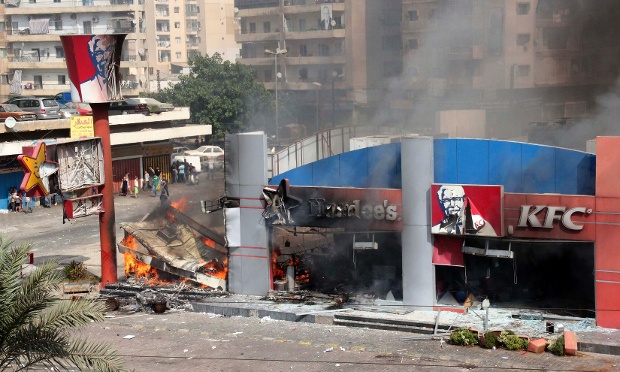
Update: Extra Crispy Fried Chicken in Lebanon as Protests Continue

By Justin Dorman
Impunity Watch Reporter, Middle East

BEIRUT, Lebanon – Another day has passed, and chaos ensues in the Middle East as demonstrators continue to violently protest America. These protests are in reaction to an anti-Mohammed film, The Innocence of Muslims, made by one fairly unknown American filmmaker.

Tripoli branches of American restaurants chains Hardee’s and Kentucky Fried Chicken were set on fire. (Photo Courtesy of the Guardian)

Demonstrations have taken place all over the Middle East and Northern Africa. So far protesters have congregated in Morocco, Algeria, Tunisia, Libya, Sudan, Egpyt, the Gaza Strip, Lebanon, Yemen, Somalia, Iraq, Kuwait, Iran, Pakistan, Kashmir, Bangladesh, and Jakarta.

Many of these demonstrations have been violent and have involved the storming of U.S. embassies in these countries. There have been casualties on both sides of this conflict. On Tuesday in Libya four Americans were killed at the U.S. Embassy including Ambassador Stevens. In many of these countries, to keep protesters from rioting the embassies, police have used tear gas, guns, and water cannons when necessary. On Friday, three protesters were reported dead outside of Tunis, another was killed in Tripoli, and another in Khartoum. Many others have been injured.

Protesters run from tear gas fired at them during a demonstration in front of the embassy in Tunis. (Photo Courtesy of Reuters)

Just outside the embassy in Tunis, protesters chanted, “Obama, Obama, we are all Osamas.”

While nearly all of the Middle East is protesting this anti-Mohammed film, not every country has turned to violence. Religious leaders in Afghanistan have urged their people to protest, but peacefully. As they assembled in Jalalabad they burned an effigy of Obama and a U.S. flag but have made no attempts to riot on any embassy. Two U.S. marines were killed at Camp Bastion in south Helmand but that involved a complex Taliban attack unrelated to demonstrations against the film.

For further information, please see:

Guardian – Middle East Live – 14 September 2012

Reuters – Middle East and North Africa Live – 14 September 2012

Impunity Watch – YouTube Video Fuels Islamic Unrest Across the Middle East – 13 September 2012

Death Toll Rises in Kenyan Ethnic Conflict

By Ryan Aliman
Impunity Watch Reporter, Africa

NAIROBI, Kenya – 38 people, including 16 men, 5 children and 9 police officers died on Monday due to renewed ethnic clashes in the southeastern village of Kilelengwani.

Orma villagers displaced by ethnic clashes.
(Photo courtesy of AFP, Carl de Souza)

Members from the Pokomo and Orma tribes have been attacking each other since last month in what is reportedly Kenya’s worst tribal conflict in years. Tribe members from both sides, armed with guns, spears, bows and arrows, would attack each other’s villages, burn homes and kill people. The conflict has now claimed approximately 116 people and 167 houses.

The two tribes have a long history of violence. The dispute between them has mainly been about the use of land and water in the Tana River delta, an ecologically rich area in the country. Cattle-grazing rights have also been a prevailing issue of contention between the Pokomo, a settled farming community, and the Orma, a semi-nomadic cattle-herding tribe.

What is remarkable about the current wave of hostilities between the Pokomo and the Orma is that the fighting seemed to have intensified. Phyllis Muema, executive director of the Kenya Community Support Centre observed that an influx of weapons from neighbouring Somalia has exacerbated the conflict. “This is actually a massacre. The level of killing shows very clearly that this is not just a resource-based conflict… The sophistication of the arms they are using indicates that they have acquired them, we suspect, from neighbouring Somalia,” says Muema.

Local people, meanwhile, attribute the latest violence to politics. “We were born into the conflict between Pokomos and Ormas,” Kadze Kazungu, a Pokomo, told reporters. “We have fought over land and water before. But whenever that occurs, elders from both tribes always find a way of resolving the issue. This time it is not about land. It is politics. Bad politics,” he added.

Human rights groups have received reports that politicians in the area have been involved in inciting violence as a strategy to win seats in the March 2013 election. Political parties would traditionally pit ethnic groups against each other to draw support from a specific tribe.

Next year’s election is said to have higher stakes than previous ones. Kenyans, for the first time, will be able to vote for county governors and senators making local votes more significant than before.

However, despite reports to authorities on the suspected involvement of politicians, not much has been done by the police. Robert Ndege, a political risk consultant at Africapractice, described their response as “pathetic”. “If [the security forces] can’t contain one flashpoint, what happens if this is repeated across the country,” he asked.

A dusk-to-dawn curfew has been in place since Monday. Houses continue to be raided and people killed, notwithstanding.


For further information, please see:

AFP – Militia behind Kenya’s Tana River killings, say villagers – 14 September 2012

The Guardian – Deadly clashes in Kenya fuel fears of election violence – 13 September 2012

Al Jazeera – Dozens killed in Kenya ethnic clashes – 10 September 2012

BBC – Kenya Tana River renewed ethnic clashes kill 30 – 10 September 2012

Support for Euthanasia Grows After High Court Dismisses Assisted Suicide Case

By Mark O’Brien
Impunity Watch Reporter, Oceania

WELLINGTON, New Zealand — A new poll this week showed increasing support for legalizing euthanasia after the country’s High Court dismissed charges against a man accused of helping his wife commit suicide.

Support for legalizing euthanasia in New Zealand grows after the country’s High Court dismissed without conviction the case of Evans Mott (right), who was charged with assisting his wife’s (left) suicide after a long battle with multiple sclerosis. (Photo Courtesy of The New Zealand Herald)

The poll, released on Friday, showed 63 percent of respondents supported a change in the law, compared to 12 percent who were opposed.  The poll’s margin of error was roughly two percent.

“Why should the law prevent you from [assisting in a loved one’s suicide], or prevent someone who loves you to assist you from doing that,” said Member of Parliament Maryan Street, who has introduced a bill that would legalize euthanasia.

Street’s “Right to Life” bill would allow people 18-years-old or older to be assisted in their own death if certain conditions were met.   At least two doctors, in consultation with the person’s family, would have to determine that the person is mentally competent.  The person then would have to wait a one-week “stand down” period before they would be allowed to proceed.  The bill has yet to be taken up for consideration.

The renewed interest in changing New Zealand’s euthanasia laws came after the High Court dismissed the case of Evans Mott.  The Auckland man was charged with helping his wife, Rosie, commit suicide late last year after her four-year battle with an aggressive form of multiple sclerosis.  Mott, 61, had pleaded guilty earlier this year.

“It’s a miracle [and] it’s so good that New Zealand had the vision to tell right from wrong,” Mott told TVNZ after the justices discharged him without conviction.  “If you know someone who’s got a hideous disease that’s degenerative, you’re hardly going to say wait until you’re a basket case.”

In discharging Mott’s case, High Court Justice Patricia Courtney said his was vastly different from other cases and the consequences of conviction would outweigh the gravity of what he had done.

“You acted out of love, and your motivation was to support your wife in the decision she made,” Justice Courtney said in court, adding that she wished Mott luck.  She also pointed to increasing public support for a change in the law.

The court’s decision marked a distinct change in precedent.  Just last November, an Auckland man was sentenced to five months of home detention for assisting the suicide of his terminally ill mother.

Opponents were quick to call the Mott outcome “a dangerous precedent” for future cases.

“[This] has opened the door for others to assist in suicide and not suffer any consequences,” said Colleen Bayer of the Family Life New Zealand lobby group.  “This decision also flies in the face of New Zealanders’ concern over the high suicide rate in our country.”

For further information, please see:

The New Zealand Herald — Courts Mirror Mood on Euthanasia MP — 15 September 2012

Radio New Zealand News — Court Decision Fuels Euthanasia Debate — 15 September 2012

The New Zealand Herald — Euthanasia Debate: Wife’s Death Video — 14 September 2012

Stuff — Support Grows for Euthanasia — 14 September 2012

TVNZ — Man Discharged over Wife’s Suicide Can Now Move On — 13 September 2012

British Producer Arrested for Gay Play in Uganda

By Ryan Aliman
Impunity Watch Reporter, Africa

KAMPALA, Uganda – British producer, David Cecil, is facing at least two years of imprisonment in Uganda for staging a play that dealt with homosexuality.

David Cecil detained in a court cell in Kampala the Ugandan Capital. (Photo courtesy of The Telegraph/Sandra Wandera/AP)

“The River and the Mountain” ran from August 17 to 23 in a small cultural center in Kampala managed by Cecil and his girlfriend. The play was initially scheduled to be held in the Uganda National Theater, but was transferred to a different venue out of fear of a police raid.

“The River and The Mountain” by British playwright Beau Hopkins, tells the story of Samson, a gay Ugandan businessman, who faces violent reactions from his family and colleagues after he comes out at a party following a promotion. His mother contracts a Christian pastor and a witch doctor to try to “cure” her son. Samson is eventually killed by his colleagues.

The play was intended to further dialogue about homosexuality and homosexual acts. Homosexual acts are illegal in Uganda and draw condemnation from church pastors and politicians.

Cecil was charged for ignoring an advance warning from the Uganda Media Council that the play was not to be staged until they obtained official clearance. The Media Council issued the warning on August 16, the day before the play premiered. On August 29, after the shows had ended, the Media Council ruled that the play was not to be staged because parts of the production “implicitly promote homosexual acts” which “are contrary to the laws, cultural norms and values of Uganda”.

Cecil said he, along with British playwright Beau Hopkins, Ugandan director Angella Emurwon and the Ugandan actors, decided to go ahead with the staging because the Media Council’s warning letter “in no way” made reference to any potential legal consequences. “Even my Ugandan lawyer read the letter and said: ‘It does not clearly constitute a legal order,'” Cecil explained.

However, Cecil was contacted by the police and subsequently charged for disobeying an order from the Media Council – a public authority in Uganda. The law enforcers asked Cecil, who has been living in Uganda for three years, to surrender his passport. A police bond was also issued for him.

The Ugandan ethics minister Simon Lokodo condemned the play. Lokodo explained, “This play is justifying the promotion of homosexuality in Uganda, and Uganda does not accommodate homosexual causes. We will put pressure on anyone saying that this abomination [homosexuality] is acceptable,”

As a conservative, dominantly Christian society, many Ugandans regard homosexuality as contrary to both African traditions and their faith. Homosexuals are often harassed and even killed in the country.

The Ugandan parliament is due to debate a 2009 bill that threatens the death penalty for what was termed “aggravated homosexuality”.


For further information, please see:

The Telegraph – British Theatre Producer Jailed for Putting on Gay Play in Uganda – 13 September 2012

BBC News – Uganda Charges British Producer David Cecil over Gay Play – 13 September 2012

The Huffington Post – Producer of Play about Gays Faces Jail in Uganda – 12 September 2012

The Observers – ‘I Play a Gay Man in Uganda, where Homosexuality is illegal’ – 11 September 2012

Radio Netherlands Worldwide – Producer of Uganda’s First Gay Play Could be Jailed – 8 September 2012

International Business Times – Producer of Pro-Gay Play Arrested in Uganda; Faces Two Years in Jail – 7 September 2012