Support for Euthanasia Grows After High Court Dismisses Assisted Suicide Case

By Mark O’Brien
Impunity Watch Reporter, Oceania

WELLINGTON, New Zealand — A new poll this week showed increasing support for legalizing euthanasia after the country’s High Court dismissed charges against a man accused of helping his wife commit suicide.

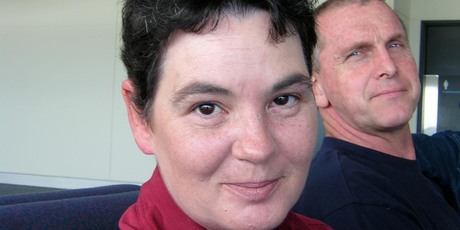
Support for legalizing euthanasia in New Zealand grows after the country’s High Court dismissed without conviction the case of Evans Mott (right), who was charged with assisting his wife’s (left) suicide after a long battle with multiple sclerosis. (Photo Courtesy of The New Zealand Herald)

The poll, released on Friday, showed 63 percent of respondents supported a change in the law, compared to 12 percent who were opposed.  The poll’s margin of error was roughly two percent.

“Why should the law prevent you from [assisting in a loved one’s suicide], or prevent someone who loves you to assist you from doing that,” said Member of Parliament Maryan Street, who has introduced a bill that would legalize euthanasia.

Street’s “Right to Life” bill would allow people 18-years-old or older to be assisted in their own death if certain conditions were met.   At least two doctors, in consultation with the person’s family, would have to determine that the person is mentally competent.  The person then would have to wait a one-week “stand down” period before they would be allowed to proceed.  The bill has yet to be taken up for consideration.

The renewed interest in changing New Zealand’s euthanasia laws came after the High Court dismissed the case of Evans Mott.  The Auckland man was charged with helping his wife, Rosie, commit suicide late last year after her four-year battle with an aggressive form of multiple sclerosis.  Mott, 61, had pleaded guilty earlier this year.

“It’s a miracle [and] it’s so good that New Zealand had the vision to tell right from wrong,” Mott told TVNZ after the justices discharged him without conviction.  “If you know someone who’s got a hideous disease that’s degenerative, you’re hardly going to say wait until you’re a basket case.”

In discharging Mott’s case, High Court Justice Patricia Courtney said his was vastly different from other cases and the consequences of conviction would outweigh the gravity of what he had done.

“You acted out of love, and your motivation was to support your wife in the decision she made,” Justice Courtney said in court, adding that she wished Mott luck.  She also pointed to increasing public support for a change in the law.

The court’s decision marked a distinct change in precedent.  Just last November, an Auckland man was sentenced to five months of home detention for assisting the suicide of his terminally ill mother.

Opponents were quick to call the Mott outcome “a dangerous precedent” for future cases.

“[This] has opened the door for others to assist in suicide and not suffer any consequences,” said Colleen Bayer of the Family Life New Zealand lobby group.  “This decision also flies in the face of New Zealanders’ concern over the high suicide rate in our country.”

For further information, please see:

The New Zealand Herald — Courts Mirror Mood on Euthanasia MP — 15 September 2012

Radio New Zealand News — Court Decision Fuels Euthanasia Debate — 15 September 2012

The New Zealand Herald — Euthanasia Debate: Wife’s Death Video — 14 September 2012

Stuff — Support Grows for Euthanasia — 14 September 2012

TVNZ — Man Discharged over Wife’s Suicide Can Now Move On — 13 September 2012

British Producer Arrested for Gay Play in Uganda

By Ryan Aliman
Impunity Watch Reporter, Africa

KAMPALA, Uganda – British producer, David Cecil, is facing at least two years of imprisonment in Uganda for staging a play that dealt with homosexuality.

David Cecil detained in a court cell in Kampala the Ugandan Capital. (Photo courtesy of The Telegraph/Sandra Wandera/AP)

“The River and the Mountain” ran from August 17 to 23 in a small cultural center in Kampala managed by Cecil and his girlfriend. The play was initially scheduled to be held in the Uganda National Theater, but was transferred to a different venue out of fear of a police raid.

“The River and The Mountain” by British playwright Beau Hopkins, tells the story of Samson, a gay Ugandan businessman, who faces violent reactions from his family and colleagues after he comes out at a party following a promotion. His mother contracts a Christian pastor and a witch doctor to try to “cure” her son. Samson is eventually killed by his colleagues.

The play was intended to further dialogue about homosexuality and homosexual acts. Homosexual acts are illegal in Uganda and draw condemnation from church pastors and politicians.

Cecil was charged for ignoring an advance warning from the Uganda Media Council that the play was not to be staged until they obtained official clearance. The Media Council issued the warning on August 16, the day before the play premiered. On August 29, after the shows had ended, the Media Council ruled that the play was not to be staged because parts of the production “implicitly promote homosexual acts” which “are contrary to the laws, cultural norms and values of Uganda”.

Cecil said he, along with British playwright Beau Hopkins, Ugandan director Angella Emurwon and the Ugandan actors, decided to go ahead with the staging because the Media Council’s warning letter “in no way” made reference to any potential legal consequences. “Even my Ugandan lawyer read the letter and said: ‘It does not clearly constitute a legal order,'” Cecil explained.

However, Cecil was contacted by the police and subsequently charged for disobeying an order from the Media Council – a public authority in Uganda. The law enforcers asked Cecil, who has been living in Uganda for three years, to surrender his passport. A police bond was also issued for him.

The Ugandan ethics minister Simon Lokodo condemned the play. Lokodo explained, “This play is justifying the promotion of homosexuality in Uganda, and Uganda does not accommodate homosexual causes. We will put pressure on anyone saying that this abomination [homosexuality] is acceptable,”

As a conservative, dominantly Christian society, many Ugandans regard homosexuality as contrary to both African traditions and their faith. Homosexuals are often harassed and even killed in the country.

The Ugandan parliament is due to debate a 2009 bill that threatens the death penalty for what was termed “aggravated homosexuality”.


For further information, please see:

The Telegraph – British Theatre Producer Jailed for Putting on Gay Play in Uganda – 13 September 2012

BBC News – Uganda Charges British Producer David Cecil over Gay Play – 13 September 2012

The Huffington Post – Producer of Play about Gays Faces Jail in Uganda – 12 September 2012

The Observers – ‘I Play a Gay Man in Uganda, where Homosexuality is illegal’ – 11 September 2012

Radio Netherlands Worldwide – Producer of Uganda’s First Gay Play Could be Jailed – 8 September 2012

International Business Times – Producer of Pro-Gay Play Arrested in Uganda; Faces Two Years in Jail – 7 September 2012


UN-Backed Tribunal Deems Khmer Rouge’s ‘First Lady’ Unfit for Trial

By Karen Diep
Impunity Watch Reporter, Asia

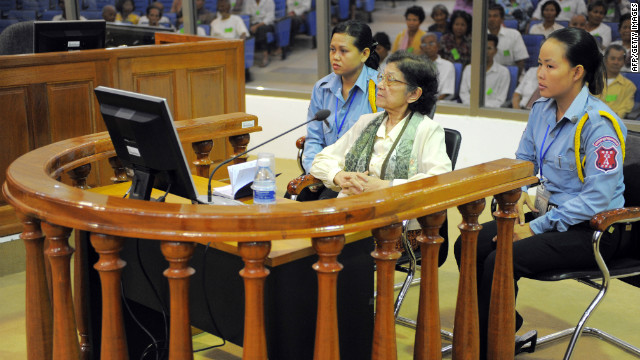
PHNOM PENH, Cambodia – Yesterday, Cambodia’s UN-backed tribunal, responsible for prosecuting the members of the Khmer Rouge for crimes against humanity, released a statement that 80-year-old leng Thirith, the regime’s “first lady,” was unfit to stand trial.

leng Thirith before the ECCC. (Photo Courtesy of CNN)

“There is not prospect that the accused can be tried in the foreseeable future,” the tribunal stated.

Furthermore, Neth Pheaktra, a spokesman for the Extraordinary Chambers in the Court of Cambodia (ECCC), said that leng Thirith would be released today if prosecutors did not appeal the court’s decision.

According to Reuters, under the Khmer Rouge’s rule from 1975 to 1979, approximately 1.7 to 2.2 million people, nearly a quarter of the population, died from execution, torture, disease, and/or starvation as a part of the regime’s attempt to create a peasant utopia.

leng Thirith, Khmer Rouge’s highest-ranking woman, acted as its minister of social affairs, and the tribunal accused her of participation in the “planning, direction, co-coordination and order of widespread purges.”  Leng Thirith was formerly charged with crimes against humanity, genocide, homicide, grave breaches of the Geneva Conventions, torture, and religious persecution.

However, according to Al jazeera, leng Thirith responded that the charges against her were “100 per cent false” and that she always worked for the benefit of the people.

According to CNN, in November of last year, proceedings against leng Thirith stopped after the ECCC decided that she suffered from dementia.

After pursuing additional medical assessments, the tribunal issued yesterday’s statement confirming that leng Thirith is suffering from a “progressive, degenerative illness (likely Alzheimer’s disease) and remains unfit to stand trial.”

The tribunal further confirmed that “all treatment options have [] been exhausted and that the accused’s cognitive impairment is likely irreversible.”  The court’s conclusion disappointed many of the regime’s surviving victims.

“I cannot oppose the court, but I am not happy with its decision,” shared Bou Meng, one of few Cambodians to survive incarceration in Phnom Penh’s Tuol Slen jail (S-21), with Agence France-Presse.  “The decision is mocking the souls of the dead, including my wife and children,” continued Mr. Meng whose wife and children never escapted S-21 alive.

The court has convicted S-21’s prison chief, Kaing Guek Eav, who oversaw the deaths of approximately 14,000 people.  The tribunal sentenced Kaing Guek Eav to 35 years in prison but he may serve only 19 years.

However, Ieng Sary, the Khmer Rouge’s former foreign minister, Nuon Chea, also known as Bother No. 2, and the regime’s former head of state, Khieu Samphan, are still on trial.  Moreover, prosecutors claimed that there is adequate evidence to charge a number other former members.

For further information, please see:

Al jazeera – Cambodia to free Khmer Rouge ‘first law’ – 13 Sept. 2012

CNN – ‘First lady’ of Khmer Rouge rules unfit for genocide trial – 13 Sept. 2012

Independent – ‘First lady’ of Khmer Rouge is judged ‘unfit to stand trial’ – 13 Sept. 2012

Reuters – ‘First lady’ of Cambodia’s Khmer Rouge mentally unfit, to be freed – 13 Sept. 2012


Colombian General Did Not Act Alone In Aided Paramilitary Organization

By Brendan Oliver Bergh
Impunity Watch Reporter, South America

SANTIAGO, Colombia — Last month, retired General Mauricio Santoyo, a former security chief to ex-president Álvaro Uribe, pled guilty to aiding paramilitary groups in Columbia. New evidence has also surfaced that shows that he did not act alone, supporting a theory previously put forth by representative from the 2nd  Chamber of the Colombian House of Representatives, Iván Cepeda. Cepeda claimed that this was “not an isolated incident” and was part of a “criminal structure” that included numerous officers and NCOs who operated within the Antioquia Police in the ‘90s and had links to the presidency from 2002 to 2010.

General Mauricio Santoyo. (Photo Courtesy of el Heraldo).

General Santoyo, who has been extradited to the United States for ties to drug trafficking, entered his plea before the Eastern District Court of Virginia for aiding the paramilitary organization United Self-Defense of Columbia (Spanish Acronym AUC). During his plea, General Santoyo identified at least seven other senior officers of the Colombian Army and Officers of the police, including two ex-directors of that institution.

During his confession, Santoyo confessed to receiving “substantial bribes” from the AUC in-exchange for helping them “achieve acts of terrorism and drug trafficking.” Santoyo continued by explaining that he intercepted communications that provided relevant information and then relayed that information to officers of the AUC. Santoyo then admitted that he would notify the AUC of imminent arrests against members of the organization. Most of these information intercepts were made by members of the police who were specifically employed to fight against paramilitary organizations.

Santoyo was promoted to Chief of Secuirty during Presdient Uribe’s administration. There, with several commissioned officers of the National Police, Santoyo was able to participate in activities that aided the AUC, and as Chief of Security he aided the rise of many officers who had been implicated for corruption by his confession.

Ex-President Uribe denies any knowledge about the ties between Santoyo and paramilitary groups as well as having influenced Santoyo’s rise to General despite Santoyo’s questionable past. Colombian Senator Jorge Enrique Robledo states “it’s extremely clear that if Col. Santoyo had not been a part of the President’s inner circle, had not been the chief of security at the presidential palace, the situation we’re discussing today wouldn’t have happened, wherever one looks.”

There have been attempts to link Santoyo’s illegal operations with officials and politicians from within Uribe’s government. This includes the former Minister of Defense, the current president Juan Manuel Santos, former national chief of police Oscare Naranjo and the former peace commissioner Luis Carlos Restrepo, who is now a fugitive from justice.


For more information please see:

El Pais – Congressman Ivan Cepeda splashed seven police officers by the Case Santoyo – 12 September 2012

The Spectador – Iván Cepeda other officers linked to scandal Santoyo – 12 September 2012

Vanguardia – Santoyo is not an isolated case, is part of a criminal apparatus: Iván Cepeda  – 12 September 2012

Global Voices – Colombia: Former General Santoyo Admits Ties to Paramilitary Group – 26 August 2012

El Pais – To help the AUC, General (r) Santoyo ‘pike’ colleagues – 22 August 2012

South Africa Struggles With Mining Labor Strikes

By Heba Girgis
Impunity Watch Reporter, Africa

CAPE TOWN, South Africa—Just today, thousands of South African miners made a vow to cripple the country’s mining industry while also bringing the country’s platinum production to a halt. This is especially crucial—as South Africa is the world’s top platinum producer.

Striking Workers at the Anglo American Platinum Mine. (Photo Courtesy of The New York Times)

This labor unrest has spread throughout the gold and platinum-producing regions of South Africa after law enforcement officers killed 34 miners while attempting to stop a violent, illegal strike held by miners demanding higher wages. Julius Malema, the former leader for the African National Congress Youth League, demanded that this strike continue until the wages for all miners are increased to at least $1,500 a month. This raise would be approximately double or triple what miners bring to the table now.

The company Anglo American Platinum, which produces about 40% of the world’s platinum, announced just yesterday that it would be shutting down its operations near the town of Marikana—where the above-mentioned killings took place—because of threats received against its workers. In a statement to the press, the company said, “In light of the current volatile situation in the Rustenburg area, where our employees, who want to go to work, are being prevented from doing so and are being intimidated by the threat of violence, Anglo American Platinum has decided to suspend its operations.”

Many of the strikers participating in this unrest were members of a radical breakaway union that was deeply dissatisfied with South Africa’s largest union, the National Union of Mineworkers. Even though this strike has been detrimental to mining companies, it has not done much damage to the overall economy of South Africa. The country’s stock market and currency have not struggled as a result of the strikes.

Although the country has not yet faced too much economic strife because of these events, the strikes reflect other problems that South Africa is up against. These problems include: the highest level of inequality of any large economy; jobless rates that reach 50% among young blacks; and finally an education system that sends out graduates who are not prepared for the jobs that the country has available.

Frans Cronje, an analyst for the South African Institute of Race Relations, noted, “The corporate world does not yet realize the seriousness of the social and economic inequalities that confront the country.”

As of today, 45 people have died since the strike began. As the strikes continue, some have begun to feel that the best way to approach this issue is to start negotiating.


For further information, please see:

Mining.com – Labour Leader Calls S.A. Workers to ‘Bring Mining Companies to Their Knees’ – 13 September 2012

The New Age – Strikers Vow to Cripple Mining Industry – 13 September 2012

The Globe and Mail – World’s Largest Platinum Producer Shuts Rustenberg Mines – 12 September 2012

The New York Times – South African Unrest in Mining Deepens – 12 September 2012