Suicide Bombing in Afghanistan Kills 14, Wounds More

By: Katherine Hewitt
Impunity Watch Reporter, Asia

KABUL, Afghanistan – On the evening of March 23, 2018, a suicide bomber drove into a crowd. A traditional wrestling match had been held that night in Lashkar Gah. After the match ended, the spectators joined in evening prayers in the stadium before leaving. The bomber drove his car though the gates, where it exploded.

As a result fourteen were killed. Forty-two were left injured. Some of the dead and injured are security guards who were stationed at the gates. However, the majority of the victims are civilians. Children are among the dead and critically wounded. The local hospital believes the death will rise, as many people are in critical condition.

A man carries an injured child from the bombing in Lashkar Gah. Photo courtesy of Abdul Khaliq.

The bomber had attempted to enter the stadium. However, the security guards recognized him and refused to let him enter. It was at this moment that he detonated the bombs.

At this moment, no group has claimed the attack as part of their operation. The Helmand province, where Lashkar Gah is located, has heavy Taliban influences. The Taliban carried out a similar attack in Lashkar Gah in the past.

The President of Afghanistan, Ashraf Ghani, released a statement that condemned the bombing saying: “the enemies of Afghanistan cannot prevent the celebration of traditional, religious and cultural events in the country.”

For more information, please see:

New York Times – Suicide Attack in Afghanistan Kills at Least 14 at Wrestling Match – 23 March 2018

Aljazeera – Afghanistan: Deadly car bombing near Helmand stadium – 23 March 2018

BBC – Car bomb targets spectators at Afghanistan wrestling match – 23 March 2018

Russian Media Boycotts Parliament Following Sexual Harassment Decision

By: Jenilyn Brhel
Impunity Watch Reporter, Europe

MOSCOW, Russia – Several Russian media outlets have boycotted Parliament in Russia after sexual misconduct charges were dropped against Leonid Slutsky, head of its international affairs committee.

Darya Zhuk, left, and Farida Rustamova, both reporters in Russia, accused Leonid Slutsky of sexual misconduct. Photo courtesy of Vasily Maximov.

On Thursday, March 22nd, Slutsky was cleared of sexual misconduct charges by the ethics commission in Russia. Since then, nearly all of Russia’s independent news agencies have decided to boycott coverage of the Duma, the lower chamber of Russian Parliament.

Accusations against Slutsky began in February 2018, when several female journalists accused Slutsky of making unwelcome sexual advances towards them.

Farida Rustamova of BBC Russia, said that Slutsky told her to leave her fiancé and “ran his hand, the flat of his palm, up against my nether region.”

Another accuser, Yekaterina Kotrikadze, deputy editor-in-chief at a Russian television station, said that in 2011 Slutsky pushed her against a wall and attempted to kiss her.

“He asked me to come without a camera,” said Kotrikadze. “He brought me into his office, locked the door and tried to pin me against the wall and somehow kiss and touch me. I got away and ran.”

Slutsky denied the allegations and mocked his accusers. In a Facebook post dated February 23rd, Slutsky stated that “attempts to make Slutsky into a Russian Harvey Weinstein look like a cheap and crude provocation … and are bound to fail.”

The ethics commission investigating the accusations released a verdict on March 22nd sating that it had “not found any violations of behavioral norms.”

The commission also took aim at the timing of the women’s allegations, suggesting that they were an attempt to undermine the presidential election in Russia that week.

One member of Parliament, Oksana Pushkina, did side with the journalists and pledged to seek adoption of a legal framework for the prosecution of sexual harassment.

Despite the committee’s decision, the accusations against Slutsky have ushered in the #MeToo movement in Russia. The boycott that has ensued in response to the allegations against Slutsky is the first of its kind in Russia.

Kotrikadze is not surprised by the ethics commission’s decision, but is optimistic about the media’s response to the accusations.

“I really think that the reaction of my colleagues, and lots of Russian media outlets, is the best thing I could imagine. This is the first time in Russian history that the journalists have not obeyed the decision of the state.”

For more information, please see:

ABC News – Russian Media Boycott Country’s Parliament Over Sexual Harassment Claims – 22 March 2018

CNN – Media Outlets Boycott Russian Parliament Over Sexual Harassment Scandal – 23 March 2018

The New Yorker – Russia Finally Gets its #MeToo Movement – 23 March 2018

The New York Times – Russian News Outlets Boycott Parliament After Harassment Decision – 22 March 2018

U.S. News and World Report – Russian Lawmaker Cleared of Sexual Harassment Accusations – 21 March 2018

Singapore Criticizes Human Rights Watch Report

By: Brian Kim
Impunity Watch Reporter, Asia

SINGAPORE, Singapore – Singapore’s government has responded to the 2017 Human Rights Watch (HRW) report, which alleged “creative repression” inside the city-state. The report suggested that the government is actively silencing political oppositions. Moreover, many groups have criticized the government for using laws to limit free speech.

Many people gathered to protest the new anti-fake news legislation in Singapore. Photo courtesy of Edgar Su.

In response, the Ministry of Law stated that “HRW’s stance is disappointing, but not surprising. HRW has a pattern of issuing biased and untruthful statements about Singapore.” In addition, the government discredited the report by stating that the report “cannot be taken seriously as a commentator or interlocutor on issues relating to Singapore.”

Vikram Nair, a member of the parliament, also wrote to the Select Committee on Deliberate Online Falsehood that the report “seems to advocate the use of false and fabricated allegations in political discourse… Singapore looks and feels different from many other countries. We stand out for our efficiency, the educational and social development of our population, the real freedoms that our people enjoy: the freedom from want, the freedom from deprivation, the freedom to walk around without fear of crime.”

Many believe that Singapore’s proposed anti-fake news legislation was taken into consideration. Although the details have not been finalized, the critics believe that the new law could allow the government to exert more influence over the country’s media. Reporters Without Border (RSF) also commented on the country’s already “draconian laws.”

At the Select Committee on Deliberate Online Falsehoods hearing, representatives from Google, Twitter, and Facebook warned against the proposed legislation.

In comparison to 180 countries, the World Press Freedom Index for 2017 ranked Singapore at 151.

For more information, please see:

Channel News Asia – PAP Policy Forum slams Human Rights Watch report on Singapore, calls it a ‘deliberate falsehood’ – 23 March, 2018

Rappler – Human Rights Watch ‘biased’ and ‘untruthful’ – Singapore – 23 March, 2018

Asian Correspondent – Singapore calls Human Rights Watch ‘biased and untruthful’ – 26 March, 2018

Argentine human rights lawyer escapes political prison in Venezuela

By: Emily Green
Impunity Watch Reporter, South America

CARACAS, Venezuela – The Argentine-Venezuelan human rights lawyer and activist Marcelo Crovato has escaped political prison under Nicolas Maduro’s regime. He made his way into Colombia over the weekend and flew to Argentina with his family on Monday.

Political prisoner who escaped from Venezuela. Image Courtesy of Enrique Garcia Medina.

Crovato was arrested during an anti-government protest in 2014 while working for a rights group that defended young protestors. He offered legal assistance to those who were arrested during the protest. At the time, there had been a wave of demonstrations against Maduro’s socialist government. The unrest left forty-three dead and thousands injured. Crovato was arrested while trying to offer legal aid to people whose homes were being raided. One Argentine newspaper lists his crimes as “public incitement, obstruction of the public highway, instigation to the disobedience of the laws, and association to commit a crime.”

As a result, Cravato spent ten months in jail.  During his time at the prison where he had once served as director, Cravato attempted to commit suicide twice. He also suffered from “a carcinoma in the skin” and “chikungunya.” Because of his frail health, he was granted house arrest in February 2015. The entire three years of imprisonment were suffered without trial, sentence, or any preliminary hearings. Many of his rights were violated and he was given no due process.

Now, Crovato has escaped. He remarks, “I am so happy to be free, but so sad for what’s left behind.” He declined to give full details of his escape for fear of retaliation against friends or relatives by Venezuelan intelligence agents. However, he reveals that he thought of a silent plan to cross into Colombia and only his wife and some relatives were aware. He left without saying good bye to his parents because he didn’t want to compromise the plan. As difficult as this was, he was afraid of dying in prison and felt that the country was dominated by Maduro. He said, “fear never disappears when you are under a police state where there is no rule.”

Crovato declines to give details about where he crossed or what vehicle he took. He is avoiding being tracked and adds, “if there is no information, they will not know what or where to look and I will go to be able to protect people who helped.”

In Colombia, he was reunited with his wife and children. He will seek medical assistance in Argentina to cope with his skin cancer. Still, he promises to continue the fight to set Venezuela free.

Crovato’s departure is the latest in a string of escapes by detained activists. However, several hundred still remain imprisoned under Maduro’s regime.

For more information, please see:

El Nacional – Marcelo Crovato in Argentina: “It seems unreal to be here” – 20 March 2018

Reuters – Argentine human rights lawyer is latest Venezuelan detainee to flee – 19 March 2018

La Voz – An Argentine detained in Venezuela during the 2014 protests, escaped to Colombia – 18 March 2018

El Nuevo Herald – Maduro escapes another political prisoner: Argentine-Venezuelan Marcelo Crovato – 18 March 2018

La Nación – The only Argentine political prisoner in Venezuela escaped to Colombia – 17 March 2018

Indigenous women demand end to extraction in the Ecuadorian Amazon

By: Emily Green
Impunity Watch Reporter, South America

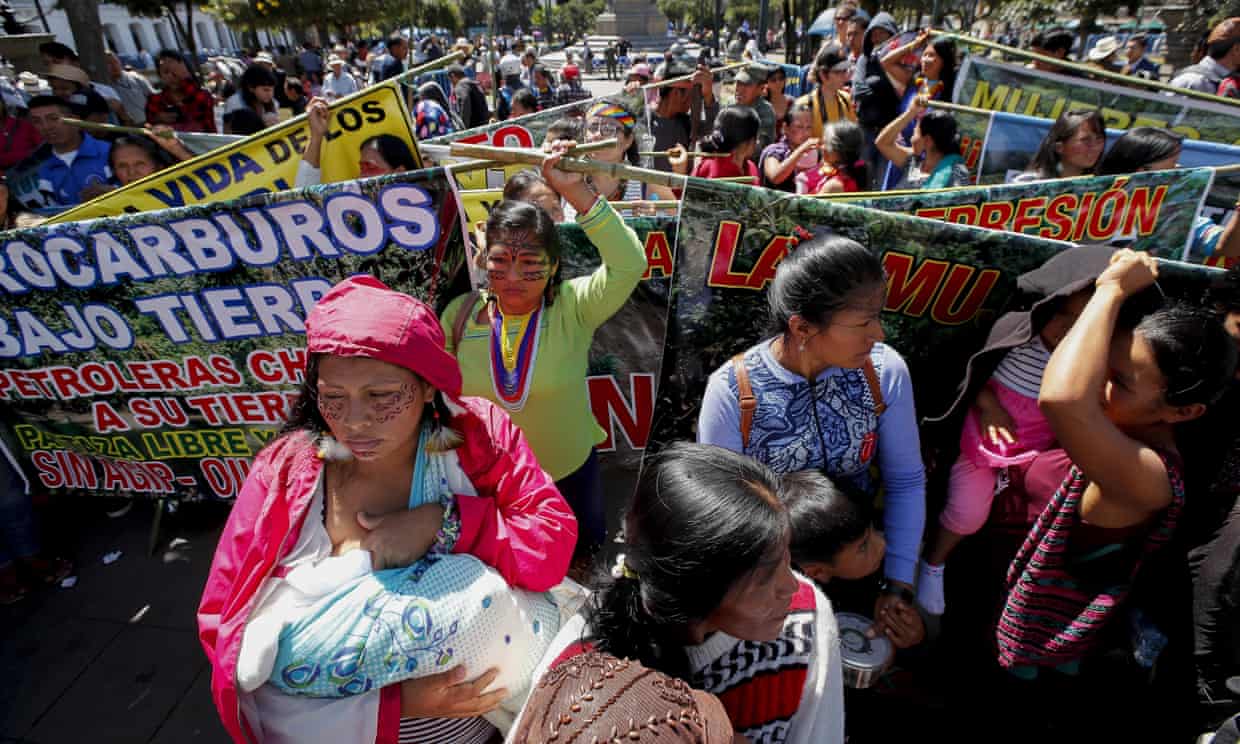
QUITO, Ecuador – Nearly 100 indigenous women of the Ecuadorian Amazon traveled to the capital to protest outside of the Presidential Palace. The women spent five days protesting and demanding a meeting with President Lenin Moreno to personally deliver their political mandate.

Women from the Ecuadorian Amazon gather outside the Presidential Palace. Image Courtesy of Jose Jacome.

Many of the women travelled on long journeys by foot and by bus to gather for this protest. The purpose was to address the oil and mining activities in the Amazon and its harsh impact on indigenous women. The protesters sought a personal meeting with President Moreno to deliver the “Mandate of Amazonian Women Defenders of the Jungle of the Bases against Extractivism.” The mandate includes 22 points that mostly involve putting an end to exploiting the Amazon. It points out that the industry has had a dire consequence on women in particular.

One point of the document refers to land-use issues. It demands the annulment of contracts granted by the government to the oil and mining companies. Also, it demands “that the indigenous territories and peoples be declared free of activities of extractive products such as oil, mining, hydroelectrics and logging.”

The protestors explain that women who live around extractive areas are often the most vulnerable populations. After contamination or community displacement destroys their traditional lifestyles in the jungle, women tend to face more economic barriers than men. One study by Oxfam reports that women struggle to find work in local towns, which often results in increased cases of position, drug abuse, and alcoholism.

Women arrived at the presidential palace carrying anti-extractive banners, wearing traditional clothing, chanting, and vowing not to leave without speaking to the president. They continued to return throughout the week and made speeches through a loudspeaker in the central plaza. However, officials reported that President Moreno could not attend to the group since he was traveling home from Chile on a work visit. The protestors stayed for five days and authorities eventually agreed to a meeting between them and the President.

President Moreno’s government has made several advancements with the indigenous community compared to the last administration. There have been improvements in areas such as bilingual education and reinforcing free, prior, and informed consent regulations for mining projects. President Moreno was praised by environmentalists last year after promising the United Nations he would take steps to protect the Amazon. However, Ecuador’s economy has heavily depended on oil and gas for economic stability and growth. In February, the government held an oil auction and handed out several new mining concessions.

Indigenous women are demanding more of their government. Patricia Gualinga, an indigenous woman, told the president, Your government cannot permit that our rights continue to be violated. Ecuador has to change its energy policy. It could be an example for the world.”

For more information, please see:

Taipei Times – Indigenous women call on Ecuador not to drill for oil – 25 March 2018

Reuters – From Ecuador’s Amazon to president’s palace, indigenous women demand end to drilling – 23 March 2018

The Guardian – Keep off our land, indigenous women tell Ecuador’s president – 23 March 2018

Mongabay – Indigenous Amazonian women demand end to extraction – 22 March 2018

Telesur – Ecuador: Indigenous Women Protest Lack of ‘Consultation,’ Environmental Damage Caused by Mineral, Oil Extraction in Amazon – 14 March 2018