The highlight of the 6th International Humanitarian Law Dialogs, held at Chautauqua Institution Aug 27-28, 2012, is the Chautauqua Declaration . Here is part 1 led by Elizabeth Andersen, Executive Director of the American Society of International Law.
Chautauqua Declaration Renewed By International Prosecutors
By Remington Whitcomb (rwhitcomb@post-journal.com)
The Post-Journal
CHAUTAUQUA , New York – Nine international prosecutors gathered at Chautauqua on Tuesday to reaffirm the promises made in the Chautauqua Declaration five years ago.

Those who were not familiar with the event taking place at the Athenaeum Hotel may have mistaken the building for some sort of embassy, as a handful of languages were audible before the afternoon renewal of the declaration.
This is because nearly every single continent was represented at the event, either as a prosecutor or as a guest.
The event began with an address delivered by Elizabeth Andersen, representative of the American Society of International Law, and followed with the reaffirmation of the Chautauqua Declaration by the highly lauded board of international prosecutors.
The original Chautauqua Declaration, which was issued in 2007 stated that, “The challenge for states and for the international community is to fulfill the promise of the law they created; to enforce judicial decision and to ensure the arrest and surrender of sought individuals …”
To begin, Andersen gave the American Society of International Law’s purpose for supporting the International Humanitarian Law Dialogues.
“I can think of few activities of the society that better serve our mission than cosponsoring these dialogues,” said Andersen. “The opportunity to bring together experts in our field for careful discussion and debate … and disseminating that information to broad constituencies of international law, that is what we are all about.
“We are impatient for justice, as we should be,” continued Andersen. “Sometimes the process seems too slow, too compromised, but when we reflect on the legacy of the special court for Sierra Leone, we can take satisfaction in progress made, lessons learned … and now pass it on to future processes. … It is for that stock-taking of lessons learned and progress made, and to rededicate ourselves to the work that remains and inspire the next generation to carry it on that we convene the dialogues …”
Following Andersen’s address, the board of prosecutors reaffirmed and commented on the Chautauqua Declaration. The board consisted of: Fatou Bensouda, International Criminal Court; Serge Brammertz, International Criminal Tribunal for the Former Yugoslavia; H.W. William Caming, United States Military Tribunal of Nuremberg; David Crane, Special Court for Sierra Leone; Sir Desmond de Silva, Special Court for Sierra Leone; Brenda J Hollis, Special Court for Sierra Leone; Hassan Jallow, International Criminal Tribunal for Rwanda; William Smith, Extraordinary Chambers in the Courts of Cambodia; Ekkehard Withopf, Special Tribunal for Lebanon.
When given the opportunity to say a few words about their accomplishments in arresting and prosecuting international war criminals, many took the opportunity to speak of the future, rather than of their many, many collective accomplishments.
“After nine years of activities, there is much we have achieved,” said Bensouda. “However, our work is far from over. We are facing many challenges, including outstanding warrants against 12 individuals.”
“I am a bit concerned as an American,” said Crane, “the United States of America has built a wonderful house beginning in 1945. It has built a house on which we seek justice for those at-large. Yet, as I look out into the not-so-distant future, particularly in the next five years, as (several tribunal courts) close, my question is: how many Americans will be a part of modern international criminal law? You won’t see anymore American chief prosecutors or judges or registrars or someone who had a leadership role in these courts, because they are all closed. So as we walk out of the house we built and close the door, within five or six years, we will only be able to look through the window of that house we built. … That’s what international justice is about: the camaraderie and teamwork of building something together under extreme circumstances and then watching it with colleagues.”
“I’ve had the privilege of listening to the words of remarkable men and women here in this room,” said Sir Desmond de Silva. “I leave Chautauqua with the renewed hope that I will see, and we will see, victory and justice over evil and the triumph of victims over despots. That is what we are here to achieve.”
Following the prosecutors’ comments, the audience gave a standing ovation which lasted for no less than a minute. The conclusion of the reaffirmation of the Chautauqua Declaration marks the end of the three-day ceremony of the International Humanitarian Law Dialogues.
UN Report Finds Gaza Will Not Be ‘Liveable’ by 2020
By Ali Al-Bassam
Impunity Watch Reporter, Middle East
GAZA STRIP — In a comprehensive report published on Monday, the United Nations determined that the Gaza Strip will not be livable by the year 2020, unless measures are taken to improve the region’s water supply, power, health, and schooling.

According to the report, Gazans must double their current supply of electricity, and must provide at least 440 more schools, 800 more hospital beds, and more than 1,000 doctors if the region is to remain habitable. The report also said that the region is suffering from a housing shortage, finding that tens of thousands of housing units must be constructed soon.
On Monday, U.N. Humanitarian Coordinater Maxwell Gaylard said in a press release that, “[A]ction needs to be taken now if Gaza is to be a livable place in 2020 and it is already difficult now.” The U.N. expects the population to grow steadily from its current number of 1.6 million to 2.1 million by the year 2020.
Gaza has been under the control of Hamas, the armed political movement that refuses to accept peace with Israel, since 2007. Despite international pressure, Israel refuses to lift its blockade on goods coming into the region out of fear that Hamas would be able to acquire weapons.
Because the Gaza Strip lacks both an airport and a seaport, it relies heavily on outside funding and illegal smuggling from Egypt through underground tunnels. The U.N.’s report says that such circumstances makes Gaza’s economy “fundamentally unviable,” also saying that Gazans are worse off than they were in the 1990’s despite the minor economic growth that the region has felt in recent years.
With 80 percent of Gazans dependent on charity, Gaylard has called on international donors to increase their aid. “Despite their best efforts the Palestinians in Gaza still need help,” he said. “They are under blockade. They are under occupation and they need our help both politically and practically on the ground.” Jean Gough of UNICEF believes that a lack of clean drinking water is the region’s greatest concern. The report states that the water needs of Gazans has increased by 60 percent, and that urgent action is necessary to protect their current water source, a single aquifer that is estimated to become unusable by 2016. The report also says that more desalination plants will be needed in the near future.
Gaylard believes that peace and security is necessary to improve the lives of Gazans. “It will certainly have to mean the end of blockade, the end of isolation and the end of conflict.”
For further information, please see:
Al Jazeera — UN Warns Gaza ‘Will not be Liveable by 2020’ — 27 August 2012
BBC News — Gaza ‘Will not be Liveable by 2020’ – UN Report — 27 August 2012
Business Insider — UN: Gaza Won’t be ‘Liveable’ by 2020 Unless Urgent Action is Taken — 27 August 2012
Haaretz — UN Report: Gaza Won’t be ‘Liveable’ by 2020 if Urgent Action not Taken — 27 August 2012
The Jerusalem Post — ‘Gaza Will not be ‘Liveable’ by 2020 Without Action’ — 27 August 2012
Assassination of Islamic Cleric Sparks Riots in Mombasa
By Ryan Aliman
Impunity Watch Reporter, Africa
NAIROBI, Kenya – The murder of Islamic cleric Aboud Rogo Mohammed, popularly known in Kenya as Rogo, sparked riots in Mombasa that began on Monday, August 27.

Identified by the US and the UN as an aide and financier to Somalia’s Al Qaeda-linked Al Shebab militants, Rogo was driving a minibus with his father-in-law, wife and children when he was shot to death by “unknown people”, according to local police. Rogo’s family members reportedly survived the attack.
Upon learning of Rogo’s “targeted assassination”, his supporters began barricading the streets with burning tires in the predominantly Muslim neighborhood of Majengo as they clamored against the alleged “witch-hunt” against Muslims by the Kenyan government. They threw stones and fired machine guns at law enforcers; looted stores; and set ablaze churches. On Tuesday, they detonated a grenade in the area which injured almost a dozen officers and killed five people, including one civilian and three police officers.
The Kenyan police attempted to quell the unrest by retaliating with open fire and by arresting some of the protesters. So far, around 24 people are in detention and are likely to face charges of illegal assembly, arson and destruction of property. Anti-riot forces have also begun to patrol the streets armed with batons, teargas and rifles. In addition, they have ordered local residents to remain in their houses.
A day after Director of Public Prosecutions (DPP) Keriako Tobiko appointed Assistant Deputy DPP Jacob Ondari to assemble the team that will investigate Rogo’s murder, the National Muslim Leaders Forum (NAMLEF) called for an end to the riots. Despite conceding that the police were behind Rogo’s death and characterizing the cleric’s assassination as an “extra-judicial killing”, the Muslim leaders openly condemned the violence inflicted upon the police and the burning of churches, stating that “Islam did not condone attacks on places of worship”.
Perhaps to avoid aggravating already strained Muslim-Christian relations in the region, Cabinet Minister Najib Balala, a member of the NAMLEF, reminded Rogo’s supporters that, “this is not a war between Muslims and Christians, it is war against crime.”
However, Prime Minister Raila Odinga seemed to disagree with Cabinet Minister Balala. “We suspect the hand of the enemies of our country in this, those who want to create religious animosity. It is an attempt to try create a division between Christians and Muslims in our country so that it appears it is a religious war,” he told reporters.
Foreign embassies, meanwhile, such as those of Australia, Britain and France have issued travel warnings for Mombasa, a popular tourist destination with a major Indian Ocean port.
For further information, please see:
BBC – Kenya Cleric Rogo Riots: Mombasa Death Toll Rises – 29 August 2012
Reuters – Kenya PM Blames Killing of Muslim Cleric on Nation’s Foes – 29 August 2012
The National – Kenyan Police Officers Killed in Mombasa Riots over Imam Death – 29 August 2012
Daily Nation – Muslim Leaders Call for End to Mombasa Riots – 29 August 2012
Arab News – Riots Break Out for 2nd Day in Kenya over Cleric’s Death – 29 August 2012
Zimbabwean Police Officers Raid Gay Rights Organization
By Tara Pistorese
Impunity Watch Reporter, Africa Desk
HARARE, Zimbabwe—On August 20, Zimbabwean police officers forcibly occupied the Harare organizational offices of Gays and Lesbians of Zimbabwe (GALZ), which advocates for national gay rights and provides health education and counseling. This was the second police raid of GALZ this month.
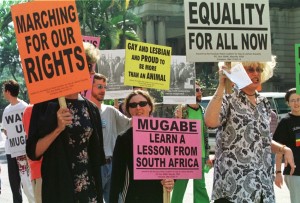
Officers confiscated computers, gay rights advocacy materials, DVDs, pamphlets, CDs, and other important documents, accusing the organization of operating without a license, in violation of the Private Voluntary Organizations Act. The “truckloads” of officers responsible for the invasion completely shut down the organization upon their departure.
The raid lasted six hours, most of which was conducted without a search warrant. When police finally provided a warrant in response to GALZ’s attorney’s demands, it stated the purpose of the raid was that GALZ was “in possession of pamphlets and fliers with information that promotes homosexuality for distribution.”
Forty-four members of the organization were arrested and will be tried, although a trial date has not yet been set, according to GALZ attorney Tonderai Bhatasara.
“It’s not an offense to be gay under the Zimbabwean Constitution,” Bhatasara explained, “but, if one man sodomized another man, then it becomes an offense. It is only intolerance within the society and political leadership here in Zimbabwe which have fueled the vilification of gays and lesbians.”
Human Rights Watch sent a letter to Zimbabwean Prime Minister Morgan Tsvangrai and President Robert Mugabe calling for the government to immediately stop persecuting members of the lesbian, gay, bisexual, transgender, and intersex (LGBTI) community, and, specifically, GALZ.
This incident comes on the heels of a similar police raid that took place on August 11. On that occasion, police forcibly entered a GALZ office without a warrant in response to the organization’s publication of the 2011 LGBTI Rights Violation Report as well as a briefing of the progress of the new Zimbabwe Constitution, which is currently being drafted. President Mugabe vowed to exclude LBGTI rights in the new Constitution.
The police detained and assaulted forty-four GALZ members with batons, slaps, and punches during the August 11 attack, forcing some of the victims to seek medical attention for the injuries they suffered.
The week following the August 11 raid, the police entered the homes of various GALZ members and forced them to accompany officers to police headquarters, where the individuals were questioned.
“Such use of force is in direct contradiction to the Global Political Agreement,” said a GALZ spokesperson. The Global Political Agreement established a power-sharing government in 2009 with the intention of resolving Zimbabwe’s political and economic crisis and illuminating a new national political direction.
GALZ has been the target of multiple other violent assaults at the hand of the Zimbabwean government, most of which subject the organization’s officers to intimidation, arbitrary arrests, and beatings.
Specifically, in May 2010, two GALZ staff members were arrested after displaying a letter from San Francisco’s mayor calling President Mugabe “homophobic.” The two individuals were assaulted and detained for six days while police officials attempted to coerce them into providing a GALZ member list.
The staff members were charged with “insulting the President,” which is a criminal offense in Zimbabwe, although both were acquitted six months later. One of the arrest victims has since fled Zimbabwe out of fear for her personal safety.
GALZ, however, has not yet retracted the mayor’s letter from public display, prompting police to concentrate on the organization’s director during their criminal investigation of the Presidential insult. The director has been threatened with prosecution for this crime unless the organization brings forth another member willing to be prosecuted for the offense.
The U.S. State Department Spokeswoman, Victoria Nuland condemned the raids saying the U.S. “stands in solidarity” with Zimbabwe’s gay rights activists and other civil society.
“We are deeply concerned when security forces become an instrument of political violence used against citizens exercising their democratic rights,” Nuland said. “We call upon the government of Zimbabwe to eradicate the culture of impunity that allows members of the security sector to continue to violate the rights of the Zimbabwean people.”
Similarly, Zimbabwe Lawyers for Human Rights (ZLHR) has condemned the police actions against GALZ and has monitored and recorded incidents of anti-gay government action. Notably, a speech from government figures in May 2012 urged Zimbabwean chiefs to banish “people who support homosexuality” from their communities and disposes them of their land.
GALZ has responded publicly to the police raids by saying, “[we] do not condone violence and we are not a threat. Those who cause violence are a threat to public safety and security and we ask that they stay away from our premises.”
For further information, please see:
Human Rights Watch—Zimbabwe: End Attacks on LGBT People—27 August 2012
ZimEye—U.S. Gov’t Blasts Zimbabwe Over Gay Group Raids—25 August 2012
The Zimbabwean—ZLHR Condemns GALZ Raids and State-Sponsored Homophobia Against LGBTS—23 August 2012
NewsDay—44 GALZ Members Arrested—13 August 2012