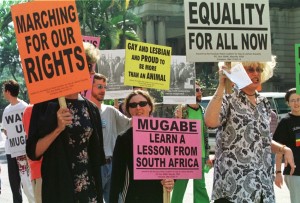
Zimbabwean Police Officers Raid Gay Rights Organization

By Tara Pistorese
Impunity Watch Reporter, Africa Desk

HARARE, Zimbabwe—On August 20, Zimbabwean police officers forcibly occupied the Harare organizational offices of Gays and Lesbians of Zimbabwe (GALZ), which advocates for national gay rights and provides health education and counseling. This was the second police raid of GALZ this month.

Activists Advocate for Gay Rights in Zimbabwe. (Photo Courtesy of The International Business Times)

Officers confiscated computers, gay rights advocacy materials, DVDs, pamphlets, CDs, and other important documents, accusing the organization of operating without a license, in violation of the Private Voluntary Organizations Act. The “truckloads” of officers responsible for the invasion completely shut down the organization upon their departure.

The raid lasted six hours, most of which was conducted without a search warrant. When police finally provided a warrant in response to GALZ’s attorney’s demands, it stated the purpose of the raid was that GALZ was “in possession of pamphlets and fliers with information that promotes homosexuality for distribution.”

Forty-four members of the organization were arrested and will be tried, although a trial date has not yet been set, according to GALZ attorney Tonderai Bhatasara.

“It’s not an offense to be gay under the Zimbabwean Constitution,” Bhatasara explained, “but, if one man sodomized another man, then it becomes an offense. It is only intolerance within the society and political leadership here in Zimbabwe which have fueled the vilification of gays and lesbians.”

Human Rights Watch sent a letter to Zimbabwean Prime Minister Morgan Tsvangrai and President Robert Mugabe calling for the government to immediately stop persecuting members of the lesbian, gay, bisexual, transgender, and intersex (LGBTI) community, and, specifically, GALZ.

This incident comes on the heels of a similar police raid that took place on August 11. On that occasion, police forcibly entered a GALZ office without a warrant in response to the organization’s publication of the 2011 LGBTI Rights Violation Report as well as a briefing of the progress of the new Zimbabwe Constitution, which is currently being drafted. President Mugabe vowed to exclude LBGTI rights in the new Constitution.

The police detained and assaulted forty-four GALZ members with batons, slaps, and punches during the August 11 attack, forcing some of the victims to seek medical attention for the injuries they suffered.

The week following the August 11 raid, the police entered the homes of various GALZ members and forced them to accompany officers to police headquarters, where the individuals were questioned.

“Such use of force is in direct contradiction to the Global Political Agreement,” said a GALZ spokesperson. The Global Political Agreement established a power-sharing government in 2009 with the intention of resolving Zimbabwe’s political and economic crisis and illuminating a new national political direction.

GALZ has been the target of multiple other violent assaults at the hand of the Zimbabwean government, most of which subject the organization’s officers to intimidation, arbitrary arrests, and beatings.

Specifically, in May 2010, two GALZ staff members were arrested after displaying a letter from San Francisco’s mayor calling President Mugabe “homophobic.” The two individuals were assaulted and detained for six days while police officials attempted to coerce them into providing a GALZ member list.

The staff members were charged with “insulting the President,” which is a criminal offense in Zimbabwe, although both were acquitted six months later. One of the arrest victims has since fled Zimbabwe out of fear for her personal safety.

GALZ, however, has not yet retracted the mayor’s letter from public display, prompting police to concentrate on the organization’s director during their criminal investigation of the Presidential insult. The director has been threatened with prosecution for this crime unless the organization brings forth another member willing to be prosecuted for the offense.

The U.S. State Department Spokeswoman, Victoria Nuland condemned the raids saying the U.S. “stands in solidarity” with Zimbabwe’s gay rights activists and other civil society.

“We are deeply concerned when security forces become an instrument of political violence used against citizens exercising their democratic rights,” Nuland said. “We call upon the government of Zimbabwe to eradicate the culture of impunity that allows members of the security sector to continue to violate the rights of the Zimbabwean people.”

Similarly, Zimbabwe Lawyers for Human Rights (ZLHR) has condemned the police actions against GALZ and has monitored and recorded incidents of anti-gay government action. Notably, a speech from government figures in May 2012 urged Zimbabwean chiefs to banish “people who support homosexuality” from their communities and disposes them of their land.

GALZ has responded publicly to the police raids by saying, “[we] do not condone violence and we are not a threat. Those who cause violence are a threat to public safety and security and we ask that they stay away from our premises.”


For further information, please see:

Human Rights Watch—Zimbabwe: End Attacks on LGBT People—27 August 2012

ZimEye—U.S. Gov’t Blasts Zimbabwe Over Gay Group Raids—25 August 2012

The Zimbabwean—ZLHR Condemns GALZ Raids and State-Sponsored Homophobia Against LGBTS—23 August 2012

NewsDay—44 GALZ Members Arrested—13 August 2012

Two Members of Pussy Riot Flee Russia to Avoid Prosecution

By Connie Hong
Impunity Watch Reporter, Europe

MOSCOW, Russia – Two members of Pussy Riot, a Russian feminist punk band, had fled the country in order to avoid prosecution for their involvement in an anti-Putin performance held at the alter of Christ the Savior cathedral.  Their decision to leave the country comes after the conviction of three of their band mates for hooliganism motivated by religious hatred.  The three women were sentenced to two years of jail time, but their defense lawyers are expected to soon appeal their sentences.

Members of Pussy Riot wearing colorful balaclavas. (Photo Courtesy of The Guardian) Continue Reading

Sixteen Lions and Tigers Stopped at Paraguay-Argentine Border

By Heba Girgis
Impunity Watch Reporter, South America

ASUNCION, Paraguay—We all know what it is like to be stuck in the security line at the airport for an hour anxiously wondering if we will make our flight departure, or wondering if just because we possess certain traits we will be held up at customs. Now take this situation and multiply it by two months of waiting.

The Cats Have Been Held in Paraguay for Almost Two Months at the Zoo in Asuncion. (Photo Courtesy of The Cortez Journal)

This is the situation that 16 lions and tigers face on the border of Paraguay because Argentine officials refused to approve the big cats’ paperwork for re-entry into the country.

The group of cats includes nine Bengal tigers and seven African lions. They all belong to an Argentine circus that travels to the capital of Paraguay every August to perform. The group’s owner, Oswal Wasconi, travelled with them to this year’s performance and ran into trouble when the group attempted to return to Argentina. Apparently a new law was passed in Paraguay banning live animal acts in performing circuses.

After realizing that they had no choice of putting on the live animal show, Wasconi decided to try to ship the lions and tigers back to Argentina. It was at this point in the game that these animals got stuck at the customs border between Argentina and Paraguay. While the animals all have good-health forms and certificates, their entry back into Argentina was blocked by government border officials who demanded more information about the protected species of cats.

Estela Gomez, the director of Paraguay’s wildlife agency, noted that her ministry decided to move the performing cats to the Asuncion Zoo in pairs “so that they can live in some comfort and not in a strange area” until the issue with the border patrol is resolved. The cats’ owner will be providing the zoo with enough food and water to care for the cats while this matter is investigated further.

Gomez said also that, “In the next few days we will continue investigating the true reasons why the Argentine authorities aren’t authorizing their return. I can’t anticipate whether these beasts will remain forever in Paraguay or eventually go to Argentina.”

Paraguay is not the only country to develop this type of ban on live animal acts. Bolivia, Peru, and Ecuador have also passed a similar law and the legislation process is under way in both Colombia and Brazil to develop their own laws of this nature.

As Wasconi awaits the news from Argentine border officials, his animals await the verdict in the Asuncion Zoo in Paraguay’s capital city.


For further information, please see:

Global Post – 16 Tigers and Lions Stuck in South American Border Limbo for 2 Months – 25 August 2012

Cortez Journal – Caged Big Cats Stuck on Paraguay Border 2 Months – 24 August 2012

Newsday – Caged Big Cats Stuck on Paraguay Border 2 Months – 24 August 2012

The Washington Post – 16 Tigers and Lions Caged in Two Month Border Limbo; Banned in Paraguay, Barred From Argentina – 24 August 2012

Japan’s Recent Resolution Around Disputed Islands Exacerbate Tensions

By Karen Diep
Impunity Watch Reporter, Asia

TOKYO, Japan – On Friday, Japan demanded South Korea end its unauthorized occupation of small islands under Japanese control.  In addition, Japan criticized China for its unrightful claims over other islands and occupation by Chinese activists.

Japanese Nationalists with on island with Japanese flag. (Photo Courtesy of New York Times)

“Since earlier this month, a series of incidents have occurred, threatening to violate our sovereignty, which we find extremely regrettable.  We do not tolerate these actions,” voiced Prime Minister Yoshihiko Noda.

On Friday, Japan’s lawmakers passed a symbolic resolution banning South Korea’s President, Lee Myung-bak, from Japan’s island, Takeshima in Japanese and Dokdo in Korean.

“We condemn [Lee’s landing] and strongly demand South Korea end its illegal occupation of Takeshima as soon as possible,” read the resolution.  According to the Washington Post, the strong language in the dispute worsened relations between both countries.

On the other front, on August 17th, Japan deported 14 Chinese activists previously detained after landing on an island concurrently claimed by Japan and China in the East China Sea.  The island, Senkaku in Japanese and Diaoyu in Chinese, lies near rich gas reserves, and in April, Tokyo’s governor announced that he would purchase the cluster of islands.

As reported by the Washington Post, critics pressured Prime Minister Noda to take harsher action monitoring and protecting the islands.  Accordingly, Mr. Noda announced that Japan would bolster its security near Senkaku or Diaoyu to prevent further “incursions by foreigners.”  Mr. Noda further stated that Japan would continue to push its position in international forums.

In response, Chinese Foreign Ministry spokesman Hong Lei claimed, “It is illegal and futile for Japan to strengthen its claim by approving the resolution.  It does not change the fact that the islands belong to China.”

In September 2010, a Chinese fishing boat collided with Japanese coastguard patrols near the disputed islands.  According to the Guardian, a Japanese coastguard claimed that the collision occurred after the captain disregarded requests to leave the area and subsequently refused to allow Japanese authorities to inspect his boat.  The Japanese further demanded that China pay for the damages.

Such events have lead to thousands of anti-Japanese protests the last few weeks in China.  As a result, Japan has urged China to protect its citizens.

“With a rising China and a more self-confident South Korea, the region is entering an era of turbulence,” shared Narushige Michishita, a security expert from Japan’s National Graduate Institute for Policy Studies.

For further information, please see: 

Tapei Times – Japan talks tough in row with South Korea on Islands – 26 Aug. 2012

The Washington Post – Japan condemns ‘illegal’ landings by Chinese activists, SKorean president on disputed islands – 24 Aug. 2012

Euro News – Japan and China clash over disputed islands – 20 Aug. 2012

The Guardian – Japan to deport 14 Chinese island activists – 17 Aug. 2012

The Guardian – Japan-China row escalates over fishing boat collision – 09 Sept. 2010


Gambia vows to Execute all Death Row Inmates

By Ryan Aliman
Impunity Watch Reporter, Africa

BANJUL, Gambia – Gambia’s President Yahya Jammeh declared that his government vows to execute all prisoners who had been sentenced to death by September.

Gambian President Yahya Jammeh.
(Photo courtesy of Gambia News)

According to Jammeh, the executions are meant to end the rise of “brutal killings” and “heinous crimes” in the country. “I will set an example on all those who have been condemned,” he proclaimed in a televised meeting with the country’s Muslim elders and religious leaders last Sunday.

Human rights groups report that Gambia has currently sentenced 44 inmates to death, including 2 women, since last year. Crimes that receive the capital punishment as penalty include murder and treason.

Once implemented, the President’s decree will mark the end of an execution-free regime that has been in place for almost 30 years. Gambia last executed a prisoner in 1985. The resumption of the death penalty will also make Gambia the only West African country to inflict capital punishment upon its prisoners. Togo, Burundi, Gabon and Rwanda have abolished the death penalty for all crimes in the last five years.

Known in Gambia as His Excellency, Sheikh Professor Alhaji Dr Yahya Jammeh, the Gambian Leader has already made similar threats several years ago. For instance, in 1995, Jammeh’s government reinstated the death penalty. Almost a decade later, he issued another statement saying that his administration will see to it that all death row inmates will be executed as soon as possible. None of these intended executions, however, have been carried out. Despite this, Human Rights groups such as Amnesty International still consider President Jammeh’s recent announcement “a matter for serious concern”.

“Any attempt to carry out this threat would be both deeply shocking and a major set-back for human rights in Gambia,” said Audrey Gaughran, Amnesty International’s Africa director. “The President’s statement is in stark contracts to the trend, both in West Africa and globally, towards ending the use of the death penalty,” she added.

In his article for Think Africa Press, Journalist Bubacarr Sowe expressed his dismay regarding the President’s administration. He writes that over the past couple of years, President Jammeh has made decisions that run counter to the President’s “promises of transparency, accountability and probity” – promises he made when he led a coup that ended former Gambian President Dawda Jawara’s 30-year rule. “Instead,” Sowe writes, “the administration is, like its predecessor, tainted with evidence of corruption and misappropriation of state resources.”

Notwithstanding the backlash against Jammeh’s regime, the President has maintained a steady number of supporters due to a recent boost in infrastructure projects which include the building of schools and hospitals, a new airport and the Gambia’s first university.


For further information, please see:

CNN – Gambia vows to execute all death row inmates by September, sparking outcry – 23 August 2012

AP – Gambia president vows to execute death row inmates – 22 August 2012

All Africa – Gambia: Murder Convicts Will Be Executed President Jammeh Tells Muslim Elders – 21 August 2012

All Africa – Gambia: President Jammeh Must Retract Call for Execution of Death Row Inmates – 21 August 2012

All Africa – Gambia: Yahya Jammeh – 18 Years and Counting – 2 August 2012