Syrian Prime Minister Defects from Assad Regime, Joins Revolt

By Ali Al-Bassam
Impunity Watch Reporter, Middle East

DAMASCUS, Syria — Two months after being appointed as Syria’s Prime Minister, Riad Hijab fled the country last Monday, and defected from President Bashar Al-Assad’s government to join “the revolution,” his spokesman says.

Syrian Prime Minister Riad Hijab defected from the Assad regime last Monday. (Photo Courtesy of Al Arabiya)

The former prime minister arrived in Jordan after being smuggled across the border.

“I announce today my defection from the killing and terrorist regime, and I announce that I have joined the ranks of the freedom and dignity revolution.  I announce that I am from today a soldier in this blessed revolution,” Hijab said in a statement read in his name by spokesman Muhammad el-Etri.  “This defection was not a matter of days or weeks, it was in the pipeline for two continuous months through a trusted cell close to the prime minister made up of rebels and aides.”  El-Etri stated that Hijab’s escape was planned in conjunction with the Free Syrian Army.

El-Etri denied a Syrian state television report that claimed Hijab was fired from his position, saying that the government made the announcement of his dismissal after officials realized that the prime minister had fled the country.  Hijab–who, like much of the opposition, comes from Syria’s Sunni majority–was not part of Assad’s inner circle.  But as prime minister and the most senior civilian official to defect, his departure dealt a symbolic blow to an establishment rooted in the president’s minority Alawite sect.

Hijab will leave for Qatar within days, following the example of other high-profile defectors, el-Etri told the AFP News Agency.  “Hijab will go to Doha, where international media are based.  He will leave for Qatar tomorrow, the day after or after a few days,” he said in the Jordanian capital of Amman.

A member of the Syrian opposition in Jordan said that Hijab will travel to the Qatari capital “in the coming few hours.”  Speaking on the condition of anonymity, he said “[w]e are currently co-ordinating to facilitate the departure of Hijab to Doha in the coming few hours, most probably at 2200 GMT.  Seven of his brothers will stay in Jordan.  We understand the sensitivity of this issue for Jordan. We do not want to create problems for the kingdom, which already has tense relations with the Syrian regime.”

The White House stated on Monday that Hijab’s defection is a crippling blow to the Assad regime, calling it a sign that the Syrian government is “crumbling from within.”  It repeated its calls for Assad to step down and end the violence gripping the country.

“This is a sign that Assad’s grip on power is loosening.  If he cannot maintain cohesion within his own inner circle, it reflects on his inability to maintain any following among the Syrian people that isn’t brought about at the point of a gun,” White House spokesman Jay Carney told a news briefing.  “The momentum is with the opposition and with the Syrian people.  It’s clear that these defections are reaching the highest levels of the Syrian government and Assad cannot restore his control over the country because the Syrian people will not allow it,” he said.

For further information, please see:

Al Arabiya — Defection of Syrian PM Shows Assad ‘Crumbling From Within:’ White House — 6 August 2012

Al Bawaba — Syria: Defected PM Slams “War Crimes and Genocide” Carried out by Assad Regime — 6 August 2012

Al Jazeera — Syrian PM Defects From Assad Government — 6 August 2012

BBC News — Syria Prime Minister Riad Hijab Defects — 6 August 2012

Reuters — Syrian Prime Minister Defects, Fighting Goes on — 6 August 2012

Senior Venezuelan Diplomat Charged With Murder

By Margaret Janelle Hutchinson
Impunity Watch Reporter, South America

CARACAS, Venezuela – Kenyan authorities have charged the first secretary of the Venezuelan embassy with the murder of the South American country’s acting ambassador, a crime police believe was motivated by a battle over embassy leadership, though allegations of a drug-trafficking scheme have also surfaced.

Dwight Sagaray, charged with the murder of acting Venezuelan Ambassador Olga Fonseca, had his immunity waived by Venezuela. (Photo courtesy of the BBC)

Dwight Sagaray was charged in court with the murder of acting Venezuelan ambassador Olga Fonseca. He pled not guilty.

Mohamed Ahmed Mohamed Hassan, Sagaray’s friend and an alleged co-conspirator who has gone into hiding, was also charged with murder.

Prosecutor Tabitha Ouya said the two suspects strangled Fonseca in her home, a mere 12 days after her arrival in Kenya. She said others were also involved in the killing, but did not name them.

Judge Florence Muchemi issued an arrest warrant for Hassan and remanded Sagaray into custody until his bail application is heard. Venezuelan officials previously agreed to waive Sagaray’s diplomatic immunity so he could be charged.

Fonseca was found strangled in the embassy’s official residence. She reported to Kenya on July 15 to replace former ambassador Gerardo Carillo Silva, who left his posting in Kenya and soon faced allegations of sexual harassment by Kenyan male workers from the embassy residence.

Kenyan nationals employed at the embassy told police at the time of Sagaray’s arrest last week that relations with the new ambassador had soured quickly after her arrival because she had ordered staff who lodged sexual-harassment complaints against her predecessor to withdraw them. When they refused to retract their allegations, Fonseca fired them, local media reported.

Former ambassador Carrillo told the Venezuelan newspaper Ultimas Noticias that five or six months after Saragary’s arrival in Kenya in July 2010, the situation at the embassy grew tense because “he refused to recognize my authority.”

“I warned twice about the problem by phone: one (call) at the end of last year and another in February when the situation became unsustainable. And other diplomats of the embassy were witnesses to that,” Carrillo was quoted as saying.

Carillo said he left Kenya on May 19 after receiving instructions from the Foreign Ministry to travel to Venezuela. On May 23, Carrillo said, he received a call from Nairobi and was told that a news article appeared in which he was accused of sexual harassment.

“I reject the accusation of sexual harassment. That isn’t true,” Carrillo told Ultimas Noticias. Carrillo said he had been working at the embassy since 2005. “During those seven years nothing ever happened. Why after my departure do they make it seem that I fled?”

Police said they believe the motive behind Fonseca’s murder was a battle for the embassy’s top job, but allegations surfaced that officials at the scandal-plagued post in Nairobi may have been trafficking drugs under cover of diplomatic immunity, Kenyan media reported.

According to the information they had received, the police linked some of the embassy staff, a few locals and some foreigners in drug trafficking. The sources said the drugs were being brought into the country as diplomatic parcels which, under the 1961 Vienna Convention on Diplomatic Relations, are not subjected to security checks.

For more information, please see:

The Associated Press – Venezuelan charged in diplomat’s killing in Kenya  – 06 August 2012

Fox News – Venezuelan charged with death of diplomat in Kenya – 06 August 2012

The Guardian –  Venezuelan official accused of killing diplomatic rival at Kenyan embassy – 06 August 2012

LA Times –  Venezuelan diplomat charged with murdering the ambassador to Kenya  –  06 August 2012

The Star –  Narcotics drugs cited in envoy’s murder  –  06 August 2012


Truth Commission Tries to Reconcile and Rebuild a Nation

By Tara Pistorese
Impunity Watch Reporter, Africa

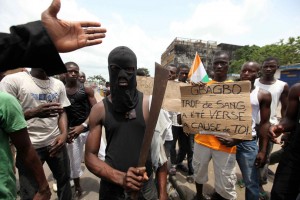
YAMOUSSOUKRO, Cote D’Ivoire—Former Ivorian President Laurent Gbagbo’s failure to admit defeat during the 2010 presidential elections gave rise to months of controversy, fighting, displacement, and death. Following the post-election tumult, an eleven-member Commission on Dialogue, Truth and Reconciliation (CDVR) was formed in an effort to promote unity and healing throughout the country.

During the post-election period, an anti-Gbagbo protester stands beside a sign, which reads, “Gbagbo–too much blood poured because of you.” (Photo Courtesy of Boston.com)

The Commission—comprised of religious leaders, regional representatives, and soccer star Didier Drogba—is modeled after South Africa’s Truth and Reconciliation Commission, which was passed in 1995 as the Promotion of National Unity and Reconciliation Act.

Aiming to uncover the truth behind the post-election tragedies of 2010-11, CDVR members have begun organizing confrontations between victims and those accused of committing atrocities. Notably, however, unlike the South African Commission, CDVR will not afford amnesty to those who confess to committing such crimes.

“We need to know the truth, even if it’s not pretty,” said Charles Konan Banny, a long-time ally of President Alassane Outtara and head of CDVR.

Sadly, however, halfway through its two-year mandate, the Commission faces a stifling lack of funding, which is evidenced by its very slow and seemingly unnoticeable progress, although CDVR Spokesman Franck Kouassi Sran believes it inaccurate to declare the Commission has had no impact.

“If we haven’t deployed all of our actions, it’s because we’re being held back by a lack of resources,” he said. “We hope that soon we can restart our activities to do everything necessary to complete our mission.”

The Ivorian government claims reconciliation is a priority, and has focused much of its recent attention on prosecuting Gbagbo’s supporters and those responsible for the crimes committed during the conflict.

Gbagbo, however, is still awaiting trial at The Hague for charges of crimes against humanity for murder, persecution, rape, and sexual violence that allegedly occurred at his hand during the post-election period.

The initial hearings were scheduled to take place in June; however, per defense counsel’s request for additional time in order to prepare, the hearing was rescheduled for August 13.

But, yet again, the hearing has been postponed to determine whether Gbagbo is healthy enough to stand trial. Defense counsel has consistently maintained Gbagbo was “tortured” during his detention in Korhogo. The attorneys claim their client needs time for psychological and physical recovery.

Although the Court offered no specific information on the state of Gbagbo’s health, it issued a statement announcing that Gbagbo’s attorneys appointed three doctors to assess the detainee’s health. The physicians filed confidential medical reports in July and the pre-trial chamber has ordered “the prosecutor and the defense to submit their observations on (medical) reports, respectively, by 13 and 21 August.”


For further information, please see:

BBC News—Ivory Coast Truth Commission ‘Not Working’—3 August 2012

Capital FM News—ICC Puts Off Gbagbo Hearing Over Health Fears—3 August 2012

Reuters—Hague Hearing for Ivory Coast’s Gbagbo Postponed—3 August 2012

The Hague Justice Portal—Trial of Suspected Génocidaire Begins at ITCR—28 September 2011

Greece to Deport 1,600 in Latest Illegal Immigrant Crackdown

By Connie Hong
Impunity Watch Reporter, Europe

ATHENS, Greece – Over the weekend, Greece has detained over 6,000 people in an effort to purge the country of illegal immigrants. While most of the detainees were eventually released, more than 1,600 of those arrested are scheduled to be deported.

Greek authorities rounding up illegal immigrants. (Photo Courtesy of 570 News)

The crackdown on illegal immigrants comes as a response to the country’s economic crisis and high unemployment rates. Public Order Minister, Nikos Dendias, defended the operation, stating that Greece could not afford an “invasion of immigrants.” Continue Reading

Swedish Ambassador Expelled From Belarus

Emilee Gaebler
Impunity Watch Reporter, Europe

MINSK, Belarus — On 3 of August, Swedish ambassador, Stefan Eriksson, was expelled from Belarus by President Alexander Lukashanko.  The action led to a number of outbursts.

President Lukashenko of Belarus speaks on 3 July at a parade for Independence Day in Minsk. (Photo Courtesy of the Associated Press)

According to the EU Observer, Swedish foreign minister, Carl Bildt, tweeted that Eriksson was expelled for being “too supportive of human rights.”  Bildt ended his posting by stating, “Outrageous.  Shows nature of regime.”

The sudden departure of Eriksson is certainly questionable.  It comes suspiciously soon after President Lukashanko’s firing of two security chiefs, on 1 August, for allowing an invasion into the Belarusian air space during the “teddy bear incident.”

This “teddy bear incident” occurred on 4 July, when a Swedish PR firm air-dropped hundreds of teddy bears into Belarus with messages that called for freedom of speech.  For weeks following the incident Belarusian officials denied that such an event took place.

Once the incident was confirmed, the stunt’s organizer, Per Cromwell, made it clear that the Swedish ambassador was not a part of the plans and that he had not even been contacted.

President Lukashanko and his administration are adamant that Eriksson was not expelled, it was simply that his accreditation was not extended.  Foreign Ministry spokesperson, Andrei Savinykh, told Reuters, in a telephone interview, that Eriksson’s work was not strengthening the Belarusian-Swedish relationship but rather harming it.

Swedish foreign minister Bildt claims that the incidents cited by Belarus to show Eriksson’s negative effect on bilateral relations are ridiculous.  Bildt said those reasons included Eriksson’s meeting with opposition leaders and the fact that the Swedish ambassador donated books on human rights to a Minsk university library.

This is not the first time that Belarus has expelled foreign diplomats.  Earlier, in February, the EU and Polish ambassadors to Minsk were pushed out when the EU imposed sanctions on a close friend of President Lukashenko.

Back in 1998, President Lukashenko went so far as to cut off water and weld shut the gates to the US envoy’s residence.  At the time the residential compound was housing EU and US diplomats but Lukashenko wanted to reside there himself.  In 1999, the ambassadors returned once a pledge was made by Lukashenko to respect the rights of foreign diplomats.

For now, the Swedish government has stated that the Belarusian diplomats, currently in Stockholm, were asked to leave.  Further diplomatic envoys from Belarus to Sweden will also be turned away.  Catherine Ashton, the EU’s foreign policy chief, said that this action by Belarus will be referred to the EU Political and Security Committee for consideration as to what is “appropriate EU measures.”


For further information, please see:

Chicago Tribune — Belarus Expels Swedish Ambassador, EU Weighs Response — 3 August 2012

Euro News — Belarus: Teddy Bear Drop Claims Swedish Victim — 3 August 2012

EU Observer  — Belarus Expels Swedish Ambassador After Teddy Bear Fiasco — 3 August 2012

Ria Novosti — Belarus Denies Expelling Swedish Ambassador — 3 August 2012