Senegal and AU Reach Deal on Trying Hissène Habré

By Ryan Aliman
Impunity Watch Reporter, Africa

 DAKAR, Senegal – On Tuesday, July 24, 2012, Senegal and the African Union (AU) reached a preliminary agreement on how they intend to try former Chadian dictator, Hissène Habré, who is accused of committing war crimes during his rule from 1982 to 1990.
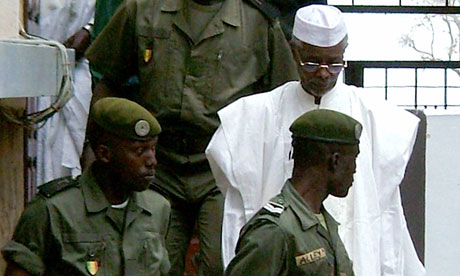
Chad’s former dictator Hissène Habré in court in Dakar. (Photo Courtesy of Ho/AFP/Getty Images)

After four days of deliberations in Dakar, AU and Senegalese government representatives drew a draft agreement on the creation of a special court in Senegal to try Habré.  Such “extraordinary African chambers” shall be incorporated “within the Senegalese court structure,” says Amadou Baal, director of the justice minister’s office.  The chambers will be divided into four sections depending on their functions, namely, instruction, investigations, trials, and appeals. Each chamber will consist of Senegalese and African judges.

Proceedings against Habré are tentatively scheduled to commence by the end of 2012 according to Senegal President Macky Sall. Baal, however, clarified that the proposal is still subject to final approval.

The deal between the AU and Senegal comes a few days after the International Court of Justice (ICJ) at The Hague, Netherlands, ruled unanimously that Senegal must either prosecute the former dictator for war crimes or extradite him “without further delay.”

The ICJ order was a response to Belgium’s request to prosecute Habré.

A lower court in Dakar has already charged Habré in February 2000, but an appeals court overturned this decision on the ground that Senegalese courts lacked jurisdiction to try crimes that were perpetrated in another country. Belgium, citing the decision of the appeals court as a form of procedural delay, brought the matter to the ICJ and sought to have Habré extradited to face charges in Belgium instead.

Habré ruled Chad for 7 years until he was overthrown in 1990. He was then sent into exile in Senegal.

His regime was marked by repression and systematic targeting of ethnic groups such as the Sara, Hadjerai and the Zaghawa. A 1992 truth commission report said that he presided over up to 40,000 political murders and widespread torture of members of these ethnic groups perceived to be a threat to Habré’s government.

Despite these allegations, Habré has been living a quiet life in the suburbs of Dakar as courts and governments have tussled over who should try him for atrocities.

“Senegal made history in 1999 as the first country to join the International Criminal Court, and it could make history again by being the first country to prosecute the human rights crimes of a foreign leader,” said Alioune Tine, president of the African Assembly for the Defense of Human Rights.


For further information, please see:

Huffington Post – Hissene Habré Trial: Senegal, African Union Reach Deal on Trying Ex-Chadian Dictator – 25 July 2012

All Africa – Chad: Agreement on Habré Court – After World Court Ruling, Plan to Try Chad’s Ex-Dictator in Senegal with African Judges – 24 July, 2012

Star Africa – AU, Senegal Agree on Special Court to Try Habré – 24 July 2012

All Africa – Chad: UN World Court Rules Senegal Must Prosecute Ex-Chadian Leader oe Extradite Him – 20 July 2012

BBC – Profile Chad’s Hissene Habré – 20 July 2012

Syrian Revolution Digest – Thursday 26 June 2012

THE COMMENTARY IN THIS PIECE DOES NOT NECESSARILY REFLECT THE VIEWS OF IMPUNITY WATCH.  

*WARNING VIDEOS MAY CONTAIN GRAPHIC IMAGES*

Solution Or Collusion?

A “solution” that keeps Assad in play and the Revolutionaries at bay when it comes to managing the transitional period is not a solution. It’s a collusion. The Revolutionaries get it, and will oppose it.

Thursday July 26, 2012

Today’s Death toll: 200. The Breakdown: 48 in Aleppo, 46 in Damascus and suburbs, 30 in Daraa (including 22 in Wadi Al-Ajami), 27 in Idlib, 21 in Homs, 14 in Deir Ezzor, 6 in Hama, 4 in Raqqah, 2 in Lattakia, 1 in Hassakeh and 1 in Qunaitra.

Cities & Towns Under Shelling: Harasta, Arbeen, Moadamiah, Harran Al-Awameed, Zabadani, Madaya, Eltal, Dmeir, Hameh, Yelda, Rankous, Qarrah(Damascus Suburbs), Sit Zeinab, Al-Qadam, Modan, Al-Hajar Al-Aswad, Yarmouk, Kafar Sousseh, Mazzeh, Qaboun, Barzeh (Damascus City), Daraa City, Khirbet Al-Ghazaleh, Tafas, Bostra Al-Sham, Na’eemah, Mseifrah, Jimreen, Hraak (Daraa), Rastan, Talbisseh, Houla, Tal Kalakh, Al-Qusayr, Al-Hosn, Al-Ghanto, Al-Bouaydah, Old Homs (Homs Province), Hreitan, Elbab, Eizaz, Marei, Bayanoun (Aleppo Province), Haffeh, Jabal Al-Akrad (Lattakia), Deir Ezzor City, Mouhassan, Albou Kamal (Deir Ezzor Province), Kafar Zeiteh, Hawash, Shahshabo, Hama City (Hama Province), Jabal Al-Zawiyeh, Ma’rrat Al-Nouman, Saraqib, Maar Shoureen, Ariha, Kafroumah, Al-Rami, Khan Shaikhoon (Idlib).

News

Op-Eds & Special Reports

Russia and Syria’s Assad: The End of the Affair? It has become clear to many officials in Moscow that the Assad regime cannot restore the pre-rebellion status quo in Syria, forcing them to consider backing away from a longtime client.

Al Qaeda’s War for Syria Now is the time to begin moving against the terror group’s Syrian assets.

Insight: Cautious on Syria, Obama moves to help rebels One of the most telling signs that the administration sees few good options in Syria is the apparent lack of major policy disagreement among Obama’s advisers. “There was more on Egypt and Libya,” a senior administration official said.

As Syrian Troops Pour Into Aleppo, Rebels Warn of Drawn-Out War The Syrian Army is trying to prevent the country’s commercial capital from becoming a base for a rebel offensive against Damascus. Damien McElroy, Adrian Blomfield, and Magdy Samaan report.

After Assad: What’s Next for the Future of Syria? If Syria is allowed to fracture, each ethnic group hunkering down, says Ammar Abdulhamid, an exiled Syria opposition leader in Washington, “it won’t be easy to put humpty dumpty back together again. It would take decades of instability and violence to sort itself out. And that is what we’re most worried about.”

Video Highlights

The following video purport to show clashes between the Syrian and Jordanian armies near Tal Shihab http://youtu.be/HueiEPXCEJ0 The clashes came at the heel of a cross-border shooting by the Syrian army that left a 3-yerl0ld Syrian refugee boy dead. The clashes were confirmed by Al-Jazeerah, but the Jordanian government refuted the report saying the Syrian army fired at refugees who were crossing into Jordan, but no clashes took place.

The pounding of Kafroumah, Idlib province, leaves several dead and wounded, including many children http://youtu.be/r3T4xKxSWoY Trying to rescue the wounded http://youtu.be/ECwHyOv2Geo , http://youtu.be/GXfI9dXFdXA Funeral for four of the dead http://youtu.be/zeiF2vZTsk4

The call for general mobilization made by the Commander of the Military Council of Aleppo, affiliated with FSA, with English subtitleshttp://youtu.be/nZmg0e4kaCo

A video surfaces of Assad celebrating the birthday of his wife’s brother back in August 2011 when his troops were busy committing massacreshttp://youtu.be/lhbYI9WO0zY

Mhardeh, Hama Province: the judge appointed for investigating the Massacre of Qoubair defects and accuses the regime of the massacrehttp://youtu.be/4UcTPQfdMlc

People in the Damascene suburb of Yelda rush to pull bodies from underneath the rubble after the suburb was shelled by helicopter gunshipshttp://youtu.be/CvfhLHljy7Q The dead and wounded include many childrenhttp://youtu.be/NbkaTPcPdRA , http://youtu.be/kX0tEvJi1Bg

The pounding of the town of Dmeir to the North leaves many buildings and shops on fire http://youtu.be/AqhtDOnXJrs

The suburb of Daraya was also heavily pounded by helicoptershttp://youtu.be/dIsaqojh6cM , http://youtu.be/dIsaqojh6cM

In Damascus City, the regime bulldozed parts of Qaboun Neighborhood as a form of collective punishment destroying many homes and shops in the processhttp://youtu.be/AKZFVOm80bo , http://youtu.be/iK5Q3WDrrU0

MIGs still taking part in the pounding in Aleppo Province. This video is from the town of Manbej http://youtu.be/gDzdtaskTh0

A little boy takes his last breaths in Albou Kamal, Deir Ezzor Provincehttp://youtu.be/1mrgx9Sru0Q

In Aleppo City, preparing for battle is not just about establishment checkpoints and barricades, in Sakhour, it’s about collecting garbage and cleaning the neighborhoods: and the fighters are doing the job http://youtu.be/1u9wLwhkdxc ,http://youtu.be/9u1-CbG2mJI

The pounding of Deir Ezor City continues http://youtu.be/k0jLXiJSMVc

Trial of Iraq’s Vice President Delayed

By Mark McMurray
Impunity Watch Reporter, Middle East

BAGHDAD, Iraq — On Tuesday, an Iraqi court postponed the trial of Iraq’s Vice President Tariq al-Hashemi until August 14.

http://www.france24.com/en/20120724-iraq-court-says-president-cannot-testify-vp-case
Vice President Tareq al-Hashemi.  (Photo Courtesy of France 24)

Al-Hashemi, a high-ranking Sunni politician, faces around 150 separate charges.  He is accused of operating death squads along with his staff and bodyguards that targeted Shia officials and pilgrims.  The vice president has denied the wrongdoing and insists the charges filed by the Shia-led government are politically motivated and that he is the victim of a political vendetta by Shia Prime Minister Nouri al-Malik.

The appeals court earlier this week refused the defense’s request to call President Jalal Talabani, an ethnic Kurd, to testify at the trial.  Seeking to have Talabani serve as a character witness with five Sunni legislators and two other government officials, al-Hashemi first filed the request in May.

With the denial of the request to call the witnesses by the lower court hearing the case, al-Hashemi’s defense sought to have Iraq’s federal appeals court overturn the ruling.  The higher court denied the request and instead announced the trial would resume on August 14.   While the defense sought to ask the witnesses if they had any information about al-Hashemi’s role in terror attacks, the three-judge panel rejected the request, believing it  would add nothing to the case.

Muayad Obeid al-Ezzi, head of al-Hashemi’s defense team, spoke shortly after the denial.  “The federal appeals court rejected all of the appeals we filed, and returned the whole case to the [Central Criminal Court of Iraq],” he said.

Additionally, during Tuesday’s session, the court heard from witnesses supporting previous testimony given on May 15, when the trial began.  Five police officers testified that they found pistol silencers during a raid on the homes of al-Hashemi and Ahmed Qahtan, his son-in-law and office manager.   The claims, in addition to testimony from bodyguards and other officials who say they were offered money, or were forced, into carrying out attacks on al-Hashemi’s orders, are contested by the defense.

A woman and her son also testified on Tuesday.  As neighbors of Qahtan, they told the court they saw policemen taking silencers from his house.  Furthermore, testifying this week, one of the more than seventy of al-Hashemi’s guards currently held in custody described to the court how he drove other guards to plant roadside bombs under the orders of the vice president.

Al-Hashemi and several of his bodyguards are being tried in absentia.  In December, after the initial charges were filed, he fled to Iraq’s autonomous Kurdish region before beginning a tour through Qatar, Saudi Arabia and Turkey.  He was last known to be in Turkey where the Turkish government has stated it will not extradite him to Iraq.

For further information, please see:

Al Monitor – Iraqi Government Wants Chevron To Scuttle Contract With Kurds – 25 July 2012

ABC News – Nine Killed in Attacks After Deadly Iraq Day – 24 July 2012

Al Jazeera – Iraqi Vice President’s Trial Postponed – 24 July 2012

France 24 – Iraq Court Says President Cannot Testify in VP Case – 24 July 2012

Fox News – Iraq President’s Testimony Rejected in Trial of Vice President – 24 July 2012

Even a “Big Man” Must Face Justice: Lessons From the Trial of Charles Taylor

Human Rights Watch Special Report


For a questions and answers document on the Charles Taylor trial and judgment, please visit:
http://www.hrw.org/node/106451

To view a special webpage on the Charles Taylor trial, please visit:
http://www.hrw.org/topic/international-justice/charles-taylor

To read a chronology of the Charles Taylor case, please visit:
http://www.hrw.org/news/2012/04/11/prosecutor-v-charles-ghankay-taylor-chronology-case-special-court-sierra-leone

For more Human Rights Watch reporting about the armed conflict in Sierra Leone, please visit:
http://www.hrw.org/node/106424

For more Human Rights Watch reporting about the armed conflict in Liberia, please visit:
http://www.hrw.org/node/106425

For more information, please contact:
In New York, Annie Gell (English): +1-510-541-0843; or +1-212-377-9424; or gella@hrw.org
In New York, Elise Keppler (English): +1-917-687-8576; or +1-212- 216-1249; or kepplee@hrw.org
In Stuttgart, Géraldine Mattioli-Zeltner (French): +49-711-722-300-90; or +49-151-4650-8928 (mobile); or mattiog@hrw.org

SNHR and DCHRS: Female Detainees Without Rights in Syrian Prisons

Bring This Mother Back to her Children:

On 19 May 2011, civilian and military clad personnel from a Syrian Air Force patrol stormed Anna’noo’ Photography Center, located on Ibn Seena Road in the city of Jableh in Lattakia Province.  Four medium-sized men from the patrol dragged away Mrs. Majida Mahmoud who had been working at the center for two years.  She was thrown into their vehicle and taken to an undisclosed location.  There were no female officers accompanying the patrol.  This was the last anybody saw Mrs. Mahmoud before her disappearance, as reported by eyewitness, Mr. (Q. N.).

Majida Adnan Mahmoud was born in the city of Jableh on 14 November 1977.  She resided in Al-Fayd neighborhood and has two children from a previous marriage, the children (Ali ,a 12 year old boy and Nour, a 10 year old girl) currently live with her mother, Safa.

The Syrian regime has forbidden any communication with the Mrs. Mahmoud.  She was kidnapped more than a month ago, and even the appointment of a lawyer, to handle her case and ensure her rights are maintained, has been denied to her.  Further, the regime has also not stated the nature of Mrs. Mahmoud’s charge that lead to her detention.

Nonetheless, female ex-detainees have stated that they bumped into Mrs. Mahmoud in holding cells or interrogation halls and have confirmed she had was arrested for communicating with her relative, Abdulhadi Mahmoud.  He is one of the most wanted men in Jableh city for charges of igniting the revolution and being one of its central leaders and activists.  Additionally, earlier this year the Syrian Aerial Intelligence arrested and detained her brother, Adnan Mahmoud for two months.  Upon his release he exhibited signs of severe and prolonged torture.

Mariam, Majida Mahmoud’s nickname, was transferred to Lattakia after her forced disappearance and later to the capital Damascus, according to the account of eyewitness (S. S.) who met her at the capital prison.  No one in Mariam’s family has been allowed to see her at this point.

Damascus Center for Human Rights and the Syrian Network for Human Rights call on international bodies and organizations to mobilize and press the Syrian regime for the protection of Mrs. Majida and the ensuring of her safe return to her children.  DCHR and SNHR call on these organizations to press for the human rights’ organizations getting access to Mrs. Majida so she can be represented and so the realities of female detainees across Syrian prisons in the Arab world be highlighted for all the world to see.