The International Community has long shifted its focus on Syria from supporting democratic transition to containing an impending “catastrophe,” to borrow Hillary Clinton’s term. But in both cases they remain unsure as to what needs to be done. That lingering uncertainty is exactly why catastrophe is fast becoming a self-fulfilling prophecy.
Saturday July 08, 2012
Today’s Death toll: 60. The Breakdown: 14 in Damascus Suburbs, 12 in Homs, 10 In Daraa, 7 in Deir Ezzor, 6 in Hama, 6 in Idlib and 5 in Aleppo.
Many towns and cities across the country came under heavy pounding today, including:
Karak, Yadoudeh, Sheikh Miskeen, Ghabaghib, Bosra, Maarabha, Izraa, Mseifrah, Ghariyeh and Daraa City (Daraa Province), Deir Jammal, Eizaz, Hreitan and Anadan(Aleppo Province), Deir Ezzor City and Mayadeen (Deir Ezzor Province), Homs city, Houla, Rastan, Qusayr, Tal Kalakh and Talbisseh (Homs Province), Douma, Jisreen, Diyabiyeh Misraba and Madaya (Damascus Suburbs), Hama City and Sahel Al-Ghab(Hama Province), Khan Shaikhoon (Idlib Province).
The Scenario: A national unity government is agreed under the presidency of a Sunni figurehead. Assad is out, but rather than going to Russia, he goes to Lattakia where he is the undisputed leader of an ethnically cleansed Alawite-majority enclave, and still in charge from behind the scenes of manipulating the national army and security apparatuses which remain for years to come under Alawite control. Kurdish enclaves are granted autonomy, and the rest of the country is held together by a Sunni Arab-majority government. FSA groups are gradually reintegrated into the regular army.
This it seems the current scenario being thrust upon us. There myriad problems with this scenario, but the most important one is the fact that events on the ground are moving too fast for it. This scenario requires a lot of micromanagement, but no party, domestic, regional or international is well-positioned or equipped to do it effectively. This is why Russia wants Iran to be onboard, but even their combined efforts cannot stand the test of unfolding realities.
Assad’s recent interview with Germany’s ARD TV provides us with few revealing gems that should help dispel some illusions, if only international leaders and experts are willing to listen.
On the infamous Houla Massacre
When asked directly about the killing of more than 100 civilians in the Syrian village of Houla in May, he blamed it on gangs who “came in hundreds from outside the city.”
This is the second time Assad has had a chance to tell us about the identity of the victims. But neither in his speech that took place after the massacre nor in this interview did Assad claim that the victims of Houla were Alawites or recent convert to Shi’ism. As such, we must in all fairness dismiss such claims as blatantly false and stand by the initial reports and eyewitness accounts, supported by videos and satellite photography, that putt eh blame clearly on pro-Assad militias. The Massacre of Houla came as part of an ethnic cleansing campaign aimed at Sunni inhabitants in key locations that Assad and his supporters want to transform into an Alawite majority enclave as part of their Plan B in dealing with the current situation.
Reform vs. Freedom
Assad said a “majority of the people ask for reforms, political reforms (but) not freedom.”
This particular pearl of wisdom should be quoted in each standard textbook on political science, political philosophy and psychology. This is exactly the kind of wisdom for which Assad should be remembered for eternity. That’s the sum total of his heritage.
On Stepping Down
He stressed that he still had the overall support of Syria’s people,firmly ruling out stepping down. “The president shouldn’t run away from challenge and we have a national challenge now in Syria,” he said.
There it is then: Assad has no plans to step down voluntarily, and the Russians want him to be part of the political transition process. What does that mean really? Political solution without military muscle will not be possible in Syria. It’s as simple and plain as that.
On dialogue
While he said he was ready for political dialogue with the opposition, Assad left no doubt that he would fight those his government perceives as terrorists. “But as long as you have terrorism and as long as the dialogue didn’t work, you have to fight the terrorism. You cannot keep just making dialogue while they are killing your people and your army,” he said.
The ethnic cleansing of Syria has already begun, warns Dall’Oglio. But he insists that it is a project of the Assad government, not an objective of the Sunni-led guerrilla forces that have inspired such misgivings among Christians and other Syrian minorities, including Assad’s Alawite sect, an offshoot of Shiite Islam.
“The regime is already acting in the logic of division of the country,” says Dall’Oglio, citing rumors of contingency plans for an Alawite-run rump state carved from the Mediterranean shore to the Orontes River. “What do you do with most of the Sunni population? They have started to kill them, massively.”
“After a couple hours of talking, they said without saying that SOF teams (presumably from US, UK, France, Jordan, Turkey) are already on the ground focused on recce [i.e. reconnaissance] missions and training opposition forces… They have been told to prepare contingencies and be ready to act within 2-3 months, but they still stress that this is all being done as contingency planning, not as a move toward escalation.” They then discuss the option of an air campaign in Syria and what its objectives would be, saying the situation “makes Libya look like a piece of cake” because of the geography and Syria’s robust air defenses. “The main base they would use is Cyprus, hands down. Brits and French would fly out of there. They kept stressing how much is stored at Cyprus and how much recce comes out of there… There still seems to be a lot of confusion over what a military intervention involving an air campaign would be designed to achieve.”
“He says there are in Syria about 3,000 IRGC men and 2,000 HZ fighters, in addition to 300 Amal Movement men [i.e. Lebanese Resistance Detachments] and 200 [Syrian National Socialist Party] militiamen. The IRGC men are leading the pro-regime armed gangs. Syrian soldiers who refuse to open fire on protesters are killed by the Iranians and pro-Syrian Lebanese allies. The Iranians and Lebanese usually stand behind Syrian troops and kill Syrian soldiers immediately if they refuse to open fire. The 17 Syrian troops dumped in the Orontes River in Hama were killed by HZ men.”
The former director of the security firm Blackwater aided the Libyan opposition and was subsequently sent to contact Syrian rebels in Turkey at the request of a U.S. Government committee, according to published Stratfor emails and reported by Al-Akhbar English.
Video Highlights
This leaked video from a defector shows the aftermath of an attack that he filmed before defecting. It was an attack by a local resistance unit on a pro-Assad military facility that left 48 loyalists dead. The attack is said to have taken place on June 28 in Iz Ma’areen Village in Hama Province http://youtu.be/5qwhIpUeT2o
Local resistance groups in the town of Anadan, Aleppo Province, take possession of a cannon that was used by pro-Assad militias in pounding their townhttp://youtu.be/embeLcpC4Os
In Hreitan, Aleppo Province, an Islamic local resistance group clash with invading pro-Assad columns http://youtu.be/PWUwt5Yg85Y
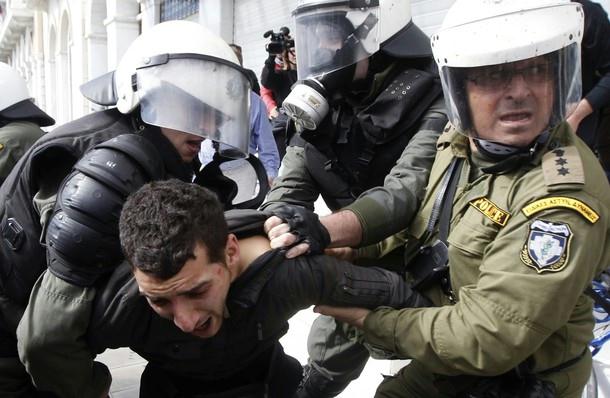
ATHENS, Greece – The Greek government’s failure to acknowledge the widespread cases of police brutality in Greece has led to the routine use of excessive force, including the use of chemical sprays and stun grenades, on peaceful demonstrators, migrants, asylum-seekers, and members of other vulnerable groups.
Greek police arresting a demonstrator. (Photo courtesy of Cryptome)
A case study done by Amnesty International detailed the amount of mal-treatment, physical abuse, and even torture that protestors and migrants have suffered at the hands of police. The report also listed the brutal methods that the police use during peaceful demonstrations, which includes using tear gas and other types of chemical weapons.
In one case, a protestor was hit by a police motorbike during a demonstration in central Athens. She suffered serious head injuries, a fractured collarbone, and fractured ribs as a result of the collision. A doctor, also a participant in the demonstration, was beaten by the police with batons when he tried to provide medical aid to the woman.
Such brutality continues to exist mainly due to the lack of investigation, prosecution, and punishment in these types of cases.
Greek authorities have minimized the issue of police brutality, claiming that while such cases do exist, they are rare and isolated. As a result, authorities have refused to adequately address the issue. Investigations, if launched, are often conducted with biases. Authorities have even denied victims prompt medical care and access to lawyers.
Amnesty International stated that the government’s lack of response led to the creation of a “climate of impunity.”
The lack of identification is a common obstacle to prosecuting and punishing those that engage in police violence. Demonstrators, especially those who have been severely beaten and gassed, often have a hard time in making out the identification number of the offending officers. Even if the protestor can see clearly after enduring the gas and pain, the identification numbers are still difficult to find because they have been strategically placed, if at all, on the back of the officers’ helmets.
Being unable to provide any identification numbers makes reporting an abusive officer virtually impossible. Other reasons why many cases go unreported are either lack of faith that reporting would bring any change, or, as in the case of illegal immigrants and asylum-seekers, fear of retribution.
Although Greek police have not issued a response to Amnesty International’s report, Greece’s new justice minister, Antonis Roupakiotis, called on prosecutors to address the issue of police brutality.
“Justice officials must investigate incidents of police violence rapidly and effectively without the long and dubious procedural delays that reinforce a sense of impunity,” Roupakiotis told a newspaper.
BAMAKO, Mali – School closures in Mali have increased the vulnerability for children making them susceptible to violence or recruitment as a child soldier. The increased violence in Mali has caused families to be torn apart. The age of the child soldiers are reported to be as young as 12 years old.
Since January, the fighting has displaced some 95,000 people within Mali and has forced more than 100,000 to flee (Photo Courtesy of All Africa).
Hassan Toure, a citizen of Mali, has stated that he chose to stay in Mali because he owns a shop there and wanted to prevent the shop from being destroyed or looted. But in March, Toure’s eldest son never returned home and is missing to this day.
While some children have been recruited as child soldiers, some girls also as young as 12, have been kidnapped and raped. In addition, UNICEF is fearful that 560,000 children are at risk for malnutrition this year with 220,000 needing a more involved treatment. Already, 70,000 children have already been treated for malnutrition in Mali this year.
Around 330,000 people have fled their homes in Mali, a fifth of them being children. Many of these people have fled to neighboring countries due to the fighting taking place in Mali.
As of April, the rebels in Mali have announced a new state called Azawad and are fighting with the help of the weapons from Libya. The group fighting for the separate state of Azawad calls themselves the Movement for the National Liberation of Azawad (MNLA) and have been known to use child soldiers.
A separate group in Mali fighting against the MNLA, the Movement for Unity and Jihad in West Africa (MUJAO), have also been using child soldiers. M’Bera, a refugee camp, is where many Malian citizens have gone to get away from the instability.
M’Bera is located in Mauritania and is now considered the fourth largest town in Mauritania. Security has become an issue, the Mauritanian government is reacting by providing free military escorts to aid workers. This is to prevent the same situation that occurred in Dadaab where aid workers were being kidnapped.
Other problems also remain with the availability of resources such as food, water, and firewood. The refugee population is now greater than the local population. The resources are depleted to a point where the humanitarian standard for providing 20 liters of water per person has been diminished to 10 liters per person, per day.
Solutions discussed include dispersing the people of Mali with the use of local hospitality of neighboring countries and people.
DHAKA, Bangladesh — On July 4, 2012, Human Rights Watch (HRW) published a report stating that detainees being held for their involvement in the 2009 government mutiny in Bangladesh were suffering from serious human rights abuses at the hands of Bangladesh’s special police force, the Rapid Action Battalion (RAB).
Members of the Rapid Action Battalion, Bangladesh's elite police force, suspected of various human rights violations. (Photo Courtesy of Reuters)
Nearly 3,000 paramilitary border guards are on trial for a 2009 mutiny which killed 74 people including 57 military commanders.
Thousands have already been found guilty of involvement in the mutiny in mass military trials. They face jail sentences for up to seven years and those who are also convicted of killing, rape or arson await the death penalty.
During the February 25-26, 2009 mutiny, Bangladeshi paramilitary border guards attacked force headquarters in Dhaka and spread their attack to surrounding towns. The mutiny occurred two months after the election of Prime Minister Sheikh Hasina. Hasina initially offered amnesty to the mutineers to end the rebellion but rescinded his offer when dozens of bodies were found in sewers and mass graves.
Following the revolt, the army and other security organizations detained thousands of suspects.
HRW reported that at least 47 of the paramilitary border guards awaiting mass trials for their alleged involvement in the 2009 mutiny have died from maltreatment while those that remain have been tortured through beatings or electric shock.
Brad Adams, HRW’s Asia director, Brad Adams, called the trial process “fundamentally flawed” and stated that suspects were being interrogated in secret locations. HRW calls for the Bangladesh government to establish an independent task force to address the human rights abuses and to close all secret, unofficial interrogation locations.
HRW claims that torture is in widespread use throughout the governmental forces of Bangladesh including the country’s army, special police force, and main intelligence agency.
HRW’s report refers to Bangladesh’s RAB as a “death squad” resulting from their suspected involvement in the human rights’ abuses. By May of this year, HRW stated that almost 200 people had died in RAB operations since early 2009 from extrajudicial killings or torture.
The RAB has called the HRW report’s allegations baseless and the Bangladesh government denies all allegations of torture or extrajudicial killings.
On July 6, the Ministry of Home Affairs charged HRW with conspiring against Bangladesh. They also demanded that the HRW withdraw the report which they deemed unfair “meddling in the internal affairs of a country.”
The Bangladeshi government states that the trial is being held in a “fair and transparent manner” and that the accused are enjoying full legal support.
According to the Asian Human Rights Commission, the Bangladesh government plans to arrest members of human rights organizations and activists who were suspected of providing information for the HRW report. The government plans to charge these activists with treason and sedition among other criminal charges.
The Bangladesh government hopes that the mass military trials will be completed by the end of the year.
CANBERRA, Australia — For the twenty-fifth time in the last month, another boatload of asylum seekers arrived on Australian soil Saturday hoping to find refuge.
Greens Senator Sarah Hanson-Young urges Australia to share the refugee burden with Indonesia or more asylum seekers could be forced to risk their lives. (Photo Courtesy of The Sydney Morning Herald)
A total of 32 Sri Lankans, including one girl, were intercepted on their small fishing vessel and taken to Christmas Island. According to The Australian newspaper, the island has roughly 1,400 asylum seekers in detention facilities. But the recent surge has the government scrambling to transfer many of them to detention centers on the mainland.
It is also calling into question Australia’s policies on refugees.
“The turn-back-the-boats option is what wee need if we are going to discourage reckless behaviour by people-smugglers and their clients,” said Opposition Leader Tony Abbott in The Australian, affirming his commitment to force asylum-seekers back to Indonesia despite warnings that the policy is dangerous and potentially illegal.
Many in the opposition party blamed Prime Minister Julia Gillard, who they said refused to restore border protection policies.
“Two years ago [Friday], Julia Gillard promised she would break the people smugglers’ business model by building an offshore processing centre on East Timor,” said Scott Morrison, an opposition immigration spokesperson, in a statement.
“Since that time, she has overseen the largest number of illegal boat arrivals under any prime minister, with 206 boats and over 13,600 people arriving on her watch.”
Saturday’s arrival capped a week that saw more than 200 refugees make it to Australia. On Thursday, the Navy picked up 162 Middle Easterners after they sent a distress signal 50 nautical miles offshore. On Friday, 38 Iraqis and four Indonesians were transferred to Christmas Island after their asylum boat was intercepted a week earlier.
“[The perception is that] everyday we’re being flooded by boat people who are cheating the system,” said Kon Karapanagiotidis, head of the Asylum Seeker Resource Centre in Australia.
“Everyday the news is reporting another boat has arrived and another boat has arrived,” he added. “It’s feeding this idea that we’re being flooded.”
Karapanagiotidis said that makes it easy to turn asylum seekers into “scapegoats” and a “political football” without any compassion or understanding for why they are refugees in the first place.
A recent report by the United Nations Commissioner for Refugees identified “a time of rising anti-refugee sentiment in many industrialized” countries. According to the report, European countries on the Mediterranean Sea saw an 87 percent increase in asylum requests in 2011 compared to the previous year, due in large part to the Arab uprisings at that time. Australia and New Zealand actually saw a nine percent decrease in 2011.
But as more asylum seekers flock to Australia now, some say the only way to stop the rush of refugees is to be more willing to help.
On Friday, Greens Senator Sarah Hanson-Young warned that more people might be forced to risk their lives on boat trips to Christmas Island unless Australia agrees to share more of the regional asylum burden with Indonesia.
“There is a very real concern from those working on the ground,” she told The Saturday Age, “that unless there is a lot of work put into the relationship, Indonesia is going to get tougher on the asylum seekers and refuges who are here and make life even more unbearable for them, which is going to force people onto boats.”
“Unless we deal with that, there’s no way of stopping people from taking that dangerous journey,” she added.
Her comments came after two days of meetings with asylum seekers, non-government bodies, and Indonesian officials, according to the Sydney Morning Herald. Unlike the government and opposition, the Greens’ prefer a regional approach that would see Australia take more refugees from countries such as Indonesia and Malaysia.
“The ALP and the Coalition accuse the Greens of not understanding this issue and being naive,” she said, “but the real naivety is thinking that pushing people anywhere else but Australia will stop them from coming [here].”