A Tribute to Two Brave Paramedics: Mahmoud Al-Ahmad and Mus’ab Bard

Mahmoud Al-Ahmad’s Story: A Paramedic of Hama City

Paramedic, Mahmoud Al-Ahmad, locally known “Abu Hussein” was one of the most prominent paramedic among the volunteers who aided the wounded in the city of Hama.  He was born in Hama in 1985.  He leaves behind, a young child, a girl less than one year old.
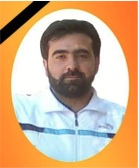
Since the early days of the Syrian revolution, Abu Hussein took to the street as both a protester and a paramedic.  On 3 June 2012, the “Children of Freedom’s” Friday, he received a gunshot that penetrated his chest.  For treatment, he was transported to a makeshift hospital where he was treated and remained through recovery.  He then returned to Hama as an avid activist.

He was persistent and worked hard, founding a makeshift hospital in the Mashaa Al-Arba’een neighbourhood, which was targeted by the Syrian regime’s army.  This neighbourhood had the largest number of the wounded in the city of Hama during the regime’s army offensive.

Abu Hussein treated and aided hundreds of the wounded in the city of Hama.  All locals speak highly of his good morals, loyalty and the invaluable aid he provided.

Abu Hussein documented, using a personal camera, the wounded whom he aided.  He did so to show the world the crimes against humanity committed by the Syrian regime.  The following are examples taken out of scores of videos he recorded in the makeshift hospital.  SNHR and DCHRS have the original copies of these videos that have been uploaded to YouTube.

The footage below shows the wounded in the Al-Hamedya makeshift hospital, where they are supervised and receive treatment from Abu Hussein.

On 20 June 2012, the Syrian regime’s army and security forces launched an offensive on Hama city; they shelled the city continually for three days and isolated it from the whole world using a media and communications blackout.  Numerous citizens fell victims and many more were wounded.  Abu Hussein hurried to aid the wounded.  While he was treating one of the victims a mortar shell, fired by the regime’s forces, hit them and killed Mahmoud along with the four citizens who were accompanying him while he treated the wounded.
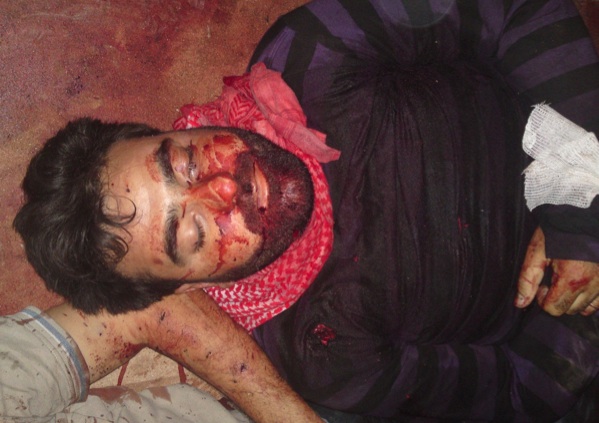
In the video below, the location of the body of Abu Hussein, the paramedic of Hama, is shown. The heroic efforts he provided to the injured of Hama are un-matched.


Mus’ab Bard’s Story: A Doctor and Paramedic

Doctor and paramedic Mus’ab Bard, was tortured to death by regime forces for aiding civilians.  He was the epitome of a medical hero.
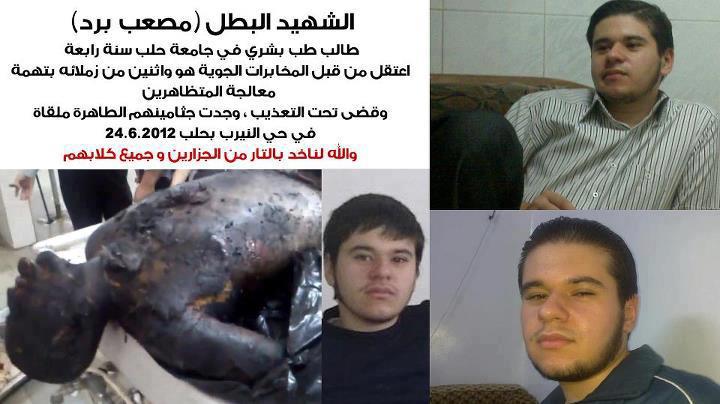
Pictures of Mus'ab Bard before his death and his body following torture by Syrian regime forces.

Mus’ab Bard (1 January, 1992 – 14 June, 2012) was born in Teftenaz, Idleb, Syria.  He was a student in the Faculty of Medicine, at Aleppo University.  He came from an eight person family.  He had three brothers (one is a doctor, the other an engineer, and the third a pharmacist), and two sisters (both are attending school). Mus’ab was always one of the finest students, garnering high achievements and the best grades, both in high school and in his first two years at the University.  However, even more noticeable were his strong morals and values that were present in all his actions.

The young doctor became a part of the Syrian revolution protests in the city of Aleppo.  He was also a member on a paramedic team that gave treatment and aid to the wounded.  Mus’ab was detained in one of the protests on 6 September, 2011.  It began as the funeral procession of Ibrahim Salqeeni, a respected scholar in Aleppo, who was poisoned by the Assad regime, according to his family.  Mus’ab was detained for a month for the crime of attending the funeral and videographing it.  After Mus’ab was released, he stopped attending protests and began a new task:  aiding the wounded and rescuing the injured.

Once Musa’b took upon this new task he worked around the clock, serving the cause of helping humanity.  He traveled with a small bag containing very basic and humble instruments to aid him in his work.  He had many supporters and was well known by dozens of Syrian activist for this noble role which he acquired during the revolution.

On Sunday, the 17th of June, the Syrian regime’s Air Force Intelligence detained Mus’ab and two of his class mates, Basel Aslan and Hazem Batteek.  The three were all returned dead one week later on Sunday the 24 of June.  Their bodies clearly showed that they had been tortured and were badly burned.  Mus’ab’s brother had difficulty identifying him due to the severity of the burns extending even to his hair.  The doctors confirmed that Mus’ab had been tortured and burned to death.  A bullet hole was also found on his body that indicated that the bullet had passed completely through his body.

Thousands of people held a funeral procession for the murdered medical students in Saif Addawla, Aleppo.  The video below shows the procession.

The video below shows the burned bodies of the three medical students inside the coroner’s office.

**WARNING: THE VIDEO BELOW CONTAINS GRAPHIC IMAGES**

Mus’ab’s body was later tranported to Teftenaz, his birthplace, where he was buried.


All information, videos, and photos in this report provided by:
Syrian Network for Human Rights

A Call to Action: Save Douma Before it Becomes Another Baba Amr

The Syrian regime’s army troops and security forces raided the city of Douma after fiercely shelling and bombarding it with helicopters. Therefore, the Free Syrian Army members and more than 95 % of its residents fled the city after scores of residents were killed with continual fierce shelling. On Thursday, 28 of June 2012, the Syrian regime’s army took the lives of 71 citizens in the city of Douma.

It is worth mentioning that the regime’s forces and pro-regime shabeeha militias raided the two makeshift hospitals in Al-Jalaa Street.  Volunteer doctors and paramedics fled to save their lives, leaving behind scores of wounded citizens including at least 8 in critical situations.  There are still some nurses providing aid in makeshift hospitals.  However, there are grave concerns that the regime’s forces may extra judicially execute the wounded, mimicking the actions taken in Baba Amr.  There, after seizing control of the makeshift hospitals, the regime’s army quickly executed the wounded receiving care.

After leaving the air in Baba Amr filled with the stench of death and the streets and sidewalks littered with bodies, regime forces ensured that any survivors would be unable to go for help by cutting the town off from the rest of the world.  Telecommunications, electricity and water were disconnected by regime forces, who surrounded the town, prohibiting anyone from leaving or entering.  They also  denied access for humanitarian aid, including provisions of food and medicine.

The Damascus Centre for Human Rights Studies and the Syrian Network for Human Rights have verified that regime forces are systematically attempting to wipe the city of Douma off the face of the earth, killing innocent citizens and looting their homes.  A new deployment of military reinforcements arrived in the town a short while ago, and a child was found stabbed by regime forces next to the Heseibeh Mosque.  Regime’s forces are clearly intent on continuing their siege on the town, and if international actors do not intervene swiftly, Douma will become another Baba Amr situation.

SNHR & DCHRS demand the international community and the UN Security Council to fulfill their responsibilities and bring the regime’s perpetrations in the city of Douma to light by making a swift decision to make the announcement that Douma is an inflicted city.  It is also requested that UN countries swiftly set up humanitarian corridors to transport the wounded, women children and men to places of safety.  SNHR & DCHRS hold the Syrian regime fully and directly responsible for all acts of killing, looting and rape, repercussions and consequences thereof.


All information contained in this report provided by:

Syrian Network for Human Rights

UK Authorities Refused Russian Mutual Legal Assistance Request in Magnitsky Posthumous Prosecution Case

Press Release
Hermitage Capital

2 July 2012 – The Russian Interior Ministry reported this morning that the UK authorities had refused their mutual legal assistance request in the case of posthumous prosecution of late whistle-blowing lawyer Sergei Magnitsky and in-absentia prosecution of his client William Browder who is campaigning for targeted visa and financial sanctions on the Russian government officials involved in the false arrest, torture and in-custody murder of Magnitsky.

In spite of the refusal from the UK to cooperate in this high-profile matter, the Russian Interior  Ministry stated their intention to move the first-in-history posthumous case to trial, saying they see no “legal” obstacle to it.

The UK refusal to execute the Russia’s mutual legal assistance request was issued by the UK State Secretary on national security grounds.

The Russian Interior Ministry announced the UK refusal of mutual legal assistance to Russia on the official website this morning, saying:

“UK competent bodies replied to us: The UK can not provide the requested legal assistance, because the State Secretary considers that the execution of the request is likely to prejudice the sovereignty, security, public order or other essential interests of the UK.”

The refusal by the UK of Russia’s legal assistance request was issued under the 1959 European Convention on Mutual Legal Assistance in Criminal Matters (http://conventions.coe.int/Treaty/en/Treaties/html/030.htm), to which both the UK and Russia are parties, which provides for the refusal of requests if they are likely to prejudice security, public order and essential national interests.

The Russian Interior Ministry further said in their official announcement:

“Nevertheless, in accordance with Russian judicial norms, this fact [the refusal of mutual legal assistance] does not pose an obstacle for sending the case to court, because Russian investigators have followed juridical formalities in full.”

The posthumous prosecution of Sergei Magnitsky was launched on orders from Viktor Grin, Russia’s Deputy General Prosecutor, on 30 July 2011, three days after the U.S. State Department announced visa bans on Russian officials associated with Magnitsky’s death, which include Viktor Grin himself. Prosecutor Grin is No 33 on the U.S. Helsinki Commission list of those involved in persecution of Magnitsky and corruption he had uncovered.

In spite of 30 complaints from the Magnitsky family and calls from Amnesty International and members of the Council of Europe and the European Union, Russian courts and government bodies have the posthumous prosecution of Sergei Magnitsky.

Conclusions from the Russian Human Rights Council of gross violations of human rights and breaches of the European Human Rights Convention in the Magnitsky case have been rejected by the Russian General Prosecutor’s Office. Russian Interior Ministry Officers involved in the false arrest, torture and death of Mr Magnitsky have been promoted and decorated with state honours.


For further information please contact:

Hermitage Capital
Phone:             +44 207 440 17 77
E-mail:             info@lawandorderinrussia.org
Website:          http://lawandorderinrussia.org
Facebook:        http://on.fb.me/hvIuVI
Twitter:            @KatieFisher__
Livejournal:      http://hermitagecap.livejournal.com/

Libya Releases International Criminal Court Officials Accused of Espionage

By Ali Al-Bassam
Impunity Watch Reporter, Middle East

TRIPOLI, Libya — Australian lawyer Melinda Taylor and her three colleagues from the International Criminal Court (ICC) were released this Monday after being detained in Libya for nearly a month.  The ICC sent them to Zintan to prepare Seif Al-Islam Gaddafi’s defense.  They have been held there since June 7, after Taylor and Helene Assaf, a Lebanese translator, were accused of smuggling documents and hidden recording devices to Al-Islam.  The group’s two male members, Alexander Khodakov, a Russian, and Esteban Peralta, a Spaniard, chose to stay with Taylor and Assaf out of solidarity.

Assaf and Taylor
Helen Assaf (L) and Melinda Taylor attended a news conference after their release. (Photo Courtesy of the Guardian)

The Zintani militia released the four members as a “humanitarian” gesture after ICC President Sang-Hyun Song traveled to Zintan on Monday and apologized to the Libyan government.

“I wish to apologise for the difficulties which arose due to this series of events. In carrying out of its duties, [the ICC] has no intention to compromise the national security of Libya,” Song said in a news conference held on Monday.  Last week, the ICC promised to investigate any claims of wrongdoing and to apply “appropriate sanctions” if necessary.

Taylor and Assaf met with Song after the news conference over lunch.  When asked by the Guardian about whether she was now free to go home, Taylor said, “I don’t know.  I think so.”  The four then met with ambassadors from their respective countries at a Tripoli military airport on Monday evening and boarded an Italian plane headed for Europe.

Friends and family of Taylor refused to comment during her detention, but they insisted that she was a respected professional lawyer who would not have done anything improper.  They suggested that the espionage accusations made by the Zintani militia were the result of a misunderstanding about the role and prerogatives of a western-style defense lawyer.

The four ICC members were sent to Zintan last month on an official mission to speak to Al-Islam about his defense rights.  Al-Islam, who was considered to be the heir apparent to his father, former Libyan dictator Muammar Gaddafi, was captured by the Zintan militia last November while he attempted to flee the country.  The ICC wants to try Al-Islam at The Hague, but Libyan officials refuse to extradite him, as they would prefer to try him in their own courts instead.

Both the ICC and the Libyan government pledged to work together for the trial of Al-Islam.  Mohammed Abdel Aziz, Libya’s Deputy Foreign Minister, told reporters at the news conference, “The agreement is that there would be a continuation of the negotiations with the ICC.”

Judicial experts believe Al-Islam is unlikely to have a fair trial in Libya.  They also feel that the detainment of ICC officials highlights the tasks ahead for the interim government in imposing its authority on militias who helped topple Gaddafi and are now vying for power.

Libyan Authorities expect Taylor to return to the country to hear her final ruling on July 23.  A senior member of the Libyan Attorney General’s office commented, “[w]e expect them to come back for the hearing, but if they don’t, a ruling will be made in absentia.”

For further information, please see:

Al Jazeera — Libya Releases Detained ICC Staff — 2 July 2012

BBC News — Libya: ICC Staff Held in Zintan Released — 2 July 2012

Guardian — Libya Frees International Criminal Court Legal Team Accused of Spying — 2 July 2012

Reuters — Libya Frees Detained ICC Staff After Apology — 2 July 2012

Timbuktu Desecrated by Radical Islamists

By Ryan Aliman
Impunity Watch Reporter, Africa

BAMAKO, Mali – Considered one of the centers from which Islam spread through Africa in the 15th and 16th centuries, Timbuktu may be counting its last days of existence as armed men raze the fabled city.


Radical Islamists tearing down a shrine in Timbuktu. (Photo Courtesy of AFP)

The attack came from radical Islamists from the Al- Qaeda linked Ansar Dine (Defenders of Faith). The campaign began after UNESCO declared the site an endangered World Heritage Site. Carrying chisels and hoes, the attackers smashed four more tombs of Muslim saints in the face of the International Criminal Court’s (ICC) warning that the destruction of sites such as Timbuktu constituted a war crime.

On Saturday the group destroyed the tombs of Sidi Mahmoud, Sidi Moctar and Alpha Moya, and on Sunday attacked four more including Cheikh el-Kebir’s mausoleum.

Yaya Tandina, a local journalist said that about 30 men, armed with Kalashnikovs and pickaxes destroyed three mausoleums of saints.

Witnesses say that the group targeted the 15th-century Sidi Yahya mosque on Monday, tearing off the entrance door.  The door is considered sacred and was to remain closed until the end of the world.

Ansar Dine says the shrines are idolatrous and have threatened to destroy any mosques housing the remains of the ancient saints.

When asked about the outpouring of anger and emotion over the destruction of the mausolea, Ansar Dine spokesman Sanda Ould Boumama said, “It is Islam which is good,”.”God is unique. All of this is haram (forbidden in Islam). We are all Muslims. UNESCO is what?” Boumama said.

He said the group was acting in the name of God and would “destroy every mausoleum in the city. All of them, without exception”.

The Islamist fighters from Ansar Dine are among the Al-Qaeda linked armed groups which occupied the north of Mali in the chaos that emerged after the March coup in Bamako.

On Sunday, International Criminal Court prosecutor Fatou Bensouda warned the perpetrators that destruction of such sites constituted a war crime.

“My message to those involved in these criminal acts is clear: stop the destruction of the religious buildings now,” the ICC Prosecutor told AFP.

Bensouda said that Mali was signatory to the Rome Statute which established the ICC. Article 8 of the statute states that deliberate attacks against undefended civilian buildings which are not military objectives constitute a war crime.

“This includes attacks against historical monuments as well as destruction of buildings dedicated to religion,” said Bensouda.

United Nations Secretary-General Ban Ki-moon deplored the destruction of tombs, with his spokesman Martin Nesirky quoting him as saying: “Such attacks against cultural heritage sites are totally unjustified.”

Nesirky added: “The Secretary-General calls on all parties to exercise their responsibility to preserve the cultural heritage of Mali.”

Ban also reiterated his support for ongoing efforts of the Economic Community of West African States (ECOWAS), the African Union and countries in the region to “help the government and people of Mali resolve the current crisis through dialogue.”


For further information, please see:

The Australian – Destruction of Mali Tombs a War Crime – 3 July 2012

Al Jazeera – ICC Threatens Mali Islamists with War Crimes – 2 July 2012

All Africa – Liberia: Is Setting Up a War Crimes Court in Liberia Timely?  – 2 July 2012

Voice of America – Mali Says Rebel Tomb Desecration a War Crime – 2 July 2012

The Telegraph – Timbuktu Shrine Destruction ‘a war crime’ – 2 July 2012

Capital FM News – Timbuktu Shrine Destruction a ‘war crime’: ICC – 2 July 2012

Channel News Asia – Timbuktu Shrine Destruction a ‘war crime’: ICC Prosecutor – 2 July 2012