New President of Paraguay Fails to Receive Foreign Recognition

By Heba Girgis
Impunity Watch Reporter, South America

ASUNCION, Paraguay — Paraguay’s now formerly ousted President Fernando Lugo has accused the country’s Congress of a “parliamentary coup d’etat” in order to force him out of power. Lugo, 61, said he would accept the decision in the name of peace but also made the following statement: “Lugo has not been dismissed; democracy has been dismissed. They have not respected the popular will.”

Newly Appointed President Fredrico Franco Sworn in on Friday. (Photo Courtesy of The Washington Post)

Friday, June 22, Fredrico Franco, the former vice president of Paraguay, was sworn in as the new president after the legislature voted to dismiss Lugo, who they said failed to fulfill his duties to maintain social harmony in the country. While Paraguay has long been ranked as one of the most corrupt countries in South America, Lugo was found to be indecisive in the face of the country’s challenges with corruption and drug trafficking.

Shortly before midnight on Sunday, June 24, Lugo made an appearance at a local demonstration where he told his supporters that his Presidency was targeted because he tried to offer support and aid to Paraguay’s poor majority.

Lugo’s impeachment and trial sparked after clashes during a recent land eviction resulted in 17 deaths of both police and land peasant farmers. Critics of the impeachment process in Paraguay argued, however, that Mr. Lugo’s lawyers only had a few hours to defend him in the Senate, after which Franco was quickly sworn in to the position.

When asked whether this decision thwarted the democratic setup of the government, new President Franco replied, “there was no break with democracy here. The transition of power through political trial is established in the national constitution.”

The Inter-American Human Rights Commission addressed its own concerns with the ousting of former President Lugo. Santiago Canton, the commission’s executive secretary noted, “It’s a travesty of justice and a trampling on the rule of law to remove a president in 24 hours without guarantees of due process.”

Argentinian President, Cristina Kirchner, took a firm stand saying that her country “will not validate this coup d’etat,” while the Brazilian government took a similar view that Lugo’s impeachment was “a rupture of the democratic order in Paraguay” that “compromises a fundamental pillar of democracy, an essential condition for regional integration.” Germany is the only foreign government to recognize the new leadership in Paraguay.

In order to restore its full democratic order, Paraguay now looks to its powerful neighbors for support with its new internal reform.


For further information, please see:

EIN News – Neighbors Protest as Paraguay Impeaches President – 25 June 2012

The Washington Post – Paraguay’s Lugo Says Parallel Govt Seeks to Regain Power; New Leader Rejects Region’s Response – 25 June 2012

Merco Press – Franco: “No Coup, a Change of Leadership”; Germany Admits New Government – 24 June 2012

The Telegraph – Paraguay’s Ousted Leader Fernando Lugo Denounces ‘Coup’ – 24 June 2012

Notes From India: Rural Health Care Facilities

Courtney Schuster
Special Contributor, Blog Entry #3

My most recent adventure was being assigned to a fact-finding team that was given the assignment of inspecting rural health facilities.    We were sent to the very rural, and very poor state of Bihar to examine how health facilities complied with the National Rural Health Mission (NRHM) standards.  The federal government instituted the NRHM in 2006.  It set the standards for care and operations at government health facilities.  Additionally, it established dozens of requirements for health facilities including: the number of staff that should be at a facility at any given time; drugs that should be present; the number of beds each facility should have; and basic medical hygiene that should be provided.

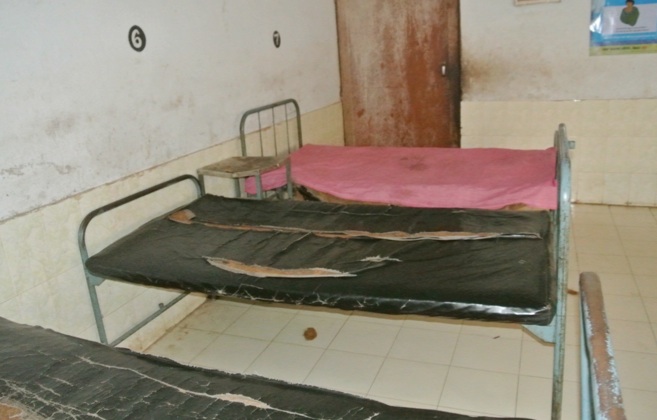
The fact-finding team spent a week in Bihar traveling to five districts and looking at twenty-five different health facilities.  The medical equipment and beds that these facilities had were mostly old and very rusted.  In every single facility we visited, there were numerous concerns that went far beyond the superficial issues like rusting bed frames.

The beds of the women's ward, where patients go after giving birth.

First, every facility had a layer of dirt on the floor.  Government facilities cannot afford to have air conditioning so they depend on windows and fans to cool the place.  Unfortunately, open doors and windows also mean that the dust and dirt get in and covers every surface.  There are no regular cleaning staff employed at any of the facilities, save the few large district hospitals; and even in those, the method of cleaning is simply sweeping with a grass broom, which is ineffective and unsanitary.

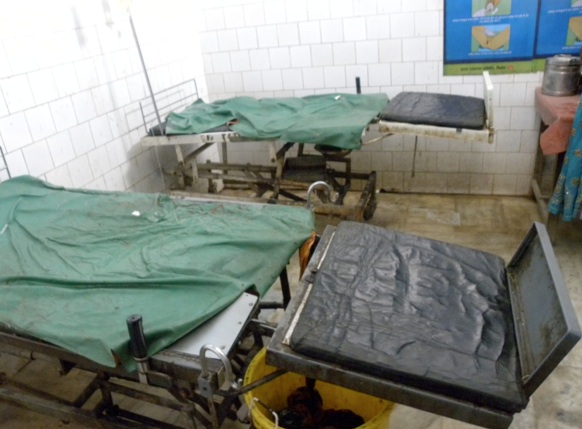
Second, poor cleanliness of supplies, bedding, and buildings is prevalent.  In every room, of every facility, the floors, and often times walls, were covered in old blood stains.  Sheets were also old and stained.  There were beds and operating tables without any sheets at all.  Medical supplies were not sterilized between uses.  Many of the larger health facilities had running water but none had the means to heat water or an autoclave.  A majority of the facilities we saw in rural areas did not even have running water.

A delivery room, in the yellow bucket is medical waste from a delivery a few hours earlier.

Third, unsafe medical waste disposal and poor garbage disposal was the norm.  Inside the facilities, used medical supplies littered the floors.  Medical waste, including blood and fluids, from births and operations were not disposed of in a proper or timely manner.  Most facilities threw delivery fluids, like after birth and the placenta, out the window.  At one center, a birth had taken place five hours before our arrival.  As we began our tour, that delivery room was still waiting to be cleaned.

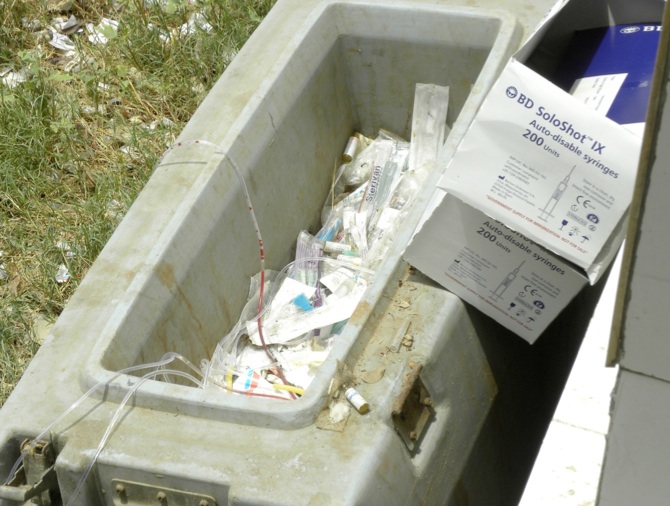
The perimeter of each facility was much worse.  Every one we visited had garbage covering the lawns.  There were water drainage ditches outside buildings full of garbage, medical waste, and sometimes even human waste.  The more rural and remote health facilities had animal feces from cattle, goats, and sheep on the ground outside and on the steps leading into the building.   Old vials, used needles, blood soaked material, used gloves, and plastic packaging were littered everywhere.  Many facilities had people, including children, waiting outside right next to the medical waste.

Medical waste is tossed into an old cooler sitting outside one of the medical facilities.

I left Bihar stunned and dismayed at the unsanitary conditions and poor management of every health facility we visited.  None of them were consistent with the NRHM standards and it became clear to me why India continue to struggles with high maternal mortality rates.


Courtney Schuster is a third-year student at Syracuse University College of Law.  She is currently working as an intern in India for the summer.  She will be contributing personal blog entries throughout her internship, documenting the challenges of solving human rights issues in international settings.  

Chinese Authorities Bar Artist’s Attendance in Courtroom

By Karen Diep
Impunity Watch, Asia

BEIJING, China -Wednesday, Chinese authorities prevented artist Ai Weiwei from attending his company’s first court hearing against Beijing tax authorities.  According to Weiwei, they proffered no explanation.

Weiwei denied court access. (Photo Courtesy of NY Times)

“This society has become a scary and dangerous one now, because there are too many things that violate people’s rights and that happen with no explanation,” stated Weiwei.

Despite police officers’ attempts to bar many Weiwei supporters from leaving their homes, hundreds were still able to rally outside the Chaoyang District Court.

In 2011, Chinese authorities detained Weiwei for three months.  In addition, the government sanctioned Weiwei’s design company, Beijing Fake Cultural Development Ltd., to a 15M yuan ($2.35M) fine for back taxes.  Weiwei’s wife and legal representative, Lu Qing, has spearheaded an appeal on behalf of the company against the fine.  Qing has also filed a separate action alleging witness and evidence mishandling by the tax bureau.

Through his work and political activism, the 54-year-old artist has earned the reverence of most in both the political and artistic communities outside of China.  The Art Review deemed Weiwei the most powerful artist in the world.

“Ai’s activities have allowed artists to move away from the idea that they work within a privileged zone limited by the walls of a gallery or museum.  They have reminded his colleagues and the world at large of the fact that freedom of expression is a basic right of any human being.”

Political activists and other Weiwei supporters purport that a direct correlation exists between his punishment and his criticism of the Chinese government.

Since his release, the authorities have forbidden Weiwei to travel outside of China.  Moreover, Weiwei is under steady surveillance.

“They didn’t return my passport, I just realized that,” Weiwei said.  “And they didn’t return my computers. You know, because for subversion of state power, they want to try to find every trace. But they can’t find anything, I guess. I mean, they owe me to say sorry. But of course they would never do it. It’s over, but it’s never totally over. You are still not allowed to go abroad.”

In addition to the pending litigation, Weiwei may face other charges: pornography, bigamy, and illicit exchange of foreign currency.  However, there is no certainty whether the authorities will pursue these suspected crimes.

Despite authorities’ alleged attempts to stop or at least deter criticism directed at them, Weiwei continues to fight his censure through banned social networks such as Twitter.


For further information, please see:

NPR-Ai Weiwei Says He is Barred From Leaving China– 21 June 2012

Voice of America-Ai Weiwei: Still Can’t Leave China– 21 June 2012

Guardian-Ai Weiwei barred from court hearing by Chinese police– 20 June 2012

New York Times- Chinese Artist Is Barred From His Own Hearing-20 June 2012

Bastrykin Apologizes for Making Threats to Decapitate Russian Journalist

By Connie Hong
Impunity Watch Reporter, Europe

MOSCOW, Russia – Alexander Bastrykin, Russia’s chief of the Investigative Committee, issued a public apology to Sergei Sokolov after making death threats to the Novaya Gazeta journalist.  In an off-the-record meeting with several editors from the Moscow media, Bastrykin apologized for being overly emotional during his confrontation with Sokolov.

Sergei Sokolov
Sergei Sokolov, deputy editor of Novaya Gazeta. (Photo Courtesy of Committee to Protect Journalists)

Sokolov, the deputy editor-in-chief of Novaya Gazeta first received fire from Bastrykin after writing an article accusing the Investigative Committee and its chief for aiding crime bosses.  The article was written in response to the light sentences served against members of the Kushchyovskaya gang, which murdered 12 people, including small children, in 2011.  Amongst those sentences that Sokolov heavily criticized was the one imposed on local legislator Sergei Tsepovyaz.  Tsepovyaz, a brother of a gang member, was only ordered to pay a fine of 150,000 rubles ($4,570) after the court found him guilty of destroying evidence of a gasoline purchase.  The gasoline had been used by gang members to burn down the victims’ home.

Bastrykin was infuriated after reading the article, and quickly acted to invite Sokolov to a conference in Nalchik.  Sokolov received the death threat on the return trip to Moscow.  According to Muratov’s open letter to Bastrykin, Sokolov was taken to a forest near Moscow in a car.  There, Bastrykin ordered his bodyguards to leave before “rudely” threatening Sokolov’s life, adding jokingly that he would personally investigate Sokolov’s murder.  Sokolov fled the country shortly after telling a colleague that Bastrykin threatened to cut his head and legs off.

Bastrykin’s apology comes after the International Federation of Journalists (IFJ) and the European Federation of Journalists (EFJ)’s criticism.  Both groups supported Muratov and his demand for a public explanation, and urged Russian authorities to investigate the threats.

Sokolov and Muratov had both accepted Bastrykin’s apology.  While some have applauded the Investigator Committee chief, others have expressed disappointment in Novaya Gazeta’s response.

“It is now forbidden to take Sergei Sokolov out in the woods and threaten to do away with him, but it’s OK to do that to other journalists.  Because as of today it’s not even a crime, just a bit of rudeness.  That is Dmitry Muratov’s gift to the journalistic community that only yesterday took to the streets for him,” wrote Masha Gessen, editor of the travel magazine Vokrug Sveta.

While Bastrykin’s apology did not change the dangerous conditions of Russian journalists, it most certainly answered Novaya Gazeta’s demands for Sokolov’s safety.  Sokolov returned to Moscow on June 19 after Bastrykin apologized to him personally.


For further information, please see:

The Economist — Publish and be Threatened: A Revealing Tale of a Journalist and a Top Policeman — 23 June 2012

Bloomberg — What to Do When Russia’s Top Cop Threatens to Behead You — 20 June 2012

The Moscow Times — Bastrykin Ate His Words — 19 June 2012

International Federation of Journalists — IFJ and EFJ Slam Head of Russian Investigative Committee over Threats to Senior Journalist — 14 June 2012

Syrian Revolution Digest – Sunday 24 June 2012

THE COMMENTARY IN THIS PIECE DOES NOT NECESSARILY REFLECT THE VIEWS OF IMPUNITY WATCH.  

*WARNING VIDEOS MAY CONTAIN GRAPHIC IMAGES*

Paper-Tigers & Wimps!

They talk tough but remain missing in action: Turkish and Western leaders better spare us their sympathy is it don’t come with an action plan that can stop Assad NOW.

Sunday June 24, 2012

The average daily death toll is now close to 150, and the worst is yet to come, with more pro-Assad militias perpetrating more and more massacres, selling more and more towns throughout the country.

News

The circumstances of the deaths were not immediately clear, with the state-run news agency saying at least 25 men were killed. In the video — which The Associated Press could not independently verify — the narrator said the victims were members of the “shabiha,” or pro-regime gunmen… It was not clear whether the men were killed execution-style or died in clashes. An activist in the area, Mohammed Saeed, said rebels regularly collect the bodies of the dead from the government side and dump them by the side of the road so troops can collect them later.

Op-Eds & Special Reports

More coverage of AEI Event on Syria, June 18, 2012

“The country is being partitioned.  Waiting will allow for the partitioning to actually take effect.  There will be repercussions that will be felt in Lebanon, in Iraq, in Jordan, in Turkey and perhaps even in Israel as well,” Syrian pro-democracy activist Ammar Abdulhamid said. (Video)

Turkey – A Paper Tiger on the Mediterranean

After making so many on promises on Syria, like vowing not to allow Hama, only to stand and watch the retaking of Hama, and the endless slaughter that followed and to watch on helplessly as Assad troops pursued refugees even inside Turkey’s borders, the downing of a Turkish fighter jet by Assad’s air defenses, mostly likely operated under guidance of Russian experts, and Erdogan’s confused reaction to the matter serve only to consolidate the emerging image of Turkey as nothing more than a paper tiger.

With its continued reliance on Iranian gas supplies, continued problems between the political and military leaderships, and continued inability to effectively address its Kurdish Question, not to mention its Alevi Question the mere enunciation of which remains a taboo, the image of a regional powerhouse that Turkey has been to project over the last few years seem highly exaggerated. Turkey is simply not ready, politically, economically, or militarily, to be a serious player on the regional scene, consideration of Turkish pride notwithstanding. Her leaders are advised to reflect this reality in their pronouncements to avoid having more egg on their faces, and to avoid the continued embarrassment of having to appear nothing more than mustachioed wimps even when confronted by the region’s lankiest and weakest link: Bashar Al-Assad.

U.S. Policy on Syria – another example of wimpishness in action

The interview below with Secretaries Clinton and Baker outline the current U.S. policy on Syria. At the heart of the policy is he continued preoccupation with Iran’s nuclear ambitions, and the belief that Russia can help find a solution for this, hence the unwillingness to anger Russians over Syria and the push for so-called political transition with Nicaragua rather than Yemen providing the model for that. But with no talk of serious enforcement mechanisms, any talk of political solutions risks going in the same direction of the Arab League and Annan plans, and will only buy Assad more time to keep killing and ensuring the de facto partition of the country.

Interview With Charlie Rose of “Conversations on Diplomacy”
Hillary Rodham Clinton Secretary of State, Former Secretary of State James A. Baker III 
Benjamin Franklin Room
Washington, DCJune 20, 2012

SECRETARY CLINTON: On Syria, so far they’ve taken Russia’s lead on Syria. But we’re working on that every single day as well.

MR. ROSE: Why did they do that? Why do they take Russia’s lead?

SECRETARY CLINTON: Well, I think both Russia and China have a very strong aversion to interference in internal affairs.

MR. ROSE: Sovereignty issue.

SECRETARY CLINTON: Yes.

SECRETARY BAKER: Yeah.

SECRETARY CLINTON: And so for the Russians, we – I was with President Obama in Mexico two days ago. We had a two-hour meeting with President Putin. They’re just – they don’t want anything to do with it. They find it quite threatening, and basically they reject it out of hand. So anything that smacks of interference for the Russians and for the Chinese, they presume against. There are other reasons, but that’s the principal objection that they make.

MR. ROSE: Would coming – both different countries and different points, but they somehow come together on these issues – Syria and with respect to Russia and the role they are playing.

SECRETARY BAKER: Yeah, yeah.

MR. ROSE: And the role that the United States is playing and the role that the region can play. What should we be doing and what is the risk of not doing?

SECRETARY BAKER: Well, I’ll answer that in just a minute. But first let me say if we’re going to have differences with Russia – and we do have some differences with Russia – it seems to me the most important difference we might have is with respect to Iran. And we don’t have that now, and that’s really important. And I don’t think we ought to create a problem with Russia vis-a-vis what we want to do in Iran about their nuclear ambitions as a result of something we might do in Syria. I just think the Iranian issue there is far more important really than how we resolve the Syrian issue.

How should we resolve the Syrian issue? I think we should continue to support a political transition in the government in Syria. But I don’t – but I think we ought to support it diplomatically, politically, and economically in every way that we can, but we should be very leery, extremely leery, about being drawn in to any kind of a military confrontation or exercise.

MR. ROSE: Does that include supplying them with arms?

SECRETARY BAKER: That – well, that’s a slippery slope. The fact of the matter is a lot of our allies are already supplying them with arms. Okay? It’s not something –

MR. ROSE: And our friends in the region.

SECRETARY BAKER: Well, I say our allies in the region. Yeah, they’re doing it. And it’s not something we have to do. I look at Syria and I think why are we not calling for something that we – this is – it may not be the right comparison, but in 1989, when we came into office, the wars in Central America were the holy grail of the left, political left in this country, and the holy grail of the political right in this country. We said if we can take these wars out of domestic politics, we can cure the foreign policy problem, and we did.

How did we do it? We put it to both parties – Daniel Ortega, the hardline, authoritarian dictator, if you will, in Nicaragua, and to Violeta Chamorro, the opposition candidate. We said if you’ll hold an election and both agree to abide by the results, that’s the way we’ll get out of this conundrum. That’s what happened. And both of them did agree, finally, to abide by the results. Ortega lost. President Carter was very instrumental in getting him to leave office. Why don’t we try something like that in Syria, I mean, and say look, political transition is what we’re looking for. Everybody – even the Russians, I think – would have difficulty saying no, we’re not going to go for an election, particularly if you let Bashar run. Let him run. Make sure you have a lot of observers in there. Make sure they can’t fix the election. Why not try that?

MR. ROSE: Why not try that?

SECRETARY CLINTON: Well, actually, that is the path that we are trying. And I spoke with Kofi Annan again today. He is working on a political transition roadmap. We are somewhat disadvantaged by the fact that I think Assad still believes he can crush what he considers to be an illegitimate rebellion against his authority and characterizes everyone who opposes him as a terrorist who is supported by foreign interests. He’s not yet at the point where he understands his legitimacy is gone and he is on a downward slope.

The other problem we have is that the opposition has not yet congealed around a figure or even a group that can command the respect and attention internally within Syria as well as internationally. So what we’re doing is, number one, putting more economic pressure, because that is important, and the sanctions and trying to cut off the Syrian regime, and send a message to the Syrian business class, which so far has stuck with Assad.

We’re also working very hard to try to prop up and better organize the opposition. We’ve spent a lot of time on that. It still is a work in progress. We are also pushing hard on having Kofi Annan lay down a political transition roadmap and then getting a group of nations, that would include Russia, in a working group to try to sell that to both the Assad regime and to the opposition .

So, I mean, the path forward is exactly as Jim has described it. Getting the people and the interests on that path has been what we’ve been working on now for several months.

MR. ROSE: Who would be in that group other than the United States, Russia? Who else?

SECRETARY CLINTON: Well, you would have to have the Arab League because Kofi Annan is a joint envoy of both the UN and the Arab League. You would have to have the permanent members of the Security Council because that’s who he represents in his UN role. And you’d have to have the neighbors. You’ve got to have Turkey involved because of their long border and their very clear interests. But when I spoke with him today, he’s going to be making another proposal to the Russians, the Turks, and other interested groups to try to get them to agree on this roadmap and then a meeting, in effect to go public with it, so that we can increase the pressure not only on the Assad regime but on the opposition as well.

MR. ROSE: Is there a role for Iran?

SECRETARY CLINTON: At this point, it would be very difficult for Iran to be initially involved. I mean, I’m a big believer in talking to people when you can and trying to solve problems when you can. But right now, we’re focused on dealing with Iran and the nuclear portfolio. That has to be our focus. Iran’s always trying to get us to talk about anything else except their nuclear program.

And then we also have the added problem that Iran is not just supporting Assad, they are helping him to devise and execute the very plans that he is following to suppress, oppress the opposition.

SECRETARY BAKER: If you get the – you’re going to get the attention of the Russians and the Chinese, in my view, in the Security Council if you come with some sort of a proposal for a political transition that might involve an election, if you’re willing to say anybody and everybody can run. That means, of course, you got to make sure that the election is not fixed. But that would put a lot of pressure – the only reason I mention this, it seems to be that would put a lot of pressure on the Russians to support this idea.

With respect to Iran, I agree with the Secretary. This is not the place to involve them. However, I would think there might be a place for them in a group with respect to Afghanistan. They helped us when we first went in there. We talked to them. They were helpful.