
Senator McCain Calls Upon President Obama to Apply Aggressive New Sanctions Designed to Combat Terrorism to the Russian Organized Crime Group Who Murdered Sergei Magnitsky
Press Release
Hermitage Capital
26 June 2012 – Today U.S. Senator John McCain called on President Obama to invoke Executive Order 13581 against the Klyuev Organized Crime Group in Russia connected to the murder of whistle-blowing lawyer Sergei Magnitsky. Executive Order 13581 was signed by President Obama in July last year and allows the President to “proscribe” organized crime groups using the same tools that the US Government currently uses against terrorist organizations.
“I write to you today to request that you begin a process to determine whether to designate and impose sanctions, under the Executive Order 13581, against a dangerous transnational criminal organization known as the “Klyuev Group ,” said Senator McCain in the letter.
“Public information, much of it uncovered by Mr. Magnitsky himself before his arrest in Russia in 2008, suggests that the Klyuev Group has colluded with senior Russian officials to engage in bribery, fraud, embezzlement, company thefts, and other serious financial crimes…Activities of the Klyuev Group appear to put the U.S. and international financial systems at serious risk of abuse,” said Senator McCain.
Designating the Klyuev Organized Crime Group (“KOCG”) as a significant criminal organisation posing a US national security threat means that all assets and property of any member of the KOCG will be blocked, and no US person is allowed to do business with them, or with anyone who does business with them anywhere in the world.
According to independent investigations, the KOCG is a major Russian criminal organization that has been involved in fraud, murder, international money laundering, as well as financing and supplies to the Mexican Sinaloa drug cartel and weapons trafficking involving North Korea and Iran (http://www.canberratimes.com.au/national/inside-the-shell-drugs-arms-and-tax-scams-20110514-1enkz.html).
In spite of numerous filings with Russian law enforcement agencies, the KOCG’s operations continue within Russia unrestrained which lead to the group being referred to as the “untouchables”.
The KOCG came to prominence when they were exposed for stealing $230 million from the Russian treasury and torturing and then killing anti-corruption lawyer Sergei Magnitsky.
The KOCG involves members of the criminal gangs from former Soviet Union, ranking members of the Russian secret service, police, judges, and tax officials, and has international connections to illicit networks and shell companies in Panama, Moldova, Cyprus, Latvia, Switzerland, UK, and New Zealand.
According to a new investigative video, “The Magnitsky Files” and filings in various jurisdictions, the Klyuev Group is extremely powerful and has embezzled and laundered around $800 million through the international banking system and is reported to be responsible for violent crimes, kidnapping, extortion and deaths.
The significance of proscribing the KOCG is that anyone lending any type of support or assistance or financing to it will be subject to the same kind of U.S. sanctions.
“Basically, applying this executive order to the Klyuev crime group would put them in the same category as Al-Qaeda. It is an extremely strong measure and will seriously curtail their criminal business,” said a Hermitage Capital spokesman.
Senator John McCain has requested President Obama to use the presidential powers under the Executive Order 13581 which is designed specifically to curtail the activities of significant criminal organisations whose operations are inter-twined with foreign governments.
“Such organizations are becoming increasingly sophisticated and dangerous to the United States; they are increasingly entrenched in the operations of foreign governments and the international financial system, thereby weakening democratic institutions, degrading the rule of law, and undermining economic markets,” says the U.S President’s Executive Order Executive Order 13581.
Sergei Magnitsky, a 37-year old Russian lawyer who was investigating the money laundering by the KOCG, was falsely arrested, tortured and killed in police custody two and a half years ago. His killers have not been brought to justice in Russia.
The Executive Order 13581 was signed by U.S. President Barak Obama on July 24, 2011 to address “the activities of significant transnational criminal organizations” posing national threat.
The term “significant transnational criminal organization” means a group of persons, that
- includes one or more foreign persons;
- engages in an ongoing pattern of serious criminal activity involving the jurisdictions of at least two foreign states; and
- threatens the national security, foreign policy, or economy of the United States.
For further information please contact:
Hermitage Capital
Phone: +44 207 440 17 77
E-mail: info@lawandorderinrussia.org
Website: http://lawandorderinrussia.org
Facebook: http://on.fb.me/hvIuVI
Twitter: @KatieFisher__
Livejournal: http://hermitagecap.livejournal.com/
33 Syrian Officers, Including General and 2 Colonels, Defect to Turkey
By Ali Al-Bassam
Impunity Watch Reporter, Middle East
ANKARA, Turkey — Thirty-three members of Syria’s military defected into Turkey on Sunday night. They were part of some two hundred people who crossed between the Syrian-Turkish border into the Hatay Province. Turkey’s state-run Andalou news agency said the group included a general and two colonels, but a government official claimed that there was no general among the group, only three colonels. Despite this, the official, who spoke on the condition of anonymity, did not know the overall number of those who crossed into Turkey. Andalou also reported that the group of defectors was placed in a refugee camp in Hatay. Turkey now hosts 33,000 Syrian refugees who have crossed into the country since the revolt against Al-Assad began 16 months ago.

The recent defections have increased the number of generals within Turkey since the revolution began to thirteen. The generals now give logistical support to the Free Syrian Army, even though Turkey denies that they are arming the rebels. Thousands of soldiers have also abandoned the Syrian regime, but most of them are low-level conscripts. So far, there is no evidence that their defections have negatively affected the Syrian military’s ability to fight.
Two days prior to the defections, a Turkish aircraft was shot down by Syrian forces who claim that it had violated their airspace. Bulent Arinc, Turkey’s Deputy Prime Minister, said that “all options are on the table” for Turkey’s response. Earlier on Monday, Jihad Makdissi, Syria’s Foreign Ministry Spokesman, said that “[t]he Turkish warplane violated Syrian airspace, and in turn Syrian air defences fired back and the plane crashed inside Syrian territorial waters.” Turkey claims that the plane was in international airspace, and that the plane was on a training flight to test Turkey’s radar capabilities. Turkey also insists that it was not spying on Syria.
Turkey has summoned a meeting with NATO for Tuesday to agree on a response to the downing of its aircraft. European Union members in Luxembourg requested a calm response from Turkey, saying that they would increase pressure on Assad. On Monday, EU spokesman Maja Kocijanci said that the EU decided to add another Syrian official and six firms and government institutions to its sanctions list, which already includes 120 individuals and nearly 50 entities.
Analysts believe it is unlikely that Turkey will take immediate military action against Syria. Cagri Erhan, a professor of political science at Ankara University, said “I don’t think Turkey’s response will be a military one. War is not one of the options. Turkey will act in line with measures taken within NATO.”
“I’m not of the opinion that Turkey will immediately respond militarily,” agreed Beril Dedeoglu of Galatasaray University. “But if there is another action, then there will certainly be a military response, there is no doubt.”
For further information, please see:
Anadolu Agency — Thirty-three Syrian Army Defectors Fled to Turkey — 25 June 2012
Al Jazeera — Turkish Cabinet Meets to Discuss Syria Crisis — 25 June 2012
BBC News — Syria General and two Colonels ‘Defect to Turkey’ — 25 June 2012
Gulf News — 33 Syria Military Members Defect to Turkey — 25 June 2012
Reuters — Syrian Officers Defect, Turkey Looks to NATO — 25 June 2012
Syrian Revolution Digest – Sunday 24 June 2012 Part II
THE COMMENTARY IN THIS PIECE DOES NOT NECESSARILY REFLECT THE VIEWS OF IMPUNITY WATCH.
*WARNING VIDEOS MAY CONTAIN GRAPHIC IMAGES*
On the Road (4)!
The official statement by the White House on the downing of a Turkish jet by Assad air defenses promised that the U.S. will “work with Turkey and other partners to hold the Assad regime accountable.” Let’s see to what further inefficient and laughable policies this promise will engender on Tuesday when NATO is scheduled to meet. Because after 16 months of stupidity, hypocrisy and inefficiency, I do not dare expect anything from international policymakers except more of the same. Of course, that’s what all can expect from us as well, because we are not planning on giving up.
Sunday June 24, 2012
Clashes are now taking place on a regular basis in towns and communities across Syria, including Homs, Idlib, Hama, Aleppo, Deir Ezzor, Daraa and Damascus Suburbs. The average daily death toll is around 150. Recourse to helicopter gunships and heavy artillery by pro-Assad troops and militias continues to be a routine occurrence.
News
Op-Eds & Special Reports
What Russia Gave Syria A guide to Bashar al-Assad’s arsenal.
“The Wounded Will Be Killed” An American photojournalist describes what he saw during the month he spent in a Syrian village under siege. The Martyrdom of Al QusayrImages from photojournalist Robert King’s recent visit to a Syrian community under siege.
Video Highlights
Shelling in Maarbah, Daraa http://youtu.be/naX791iSjKU Daraa City, Daraahttp://youtu.be/a5WlwtikWno Al-Hraak, Daraa – a dead child is mourned by his motherhttp://youtu.be/Btlb1jzbLXY Talbisseh, Homs http://youtu.be/jLDD9CBXGLI Rastan, Homs http://youtu.be/0MHax97PwrU The mangled bodies of the localshttp://youtu.be/gyZDrMovU24 Homs City http://youtu.be/M_Brv5q0pBI ,http://youtu.be/ZxBIoGzwzTY Deir Ezzor City http://youtu.be/BRQhTC_pTM8 Ariha, Idlib http://youtu.be/qatXgmCmd08 Hass, Idlib a tank takes part in the poundinghttp://youtu.be/tFSdnrsUZx8
Western Leaders Invited to Inspect Zimbabwe’s “Blood Diamond” Fields
By Tara Pistorese
Impunity Watch Reporter, Africa
HARARE, Zimbabwe—Zimbabwean authorities, including security forces and the national army, have recently been accused of beating, torturing, and killing diamond miners in the Marange fields, approximately 250 miles east of Harare.
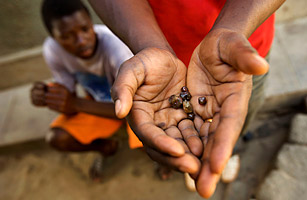
Four diamond companies are currently operating in Marange. One such company, Marange Resources, says it can produce a minimum of 200,000 carats per month between its three plants. This further supports an expert theory that Marange may be the largest diamond discovery in generations.
One of the most heavily criticized companies, Anjin, maintains a 50-50 partnership with DMC, another diamond company. Military and police officers make up a large portion of Anjin’s leadership board.
According to Global Witness (GW), one of the first non-governmental organizations to expose the international trade in blood diamonds, Anjin’s internal structure creates opportunities for “off-budget funding of the security sector” and “a real risk of these revenues being used to finance violence during a future election.”
After reports surfaced that diamond companies in the area may be assisting President Mugabe to suppress political opponents, the United States, Great Britain, and other countries imposed sanctions.
“It was actually quite shocking that sanctions would be slapped on us even though we are fully compliant by the Kimberley Process,” said Ramzi Malik, project manager for DMC. “So for us we just continue doing our business and doing our thing, and that is the end of it.”
The “Kimberley Process” (KP), an agreement between the UN, the EU, the World Diamond Council, and seventy-five countries and interest groups, requires the close supervision of rough stones in order to ensure legitimate mining and sales activities.
Lately, KP’s failure to implement a system for independent verification has initiated controversy over the system’s effectiveness. Pursuant to this perceived gap, members are still unsure where the diamonds originated or whether the proceeds are used to finance violence or abusive regimes.
As a result, GW has pulled out of KP; however, China and India’s participation in the diamond market has remedied any would-be surplus of diamonds.
President Mugabe and his allies are pushing to have the sanctions lifted. In an effort to put human rights abuse reports to rest, the Zimbabwean government has invited Western ambassadors to tour the controversial fields. The two-day mission will begin on Tuesday.
For further information, please see:
All Africa—Zimbabwe: EU Diplomats Set to Visit Marange Diamond Fields—24 June 2012
Voice of America—Zimbabwe Diamond Policy Won’t Improve Accountability in Marange—22 June 2012
Voice of America—Diplomats to Tour Controversial Zimbabwe Fields—19 June 2012
Human Rights Watch—Zimbabwe: Diamond Abuses Show Need for Reforms—4 June 2012
World Press—Blood Diamonds—15 April 2012
CNN—Inside Zimbabwe’s Controversial Marange Diamond Field—16 March 2012