Bangladesh Refuses Entry to Myanmar Refugees

By Jenna Furman
Impunity Watch Reporter, Asia

DHAKA, Bangladesh—Despite pleas from the United Nations and countries such as the United States, the Bangladesh Government has refused to grant assylum to recent Rohingya Muslim refugees escaping sectarian violence in Myanmar.

Rohingya Muslims fleeing sectarian violence in Myanmar. (Photo Courtesy of LA Times)

“It is not in our interest that new refugees come from Myanmar,” Dipu Moni, the Bangladeshi Foreign Minister, stated at the capital, Dhaka, on Tuesday.

Border guards turned back an estimated 1,500 Rohingya refugees over the weekend after further violence broke out between the minority Rohingya Muslims and the majority Rakhine Buddhists.

Dipu Moni also cited a strain on resources as a reason for turning back boats traveling across the Naf river to the Bangladeshi border. Bangladesh already houses around 30,000 Rohingya Muslim refugees in two camps in Cox’s Bazaar.

Human Rights Watch refugee program director Bill Frelick stated,“Bangladesh has an obligation under international law to keep its border open to people fleeing threats to their lives.”

The UN refugee agency reported that boats transporting women, children and some wounded have been turned back even within reach  of locals trying  to give assistance to the refugees. The agency indicated that the refugees are in need of food and medical care.

However, Bangladesh emphasized that the Myanmar and Bangladeshi governments are trying to “to ensure that developments in the Rakhine state do not have any trans-boundary spillover.”

Still, thousands of people have been displaced as a result of the fighting thought to have been sparked last month by the rape and murder of a Rakhine Buddhist woman followed by an attack on a bus carrying Rohingya Muslims, which left 10 people dead. Twenty-nine people are estimated to have died and many homes have been burnt to the ground in the western Rakhine region.

Myanmar President Thein Sein declared a state of emergency after rioting began a little over week ago in the town of Maung Daw which spread to the capital, Sittwe, and other nearby villages. The violence highlights the delicate nature of the relations between ethnic groups in Myanmar.

The Rohingya have been deemed a “stateless” group by both Myanmar and Bangladesh. Myanmar views the Rohingya as illegal immigrants from Bangladesh and denies them citizenship while Bangladesh argues that the Rohingya have lived in Myanmar for centuries and should be recognized as citizens.

According to The United Nations, Myanmar’s 800,000 Rohingya Muslims are one of the most persecuted minorities in the world.

For further information, please see:

NY Daily News – Violence Highlights Myanmar’s Sectarian Tension –  16 June 2012

Aljazeera – Bangladesh ‘Turns Back’ Myanmar Refugees – 15 June 2012

BBC News – UN Urges Bangladesh to Take in People Fleeing Burma Violence – 15 June 2012

Los Angeles Times – Bangladesh Rebuffs Pleas to Admit People Fleeing Myanmar Violence – 13 June 2012
Syrian Revolution Digest – Wednesday 20 June 2012

THE COMMENTARY IN THIS PIECE DOES NOT NECESSARILY REFLECT THE VIEWS OF IMPUNITY WATCH.  

*WARNING VIDEOS MAY CONTAIN GRAPHIC IMAGES*

Updates from the Road (2)!

Notes From India: Prisoner Realities and Additional Challenges for Inmates With Disabilities

Emily Schneider
Special Contributor, Blog Entry #2

“I’ve never seen so many men fighting before,” said a young attorney, who sat across the desk from me and the rest of our group of five.  She was just returning from a walk-through, of another part of the prison, which we were all visiting that day and describing her experience.

“While we were standing there, speaking with a supervisor, one of the men started to punch another.  One had a razor, or a piece of wire, and cut the other; there was so much blood.  Soon after, all the guards rushed in and grabbed the man who started the fight.  They beat him repeatedly, on the face, the arms, and stomach. When he finally fell down they picked him up and carried him off.”

My supervisor asked where they took the man who instigated the fight.

“We asked one of the prisoners what would happen to him and he told us the guards would put him in solitary confinement for a few days and then release him back into the large cell with the group,” she replied

After hearing this story, we all sat there in disbelief.  My supervisor explained to me that they were familiar with the reality that guards habitually beat inmates but had never seen it firsthand. This time the HRLN attorneys witnessed such a beating and might be able to use the experience to file a petition for a public interest litigation (PIL).

“After things calmed down, we asked the guard giving us the tour of the jail what normal procedure was for incidents like this.  His response was that we, “Just saw it.”  He also mentioned that the guards at this particular jail are specially trained in calming prisoners down.  Sometimes they are even sent to other facilities, including the women’s jail, to enforce peace.

I asked him why there would be a need to send male guards to the women’s jail as the female guards stationed at them are supposed to enforce the peace.  He looked right at me and said, “Yes, but there are some things a man is needed for.”  I think he knew right away that he had said too much because he didn’t answer the rest of our questions.

It was my second week working at HRLN and I was in a meeting for the disability rights initiative.  The woman speaking was a young attorney who was assigned to the disability department.  She and two other attorneys were investigating torture and cruel treatment of prisoners with disabilities in jail.  When I first joined the disability rights initiative I was a bit disappointed; I was hoping to be assigned to the anti-trafficking or reproductive rights departments.  Disability law was something I could do in the U.S. and I was looking for new experiences at HRLN.

However, India’s treatment of persons with disabilities is so atrocious that the issues tackled by the disability rights initiative at HRLN are not even remotely similar to the problems facing people with disabilities in the United States.  In India, there is nothing in the government system that is designed to provide any form of aid to these people.

My research of Indian law, found that almost no provisions are given to support, or provide, for persons with disabilities in any sector.  There is no help for them in obtaining: education, employment, transportation, and juvenile justice legislation.  Instead, persons with disabilities are treated as second class citizens and are denied equal access to employment, education and housing.  Worse, some are placed in substandard institutions for the rest of their lives.

HRLN takes on high-impact public interest litigation cases to try and change the standard for persons living with disabilities and bring the domestic laws of India up to general international standards, and to achieve compliance with the UN Convention on Rights of Persons with Disabilities.

The lack of provisions for persons with disabilities in daily aspects of life is disheartening itself, but when persons with disabilities are denied care during incarceration, a whole new set of problems arises.  In a recent case, adopted by HRLN, a physically handicapped prisoner was put in a large cell with other inmates where he was expected to share a single toilet and shower facility.  He could not walk the length of the cell to the toilet, nor could he stand up to use the facilities if he was lucky enough to get to them.  Instead, he was forced to defecate in his bed and went without showering for a month.

It was not surprising that because of this he developed bed sores that got badly infected.  To add to his predicament, he was able to eat only when the guards delivered his meal within arms length.  If they didn’t slide it far enough into the cell then he didn’t eat that day.

The prisoner recently died and his family approached HRLN, asking them to take the case. HRLN is planning to argue that this treatment denied the prisoner basic human rights and violated India’s obligations to ensure these basic rights under international law.  Sadly, like so many others, this case is now in a purgatory-like “pending” stage due to the Indian courts’ system being flooded by more cases than they can even remotely hope to handle.


Emily Schneider is a third-year law student at Syracuse University College of Law.  She will be contributing to Impunity Watch by blogging about her experiences in India, where she is spending her summer working as an intern.  

Egypt’s Army Retains Political Power During Presidential Uncertainty

By Ali Al-Bassam
Impunity Watch Reporter, Middle East

CAIRO, Egypt — As uncertainty surrounds the result of last Sunday’s presidential runoff, the Supreme Council of Armed Forces (SCAF) issued a declaration to retain the authority to exercise legislative powers until a new parliament is elected.  These powers include control over the budget, and over who writes the permanent constitution.  The organisation also retained the power of authority over the army, limiting the president’s power as commander-in-chief, only granting him the power to declare war with the military council’s approval.

Assar and Shahin
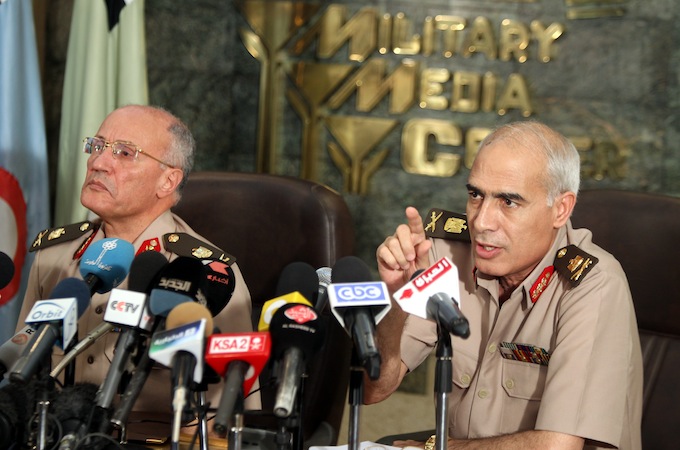
Generals Mohammed Al-Assar (left) and Mamdouh Shahin discuss the SCAF's decision to retain legislative power. (Photo Courtesy of Al Jazeera)

The SCAF’s decision was made after it dissolved parliament, the majority of whose members were part of the Muslim Brotherhood.  The dissolution occurred after the Supreme Constitutional Court ruled last year’s legislative polls unconstitutional because party members contested seats in the lower house that were intended to be reserved for independents.

Its actions have been met with criticism.  Mohamed ElBaradei, a prominent political figure, believes they are a “grave setback for democracy and revolution.”  Former presidential candidate Hamden Sabahi considers them to be “a seizure of the future of Egypt.”

Mohammed Al-Assar, a general of the SCAF, assured those concerned with the power grab that it was temporary.  At a press conference, Al-Assar said “we’ll never tire or be bored from assuring everyone that we will hand over power before the end of June.”  Last Sunday, the group issued a decree stating that it will retain these powers until a new parliament is elected.

It is also likely that the next Egyptian president will have a short term, and will be replaced after a new constitution is drafted.  Sameh Ashour, head of the SCAF’s advisory council, said that “[t]he upcoming president will occupy the office for a short period of time, whether or not he agrees.  His office term will be short despite the huge efforts exerted in the election campaigns.”

A statement issued by the SCAF said that a “constitutional commission representing all segments of society” will have three months to draft a new constitution.  The organization will also have the power to veto anything in the new constitution it objects to as “contrary to the interests of the country.”  The group also holds the right to form a new constitutional commission if it believes there is a setback “preventing them from performing their work.”  Lastly, the declaration grants SCAF chief Marshall Hussein Tantawi “power to decide all matters within the armed forces, the appointment of its commanders, and the extension of their service.”

Yesterday’s runoff has been marred with confusion over the vote count as both Muslim Brotherhood candidate Mohammed Mursi, and former Prime Minister Ahmed Shafiq claimed victory.  The Brotherhood’s unofficial tally has Mursi winning 52.5 percent of the votes.  Shafiq accused Mursi of miscounting the votes, with his camp claiming that he had won with 52 percent.

The Brotherhood is critical of the SCAF’s decree, finding it “null and unconstitutional.”  Ahmed Abdel-Atti, Mursi’s campaign director, expects “popular action” against the group’s undertakings in the near future.

For further information, please see:

Albawaba — Egypt: Muslim Brotherhoods Claim Presidential Victory — 18 June 2012

Al Jazeera — Political Uncertainty Threatens Egypt — 18 June 2012

BBC News — Egypt’s Military Grants Itself Sweeping Powers — 18 June 2012

Reuters — Egypt Rivals Claim Presidency as Army Tightens Grip — 18 June 2012