Russian Journalists Detained After Passage of New Assembly Regulations

By Connie Hong
Impunity Watch Reporter, Europe 

MOSCOW, Russia — On June 13, 2012, Natella Boltyanskaya, Olga Bychkova, Alina Grebneva, Vladimir Varfolomeev, and Alexander Podrabinek were detained by Russian police after engaging in peaceful, individual pickets.  The five journalists were trying to hold up posters to support their colleague, Sergei Sokolov, who had received threats from the head of the Investigation Committee, Alexander Bastrykin.  One of the detained journalists said that the police moved so rapidly to arrest them that only two of the journalists had time to unravel and display their posters.  Sergei Sokolov, the deputy chief editor of Novaya Gazeta, began receiving threats from Bastrykin after accusing Bastrykin and the rest of the Investigation Committee of aiding crime bosses in a recent article.

Russian police using new regulations to disrupt journalist's peaceful protest. (Photo Courtesy of RIA Novosti)

The journalists were protesting separately in front of Russia’s Investigation Committee, the state agency in charge of criminal investigations, when police officers forced them into a van.  Despite the fact that each of the journalists were careful to stand some distance away from the others, they were all taken to the Basmanny precinct in central Moscow.  There, they were questioned and forced to provide written statements explaining their actions before they were released without charge.

Bychkova told Human Rights Watch that demonstrating individually does not, by law, require authorization in advance.  The recent legislation on public rallies however, defined individual pickets as organized public events if they appear to “have attributes of planned collective action,” and therefore require prior authorization.  It is under the new regulations that the police found a basis for detaining the journalists.  Bychkova said that the police had warned them at the precinct “not to attempt any such thing in the future,” and continually referred to the new law.

The detention of the five journalists sparked media outcry and inspired other journalists to show up at the Investigation Committee building.  A policeman told one of the journalists that taking over someone else’s poster qualifies as collective action, and would give him the right to arrest her.  When asked if she could draw her own poster, the policeman replied: “If your new poster revolves around the same idea as the other poster, it will mean that this is an organized public action, not an individual picket.”

Noting their repressive and abusive nature, Humans Rights Watch has sharply criticized Russia’s new regulations on peaceful assembly.  It urged the Kremlin to revise the new law since it so starkly conflicts with Russia’s duty to respect and uphold freedom of expression and peaceful demonstration.  According to Tanya Lokshina, a senior researcher for Russia at Human Rights Watch, “Even if a law gives police powers of detention, to use them to suppress the legitimate exercise of fundamental rights makes that use arbitrary and abusive.”


For further information, please see:

Human Rights Watch — Russia: Five Journalists Detained — 14 June 2012

Gulf Times — Top Russian journalist flees ‘investigator’s death threat’— 13 June 2012

The Republic — Russian top investigator threatens reporter, paper says — 13 June 2012

Human Rights Watch — Russia: Reject Restrictions on Peaceful Assembly — 8 June 2012


Possession of Lemon Leads to Deaf-Mute Facing 25 Years in Prison

By Melike Ince
Impunity Watch Reporter, Middle East

ANKARA, Turkey — A Kurdish man who is deaf, mute, and illiterate faces twenty-five years in prison in Turkey for allegedly taking part in protests that support terrorism.

Mehmet Tahir Ilhan faces up to 25 years in jail for allegedly supporting terrorism. (Photo Courtesy of Hurriet Daily News)

On April 21, 2011, Mehmet Tahir Ilhan was on his way home from his job as a porter in the city of Mersin when he noticed protestors for the banned Kurdish Workers Party (PKK) conducting a demonstration.  With the help of a sign language interpreter, Ilhan testified that “A friend [of mine] gestured at me to join them but I refused.”   He added, “I did not throw rocks, Molotov cocktails or fireworks at the police.”  He was arrested at the protest and later released in Mersin, only to again be taken into custody in the province of Adana, an area that happened to be looking into the case.

Ilhan, who is married and father to six children, has been deaf and mute his entire life.  His lawyer, Tugay Berk, believes that the charges defy logic.

“It is impossible for my client to chant slogans,” said Berk.  “It is against logic and reason to charge a suspect, who is lacking the physical abilities to make propaganda on behalf of an organization, with such an accusation.  The fact that İlhan is being put on trial for making propaganda on behalf of a terrorist organization is tragicomic.  We request that this unlawfulness be ended immediately.”

The charges against Ilhan include committing a crime on behalf of a terrorist organization, making propaganda on behalf of a terrorist organization, and resisting arrest.  The evidence the prosecutor intends to use consists of Ilhan’s possession of half a lemon, which is known to ease the effects of tear gas.  Turkish Courts been known to convict with little evidence to support a charge.

It is an offense to show any public support for the PKK in Turkey, even though the use of these anti-terrorism laws has been controversial.  Over the last year and a half many Kurdish activists, journalists, and politicians have been detained under the long arm of these laws.  The Council of Europe stated their concern by noting that the laws were having a “chilling effect” on freedom of speech.

To encourage Kurdish moderates–and to isolate the more extreme members–the Turkish government has taken steps to bridge the gap between the two cultures with efforts, including the offering of Kurdish language classes in schools. But with the tension so high, some worry that the actions taken by Turkey’s judiciary will ultimately threaten the already hostile relationship.

For further information, please see:

BBC News — Turkey: Kurd with Lemon Accused of Supporting Terror — 15 June 2012

Global Post — Deaf, Mute & Illiterate Kurdish Man Faces 25-yr Jail Term in Turkey — 15 June 2012

Hurriyet Daily News — Deaf, Mute Man Faces 25 Years in Jail For Terrorist Propaganda in Turkey — 14 June 2012

Today’s Zaman — Prosecutor Demands 25 Years For Deaf Man Over Illegal Slogan — 14 June 2012

Ukranian President Yanukovich Links Political Rival to Murder Charge

By Pearl Rimon
Impunity Watch Reporter, Europe

KIEV, Ukraine — Viktor Yanukovich, the President of Ukraine has linked political rival Yulia Tymoshenko to a 16 year old murder. Tymoshenko, the former Prime Minister, has been imprisoned since October for alleged abuse of office charges.

Former Ukrainian Prime Minister Yulia Tymoshenko is serving a seven-year prison sentence. (Photo Courtesy of UPI Photo)

Tymoshenko was convicted on charges alleging that she abused her authority  in 2009 in a natural gas deal with Gazprom, a Russian energy company.  Her appeal for this conviction is scheduled for June 26. She also faces a separate charge for tax evasion and embezzlement for June 25.

Yanukovich’s latest accusations add on to the current scrutiny he is under by other European officials. Western European governments have chosen to boycott the 2012 Eurocup soccer matches, which are being jointly hosted by Poland and Ukraine.  Tymoshenko’s conviction is claimed to be politically motivated by other European officials, which is why they have boycotted the matches.

Stefan Fule, European commissioner for enlargement believes that the charges and conviction are due to acts of selective justice, “They were not conducted according to international standards.  There was no impartiality of judges and there was no equality of arms between prosecution and defense.”

The latest accusation against Tymoshenko by Yanukovich links her to the 16 year old contract killing case of Yevhen Shcherban. Shcherban was attacked in a hail of bullets as he left a plane in Donetsk, Ukraine. The attack also took the lives of his and several bystanders.

Current Prime Minister Mykola Azarov supports Yanukovich’s accusation. After Shcherban’s death, Unified Energy Systems of Ukraine, headed by Tymoshenko, made large profits in the local market.  “So this person (Tymoshenko) is very controversial and those who want to make a symbol of a fighter for democracy out of her must first get to grips with the facts,” Azarov told Reuters in an interview.

Olexander Tymoshenko, Tymoshenko’s husband, has public accused Yanukovich for using the government to carry out a personal vendetta against his wife. “This is a new step in the evolution of dictatorship … You, Yanukovich, and your followers have delivered the verdict to the leader of unified opposition.”, said Tymoshenko.

Yulia Tymoshenko lead the 2004 Orange Revolution which halted Yaunkovich’s first attempt at for the presidency. After losing the 2010 presidential election to Yanukovich, she and numerous opposition leaders faced charges for corruption.

For further information, please see:

Chicago Tribune — Tymoshenko’s husband cries foul over murder charge – 14 June 2012

United Press International — EU has eye on Tymoshenko case –14 June 2012

Chicago Tribune — Ukraine leader stirs Tymoshenko row with murder charge –13 June 2012


Ex-Ivory Coast President May Get Thirty Years for Crimes Against Humanity

By Tara Pistorese
Impunity Watch Reporter, Africa

YAMOUSSOUKRO, Cote D’ivoire—Ex-Ivory Coast President Laurent Gbagbo faces four counts of crimes against humanity for murder, rape, and inhumane acts that occurred after the 2010 South African presidential elections.

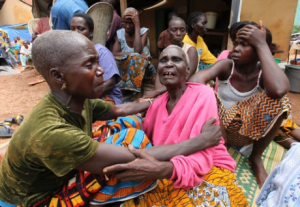
Ivory Coast Refugees Forced to Flee Amidst Post-Election Violence Mourn the Death of a Relative. (Photo Courtesty of AlertNet)

After polls declared internationally accepted candidate Alassane Outtara the new president, Gbagbo refused to step out of office, sparking the beginning of a violent four-month standoff between supporters of the two candidates.

During the post-election period from December 2010 to April 2011, approximately 3,000 people were killed and 1 million were displaced. However, human rights groups have said that both sides committed crimes during this period of violence.

Gbagbo was arrested in April 2011 after being captured by French Special Forces. He was removed to The Hague in November of the same year.

According to a statement issued by the International Criminal Court (ICC), “Mr. Gbagbo allegedly bears individual criminal responsibility, as indirect co-perpetrator, for four counts of crimes against humanity.”

Gbagbo, however, says he is innocent of any offenses committed by forces loyal to him.

Recently, related allegations surfaced that Gbagbo supporters made unsuccessful attempts to stage a coup d’état earlier this year. While Lida Kouassi, South Africa’s previous defense minister, admitted during questioning to possessing information about the coup plot, others claim the allegations were concocted for political gain.

“There is no real evidence of such a coup…this regime is such a mess, due to [President Outtara’s] way of ruling the country, that they think the best way to get out of this situation is to find somebody…and to charge him with trying to make a coup,” said Popular Front Party treasurer Tcheide Jean Gervais.

An ICC hearing to determine whether the evidence against Gbagbo is sufficient to proceed to trial was scheduled for June 18. But, the former ICC chief prosecutor, Luis Moreno-Ocampo, claims the evidence against Gbagbo is “solid” and believes Gbagbo could receive up to thirty years in prison.

This determination will have to wait as Gbagbo’s defense team was granted postponement until August 13 to allow more time to prepare an executive defense and so that Gbagbo may recover from alleged bad treatment he received while in Ivory Coast detention.

Some have also entertained the possibility that the ICC prosecutor and President Outtara may strike a deal regarding Gbagbo’s trial. At this point, however, President Outtara wants to obtain additional information on the matter.


For further information, please see:

Mgemi Online—Ivory Coast Coup Plot ‘Foiled’—14 June 2012

Voice of Africa—Ivory Coast Official Denies Coup Allegations—14 June 2012

CNN-US—War Crimes Court Postpones Gbagbo Hearing to August—13 June 2012

RTT News—ICC Postpones Gbagbo’s Charges Confirmation Hearing—13 June 2012

Reuters—Former Ivory Coast Leader’s Trial Postponed—12 June 2012

All Africa—Cote d’Ivoire: ICC Chief Prosecutor’s Statement Ahead of Laurent Gbagbo’s Hearing Sparks Controversy—4 June 2012

Syrian Revolution Digest – Friday 15 June 2012

THE COMMENTARY IN THIS PIECE DOES NOT NECESSARILY REFLECT THE VIEWS OF IMPUNITY WATCH.  

*WARNING VIDEOS MAY CONTAIN GRAPHIC IMAGES*

Hedging Bets!

I wouldn’t ask for intervention had it not been a reality of our lives already, had Russia, China, Iran, Iraq, Belarus and Venezuela not chosen to intervene from the onset in our affairs, siding with the Assads, arming them to the teeth, helping circumvent sanctions, shielding them from accountability. Things need to be made equal. We need to be given a fighting chance. Assad is conducting a war of attrition against the rebels, while carving out his own personal fiefdom, hedging his bets. We only have one bet: staying the course, come what may.

Friday June 15, 2012

Death tolls: 48. The Breakdown: 14 in Damascus City and Suburbs (most in Douma), 9 in Homs, 10 in Daraa, 6 in Deir Ezzor, 6 in Aleppo, 2 in Idlib, and in Raqqah.

News

Mr. Isaykin, a powerful figure in Russia’s military industry, openly discussed the weapons being shipped to Syria: the Pantsyr-S1, a radar-guided missile and artillery system capable of hitting warplanes at altitudes well above those typically flown during bombing sorties, and up to 12 miles away; Buk-M2 antiaircraft missiles, capable of striking airplanes at even higher altitudes, up to 82,000 feet, and at longer ranges; and land-based Bastion antiship missiles that can fire at targets 180 miles from the coast.

My comment: I guess Assad will have to make do with Russian caviar just he is doing with Russian tanks.

Op-Eds & Special Reports

Syria: Sexual Assault in Detention Security Forces Also Attacked Women and Girls in Raids on Homes.

Syria: Shabiha Militia Member Tells It Like It Is An active member of Syria’s feared shabiha militia says he is in a “win or die” fight for his president (and a little bit of cash).

Houla Again

Germany’s FAZ, its main source, Mother Agnes, and John Rosenthal from the National Review Online are sticking to their story that the Houla Massacre was perpetrated by jihadists against Alawite inhabitants. But neither FAZ, nor Mother Agnes nor Rosenthal offer any new proof to back their claims. They simply stick to their story that unidentified sources from the opposition and inhabitants from the village of Kafar Laha were behind the revelation.

Bear in mind here that even the Assad regime does not make or endorse this claim. Bear in mind as well that no one tried to explain why and how Sunni rebels were allowed to bury the bodies of their alleged Alawite victims in open daylight in shallow mass graves while documenting the entire event via YouTube, and while pro-Assad checkpoints were all over the place. Moreover, we have not heard any similar assertions from any of the Alawite communities in the area despite the regime’s access to them.

So, why is it that we can always provide videos and often eyewitnesses to back our stories, while the regime and its supporters, and whoever choose to believe them, for whatever reason, have only their assertions and their unidentified and unidentifiable sources? They certainly have more resources than we do to document their “suffering.” And locals who are sympathetic to the regime have cameras and smartphones as well, and open access to the Internet. How come, then, we are always left having to take their words and only their words for it?

Pointing out that an eyewitness said that people with long beards and shaved heads were the ones who committed this massacre is evidence of nothing in itself: because this is how many Shabbiha members (pro-Assad militias) look like.

Telling us that 80,000 Christians were forced to leave Homs City, well, so did 500,000 Sunnis. The question is why? Mother Agnes and the regime, and she is an unabashed supporter of the regime of course, want us to believe that this is the work of Sunni extremists and Jihadi elements. The evidence we have, not only the videos and testimonies offered by local activists, but those offered by foreign journalist as well, suggest that the intensive indiscriminate pounding of residential neighborhoods by pro-Assad troops and militias did in fact pave the way to this.

Who do you want to believe? Your eyes? Your people? Or the assertions of killers and their supporters? Don’t tell me Mother Agnes is a nun, I know nuns can be wonderful, Sisters Danielle and Jordanie, the nuns from the private school I briefly attended in Lebanon in my childhood, definitely were: cruel but wonderful. On the other hand, I know enough history and watch enough news to know that the habit and the cloth are not shields against prejudice and avarice. So, nun or not, the good old mother needs to offer proof other than her say so to back her stories, and it better be damn convincing. Because knowing Mother Agnes, and yes, I do know Mother Agnes, I know very well that she is no Mother Teresa, or an Angel or Mercy, or a good preacher or practitioner of Christian love.

But to each his source.