
Egypt’s Army Retains Political Power During Presidential Uncertainty
By Ali Al-Bassam
Impunity Watch Reporter, Middle East
CAIRO, Egypt — As uncertainty surrounds the result of last Sunday’s presidential runoff, the Supreme Council of Armed Forces (SCAF) issued a declaration to retain the authority to exercise legislative powers until a new parliament is elected. These powers include control over the budget, and over who writes the permanent constitution. The organisation also retained the power of authority over the army, limiting the president’s power as commander-in-chief, only granting him the power to declare war with the military council’s approval.
The SCAF’s decision was made after it dissolved parliament, the majority of whose members were part of the Muslim Brotherhood. The dissolution occurred after the Supreme Constitutional Court ruled last year’s legislative polls unconstitutional because party members contested seats in the lower house that were intended to be reserved for independents.
Its actions have been met with criticism. Mohamed ElBaradei, a prominent political figure, believes they are a “grave setback for democracy and revolution.” Former presidential candidate Hamden Sabahi considers them to be “a seizure of the future of Egypt.”
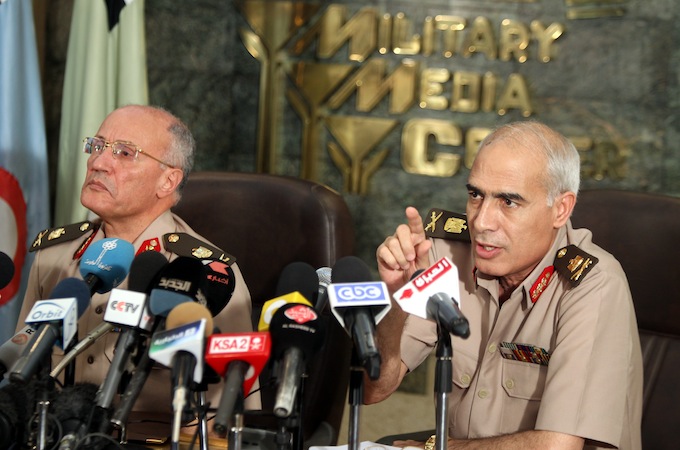
Mohammed Al-Assar, a general of the SCAF, assured those concerned with the power grab that it was temporary. At a press conference, Al-Assar said “we’ll never tire or be bored from assuring everyone that we will hand over power before the end of June.” Last Sunday, the group issued a decree stating that it will retain these powers until a new parliament is elected.
It is also likely that the next Egyptian president will have a short term, and will be replaced after a new constitution is drafted. Sameh Ashour, head of the SCAF’s advisory council, said that “[t]he upcoming president will occupy the office for a short period of time, whether or not he agrees. His office term will be short despite the huge efforts exerted in the election campaigns.”
A statement issued by the SCAF said that a “constitutional commission representing all segments of society” will have three months to draft a new constitution. The organization will also have the power to veto anything in the new constitution it objects to as “contrary to the interests of the country.” The group also holds the right to form a new constitutional commission if it believes there is a setback “preventing them from performing their work.” Lastly, the declaration grants SCAF chief Marshall Hussein Tantawi “power to decide all matters within the armed forces, the appointment of its commanders, and the extension of their service.”
Yesterday’s runoff has been marred with confusion over the vote count as both Muslim Brotherhood candidate Mohammed Mursi, and former Prime Minister Ahmed Shafiq claimed victory. The Brotherhood’s unofficial tally has Mursi winning 52.5 percent of the votes. Shafiq accused Mursi of miscounting the votes, with his camp claiming that he had won with 52 percent.
The Brotherhood is critical of the SCAF’s decree, finding it “null and unconstitutional.” Ahmed Abdel-Atti, Mursi’s campaign director, expects “popular action” against the group’s undertakings in the near future.
For further information, please see:
Albawaba — Egypt: Muslim Brotherhoods Claim Presidential Victory — 18 June 2012
Al Jazeera — Political Uncertainty Threatens Egypt — 18 June 2012
BBC News — Egypt’s Military Grants Itself Sweeping Powers — 18 June 2012
Reuters — Egypt Rivals Claim Presidency as Army Tightens Grip — 18 June 2012
Syrian Revolution Digest – Tuesday 19 June 2012
THE COMMENTARY IN THIS PIECE DOES NOT NECESSARILY REFLECT THE VIEWS OF IMPUNITY WATCH.
*WARNING VIDEOS MAY CONTAIN GRAPHIC IMAGES*
Updates from the Road (1)
Russia will not be part of the solution in Syria. Yemeni-style scenarios are unlikely. Obama needs to hit the reset button again. There is little time left to save a country and a region from a meltdown.
Tuesday June 19, 2012
News
Op-Eds & Special Reports
Sectarian realities in Homs
USA Politics and Syria
On the personal front
Getting Serious on Syria: my participation in a panel at the American Enterprise Institute where the keynote speaker was Senator McCain: Excerpt from my intervention, the whole event.
More fall-outs from our April trip to Kosovo: The Pristina-Damascus Connection
Over the next 5-7 days, I will be taking part in a series of activities that will take up most of my time and might, therefore, be unable to update the blog as regularly and extensively as I want. But I will be back in full force soon.
Syrian Network for Human Rights: Documenting the Widespread Massacres
In the past few weeks the number of massacres taking place around Syria drastically increased. The Syrian Network for Human Rights, in collaboration with the Damascus Center for Human Rights Studies, have documented a number of them. Below is their summarized reports for the past four massacres; beginning with the most recent.
Douma | 16 June 2012
The Syrian regime’s combat forces launched a fierce and concentrated attack on the city of Douma, located to the east of the capital Damascus. The residents came under continual mortar shelling by the forces surrounding the city; additionally there was intense shelling originating from the vehicles administration headquarters, which is located in the neighbouring city of Harasta. The shelling went through the night until dawn; it stopped around 3:00 am.
Artillery shelling was concentrated on residential quarters located behind the mosques of Haseeba and Al-Agha. Eight people, including three women, were killed at the onset, when shelling targeted a residential building. This was a clear indication that shelling was random with the intent of killing for the sake of killing. This building, the first target, is located between the Great Mosque and Haseeba Mosque and the area is one of the most densely populated quarters of the city.
We were not able to access the inflicted area to provide assistance due to the full siege and the Syrian government’s refusal to give access to any Human Rights or relief organization to work on the Syrian territories. By contacting locals and victims’ relatives, we were able to confirm eight names of the victims who fell to the shelling and documented at least 40 wounded, including four people with very critical injuries.
There is a severe shortage of medical necessities because the Syrian government hinders the transport of the wounded and the injured to hospitals, so they are treated in houses that lack real medical supplies or preparation facilities.
Saqba | 16 June 2012
The Syrian regime forces moved from Douma to Saqba on this same day. Upon entering the city, which is located east of Damascus, they quickly took control and began to instill terror in the residents. Tanks, armoured vehicles and infantry advanced from the south (from the Kafr Batana region), the north (from the Hamouriya direction), the west (from the Hazza direction), and the east (from the Jesreen direction). This entry in the city was followed by raid campaigns, around a square known as Al-Jameiya, while other combat troops moved to the secondary school street, and remaining troops moved to the northern area of Al-Jouzeh.
One of the tanks, positioned in the city centre, fired a shell on a residential building; this caused severe damage in the building and several injuries, including a child who received an injury to the eye. Dozens of residents were arrested. We were able to identify a few of them from the Al-Khawaja family. Following this, troops moved to the Al-Mahfara area, to the west of the city, where they looted commercial shops.
The horrendous massacre harvested the lives of 19 civilians including a woman and a child. We have been able to contact residents to confirm and document the names of victims. To add insult to injury, some of the victims were slaughtered by knives in a revengeful, sadist fashion that was reminiscent of the Dark Ages and reflected a mindset of the utmost savagery.
Maarat Al-Numan | 10 June 2012
During the night, the Syrian regime’s army forces shelled the city of Maarat al-Numan with many mortar shells, which are internationally considered to be inaccurate. This mortar shelling is hard evidence, and a clear indicator, that the Syrian regime does not discriminate between the killing of a child, a woman or a young man. This reality is readily apparent on the ground as a high number of children and women are killed.
The preliminary death toll stands at thirteen victims. The victims’ body parts were scattered in the streets following the attack. More than 90 people were wounded, 25 of whom suffer from severe and critical injuries. As usual, the Syrian regime has cut off all means of communications and prevented doctors from treating the wounded or transporting them to safer zones where medical care necessities are available. Many houses and shops were damaged from the attack as well.
Dar’aa | 9 June 2012
The Syrian regime’s army and security forces launched a fierce attack on the city using mortars, which the international community considers to be random inaccurate projectile, and heavy machineguns. Those shells hit the houses of:
Suliaman Shihadeh Aba Zeed, Adnan Dyab Aba Zeed, Ibrahim Mifleh Aba Zeed, Muhammad Kheir Aba Zeed, Yusuf Aba Zeed, Abu Nasir Abu Al-Qayasin al-Bajabja neighbourhood
A shell fell on al-Dallou family house killing 7 members of the family and burning down the house. Residents recovered the bodies of Mansour Rizq Aba Zeed, Rita Rizq Aba Zeed and Rizq Hasan Shihada from under the rubble.
The regime’s army snipers, stationed at the roof of the national hospital, targeted citizens who came to donate blood following the attack. The regime’s army checkpoint, stationed at Al-Sad road, targeted a civilian car that was transporting the wounded to the makeshift hospital, killing the volunteer in the process.
For further information, please visit the website listed below:
Acid Attacks Against Women On The Rise
By Heba Girgis
Impunity Watch Reporter, South America
BOGOTA, Colombia — Viviana Hernandez still vividly recalls the acid attack that left her with burns on her face, chest, and hands, and took her eyesight in her left eye. “All of a sudden you see some liquid coming towards your face and you think that somebody might have slipped, or that they want to get you wet,” she said. “You never imagine that it can happen to you.”

The aim of these attacks is not to kill but to punish women. Hernandez, 28, noted that when her former husband wanted to get back together with her, she refused. She said, “he used to call me, to threaten me. On the day of the attack, he followed me.” While, her husband did not throw the acid himself, he did point her out to hired attackers.
Another young woman told BBC that “when they threw acid, they also told me: ‘it is your fault for being so pretty.” These attacks often result from domestic disputes or romantic rivals, and as a result, many of the victims are not given proper care, nor are they immediately hospitalized.
A plastic surgeon in Colombia, Dr. Linda Guerrero, explains that, “When a woman has little schooling and no job, she’s financially dependent on a man. That creates a situation where women are inferior, where men can say, ‘I’m the owner of that woman and therefore I have a right to do want I want with her.'”
Colombian Congresswoman Gloria Estela Diaz introduced a bill in mid-march to toughen the punishment for acid attackers. Currently, assailants can get a maximum ten-year jail sentence. Diaz’s bill will heighten the sentence from between eight-to-thirty years, without a possibility of reduced jail time. She also hopes to restrict the sale of the acids typically used against women–phosphoric acid, sulfuric acid, and nitric acids.
Many women continue to struggle proving the identity of their attacker. Hernandez is one of these women. As a result, she was forced to flee to another city to protect herself. “We carry this tragedy with us every day,” she stated.
For further information, please see:
UPI – 3 Arrested in Bogota for Acid Attacks – 6 June 2012
BBC – Colombia Acid Victims Seek Justice as Attacks Spread – 30 May 2012
Care2 Make a Difference – Acid Attacks on Colombian Women – 21 May 2012
Fijilive – Acid Attacks on Women Grow in Colombia – 8 March 2012