L.A. County Leaders Repeal Support of Japanese American Internment Camps

By Mark O’Brien
Impunity Watch Reporter, North America

LOS ANGELES, California — The Los Angeles County Board of Supervisors voted Wednesday to right a 70-year-old wrong.
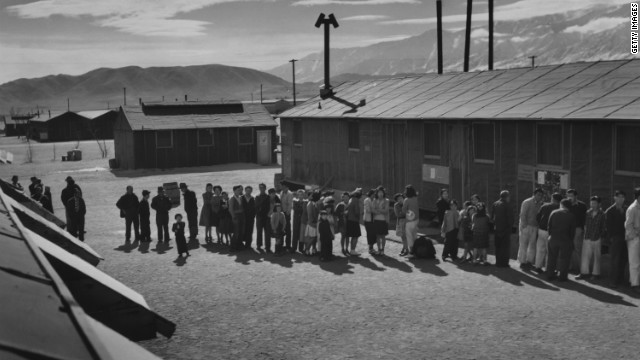
Japanese Americans line up outside a mess hall at an internment camp in California in 1943. (Photo Courtesy of CNN)

The supervisors unanimously repealed a 1942 resolution that supported the internment of Japanese Americans at the start of World War II.

“We were imprisoned behind barbed wire fences when there were no charges, no trial,” former “Star Trek” actor George Takei told the Los Angeles Daily News.  He gave a moving presentation to the board supporting the repeal about his time in the camps when he was only five years old.

“It still stank of horse manure,” he said of the stables at Santa Anita Park, a thoroughbred racetrack, where he, his parents, and two siblings were housed.  “My mother said it was her most humiliating and degrading experience up to that point, but more were to follow.”

Takei’s family was among the 17,000 who lived at the camp for several months before they were shipped to internment camps in northern California and southeast Arkansas.

“Our only crime was looking like the people who had bombed Pearl Harbor,” he said.

The board passed the resolution shortly after Japan’s surprise military attack on the U.S. naval base at Pearl Harbor, Hawaii.  The bombing directly led to the American entry into World War II.  At the time, the board hoped its resolution would urge President Franklin D. Roosevelt to move forward with the internment camps because the board felt it was difficult “if not impossible to distinguish between loyal and disloyal Japanese aliens.

Roosevelt signed Executive Order 9066 in February 1942, placing roughly 120,000 Japanese Americans in camps for up to three years.  Nearly a third of them were in Los Angeles County.  Thousands of people with German or Italian ancestry were also placed in the camps.

“The internment of American citizens of Japanese ancestry was, no doubt, a low point in American history,” said Supervisor Mark Ridley-Thomas, who introduced the motion to rescind the old resolution.  “To ignore this and leave it as unfinished business is essentially to trivialize it, and we choose not to trivialize this travesty.”

Over the weekend, many Japanese Americans, who once were housed at Santa Anita Park, gathered there to reflect on the struggles and foster inspiration and healing.

“Every family that was put in the camps has a wide range of emotions,” event organizer Wendy Fujihara Anderson.  “My parents never talked about the camps.”

President Gerald Ford proclaimed in 1976 that Roosevelt’s executive order officially ended when the war did.  President George H. W. Bush issued an official apology in 1989.

Many who supported the board’s repeal said it was a long time coming, and a significant one at that.

“We (now) can face the future having extracted important lessons from our democracy,” Takei said.


For further information, please see:

CNN — L.A. County Board Repeals Support of WWII Japanese Internment — 6 June 2012

Contra Costa Times — Supervisors Repeal 1942 Act Supporting Japanese-American Internment — 6 June 2012

Los Angeles Times — County Supervisors Rescind 1942 Japanese American Internment Vote — 6 June 2012

Los Angeles Daily News — L.A. County Supervisors to Repeal 1942 Resolution Supporting Internment of Japanese Americans — 4 June 2012

San Gabriel Valley Tribune — Japanese Internment Recalled in Santa Anita; Heroes of Era Honored — 4 June 2012

ArcadiaPatch — Japanese-American Internment Camp Victims Remembered, Honored — 3 June 2012

Rioting at Rio+20?

By Margaret Janelle Hutchinson
Impunity Watch Reporter, South America

BRASÍLIA, Brazil – As Brazil prepares to host Rio+20, the United Nations Conference on Sustainable Development, president Dilma Rousseff is trying to set an example through legislation and other environmental projects, but environmentalists say her efforts don’t go far enough.

Rousseff wants Brazil to be an example at Rio+20. (Photo courtesy of MercoPress)

Activist and former Brazilian presidential candidate Marina Silva called Tuesday for protests matching the magnitude of Egypt’s Tahrir Square demonstrations at the upcoming environmental summit.

More than 100 heads of state and tens of thousands of participants from governments, the private sector and NGOs will converge on Rio de Janeiro from the 20th-22nd of June for the conference.  Marking the 20th anniversary of the “Earth Summit” in 1992 in Rio de Janeiro, the Rio+20 gathering aims to break years of deadlock on pressing environmental issues and set up long-term paths toward green development and sustainability.

Late last month, President Rousseff partially vetoed a bill that would have weakened her country’s efforts to protect the Amazon and other forests.  Legislators in both houses had passed a set of revisions to the Forest Code that threatened permanent preservation areas – a key provision in Brazilian environmental legislation – that obliged farmers to keep a proportion of their land as protected forests, particularly on the fringes of rivers and hillsides.  Brazil’s powerful agricultural lobby has long opposed the preservation requirement.

Speaking on World Environment Day, Rousseff stressed that economic problems should not serve as a pretext to abandon efforts to safeguard the planet.

“The crisis can’t be an argument to suspend measures to protect the environment, much as it can’t be an argument to suspend policies of social inclusion,” Rousseff said.

Everybody from the Brazilian Academy of Sciences to, literally, the Brazilian equivalent of Bugs Bunny was saying ‘veto this bill completely,’ according to Steve Schwartzman, director of Tropical Forest Policy for the Environmental Defense Fund.

In the end, President Rousseff vetoed 12 sections of the bill. The most controversial clause would have given amnesty to all landowners that illegally deforested before 2008.  Instead, Rousseff modified that section to only apply to small landowners.  Congress has until mid October to discuss and vote on an amended version of the bill.

Many environmentalists see Rousseff’s actions as not going far enough.  They feel that Rousseff is striking a precarious balance between powerful economic players and the future of the planet.

“This sends a bad signal on the eve of the Rio+20 when Brazil could have been an example,” Silva said.  “If on the eve of the Rio+20 we practically eliminate the law that protects forests, we change the law that defines the boundaries of indigenous lands and we withdraw the capacity of a federal agency responsible for combating illicit deforestation… imagine what will happen,” she said.

Nevertheless, Brazil has made strides in forest preservation.  Deforestation of the Amazon has fallen to its lowest levels since records began, according to data recently released by Brazil’s National Institute for Space Research.

Amazon deforestation over the years. (Photo courtesy of The Guardian)

Using satellite imagery, the institute said 6,418 sq km of Amazon forest was stripped in the 12 months before 31 July 2011 – the smallest area since annual measurements started in 1988.

“This reduction is impressive; it is the result of changes in society, but it also stems from the political decision to inspect, as well as from punitive action by government agencies,” Rousseff said.

She was speaking at a ceremony on Tuesday to mark the opening of two new nature reserves: the 34,000-hectare (83,980 acres) Bom Jesus Biological Reserve in Paraná, and the 8,500-hectare (20,995 acres) Furna Feia National Park in Rio Grande do Norte.

Likewise in advance of the Rio+20 summit the state government of Rio do Janeiro last week announced the closure of one of the world’s largest open-pit landfills, where thousands of people have made a living sorting the debris.

Long a symbol of ill-conceived urban planning and environmental negligence, the Jardim Gramacho dump is being transformed into a vast facility that will harness the greenhouse gases generated by the rotting rubbish and turn them into fuel capable of heating homes and powering cars.

Environmentalists had blamed Gramacho for the high levels of pollution in Rio’s once pristine Guanabara Bay, where tons of run-off from the garbage had leaked.

Despite these efforts by the government to make progress in environmental preservation and sustainability efforts, key activists are calling for large scale protesting and demonstrations during the Rio+20 summit.

“I hope that Rio+20 will become the Tahrir Square of the global environmental crisis and that international public opinion will be able to tell leaders that they cannot brush off the science,” Silva told AFP. “They cannot lower expectations in the face of a crisis worsening every day,” said the 53-year-old figurehead of Brazil’s environmental movement.

The Brazilian military plans to deploy 15,000 security personnel for the UN summit and a parallel “people’s summit” at the Flamengo park in southern Rio, which will be sponsored by civil society and is expected to see the attendance of nearly 20,000 people a day.

For further information, please see:

The Guardian – Amazon deforestation at record low, data shows – 7 June 2012

Merco Press – In anticipation of Rio+20, Brazil creates new nature reserves and closes major land-fill – 7 June 2012

iBahia – MP do Código Florestal será votada no Congresso até outubro – 6 June 2012

Public Radio International – On eve of Rio +20 environmental conference, Brazil’s president pushes back on forestry changes – 6 June 2012

Ahram Online – Brazil’s Silva calls for Tahrir-style demo at Rio+20 – 5 June 2012

The Guardian – Brazil’s leader vetoes portions of new Amazon rainforest law – 25 May 2012

Local Church Chains Mentally Impaired Followers

By Ryan Aliman
Impunity Watch Reporter, Africa

WINDHOEK, Namibia – Namibian Police ordered an Apostolic Faith Church pastor at a Sauyemwa informal settlement in Rundu to unchain mentally impaired patients the Church was reportedly treating on the premises. The police found nine people bound to heavy metal objects and wooden posts. One of the patients said he had been confined in the Church for more than a year.

Man lies chained to a steel post awaiting spiritual treatment. (Photo Courtesy of New Era Newspaper)

The police confiscated all the chains that were used to tie up the patients. However, the officers met resistance from the patients’ relatives who were convinced that the patients were merely being treated; and that the patients’ detention was a necessary part of the spiritual healing the Church offered. The Church’s treatment consisted of prayer, water, and olive oil with the patient chained to a heavy object.

The police launched an investigation on the Church’s activities after the Apostolic Faith Church gained popularity as a “clinic” of sorts for people with different afflictions who go to the church seeking “divine intervention”.

It was revealed that the Church would detain “aggressive patients” by chaining them to trees and rocks. These patients, some of them from the neighboring Angola, were kept in chains for the whole duration of their treatment at the Church.

According to Reverend Moses Matyayi, the pastor in charge of the Apostolic Faith Church in Sauyemwa, the chains were necessary as the patients posed a danger to the community. In fact, he added, this practice has been observed for over a decade.

Reverend Matyayi further claimed that not only have the relatives of the patients consented to this practice, but they have also supplied the Church with chains to be used on their mentally ill kin.

Upon examination by the Namibian Police, the relatives explained that they turned to the Church because State hospitals allegedly did nothing to improve their family members’ conditions.

The police however saw the treatment less favorably and ordered Reverend Matyayi to release the patients on the ground that the latter’s treatment violated fundamental human rights and was thus illegal. The police arranged for the patients to be sent to the Rundu State Hospital psychiatric unit in Windhoek.

Deputy Commissioner Willie Bampton noted that “although Reverend Matyayi’s intentions were good, his method of chaining people was cruel and inhumane”. Bampton added that chaining mentally handicapped individuals “robbed the patients of their dignity”.

Chief Social Worker in the Ministry of Gender Equality and Child Welfare, Fransiska Hamutenya, weighed in by describing the whole situation as “degrading”. “If someone is mentally ill it does not take away his or her rights. This is abuse,” she said.


For further information, please see:

The Namibian – Namibia: Police Order Church to Unchain – 1 June 2012

Nampa Mobile News – Police Order Church to Unchain – 31 May 2012

New Era Newspaper – Namibia: Rev. Warns Against Foreign Prophets – 31 May 2012

New Era Newspaper – Namibia: Church Chains Followers – 30 May 2012


Trial of NGO Workers Adjourned Until July

By Mark McMurray
Impunity Watch Reporter, Middle East

CAIRO, Egypt — On Tuesday, the trial of forty-three non-governmental organization (NGO) workers was adjourned until the first week of July.  The delay follows a hearing which dealt with the procedural aspects related to the case.  The trial has stirred fears that Egyptian authorities will continue to crackdown on civil rights activists operating within the country.

U.S. national Robert Becker leaves a courtroom cage in Cairo. (Photo Courtesy of the Washington Post)

All of the accused deny the government’s charges of receiving illegal funds from foreign governments and organizations and operating within the country without proper permits.  The charges originate from the work conducted by the NGOs last year, prior to the parliamentary elections.  Authorities claim the work undertaken by the NGOs, focused primarily on civil society and pro-democracy issues, was a plot to promote unrest following the fall of former President Hosni Mubarak’s regime.  When the trial resumes, the aid workers face up to six years in prison if they are found guilty.

The diverse group includes nineteen U.S. nationals and fourteen Egyptians, with the remaining defendants hailing from a variety of European and Arab countries.  At the hearing on Tuesday, only seventeen defendants were present: the fourteen Egyptians, two Americans, and a German national.  Those defendants present in court were released until the trial resumes.  The others elected not to return for the hearing.  They left Egypt when their travel ban was lifted.

U.S.-Egyptian relations have been strained as a result of the accusations.  In response to the charges, forty-one members of the U.S. Congress sent a letter to Secretary of State Hillary Clinton and Defense Secretary Leon Panetta.  The letter urged the administration to withhold aid to Egypt, including $1.3 billion in yearly military aid, until Egyptian leadership allowed the offices of the NGOs to reopen and returned seized property.  Seeking to ease tensions, Egyptian authorities lifted a travel ban that was imposed in March, allowing the accused Americans to leave the country.  The maneuvering was seen as a way to avoid having a trial, as it was unlikely that those who left would return to stand trial.

However, Robert Becker, an American working with the U.S.-based National Democratic Institute, elected to remain in Egypt to stand trial.  Becker, who was present at the hearing on Tuesday, explained his reasoning for staying within the country.  “I keep saying captains stay with their crew.  There is no way that I would be able to live with myself being safely in the United States if they were potentially facing a jail term,” he said.

Lawyers for the defendants made a number of requests during Tuesday’s court proceeding.  These included requests to have defense witnesses be allowed to give testimony, to have the documents seized from the NGOs during raids translated into Arabic, and to have Egyptian officials give testimony in court.  With Egyptian officials slated to testify at the trial, Becker told the Los Angeles Times that the evidence “against us doesn’t match what we were doing,” and that the Egyptian government was undertaking a “demonization of NGOs.”

For further information, please see:

Christian Science Monitor – In Egypt, American NGO Workers Head to Court in Civil Society Trial – 5 June 2012

CNN – Trial of NGO Workers Set to Resume in Egypt – 5 June 2012

Egypt Independent – Defense Witnesses Can Give Testimony in Next NGO Trial Session, Court Rules – 5 June 2012

Los Angeles Times – New Trial Date Set for Pro-democracy Activists in Egypt – 5 June 2012

Washington Post – Hearing in Egypt NGO Case Resumes Tuesday – 4 June 2012

Syrian Revolution Digest – 6 June 2012

THE COMMENTARY IN THIS PIECE DOES NOT NECESSARILY REFLECT THE VIEWS OF IMPUNITY WATCH.  

*WARNING VIDEOS MAY CONTAIN GRAPHIC IMAGES*

Risking Genocide!


One Houla. Two Houlas. Three Houlas. Four Houlas… How many Houlas before you act? Over 15,000 dead and the U.S. is still talking sanctions and Russia just now considering changing Assad but not the regime! Something gotta give, before it’s too late, before a 100,000 Syrians are killed, before the country is no more.  


Wednesday June 06, 2012


Today’s death toll: 140. The Breakdown: 92 in Marzaf (Hama), 15 in Hiffeh (Lattakia), 11 in Idlib, 12 in Homs, 5 in Deir Ezzor, 2 in Damascus and 1 in Daraa.


New Massacres have been reported in Kafar Zeiteh and Marzaf towns in Hama Province. final tallies are still being compiled.


In Damascus, clashes between pro-Assad militias and local resistance were reported in Kafar Batna, Saqba and neighboring communities.


In Lattakia, pro-Assad militias continue their siege and pounding of the town of Hiffeh, but their attempts at taking the small town continue to be repelled by local resistance.


In Aleppo, the pounding of the town of Hayan by pro-regime militias and regulars continues.


News


Op-Eds & Special Reports


Video Highlights


After pro-Assad militias and regulars managed to drive out the members of the local resistance from the town of Kafar Zeiteh, following days of continuous bombardments using tanks, heavy artillery and choppers, they stormed on June 5 and perpetrated another massacre. Locals returned to find burnout homes, shops and cadavers. Over 150 are said to be missing. Burnt out bodies http://youtu.be/LF6eTRP-2t4 http://youtu.be/cwaztAW8sSM ,http://youtu.be/Al7-VF3bEKk Burnt out homes and shops http://youtu.be/U-77VwwHsmI Earlier in the day, the town was pounded one more time after the militias lefthttp://youtu.be/sWc8P8_t8J0 Militias then set the crops on fire http://youtu.be/zQZbgfUmxOQ , http://youtu.be/n-G5njKB5m4


But the pro-Assad militias were not done. They simply moved to the nearby village of Marzaf where they perpetrated a similar massacre in Qubeir Farm http://youtu.be/0y77I_lTfwc , http://youtu.be/3dHhhLu2qmE


Now pro-Assad militias are reportedly targeting the towns of Hilfaya and Taybat Al-Imam and nearby communities. Taybat Al-Imam: the pounding begins at night http://youtu.be/y_-hCfgmfes


All killings are now sectarian I character. The killers are Alawites. The victims Sunnis.


Elsewhere…


Operation Damascus Boiling: in order to show how widespread the disaffection with the regime local residents have become and how shaky the regime’s control over the city has become, activists in Damascus City launched an operation in which they simultaneously interrupted traffic with burning tires in over 30 locations around the city. Overview from Mount Qasayoun http://youtu.be/t_Y76GwbeXk Baramkeh http://youtu.be/5Acwl2j8d7Q , http://youtu.be/NwEhq9IWwCo ,http://youtu.be/jG4bNRTedF0 , http://youtu.be/clBHVXX23H0 Midan http://youtu.be/Jk0J2LfJ1I4 Jazmatiyeh http://youtu.be/S037cvLtO_I Kafar Sousseh http://youtu.be/lT41RVF-6Ac


But the main story on Damascus was all about the clashes that took place in different suburbs and neighborhoods at different times of the day: Gunfire and explosions in Jobar http://youtu.be/VbIBvsJ619s gunfire in Al-Hajar Al-Aswad http://youtu.be/EJPGVUzqqL8 In Qalamoun, members of the local resistance carry out a raid against the headquarters of th Division and liberate some of their colleagueshttp://youtu.be/pVaJ512kHo0


Protesters in Ruknaddine come under fire http://youtu.be/HT-28gXAHuA


Daraa City: the sounds of distant clashes can be heard all through the night http://youtu.be/5_J9fu5oDss


Nighttime protesters in Salaheddine Neighborhood, Aleppo City, come under firehttp://youtu.be/vCJVIpy_jLo


The town of Hayan, Aleppo Province, comes under heavy pounding http://youtu.be/TBK0curxjZU , http://youtu.be/8QwjmGv1iTk ,http://youtu.be/6n8K1x4dMbI


Pro-Assad militias set crops on fire in the town of Mouhassan, Deir Ezzor Province http://youtu.be/NGTUvExR5R8


The pounding of the town of Rastan, Homs Province, resumes at night http://youtu.be/nATEyaCOkNw , http://youtu.be/o00cjrMWLQ4


The old neighborhoods in Homs City were also pounded: Boustan Al-Diwan http://youtu.be/IVvM526cUHs Khaldiyeh http://youtu.be/VI0NvzypqPM Hamdiyeh Buildings fall apart http://youtu.be/IE5ib02Hfw8 http://youtu.be/U5sRT9O4gjk Qoussour http://youtu.be/4kgl5JNBWsA , http://youtu.be/L_5LK4DTXY0 , http://youtu.be/QXPolG02hS0 Wadi Al-Sayih http://youtu.be/7INV7iJDmWc


This leaked video shows pro-Assad militias humiliating a teenagerhttp://youtu.be/YpVPFW0dmng