Bolivian Right-Wing Politician Seeks Refuge in Brazilian Embassy

By Heba Girgis
Impunity Watch Reporter, South America

SUCRE, Bolivia — Roger Pinto, the head of an opposition party in Bolivia took political refuge in the Brazilian Embassy, in La Paz, Bolivia. Pinto stated that he and his family face death threats and political persecution after alleging that links existed between corrupt government officials and drug trafficking.

Roger Pinto Seeks Refuge in Brazilian Embassy. (Photo Courtesy of JournadaNet)

Pinto, a long-time foe of the current Morales government, stated that “I have no other alternative to the relentless harassment and persecution to which I was subjected to under the government of Evo Morales.”

President Evo Morales is head of the Movimiento al Socialismo (Movement for Socialism, MAS), a left wing, Socialist party founded in 1997. The MAS has governed the country since 2006 after the first majority victory by a single party in the elections held in December 2005. The MAS regime grew out of a movement to defend the interests of local Bolivian coca growers.

Since Morales came into the Presidency, international law enforcement officials have said that drug activity has increased dramatically. In 2006, Morales promised to expand the cultivation and growing of the coca plant which is the raw material of cocaine—a legal crop in Bolivia, used often as a chewable, mild stimulant.

This is not the first time Pinto has taken a stand against the Bolivian government. Recently, Pinto made several claims presenting documents alleging meetings between several senior level Morales officials and drug traffickers.

Since presenting these allegations, Pinto says he became a victim of at least 20 criminal investigations including sedition and defamation. These investigations developed into death threats which prompted him to seek political asylum in the Brazilian embassy. In a letter Pinto wrote to the Embassy, he said “I have been a victim of constant death threats, and my family has also been threatened.” His daughters also mentioned that they received many anonymous calls that they believed were from people affiliated with the Bolivian government.

As of yet, Brazil has not yet decided whether to grant Pinto the asylum he has requested. While Brazil continues to work for good relations with its neighbors, the country is also hoping to avoid a repeat of the 2009 coup in Honduras. In 2009, Honduran leader Zelaya took up residence in a Brazilian embassy claiming that he was under attack by unseen Israeli agents. Because Brazil lost some credibility in trying to resolve this situation, the country remains hesitant to offer Pinto political asylum.


For further information, please see:

ABC News–Bolivia: Senator’s Asylum Bid Embarrasses Morales–1 June 2012

The Republic–Bolivia says right-wing senator’s asylum bid seeks to embarrass Morales on eve of OAS summit–31 May 2012

Topix–Bolivia: Senator’s asylum bid embarrasses Morales–31 May 2012

The New York Times–Bolivian Politician Takes Refuge at Brazilian Embassy–30 May 2012
Palestinian Prisoners Threaten to Renew Hunger Strike

By Ali Al-Bassam
Impunity Watch Reporter, Middle East

TEL AVIV, Israel–Palestinian prisoners in Israel threatened to resume a hunger strike on Sunday.  They claim that Israeli prison authorities have reneged on an agreement to make changes to their current prison policies.

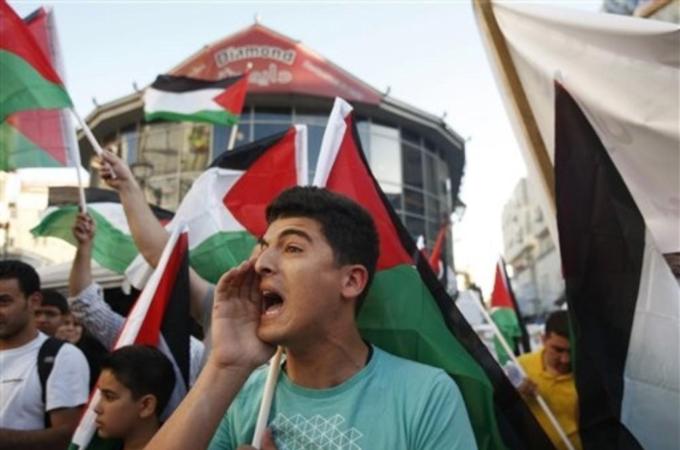
Prison protesters
Palestinian protesters gathered in support of prisoners who went on hunger strike. (Photo Courtesy of Al Jazeera)

On April 17, about 1,600 prisoners launched a massive  hunger strike in efforts to obtain improvements to their conditions, and an end to certain practices such as limited visitation rights, and solitary confinement.  The original hunger strike ended on May 14, when Palestinian prisoners were promised a package of measures in exchange for ending their hunger strike, and also to not engage in militant activity. In return, Israel promised the prisoners visitation from relatives in Gaza, and to also transfer detainees out of solitary confinement. Also part of the agreement was Israel’s promise to not extend its program of administrative detention, where suspects could be held without charge for renewable periods of up to six months.

The Palestinian Minister of Prisoner Affairs, Issa Qaraqaa, said that Israel failed to keep its promise. At a press conference in Ramallah, Qaraqaa stated that “Israel has begun to violate the deal it signed with the prisoners, and within ten days after announcing the end of the strike, Israel renewed administrative detention orders for approximately 30 prisoners.” Qaraqaa also said that he does not believe Israel that would grant visitation rights to prisoners. “So far, we don’t know if Israel will even allow families of prisoners from Gaza to visit their imprisoned relatives,” he claimed.

An Israeli defense official, who preferred to remain anonymous, refuted Qaraqaa’s claims. The official said that “as of the end of last week, three administrative detention orders were renewed.” The official also stated that Israel is currently working towards enabling visitation between Palestinian prisoners and their family members.  But it is a process that “would take some time,” however, because it “involves many different bodies.”

In his press conference in Ramallah, Qaraqaa discussed the situations of two prisoners, Mahmud Sarsak and Akram Rikhawi, who are currently on extended hunger strikes.  Sarsak, a recognized prisoner of war from Gaza, began his hunger strike on March 23. He went without food for 53 days until May 14, when he temporarily ceased his hunger strike after the agreement was signed. He resumed with his strike the following day.  Rikhawi wants the prison authority to deliver his medical file before he appears in front of a prison release committee so that his release may be expedited.  Qaraqaa stated that “both prisoners are currently on the verge of a coma and have a low heart rate.”

Sivan Weizman, an Israeli Prison Service spokeswoman, said the two were under medical supervision in Ramle Prison, located near Tel Aviv.   Should further care prove necessary, they will be transferred to a nearby hospital.

For further information, please see:

The National — Palestinian Prisoners Threaten New Hunger Strike — 4 June 2012

Al Jazeera — Jailed Palestinians Warn of New Hunger Strike — 3 June 2012

The Daily Star — Palestinians Threaten to Relaunch Prisoner Hunger Strike — 3 June 2012

The Jerusalem Post — Palestinian Prisoners Threaten to Strike Again — 3 June 2012

Government Officials Steal $4 Billion from South Sudan

By Tara Pistorese
Impunity Watch Reporter, Africa

JUBA, South Sudan—South Sudan President Salva Kiir has accused past and present government officials of stealing $4 billion in public funds from South Sudan. The alleged corruption follows less than one year after the nation seceded from Sudan.

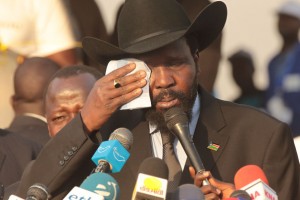
South Sudan President Salva Kiir speaks to the media on the first day of voting for South Sudan independence. (Photo Courtesy of Zimbia)

The Sudanese government and the Sudan People’s Liberation Army were locked in battle from 1983-2005. The civil war claimed approximately two million lives—the highest civilian death toll since World War II.

In July, South Sudan’s capital city, Juba, split from the North and claimed 75 percent of the region’s oil. To this day, South Sudan is still battling with Khartoum over oil revenues, crude transit fees and border delineation.

South Sudan filed a complaint with the U.N. Security Council on Friday against Khartoum for repeated airstrikes against South Sudan border states. Khartoum, however, denies the accusations.

In January, South Sudan shut down the vast majority of its oil output to stilt Sudan’s ability to seize the oil in lieu of what Sudan called unpaid export fees. At that point, oil production formed 98 percent of the South Sudan’s revenue.

According to South Sudan’s Information Minister Barnaba Marial Benjamin, more than half of the stolen funds were taken during the “durra” scandal, when a large government purchase of sorghum, the country’s staple food, was never distributed.

The 8.6 million people in South Sudan suffer some of the most devastating education and health statistics in the world. Similarly, just last month, the World Bank expressed its “deep concern” for Juba’s economy.

“We fought for freedom, justice and equality. Many of our friends died to achieve these objectives. Yet, once we got to power, we forgot what we fought for and began to enrich ourselves at the expense of our people,” reads a letter written on May 3 by President Kiir.

The letter, which was verified by Minister Benjamin on Monday, was addressed to 75 former and current government officials and asked for the return of all or a portion of the stolen funds in return for amnesty. “The credibility of our government is on the line,” President Kiir pleads.

Although it is unclear exactly when the money was taken, President Kiir believes it has “been taken out of the country and deposited in foreign accounts,” or that the funds were used to make cash property purchases.

President Kiir has reached out to leaders of eight other nations in regions of Europe, the Middle East, the United States, and Africa, for help recovering the missing funds.


For further information, please see:

Chicago Tribute—South Sudan Officials Have Stolen $4 Billion-President—4 June 2012

CTV News—S. Sudan President Asks Officials to Return Stolen Funds—4 June 2012

Expatica Switzerland—Sudanese Refuge Spike to South Worries U.N.—4 June 2012

Modern Ghana—Corrupt South Sudan Officials Have Stolen $4 Billion: Kiir—4 June 2012

Reuters-Africa—Sudan, South Sudan Start First Security Talks Since Border Clash—4 June 2012


Syrian Revolution Digest: 3 June 2012

THE COMMENTARY IN THIS PIECE DOES NOT NECESSARILY REFLECT THE VIEWS OF IMPUNITY WATCH.  

*WARNING VIDEOS MAY CONTAIN GRAPHIC IMAGES*

Abkhazia on the Mediterranean!

By announcing that he is no longer the president of all Syrians but only of those who accept his rule, Bashar Al-Assad formalized his “divorce” from the revolutionaries. Now the fight over division of “marital” assets begins at earnest. Unsurprisingly this will translate into more bloodshed; after all, this was an unfriendly divorce. “Friends” will also sort themselves out. Iran and Russia will stand by their man in hope of getting a foothold in the upcoming Abkhazia on the Mediterranean. While the “Friends of Syria,” for all their dithering, will have to deal with the remaining mess.

Sunday June 03, 2012

Today’s death toll: 33. The Breakdown: 23 in Damascus (Douma, Daraya, Artouz, Saqba, Assal Al-Ward, Qudsaya, Damascus City), 7 in Homs (including 3 in Qusayr), 3 in Hama, 3 in Aleppo, 1 Daraa (a child).

In the Damascene suburb of Douma, the known activist Adnan Wahbi, a co-founder of the National Coordination Body, was assassinated in his home by unknown assailants. Colleagues blame pro-Assad death squads. This Mr. Wahbi’s bodyhttp://youtu.be/Pacf5IKlxdw

In the Hiffeh District, Lattakia Province, local activists report that inhabitants of a number of Sunni villages have been forced to evacuate after days of pounding and raid by local pro-Assad militias.

News

Op-Eds & Special Reports

Video Highlights

Many of Houla’s inhabitants, Homs Province, have been forced to flee into neighboring communities where their living conditions are dismal: the children in this video are not dead, for now, they’re just sleeping. International dithering might yet seal their fatehttp://youtu.be/AGaYrIn5P3I Meanwhile, the pounding of the town continued, even as Bashar Al-Assad delivered his speech and blamed the massacre of Houla on monstershttp://youtu.be/JphA0S_Fg9w A new report by Syrian TV clams that 800 heavily armed men came into this town besieged by the regular loyalist troops and conducted the massacre, then left. There is no explanation of why the current pounding is taking place.

In the town of Douma, Damascus Suburbs, clashes left over 10 locals dead: the poundinghttp://youtu.be/q8dVhBYQBSk The martyrs http://youtu.be/t0dm7lspNu4 ,http://youtu.be/DfGoXRPnE3E , http://youtu.be/b-r_jgmIcZo , http://youtu.be/FCAqP-2VICE , http://youtu.be/-xuxjzUF4L8 (Graphic) http://youtu.be/6CGaqaIJ-6w The body of activist Adnan Wahbi http://youtu.be/Pacf5IKlxdw

The town of Saqba, Damascus Suburbs, comes under fire http://youtu.be/aUJaDRSsdnw ,http://youtu.be/2IEagS9FueM Chopper surveying the scene http://youtu.be/71tXwQjKuEI

Fields around the village of Al-Rami, Idlib Province, catch fire after intense poundinghttp://youtu.be/i1Dz1BtEEEc A number of locals were killed and immediately buriedhttp://youtu.be/ZnuOFsPjoNI

The pounding of Ariha, Idlib Province, continues http://youtu.be/XgcaIRxMZz0 ,http://youtu.be/YJ9tTXv6joI

The town of Mourik, Hama Province, comes under heavy poundinghttp://youtu.be/qpJkgtBnte4

In Aleppo Province, loyalist troops move into the town of Hayanhttp://youtu.be/V5bbBx7tWPI the pounding sets many installations on firehttp://youtu.be/LMS1oE8fQqE

The pounding of Old Homs continues http://youtu.be/xk0YLIRBbdI ,http://youtu.be/3AUFzqi46O0

The town of Ghabaghib, Daraa Province, comes under heavy poundinghttp://youtu.be/8rBfSBXZNMg