Syria: Massacre of Adults and Children in Houla

By Mark McMurray
Impunity Watch Reporter, Middle East

DAMASCUS, Syria — On Saturday, more than ninety civilians, including at least thirty-two children under the age of ten, were killed in the Syrian village of Houla, located near the city of Homs.  The deaths occurred during an artillery bombardment.
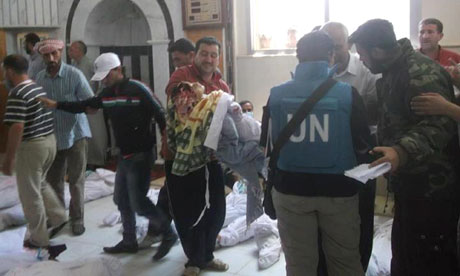
UN observers meet with victims of the Houla massacre. (Photo Courtesy of The Guardian)

General Robert Mood, head of the United Nations Supervision Mission in Syria (UNSMIS), confirmed the killing after UN observers viewed the victims’ bodies.  UN observers also confirmed artillery and tank shells were fired at Houla after examining ordnance found in the area.  According to Al Jazeera, witnesses have reported that government forces attacked Houla with mortars following anti-government protests.  Following the shelling, pro-government thugs known as Shabiha raided the area, killing men, women, and children.

The government of Syria denied involvement.  Foreign Ministry spokesman Jihad Makdissi told the official Syrian news agency, SANA, that the government “has categorically denied responsibility of the Syrian forces for the massacre.”  The government blamed the killing on “armed terrorist groups [where] clashes led to the killing of several terrorists and the martyrdom of several members of the special forces.”  Furthermore, it claimed that “brutal killing doesn’t belong to the ethics of the Syrian army.”

A statement released by the opposition Free Syrian Army (FSA) announced “that unless the UN Security Council takes urgent steps for the protection of civilians, Annan’s plan is going to go to hell.”  The FSA said it could no longer commit to the U.N.-brokered ceasefire, which went into effect on April 12, unless there was a swift response to the violence.  The massacre was one of the single deadliest incidents to have taken place during the fourteen-month-old uprising against the regime of President Bashar al-Assad.

UN Secretary-General Ban Ki-moon and the Joint Special Envoy of the UN and the League of Arab States for Syria, former Secretary-General Kofi Annan, released a joint statement declaring that “this appalling and brutal crime involving indiscriminate and disproportionate use of force is a flagrant violation of international law and of the commitments of the Syrian Government to cease the use of heavy weapons in population centres and violence in all its forms.”  Additionally, the statement declared that “those responsible for perpetrating this crime must be held to account.”

In response to the violence in Syria, the Security Council created UNSMIS in April 2012.  However, the violence and bloodshed have yet to stop, even after 270 unarmed military observers were deployed in support of Annan’s six-point plan.  The plan calls for “an end to violence, access for humanitarian agencies to provide relief to those in need, the release of detainees, the start of inclusive political dialogue that takes into account the aspirations of the Syrian people, and unrestricted access to the country for the international media.”  Over the past fourteen months, the UN estimates that more than 9,000 people, mostly civilians, have been killed in Syria, with tens of thousands having been displaced.

For more information, please see:

Al Jazeera – UN confirms ‘massacre’ of children in Houla – 27 May 2012

The Washington Post – Syrian government denies blame in attack that killed dozens, including 32 children – 27 May 2012

BBC News – Syria crisis: Houla child massacre confirmed by UN – 26 May 2012

United Nations News Centre – Syria: UN officials deplore ‘brutal’ killing of civilians near Homs – 26 May 2012

Colombian FARC Kidnap 13 Teens and Execute 13 Year-Old Girl for Desertion

By Emilee Gaebler
Impunity Watch Reporter, South America

BOGOTA, Columbia – In the southern province of Putumayo, 13 teenagers were pulled out of boarding schools by FARC forces.  The teens taken were primarily young girls.  They will now be forced to join the forces of the insurgency.

Teen recruits in the FARC forces. (Photo Courtesy of Latin American Herald Tribune)

Prominent activist and Andean parliamentary member, Gloria Inez Florez, reported the kidnappings.  She stated that the forces burst into various schools in the neighborhood and forcibly removed the teens.  Florez confirmed that the majority taken were girls, and that they were all between  the ages of 13 years-old and 15 years-old.  She could not confirm how many were indigenous.

“[Boarding schools] have become places of protection for school-boys and -girls, given the serious conditions of the armed conflict,” said Florez.  Unfortunately, this new practice, of securing children in boarding schools, appears to have come to the notice of FARC forces with the recent kidnapping.

The FARC’s recruitment of children is a violation of international humanitarian laws that prohibit the recruitment of children into armed forces.  The Colombian Family Welfare Institute (ICBF) sent delegates to confirm the situation and investigate the allegations of children being kidnapped from the rural communities.  ICBF director, Diego Molano made the statement that the agency’s findings are conclusive that there is child recruitment taking place in the southern rural regions.

Not only are the FARC recruiting teens, but the large majority of them are young girls, demonstrated by the recent kidnapping of the 13 students being primarily young girls.  A 13 year-old girl was ordered to be executed by the FARC leader in the province of Tolima because she had fled the ranks.  Upon her escape she said that she had fled due to mistreatment, including sexual abuse.  Her mother however turned her right back over to the group and her execution was immediately ordered.

General Guillermo Suarez, the commander in charge of the Southern Task Force in Tolima, hopes that the murder of the girl will act as a wake-up call to families in the area who willingly hand over adolescents in exchange for farmland, thus fostering the forced recruitment practices.  ICBF director in the Tolima region, Carlos Eduardo Buenaventura says that authorities need to conduct an in-depth investigation and punish those responsible, including the murdered girl’s mother for putting her at risk.

Ilva Miriam Hoyos, the prosecutor delegate for children and adolescents, made a request that the Colombian Victim’s Law legislation include a section on child soldiers.  The legislation allows for compensations to be made to victims of the long-standing armed conflict.  Hoyos hopes that the government will be able to make an exact determination of the number of minors working in the FARC and provide compensation to them and their families.


For further information, please see;

Latin American Herald Tribune – Colombian Guerillas Kill Teen Girl for Desertion – 24 May 2012

Colombia Reports – FARC Recruits 13 Minors in Southern Colombia – 21 May 2012

Hispanically Speaking News – Rebels Recruited Teens Against Their Will in Colombia – 19 May 2012

Latin American Herald Tribune – Colombian Rebels Forcibly Recruited Teens, Activist Says – 19 May 2012

Notes from Kampala: Food as a Vehicle for Culture

By Reta Raymond
Associate Special Features Editor

After writing about some of the brighter aspects about Ugandan culture in my last note, I want to continue this trend for one more week and share my notes on a favorite topic—Ugandan food!
My mother is a chef, so food has always been an important part of my life.  I thought I’d write this article about the different foods that I encountered in Uganda through birthday parties, good-bye feasts, and daily lunches at the law firm.  Generally, Ugandan cuisine is very carbohydrate heavy and a little bland, but I found my favorites quickly!

Notes from Kampala: Food as a Vehicle for Culture
Notes from Kampala: Food as a Vehicle for Culture (Photo by Reta Raymond)

The one thing I learned from my mother is that you must eat other people’s cooking.  In Uganda, I always felt as though I was under the microscope around mealtimes.  Joel, the guesthouse manager, would cook dinners for us, which ranged from pancakes (our favorite) to cinnamon flavored meat stew (I would eat rice).  When he found that someone wasn’t eating his food, he’d be angry and would rebut our protests of certain foods with, “I know what Muzungus like to eat!”  So he would serve what he thought was the “Muzungu” (white people) version of Ugandan food.  For example, Ugandans will typically eat rice, posho (a slightly sweet porridge/mashed potatoes equivalent), matoke (steamed mashed plantains), beans, and meat stew for one meal.  Joel would translate this into rice, mashed potatoes, French fries, pasta, and fried chicken.  There were always at least three different types of carbohydrates at every meal.

At the law firm, the whole firm would eat at the same time.  We would all line up outside the kitchen down the hall and serve up traditional Ugandan food that was made by a former employee and brought in.  It was pretty much the same meal, every day.  Rice, beans, matoke, posho, beans, maybe some steamed bitter greens and meat stew.  It was quite well made, and I always ate in for the social aspects of it, as well as to be polite.  But I can’t lie: I haven’t eaten beans since the summer.  However, I did find the posho to be kind of good, probably because I like sweet things and it had a vaguely sweet taste.  After reading up on the nutritional content online, my eyes nearly popped out of my head.  Posho is a food that is used to rehabilitate starving people, as it has nearly 300 calories per half cup.  A 300-calorie serving goes a long way for a short girl that sits in an office all day.

One weekend I ended up spending the day at my friends’ goodbye “dinner” at their bosses’ modest middle-class home in a suburb of Kampala.  It turned out to be an eight-hour feast with nearly two-dozen different dishes served.  The boss’ girlfriend and his sister served and prepared the food, kneeling to the men when they were serving them.  The women stayed in the kitchen nearly the entire visit.  We were asked to be there at noon, but didn’t eat until at least six.  In addition to the already mentioned typical Ugandan foods, there was also chapatti (a thin spongy pancake-like bread, similar to Ethiopian injera) and many different types of stews and steamed, starch vegetables wrapped in banana leaves.  They also served plates of spaghetti noodles for a Muzungu carbohydrate, and then there was Ugandan spiced cake and brandy at the end.  It was a feast for ten Ugandan kings and three Muzungu girls.

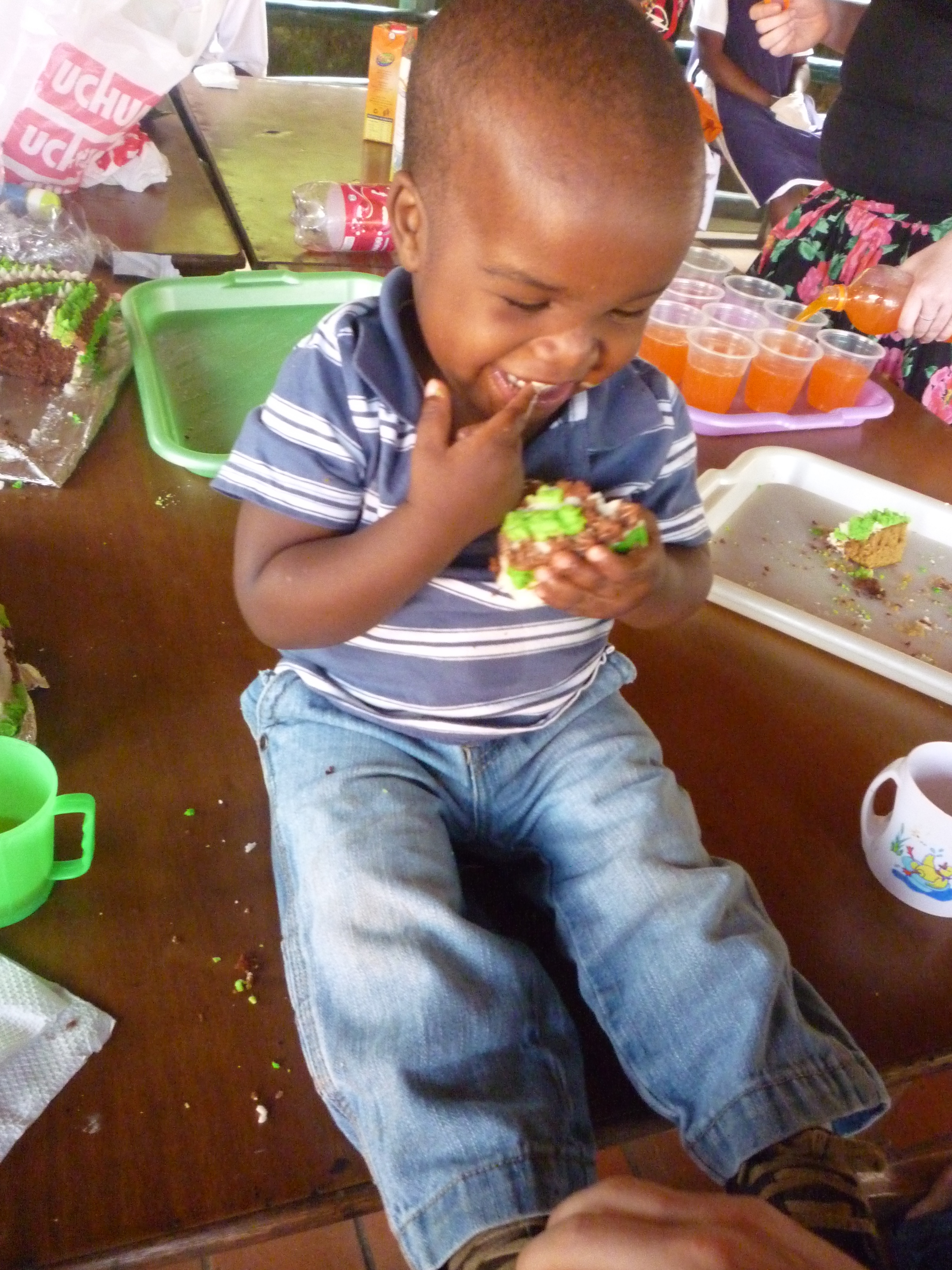
I would also attend parties at the babies home (a Ugandan orphanage for children under four-years-old) next door to my guesthouse.  These usually occurred when the children were baptized or if one was leaving because they had been adopted.  The typical party would involve soda for the children (I was astonished that children under four-years-old were given soda), samosas, and a Ugandan spiced cake, which is similar to carrot cake.  Drum playing, singing, and dancing would eventually follow with the caffeine and sugar rushes.

Notes from Kampala: Food as a Vehicle for Culture (Photo by Reta Raymond)

I cannot say that I was the biggest fan of most Ugandan food, except for chapatti and posho.  I was always a little afraid of the meat—the meat shops on the street smelled like death—but I did enjoy the experience of trying these new and different foods, even if they didn’t end up being my favorite.  And even when I couldn’t communicate well with a particular host or their family, and regardless of where I was in Uganda, it did make people happy to see that the silly Muzungu girl was eager to try the local food.

In retrospect, I guess I could have survived off trail mix, beef jerky, and peanut butter from America, like one of my housemates did.  However, the irony was that she got the stomach flu, and I, who always ate the food, never got sick!

Syrian Human Rights Violations Report: 19 May 2012

Idleb | Khan Shaikhoun

A mass grave of 35 victims, killed in the Khan Shaikhoun massacre the previous day, and the families are burying them in the dark of night out of fear of the security forces.

Homs | Arrastan

The children of Arrastan are soaked with blood due to the continuous shelling for the seventh consecutive day.

Idleb | Khan Shaikhoun

A clip showing how the residents were trying to save one of the United Nation monitors from the security forces fire.  They are pulling him and saving him while the residents lost at least 38 victims, killed in this massacre on 15 May, 2012.

Hama | Al-Arba’een

An important clip showing members of the army transferring ammunition from a military car and placing it in a storage room; when one member saw the person capturing the scene, he fired at him.

*WARNING: GRAPHIC CONTENT*

Homs | Ashammas

A brutal attack was launched in the middle of the night by the security forces against the Babo Amro neighborhood.  Many displaced residents of Baba Amro fled to  the Ashammas neighborhood.  They were fleeing from death in Baba Amro only to face killing, detention and torture in the Ashammas neighborhood as well.  Regime forces killed at least 21 people and more than 100 were detained.  


Casualty Report

26 confirmed casualties killed by the regime in Syria on Friday, 18 May 2012.

*Including a defected soldier, one old man, two kids, and four women.*

Homs: 8
Dar’aa: 2
Hama: 2
Damascus & Damascus Suburbs: 4
Idlib: 6
Aleppo: 3
Deir Ezzour: 1

37 confirmed casualties killed by the regime in Syria on Thursday, 17 May 2012.

*Including a two defected soldiers, one old woman, three children, and two victims of torture.*

Homs: 10
Dar’aa: 3
Al-Rakka: 1
Damascus & Damascus Suburbs: 13
Idlib: 4
Aleppo: 3
Deir Ezzour: 2
Al-Suweida: 1


Videos and Statistics Courtesy of :

Syrian Network of Human Rights – Casualty Report – 18 May 2012

Syrian Network of Human Rights – Violations Report – 18 May 2012

Syrian Network of Human Rights – Casualty Report – 17 May 2012

Syrian Network of Human Rights – Violations Report – 17 May 2012