Child Torture Revelations in Syrian Conflict

By Tyler Yates
Impunity Watch Reporter, Middle East

DAMASCUS, Syria — In a twisted development to an already aberrant conflict, there is news that Syrian authorities have been detaining and torturing children.  This is coupled with previous reports that the Syrian military has routinely raped women, tortured detainees, shot unarmed civilians, and encouraged looting of houses they storm.  There have been (unconfirmed, as of yet) stories of the Syrian opposition army employing child soldiers.

The individual stories of child torture are shocking.

13 Year Old Hossam is one of many children that has been tortured by the Syrian army (Photo courtesy of Salon).

Hossam, a 13 year-old boy, talks of the “ultimate pain” of his torture when a “terrifying person” with a “huge body” drove a screwdriver up into his big toe nail before ripping it out with pliers.  The man screamed, “’You want freedom? You want to topple the regime?’” as he beat the boy.

Mohammed, a 16-year old from Duma, was tortured with electricity after being arrested, and telling his captors that he supported a Syria that benefits all Syrians.  He was beaten with a cable two or three times a day, and electrocuted on his chest, hands, legs, neck, and on his stomach, close to his genitals.

Pure physical torture of children does not cover the extent of the stories coming out of Syria.

Ayman Karnebo, a dissident who was arrested last May when the uprising against Syrian President Bashar al-Assad began, witnessed the Syrian security forces torturing a pregnant mother, her husband, and her husband’s mother in front of the couple’s infant sons.  Karnebo was sharing a cell with them at the time.

He recalls that the family was of Somali origin; having been rounded up after the revolt took hold.  All foreigners were viewed with suspicion by the Assad government, leading many, like this family, to be detained and questioned.

Karnebo describes all three adults as being tortured with electric shocks to the elbows, hands and toes in front of their terrified children.  After this round of torture the family was moved to another jail.  Their fate remains unknown.

The Assad regime has long been known for its systematic and widespread use of torture, but these new revelations have still come as a surprise.

Amnesty International recently identified 31 methods of torture being employed by Syrian authorities. Some methods have been in use for decades, include the “tire,” where the victim is forced into a large tire and beaten on the feet. There is also the “flying carpet,” where the prisoner is strapped face-up on a wooden board that is bent to stretch the spine.

There are relatively unknown apparently new and even more disturbing techniques, including using pincers to rip out flesh, anal rape with sharp objects and a form of crucifixion where the prisoner is hung from a wall by their wrists.

“The biggest lie of the regime is that there are no orders to torture,” a defected former member of Syrian Air force Intelligence told GlobalPost. “It’s a program, a routine. I saw an old man with a 6-year-old girl brought to the interrogation department. Just five minutes of what she saw there, the screams she heard will surely traumatize her for the rest of her life.”

Navi Pillay, the United Nations’ human rights chief believes that the UN Security Council has enough reliable information to refer Syria’s actions to the International Criminal Court (“ICC”).

“They’ve gone for the children — for whatever purposes — in large numbers,” the BBC quoted her as saying. “Hundreds detained and tortured… it’s just horrendous…Children shot in the knees, held together with adults in really inhumane conditions, denied medical treatment for their injuries, either held as hostages or as sources of information…I feel that investigation and prosecution is a crucial element to deter and call a stop to these violations.”

Syria is not a party to the ICC, so unless Damascus refers itself to the court’s jurisdiction, the only other way for ICC jurisdiction to be created is by a UN Security Council vote.  Given the previous vetoes by Russia and China on resolutions concerning Assad’s violent crackdown such actions are unlikely.

The United States, for its part, is urging the Syrian opposition to unite and pledge to respect minority rights should they eventually push Assad out of power.

“They must be able to clearly demonstrate a commitment to including all Syrians and protecting the rights of all Syrians,” US Secretary of State Hillary Clinton said.

More than 9,000 people have been killed in the yearlong Syrian uprising.  Both the opposition and the Syrian government have been accused of human rights abuses during the conflict, drawing international flack from NGOs and other countries alike.

A supposed cease-fire between the opposition and the Syrian government, brokered by the United Nations, is scheduled to start on April 14, but its already shaky future is now further in doubt as the Syrian government is now claiming its conditions were misunderstood.

 For more information, please see:

Miami Herald — Syria puts new conditions on cease-fire — 08 April 2012

Business Mirror — Torture of children, rape by Syrian army ‘routine,’ ex-soldiers say — 07 April 2012

Independent — Syrians tortured parents in front of terrified children — 07 April 2012

Salon — Syria’s tortured children — 04 April 2012

Kansas City Star — Torture of children, rape by Syrian army ‘routine,’ ex-soldiers say — 02 April 2012

The Independent — Assad’s forces target children, says UN envoy — 29 Mar. 2012

MSNBC — Syria is torturing children, UN human rights chief says — 28 Mar. 2012


Bahrain’s Hunger Striker Moved To Hospital Rather Than Released

By Carolyn Abdenour
Impunity Watch Reporter, Middle East

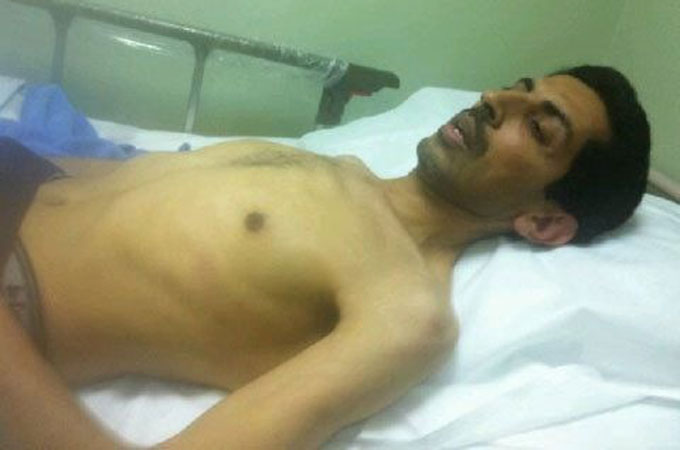
MANAMA, Bahrain – On Friday, 6 April, Bahraini and Danish citizen Abdulhadi al-Khawaja began receiving intravenous fluids to combat his 58-day hunger strike when authorities moved him to the Bahrain Defence Force Hospital.  Mr. Khawaja began his hunger strike to protest the life sentence he received by a special military court for engaging in anti-government protests last year.  The court convicted him of attempting to overthrow the royal family.

Abdulhadi al-Khawaja in his hospital bed on Saturday.  (Photo Courtesy of Al Jazeera).
Abdulhadi al-Khawaja in his hospital bed on Saturday. (Photo Courtesy of Al Jazeera).

Mr. Khawaja’s lawyer Mohammed al-Jishi reported his client’s health is deteriorating, and the authorities moved him to the hospital after he dropped twenty-two pounds.  Mr. Jishi stated, “His condition has worsened…his blood pressure is down, and he is getting an IV (intravenous) drip.”  He added the IV drip only contained saline and glucose, and “The doctors said this won’t be enough to keep him alive.  He is in a critical phase and he still needs to take food.”

His family fears he will die from an impending cardiac arrest and urges the government to take action to save his life.  Furthermore, Khadija Almouosawi, Mr. Khawaja’s wife, asserts the nurses and guards mistreated her husband in the military hospital.

Human rights groups are also advocating for Mr. Khawaja’s release.  Mr. Khawaja is a Danish citizen, and Denmark has requested Bahrain to transfer Mr. Khawaja into its custody for medical treatment.

Moreover, authorities detained Mr. Khawaja’s daughter Zainab on Thursday for protesting her father’s “illegal treatment”.  On Friday, the authorities transferred Zainab to a prison before releasing her on Saturday.

Furthermore, thousands of protesters calling for Mr. Khawaja’s release endured the teargas and water cannons security forces fired upon them on Friday.  These protesters have held daily rallies, and they have planned mass demonstrations supporting their fellow protester’s release.

The authorities arrested Mr. Khawaja last April after a protest at Pearl Roundabout in Manama, Bahrain’s capital.  Protests occurred in Bahrain when police and security forces confronted people peacefully occupying the roundabout.

Amnesty International asserts the court convicted Mr. Khawaja in June with a confession obtained under duress and without proper evidence demonstrating he relied on violence during the protests.  Mr. Khawaja was one of eight protestors who received life sentences for their charged crimes.  Mr. Khawaja also reported to the Bahrain Independent Commission of Inquiry he endured tortious acts throughout his detention.

After her release, Zainab tweeted, “My father just called, he can hardly speak, and he can hardly breath(e).”

For further information, please see:

Al Jazeera – Bahrain Mulls Denmark Plan For Hunger Striker – 7 Apr 2012

Channel 4 News – Calls To Drop F1 Grow as Bahrain Hunger Striker Hotpialised – 7 Apr 2012

BBC – Bahrain Hunger-Striker al-Khawaja Moved to Hospital – 6 April 2012

Tehran Times – Bahrain Hunger Striker’s Daughter Jailed – 6 Apr 2012

Argentina Takes Steps Forward, 18 Years Later Ex-President Menem to Stand Trial for Cover-Up in AMIA Bombing

by Emilee Gaebler
Impunity Watch Reporter, South America

BUENOS AIRES, Argentina – A former Argentinian President will finally stand trial for the corruption scandals he was tied to during his terms in office.  Carlos Menem was directed to stand trial last week, by federal judge Ariel Lijo, for his involvement in the 1994 bombing of the Argentine Jewish Mutual Association (AMIA) building.

Carlos Menem to stand trial for tampering with evidence in worst terrorist attack ever to take place in Argentina. (Photo Courtesy of J Space)

The 1994 bombing completely wiped out the seven-story building.  There were 85 deaths, and more than 300 people injured, when a truck loaded with explosives drove straight into the structure.  Argentina, has the largest community of Jewish citizens in the Americas, outside the United States.

At the time, Argentinian prosecutors said the attack was planned and paid for by Iran who hired the Lebanese militant group Hezbollah to carry it out.  Iran has adamantly denied any involvement.  Following the bombing relations between Iran and Argentina were completely frozen.  Argentina sought for years to extradite eight Iranian officials who allegedly masterminded the bombing.  No conviction, or even trial has ever been held regarding the attack.

In 2009 Menem was first accused of concealing and tampering with evidence that indicated the attack at AMIA had a Syrian connection.  Menem is the child of two Syrian immigrants.  A close family friend who died in 2010, Alberto Kanoore Edul, a Syrian-Argentine businessman, is alleged to have been involved.  It is believed that Menem ordered his staff to destroy evidence that linked Edul to the attack.

Judge Lijo has also issued that former judge Jose Galeano, who was in charge of the investigation, stand trial.  Menem is accused of pressuring Galeano to abandon further inquiries into Edul’s involvement.  Other officials also called to stand trial were: the former head of state intelligence, Hugo Anzorreguy; his deputy Juan Carlos Anchezar; former police chief Jorge Palacios; and a former federal police agent.

The Israel UN envoy in the US praised this “re-energizing” action and gave Argentina credit for rechecking the facts and trying to clear up and close the case.  In the past 18 years almost nothing has been done to investigate the attack.

Menem served two-terms as President of Argentina.  He was a member of the Peronist party and in the beginning he was very popular with the public.  However, his popularity decreased as his personal scandals and tough free-market policies alienated him from the public.  Corruption scandals emerged towards the end of his second-term, including charges of smuggling arms to Ecuador and Croatia in the 1990s.  He was recently cleared of these charges.


For more information, please see;

Buenos Aires Herald – AMIA Inquiry: Judge Announces Menem, Galeano to Stand Trial – 7 April 2012

J Space – Ex-Argentinian President to Stand Trial for AMIA Attack – 2 April 2012

Merco Press – Former President to Stand Trial in Relation to Argentina’s Deadliest Terrorist Attack – 1 April 2012

European Jewish Press – AMIA Bombing: Argentina’s Carlos Menem to be Tried for Obstruction – 31 March 2012

BBC – Argentina’s Carlos Menem Faces Bombing Trial – 30 March 2012

Amnesty International Slams Russian Government’s Posthumous Prosecution Of Sergei Magnitsky

Hermitage Capital Press Release
Originally Sent April 6, 2012

On the eve of April 8th, which would have been the 40thbirthday of the late Russian whistle-blowing lawyer Sergei Magnitsky, Amnesty International has publicly called on the Russian Government to stop his posthumous prosecution, and to bring his oppressors and those pressuring his family to justice.

“On 8 April 2012, lawyer Sergei Magnitsky would have turned forty. He died over two years ago, after months of ill-treatment and having suffered multiple human rights violations. For many in Russia and beyond, his death in custody in November 2009 has come to symbolize the injustices associated with Russia’s malfunctioning criminal justice system and widespread corruption,” said Amnesty International in its public statement. (http://www.amnesty.org/en/library/asset/EUR46/015/2012/en/6f21ef79-67fe-4014-a084-0f3e8fe8e95f/eur460152012en.pdf).

Amnesty International stressed in its statement that the Russian justice system has consistently failed to protect Sergei Magnitsky and his family from gross rights abuses.

“The [Russian] justice system has not only failed to uphold and protect his rights, but it has also been abused since to continue to violate his, and now his family’s rights in the form of his posthumous criminal prosecution, and by trying to force his close relatives to take part in this process,” said Amnesty International.

Amnesty International described the posthumous prosecution of a dead lawyer as a violation of international and national laws, and demanded that the Russian government stop the posthumous prosecution and stop pressuring his family.

“Amnesty International is calling on the Russian authorities to take immediate steps to rectify these injustices and stop the posthumous criminal prosecution of Sergei Magnitsky, and bring all those responsible for his death to justice,” said Amnesty International in its statement.

Amnesty International went on to say:

“Sergei Magnitsky’s relatives…and Russian and international human rights law regard him as innocent in virtue of the principle of the presumption of innocence, and no court decision is needed to confirm this…The posthumous criminal prosecution of Sergei Magnitsky must stop, and the pressure on his family in connection with their objections to this must cease.”

The Magnitsky family has been unable to stop his posthumous prosecution through the Russian legal system in spite of over 25 petitions filed with the Russian General Prosecutor’s Office, the Russian Interior Ministry and the Moscow courts protesting the illegality of the prosecution. All  petitions have been denied by the authorities. Earlier this week, on 3 April 2012, Judge Yulia Bobrova of the Ostankinsky District Court of Moscow approved the decision of the prosecutors to open a case against Sergei Magnitsky after his death in spite of the fact that he can’t defend himself. Judge Bobrova also sided with prosecutors allowing them to continue to treat Magnitsky’s mother and widow as defendants in this case.

The Russian court system has denied Sergei Magnitsky and his family any measure of justice. Last year, 14 Russian judges, including the chair of the Moscow City Court, Olga Egorova, refused all petitions from the Magnitsky family seeking access to his case file and to his tissue samples for an independent medical examination. When Sergei Magnitsky was still alive, 11 Russian judges rejected his 40 petitions about his unlawful arrest and repression by the officers he had accused of $230 million corruption.

In spite of the findings of gross human rights violations by the Russian President’s Human Rights Council, the Russian Interior Ministry and General Prosecutor’s Office “established no wrong-doing” in the actions of law enforcement officials who arrested and tortured Sergei Magnitsky to death in custody.

Amnesty International is now demanding that the allegations of the arbitrary criminal prosecution of Sergei Magnitsky made by the human rights activists are investigated “immediately, effectively and impartially”, and that “all those found responsible brought to justice”.

So far all Russian investigations in this case remain under control of Viktor Grin, Deputy General Prosecutor of Russia and Number 33 on the U.S. Helsinki Commission list of Russian officials involved in the torture and murder of Sergei Magnitsky and the corruption he had uncovered. Viktor Grin ordered the posthumous prosecution of Sergei Magnitsky on 30 July 2011, which was three days after he and other Russian officials were banned by US State Department for their role in the Magnitsky case, and was seen as an act of personal retaliation.

The case is also controlled by first deputy chief of the Interior Ministry’s Investigative Department Tatiana Gerasimova, who was named by the U.S. Senators last November for her role in the Magnitsky case in a petition to the U.S. State Department seeking to ban her U.S. visa.

“In pursuing the posthumous case against Sergei Magnitsky, Russian authorities have rejected the conclusions from the Russian President’s Human Rights Council. It is clear that no justice is possible and no investigation can be impartial and independent as long as it remains controlled by the same officials and bodies who committed crimes against him. To recognise that Magnitsky was right for them, means to recognise that they themselves had been wrong and committed grave crimes,” said a Hermitage Capital representative.


For further information please contact:

Hermitage Capital

Phone:             +44 207 440 17 77

E-mail:             info@lawandorderinrussia.org

Website:          http://lawandorderinrussia.org

Facebook:        http://on.fb.me/hvIuVI

Twitter:           @KatieFisher__

Livejournal:     http://hermitagecap.livejournal.com/

Statement on Sergei Magnitsky on Amnesty International’s website:

http://www.amnesty.org/en/library/asset/EUR46/015/2012/en/6f21ef79-67fe-4014-a084-0f3e8fe8e95f/eur460152012en.pdf