Banda Sworn in as New Malawi President; Vows Reform

By Zach Waksman
Impunity Watch Reporter, Africa

LILONGWE, Malawi – Joyce Banda was sworn in as Malawi’s first female president on Saturday, a week after the death of President Bingu wa Mutharika, whose party expelled her after a disagreement over whether his brother Peter could succeed him.  The former vice president takes on the task of rebuilding a crumbling economy and restoring confidence in government.

“The first priority would be to revamp the economy and ensure that there is good governance,” said Banda.  “I know this is a great challenge but I thank all Malawians for having confidence in me.”

She took her first steps in that process on Monday, firing Police Inspector General Peter Mukhito.  Once hailed by Mutharika as the best IG Malawi ever had, Mukhito’s departure came as a surprise to some.  Banda’s administration did not provide an explanation, but his handling of recent events may have been a factor.  The country faced anti-government protests about the economy last July.  In response to the rallies, Malawian police fired into the crowds, killing at least 19 people.

Mukhito garnered fame for his questioning a lecturer about his comparisons between the Arab Spring uprisings and the country’s fuel crisis last year.  The incident escalated to the point that Chancellor College, part of the University of Malawi, was forced to close.  According to the People’s Party (PP) Orange Intellectuals, the youth wing of Banda’s political party, the conflict over academic freedom raged for eight months.  It welcomed the change in leadership.

“This could not have come at a better time,” said National Coordinator Edgar Chipalanjira, a student at the since-reopened Chancellor College.  “Honestly, it was hell under the former IG who was ironically dubbed ‘finest ever’ by the late President.  Those were the days no Malawian would wish to experience again.”

Banda has appointed commissioner Lot Dzonzi to replace Mukhito.

She will face a stiffer challenge on economic issues.  In the year before his death, Mutharika had a falling out with the United Kingdom, who cut off its aid to Malawi.  This has contributed to a shortage of foreign currency, as Mutharika also had poor relations with the International Monetary Fund and the World Bank.  Despite these hurdles, and her party’s lack of representation in Parliament, the government does not expect much political wrangling.

“We would like to help the new president to rebuild the country. Malawi at the moment is confronted by several challenges and the new needs support from lawmakers. By working with her, Malawians will benefit from development projects,” said an optimistic Ken Kandodo, the country’s former finance minister.  “We had [a] very smooth transition according to the Constitution. There were some people from the national governing council who wanted to disrupt this smooth process but have failed. We should all celebrate because democracy has triumphed.”

But government alone will not be enough to guarantee a successful turnaround.  Banda has emphasized the need to reestablish relations with foreign exchanges and to build up its own industries once again.

“The economy is on a downward spiral with challenges of availability of foreign exchange, fuel shortages and failure to pay civil servant on time or at all,” Banda said last May.  “The private sector is constrained to take an active role.  The country needs to urgently find alternative sources of foreign exchange.”

For more information, please see:

BBC — Malawi’s New President Sacks Police Chief Mukhito — 9 April 2012

Daily Times (Malawi) — Banda Tipped on Priorities — 9 April 2012

Daily Times (Malawi) — Industry Hopeful with New Regime — 9 April 2012

Nyasa Times — PP “Intellectuals” Hail Appointment of New Police Chief — 9 April 2012

Malawi Voice — Inspector of Police Mukhito Fired; Dzonzi Takes Over — 8 April 2012

New York Times — In Mourning, Malawi Swears in a New President — 7 April 2012

Child Torture Revelations in Syrian Conflict

By Tyler Yates
Impunity Watch Reporter, Middle East

DAMASCUS, Syria — In a twisted development to an already aberrant conflict, there is news that Syrian authorities have been detaining and torturing children.  This is coupled with previous reports that the Syrian military has routinely raped women, tortured detainees, shot unarmed civilians, and encouraged looting of houses they storm.  There have been (unconfirmed, as of yet) stories of the Syrian opposition army employing child soldiers.

The individual stories of child torture are shocking.

13 Year Old Hossam is one of many children that has been tortured by the Syrian army (Photo courtesy of Salon).

Hossam, a 13 year-old boy, talks of the “ultimate pain” of his torture when a “terrifying person” with a “huge body” drove a screwdriver up into his big toe nail before ripping it out with pliers.  The man screamed, “’You want freedom? You want to topple the regime?’” as he beat the boy.

Mohammed, a 16-year old from Duma, was tortured with electricity after being arrested, and telling his captors that he supported a Syria that benefits all Syrians.  He was beaten with a cable two or three times a day, and electrocuted on his chest, hands, legs, neck, and on his stomach, close to his genitals.

Pure physical torture of children does not cover the extent of the stories coming out of Syria.

Ayman Karnebo, a dissident who was arrested last May when the uprising against Syrian President Bashar al-Assad began, witnessed the Syrian security forces torturing a pregnant mother, her husband, and her husband’s mother in front of the couple’s infant sons.  Karnebo was sharing a cell with them at the time.

He recalls that the family was of Somali origin; having been rounded up after the revolt took hold.  All foreigners were viewed with suspicion by the Assad government, leading many, like this family, to be detained and questioned.

Karnebo describes all three adults as being tortured with electric shocks to the elbows, hands and toes in front of their terrified children.  After this round of torture the family was moved to another jail.  Their fate remains unknown.

The Assad regime has long been known for its systematic and widespread use of torture, but these new revelations have still come as a surprise.

Amnesty International recently identified 31 methods of torture being employed by Syrian authorities. Some methods have been in use for decades, include the “tire,” where the victim is forced into a large tire and beaten on the feet. There is also the “flying carpet,” where the prisoner is strapped face-up on a wooden board that is bent to stretch the spine.

There are relatively unknown apparently new and even more disturbing techniques, including using pincers to rip out flesh, anal rape with sharp objects and a form of crucifixion where the prisoner is hung from a wall by their wrists.

“The biggest lie of the regime is that there are no orders to torture,” a defected former member of Syrian Air force Intelligence told GlobalPost. “It’s a program, a routine. I saw an old man with a 6-year-old girl brought to the interrogation department. Just five minutes of what she saw there, the screams she heard will surely traumatize her for the rest of her life.”

Navi Pillay, the United Nations’ human rights chief believes that the UN Security Council has enough reliable information to refer Syria’s actions to the International Criminal Court (“ICC”).

“They’ve gone for the children — for whatever purposes — in large numbers,” the BBC quoted her as saying. “Hundreds detained and tortured… it’s just horrendous…Children shot in the knees, held together with adults in really inhumane conditions, denied medical treatment for their injuries, either held as hostages or as sources of information…I feel that investigation and prosecution is a crucial element to deter and call a stop to these violations.”

Syria is not a party to the ICC, so unless Damascus refers itself to the court’s jurisdiction, the only other way for ICC jurisdiction to be created is by a UN Security Council vote.  Given the previous vetoes by Russia and China on resolutions concerning Assad’s violent crackdown such actions are unlikely.

The United States, for its part, is urging the Syrian opposition to unite and pledge to respect minority rights should they eventually push Assad out of power.

“They must be able to clearly demonstrate a commitment to including all Syrians and protecting the rights of all Syrians,” US Secretary of State Hillary Clinton said.

More than 9,000 people have been killed in the yearlong Syrian uprising.  Both the opposition and the Syrian government have been accused of human rights abuses during the conflict, drawing international flack from NGOs and other countries alike.

A supposed cease-fire between the opposition and the Syrian government, brokered by the United Nations, is scheduled to start on April 14, but its already shaky future is now further in doubt as the Syrian government is now claiming its conditions were misunderstood.

 For more information, please see:

Miami Herald — Syria puts new conditions on cease-fire — 08 April 2012

Business Mirror — Torture of children, rape by Syrian army ‘routine,’ ex-soldiers say — 07 April 2012

Independent — Syrians tortured parents in front of terrified children — 07 April 2012

Salon — Syria’s tortured children — 04 April 2012

Kansas City Star — Torture of children, rape by Syrian army ‘routine,’ ex-soldiers say — 02 April 2012

The Independent — Assad’s forces target children, says UN envoy — 29 Mar. 2012

MSNBC — Syria is torturing children, UN human rights chief says — 28 Mar. 2012


Bahrain’s Hunger Striker Moved To Hospital Rather Than Released

By Carolyn Abdenour
Impunity Watch Reporter, Middle East

MANAMA, Bahrain – On Friday, 6 April, Bahraini and Danish citizen Abdulhadi al-Khawaja began receiving intravenous fluids to combat his 58-day hunger strike when authorities moved him to the Bahrain Defence Force Hospital.  Mr. Khawaja began his hunger strike to protest the life sentence he received by a special military court for engaging in anti-government protests last year.  The court convicted him of attempting to overthrow the royal family.

Abdulhadi al-Khawaja in his hospital bed on Saturday.  (Photo Courtesy of Al Jazeera).
Abdulhadi al-Khawaja in his hospital bed on Saturday. (Photo Courtesy of Al Jazeera).

Mr. Khawaja’s lawyer Mohammed al-Jishi reported his client’s health is deteriorating, and the authorities moved him to the hospital after he dropped twenty-two pounds.  Mr. Jishi stated, “His condition has worsened…his blood pressure is down, and he is getting an IV (intravenous) drip.”  He added the IV drip only contained saline and glucose, and “The doctors said this won’t be enough to keep him alive.  He is in a critical phase and he still needs to take food.”

His family fears he will die from an impending cardiac arrest and urges the government to take action to save his life.  Furthermore, Khadija Almouosawi, Mr. Khawaja’s wife, asserts the nurses and guards mistreated her husband in the military hospital.

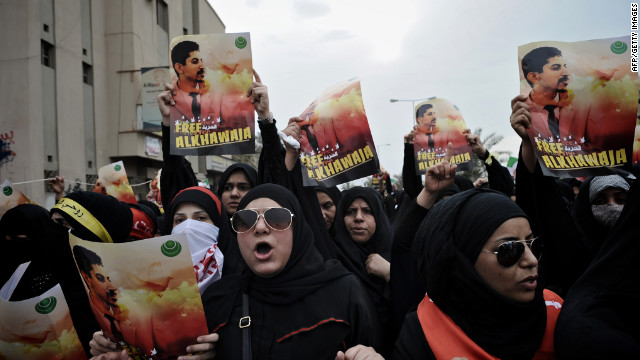
Human rights groups are also advocating for Mr. Khawaja’s release.  Mr. Khawaja is a Danish citizen, and Denmark has requested Bahrain to transfer Mr. Khawaja into its custody for medical treatment.

Moreover, authorities detained Mr. Khawaja’s daughter Zainab on Thursday for protesting her father’s “illegal treatment”.  On Friday, the authorities transferred Zainab to a prison before releasing her on Saturday.

Furthermore, thousands of protesters calling for Mr. Khawaja’s release endured the teargas and water cannons security forces fired upon them on Friday.  These protesters have held daily rallies, and they have planned mass demonstrations supporting their fellow protester’s release.

The authorities arrested Mr. Khawaja last April after a protest at Pearl Roundabout in Manama, Bahrain’s capital.  Protests occurred in Bahrain when police and security forces confronted people peacefully occupying the roundabout.

Amnesty International asserts the court convicted Mr. Khawaja in June with a confession obtained under duress and without proper evidence demonstrating he relied on violence during the protests.  Mr. Khawaja was one of eight protestors who received life sentences for their charged crimes.  Mr. Khawaja also reported to the Bahrain Independent Commission of Inquiry he endured tortious acts throughout his detention.

After her release, Zainab tweeted, “My father just called, he can hardly speak, and he can hardly breath(e).”

For further information, please see:

Al Jazeera – Bahrain Mulls Denmark Plan For Hunger Striker – 7 Apr 2012

Channel 4 News – Calls To Drop F1 Grow as Bahrain Hunger Striker Hotpialised – 7 Apr 2012

BBC – Bahrain Hunger-Striker al-Khawaja Moved to Hospital – 6 April 2012

Tehran Times – Bahrain Hunger Striker’s Daughter Jailed – 6 Apr 2012

Argentina Takes Steps Forward, 18 Years Later Ex-President Menem to Stand Trial for Cover-Up in AMIA Bombing

by Emilee Gaebler
Impunity Watch Reporter, South America

BUENOS AIRES, Argentina – A former Argentinian President will finally stand trial for the corruption scandals he was tied to during his terms in office.  Carlos Menem was directed to stand trial last week, by federal judge Ariel Lijo, for his involvement in the 1994 bombing of the Argentine Jewish Mutual Association (AMIA) building.

Carlos Menem to stand trial for tampering with evidence in worst terrorist attack ever to take place in Argentina. (Photo Courtesy of J Space)

The 1994 bombing completely wiped out the seven-story building.  There were 85 deaths, and more than 300 people injured, when a truck loaded with explosives drove straight into the structure.  Argentina, has the largest community of Jewish citizens in the Americas, outside the United States.

At the time, Argentinian prosecutors said the attack was planned and paid for by Iran who hired the Lebanese militant group Hezbollah to carry it out.  Iran has adamantly denied any involvement.  Following the bombing relations between Iran and Argentina were completely frozen.  Argentina sought for years to extradite eight Iranian officials who allegedly masterminded the bombing.  No conviction, or even trial has ever been held regarding the attack.

In 2009 Menem was first accused of concealing and tampering with evidence that indicated the attack at AMIA had a Syrian connection.  Menem is the child of two Syrian immigrants.  A close family friend who died in 2010, Alberto Kanoore Edul, a Syrian-Argentine businessman, is alleged to have been involved.  It is believed that Menem ordered his staff to destroy evidence that linked Edul to the attack.

Judge Lijo has also issued that former judge Jose Galeano, who was in charge of the investigation, stand trial.  Menem is accused of pressuring Galeano to abandon further inquiries into Edul’s involvement.  Other officials also called to stand trial were: the former head of state intelligence, Hugo Anzorreguy; his deputy Juan Carlos Anchezar; former police chief Jorge Palacios; and a former federal police agent.

The Israel UN envoy in the US praised this “re-energizing” action and gave Argentina credit for rechecking the facts and trying to clear up and close the case.  In the past 18 years almost nothing has been done to investigate the attack.

Menem served two-terms as President of Argentina.  He was a member of the Peronist party and in the beginning he was very popular with the public.  However, his popularity decreased as his personal scandals and tough free-market policies alienated him from the public.  Corruption scandals emerged towards the end of his second-term, including charges of smuggling arms to Ecuador and Croatia in the 1990s.  He was recently cleared of these charges.


For more information, please see;

Buenos Aires Herald – AMIA Inquiry: Judge Announces Menem, Galeano to Stand Trial – 7 April 2012

J Space – Ex-Argentinian President to Stand Trial for AMIA Attack – 2 April 2012

Merco Press – Former President to Stand Trial in Relation to Argentina’s Deadliest Terrorist Attack – 1 April 2012

European Jewish Press – AMIA Bombing: Argentina’s Carlos Menem to be Tried for Obstruction – 31 March 2012

BBC – Argentina’s Carlos Menem Faces Bombing Trial – 30 March 2012