Haiti Not Receiving Enough Humanitarian Aid to Combat Cholera Outbreak

By Brittney Hodnik
Impunity Watch Reporter, North America

PORT AU PRINCE, Haiti – Almost two years since the first reported case of cholera in Haiti, not much has changed.  The quick-acting intestinal illness has claimed thousands of lives in Haiti and many are wondering why more has not been done to help the struggling country.

The upcoming rainy season is going to only make the spread of cholera worse throughout Haiti. (Image courtesy of The New York Times)

Since October 2010, cholera has claimed the lives of 7,000 Haitians and has made over 530,000 others sick, according to NPR.  Literally one hundred thousand people are waiting to be vaccinated against cholera but the short funding has prevented this from happening.

Besides the cholera outbreak, the country never recovered from the devastating earthquake in 2010.

According to NPR, even with the plan for vaccination that the country has already laid out, only about 1% of the population will be vaccinated.  In order to really contain the outbreak, millions of people need to be vaccinated before next year’s rainy season.

Interestingly, the United Nations might be to blame for the entire cholera outbreak.  According to The New York Times, epidemiologic and microbiologic evidence suggests that United Nations peacekeeping troops imported cholera to Haiti and accidentally contaminated the tributary next to their base.  The troops came from Nepal and the contamination happened due to a faulty sanitation system.  Dr. Paul S. Keim says that the Haitian and Nepalese cholera strains are virtually identical, reports The New York Times.

The South Florida Caribbean News reports that the Haitian government and the United Nations alike are worried about the lack of humanitarian efforts in the country.  The humanitarian community seeks $231 million to fund effectively the island nation, and so far has only received about 8.5% of that amount.  The lack of funding has forced many humanitarian workers out of affected areas.

The upcoming hurricane season (May through November) brings even more worries for the countries.  The heavy rainfall only increases the spread of cholera.  According to The South Florida Caribbean News, resources are needed to overall improve access to clean water and maintain solid waste management systems, along with increasing preparedness ahead of hurricane season.

According to The New York Times, Anthony Banbury, a U.N. assistant secretary general said last week, “We don’t think the cholera outbreak is attributable to any single factor.”  Additionally, many believe that the prime time to suppress the epidemic passed long ago; now that it has had time to spread, the problem is becoming much more difficult to control.

So as Haitians continue to die from the dehydrating illness, humanitarian efforts will continue and hopefully expand.

For more information, please visit:

Newser — How Bickering Aid Workers Brought Cholera to Haiti — 1 Apr. 2012

South Florida Caribbean News — UN Concerned Over Funding for Humanitarian Services in Haiti — 1 Apr. 2012

The New York Times — Haiti’s Cholera Outraced the Experts and Tainted the U.N. — 31 Mar. 2012

NPR — In Haiti, Bureaucratic Delays Stall Mass Cholera Vaccinations — 27 Mar. 2012
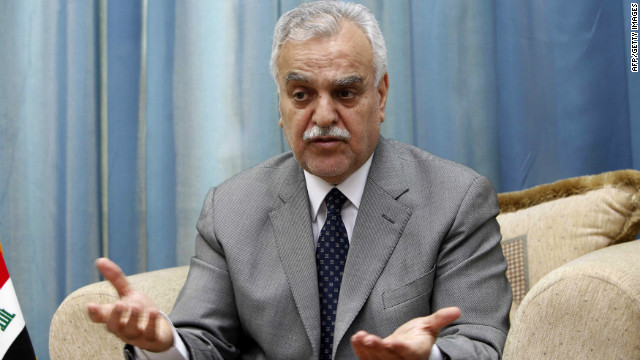
Fugitive Iraqi VP Travels to Qatar

By Tyler Yates
Impunity Watch Reporter, Middle East

BAGHDAD, Iraq — Tariq al-Hashimi, Iraq’s fugitive Sunni vice president, left the country on Sunday for a diplomatic visit to Qatar, despite being under an international travel ban imposed by the Iraqi government.  The development is likely to put a wrench in the Iraqi government’s recent attempts to repair ties with other Arab nations.

Tariq al-Hashimi, Iraq's fugitive VP (Photo courtesy of CNN).

Al-Hashimi has increasingly frustrated the Shi’ite led government in Baghdad, as he has thus far avoided their attempts to prosecute him on terrorism charges.

Last December, al-Hashimi fled to the semiautonomous Kurdish region of Iraq after the government accused him of using his bodyguards as a personal death squad and issued an arrest warrant.  For the last few months he has lived under the protection of Kurdish officials, who refuse to turn him over for a trial in Baghdad.

Al-Hashimi has denied all of the charges levied against him, and claims he is the victim of a political witch hunt.

This visit is the first time al-Hashimi has left Kurdistan since the issuance of his arrest warrant.

Iraqi officials are enraged that al-Hashimi was allowed to leave Iraq.

“How could they let him leave?” said Ali al-Moussawi, an adviser to Prime Minister Nuri Kamal al-Maliki. “He is prevented from traveling. This is a violation. And receiving him in Qatar is a violation.”

Al-Moussawi has called upon Interpol, the international police organization, to arrest the vice president.

Iraq has been making strides recently to portray itself as a stable, functioning country, mending rifts with its powerful Sunni Arab neighbors.

The Qatari prime minister recently expressed concern about the growing sectarianism in Iraq, and the disenfranchisement of the country’s Sunni minority.  Similar concerns have been expressed by other Sunni-led Gulf states, such as Saudi Arabia and the United Arab Emirates.

The Sunni Gulf states are also wary of the close ties Iraq’s government has formed with the Shi’ite state of Iran, which they see as a rival.

Al-Hashimi’s office has said that he does plan to return to his temporary headquarters in Kurdistan once he finishes his diplomatic travels.  Any attempt to re-enter Iraq will likely set off a struggle between Iraqi and Kurdish authorities over who controls the country’s airports, borders, and airspace.

Before official news of al-Hashimi’s travels emerged, al-Malawi issued a warning to other Arab states that afford him an official welcome.

“They must know that the accused is wanted by a country which is a member of the Arab league … so he is not supposed to be received as a vice president, which is a violation of the nature of the international relations,” he said.

For more information, please see:

Al Jazeera — Fugitive Iraq vice president arrives in Qatar — 1 April 2012

Boston Globe — Qatar: Iraq’s fugitive VP arrives for visit — 1 April 2012

CNN — Iraqi VP visits Qatar despite travel ban — 1 April 2012

New York Times — Iraq’s Fugitive Vice President Travels to Qatar — 1 April 2012

The Guardian — Fugitive Iraqi vice-president Tariq al-Hashemi travels to Qatar — 1 April 2012


NGO Angered At U.S. Decision to Suspend Food Aid to North Korea

By: Jessica Ties
Impunity Watch Reporter, Asia

 PYONGYANG, North Korea – An NGO have expressed anger at the United States decision to suspend food aid to North Korea after it became known that North Korean planned a satellite launch said to violate an agreement between the two nations.

Food aid to North Korea has been suspended following plans to launch a test missile (Photo Courtesy of Top News).

The agreement provided that the U.S. would deliver 240,000 tons of food over the next year if international inspectors were permitted to visit North Korean nuclear facilities and missile tests were suspended.

The U.S. claims that North Korea breached its agreement when it launched a satellite atop a rocket that believed to be capable of delivering a nuclear warhead because it “…reflects their lack of desire to follow through on their commitments….”

North Korea, however, maintains that the rocket is not a missile test and is instead a scientific weather satellite.

Despite the suspension of food aid, the U.S. State Department has continued to state that the aid does not depend on political concession but is instead an attempt by the U.S. to regain “confidence in the commitments” about promises by the North Korean government to monitor and distribute the food appropriately.

The state department has stated, “[w]e’re not going to send food to a country where it might be diverted to the elites…[So] there’s a link in the sense that we don’t have confidence in the good faith of the government…If they want to restore our confidence in their good faith, they can cancel the plans to launch this satellite.”

Samaritan’s Purse, a U.S. aid agency disagrees with the account of the State Department. The organization’s Vice President, Ken Isaacs, has stated that “there is evidently a strong linkage in the negotiations between the U.S. and North Korea-the linkage being an exchange for discontinuation of enriching uranium in swap for food…”

Isaacs continued to express that the people who would suffer as a result of the United States’ decision would be the individuals living in the rural areas who are already hungry and malnourished.

In February 2011, Samaritan’s Purse and four other NGO’s sent a food assessment to North Korea reporting that children in many parts of the country were suffering from severe acute malnutrition.

As a result, the organization determined that an intervention was necessary to save the lives of those at risk. The organization also determined through interviews with those who had received food aid that there has never been any direct information that food was being inappropriately diverted making the refusal to send the food aid unnecessary.

North Korea has relied on foreign food aid since the 1900’s when famine struck the country and marked the beginning of constant famine.


For more information, please see:

Radio Free Asia – ‘No Political Links’ to Food Aid – 29 March 2012

Reuters – U.S. Suspends Food Aid to North Korea Over Missile Plans – 29 March 2012

BBC – U.S. Confirms it has Suspended North Korea Food Aid Plans – 28 March 2012

Decision by Brazil’s Superior Court of Justice Sparks Outrage

By Paula Buzzi
Impunity Watch Reporter, South America

BRASILIA, Brazil — Amnesty International and human rights activists around the world are showing outrage at a Superior Court of Justice’s decision this week, which ruled that sex with a 12-year-old does not necessarily constitute statutory rape. The head of Amnesty International’s Brazil branch, Atila Roque, is concerned that this ruling will serve as a green light to rapists and discourage victims of sexual abuse from reporting their abusers.

A model wearing clothes made by sex workers in a Brazilian red light district. (Photo Courtesy of The Global Post).

A Brazilian law, adopted in 2009, forbids sex with anyone under the age of 14. This week, however, Brazil’s Superior Court of Justice did not convict a man accused of having sex with three 12-year-olds because, among other things, the girls had previously worked as prostitutes and the incident occurred in 2002.  Amnesty International said in a statement that “It is of extreme concern that the protections provided by Brazil’s legislation in cases such as these have not been implemented.”

Brazil’s human rights minister, Maria do Rosario Nunes, believes the court’s ruling “would in practice spell impunity” and has pledged to try to get the case overturned. Tourism Minister, Gastao Vieira, agrees, and stated on Tuesday that “the exploitation of sex is a crime and those responsible for it must be punished.”

According to the court’s president, Ari Pargendler, the court is open to revisit the decision.

Underaged prostitution has drawn many tourists to Brazil over recent years. Brazil’s Tourism Ministry stated on Tuesday that over 2,000  websites have been found, many of them hosted in the United States, promoting Brazil as the “sex tourism” destination in 2011. The websites show pictures of women in sensual poses and encourages sexual encounters with minors.

Taking down and reporting these websites is going to be one of the many steps the Brazilian government will take to combat the sexual exploitation of underaged girls during the 2014 World Cup. Last year, members of the Brazilian government distributed posters and sponsored advertisements across the country containing warnings that the sexual exploitation of minors is considered a crime. The posters were also distributed to the United States, Germany, Italy, France, the Netherlands and Spain.


For further information, please see:

ABC News – Brazil: Critics Slam Court’s Underage Sex Verdict – 30 March 2011

The Global Post – Human Rights Group Outraged At Brazil’s Underage Sex Ruling – 30 March 2012

The Washington Post – Critics Slam Brazilian Appeals Court’s Lenient Verdict in Sex With Minors Case – 30 March 2012

Associated Press – Brazil Takes on Websites That Promote Sex Tourism – 27 March 2012


Poland Prosecuting Former Intelligence Head For Role In CIA Torture

By Terance Walsh
Impunity Watch Reporter, Europe

WARSAW, Poland — Polish prosecutors have filed charges against Poland’s former head of intelligence, Zbigniew Siemiatkowski, for his role in CIA torture of al Qaeda suspects on Polish soil.  Prime Minister David Tuck is supporting the ongoing investigation and prosecution and has promised the truth.

Poland's Prime Minister Donald Tuck (Photo courtesy of Reuters)

The prosecutors charged Siemiatkowski with acting beyond the scope of his powers and violating international law for “unlawful depravation of liberty” and “corporal punishment.”

The investigation over torture in Poland began in 2008.  Although Prime Minister Tusk supports the investigation, he has called for great discretion to assist in finding the truth.  In a news conference Tusk said, “I did not came up with those charges and, if I were in the prosecutors’ shoes, I would not come up with such charges. But maybe I don’t have enough information.”

He added that the investigation “must rise to the highest standards of concern for state interest” and exercise the “utmost discretion.”

Despite Tuck’s skepticism, he remains confident that the investigation is a positive endeavor.  “Poland will never again be a country where politicians, even if they are working hand-in-hand with the world’s most powerful country, can make under-the-table deals.”

A 2006 report from the Council of Europe accused 14 member states of participating in over 1,000 CIA flights across European territory.

Since 2007 the Council of Europe has expressed concern over allegation that al Qaeda suspects were being detained in secret prisons in Poland, Romania, and Lithuania.  All three countries have denied the existence of any such prisons.

Additionally, former U.S. CIA officials have stated that the U.S. used secret prisons in Poland, Romania, and Lithuania to detain al Qaeda suspects.

Polish campaigners have found evidence of the secret prisons after compiling records of CIA planes that landed in Szymany, a Polish military base, in 2002 and 2003.  One of the planes is said to have been carrying Kalid Sheikh Mohammed, the self-identified 9/11 mastermind who now faces a United States military tribunal in Guantanamo Bay.  Mohammed himself says he was detained in Poland for a period.

According to the campaigners the secret prison was located in Kiejkuty.

Terror suspect Abu Zubaydah also claims that he was tortured in CIA prisons in several countries, including Poland.  Polish officials have given Zubaydah “victim” status over the course of the investigation.

Human rights groups have applauded the initiative Poland has taken in prosecuting Siemiatkowski.  “Poland deserves credit for this step, as the first European state to begin to deal with CIA torture on its own soil,” said Reprieve, a London based group.  Reprieve also encouranged Romania and Lithuania to follow Poland’s example.

“Every state that has signed the (United Nations’) Convention Against Torture has an obligation not just to prevent torture but to hold accountable officials who authorize or facilitate it,” said Jameel Jaffer of the American Civil Liberties Union.

“I suppose it may be true that the Polish secret service was making a base available and then was not really engaged in what was going on there,” said Adam Bodnar of the Helsinki Committee for Human Rights.  “But for such an operation to go ahead smoothly various units must coordinate their actions and have approval from politicians at the highest level. Any intelligence head would not make such a decision alone,”

In addition to the UN regulations, Poland has provisions in its constitution that ban torture and imprisonment without consent of the courts.  Politicians and officials who violate this provision are subject to prosecution in the courts.

Poland has been one of the United States’ staunchest allies throughout the course of the “War on Terror.”  It has taken part in American missions in both Iraq and Afghanistan.

The U.S. does not deny that it has flown prisoners to stations all over the world but it denies the use of torture in those prisons.

There also remain questions about how much Leszek Miller, the Polish Prime Minister in at the time the alleged detentions occurred, knew about the secret prisons.  There is, however, evidence that Miller was aware of the prisons and could face charges for allowing the prisons to operate on Polish soil.

The Polish prosecutor’s office has declined any comment on the matter.

For more information please see:

Adelaide — Light Shines On CIA “Black Site” — 30 March 2012

Huffington Post — PM: Poland Is “Victim” Of US Leaks On CIA Prison — 30 March 2012

BBC — Polish PM Promises Truth On CIA Rendition Of Prisoners — 29 March 2012

Reuters — Polish PM Urges “Discretion” Around CIA Prison Probe — 29 March 2012

Reuters — Human Rights Groups Welcome Reports On CIA Prisons — 28 March 2012

PolskieRadio — Former Polish Intelligence Chief Charged In CIA “Black Sites” Case — 27 March 2012