ICTJ In Focus March 2012 Issue 17
Al-Assad’s Regime Agrees to Peace Accord, Brings Hope To End The Violence
By Adom M. Cooper
Impunity Watch Reporter, Middle East
DAMASCUS, Syria–According the spokesman for UN delegate Kofi Annan, The Syrian government has agreed in principle to accept the joint UN-Arab League envoy’s six-point plan on ending the violence in Syria. This is tremendous news for the civilians of Syrian who are desperate to see the violence end and receive proper humanitarian attention.
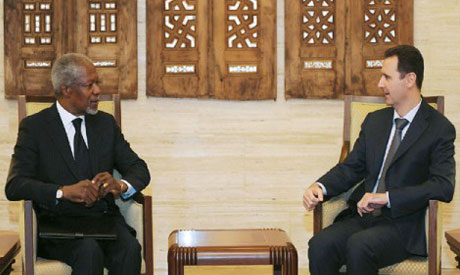
“The Syrian government has written to the joint special envoy Kofi Annan, accepting his six-point plan, endorsed by the United Nations Security Council. Mr. Annan views this as an important initial step that could bring an end to the violence and the bloodshed, provide aid to the suffering, and create an environment conducive to a political dialogue that would fulfill the legitimate aspirations of the Syrian people.”
The six points of the peace plan are listed below:
1)Syrian-led political process to address the aspirations and concerns of the Syrian people
2)UN-supervised cessation of armed violence in all its forms by all parties to protect civilians
3)All parties to ensure provision of humanitarian assistance to all areas affected by the fighting, and implement a daily two-hour humanitarian pause
4)Authorities to intensify the pace and scale of release of arbitrarily detained persons
5)Authorities to ensure freedom of movement throughout the country for journalists
6)Authorities to respect freedom of association and right to demonstrate peacefully
Mr. Annan is currently in Beijing on a mission to remove any skepticism about his six-point plan so that it can be approved and implemented. Annan met with Chinese Premier Wen Jiabao, who pledged his support for the tireless efforts to bring peace to the people of Syria, and Annan has also met with Russian President Dmitri Medvedev in Moscow. It seems that support from both China and Russia should see the plan through and have the needed assistance reach the citizens of Syria immediately.
China and Russia are both close allies of Syria and already blocked two United Nations Security Council resolutions that condemned al-Assad’s regime. Their previous blocking of resolutions has drawn harsh criticism from Western nations. China continues to oppose foreign military intervention or any type of regime change after witnessing Western forces helping in the successful removal of Libya’s Moammar Gaddafi.
Russia President Medvedev stated on Tuesday 27 March 2012 that it was “short-sighted” to believe that the solution to the crisis is Assad agreeing to Western demands to step down.
As the news of al-Assad’s willingness to agree to the plan broke, opposition forces in Syria known as the Syrian National Council (SNC) met for a second day in Istanbul, Turkey to have a meeting of the minds on common objectives for their nation’s future as the weekend’s “Friends of Syria” conference looms. The opposition in Syria is fragmented and has struggled to remain united in the face of the regime’s deadly crackdown. The talks in Istanbul are aimed at bringing the members to a general consensus and securing international recognition.
Basma Kodmani, a spokeswoman for the SNC, shared these words with Reuters.
“A peaceful transition means that the regime needed to be changed. And that starts with the removal of the head of the state. Mr. Annan’s initiative for us should lead to development of clear terms of reference for negotiation on the modalities of change. Not on whether the change should happen or not.”
While al-Assad and the opposition leaders continue to talk amongst themselves, the situation on the ground has not changed at all. According to the Syrian Observatory for Human Rights, Syria forced continued their assault across the nation with at least eight people, including three women, killed overnight in battle with rebel troops. Video posted on the Internet by activists showed thick black smoke and blazing buildings in a district of Homs. There were wounded and bleeding men and women lying in a street.
The United Nations has estimated that more than 9,000 people have lost their lives in Syria’s upheaval over the past year, according to the UN Middle East envoy Robert Serry. The Syrian government has continually blamed foreign-backed terrorists for the violence and reported that 3,000 soldiers and police have been killed.
Activists in Syria have shared their skepticism for Kofi Annan’s plan, noting that the Syrian government had only partially implemented a previous Arab League-led plan to halt the violence. A rebel spokesman, identifying himself as Abu Rami, shared with Reuters from Homs, the main arena for fierce fighting between Syrian forces and protesters, that he expected the violence to continue.
“It’s like other initiatives that have been before. They did not stop the shelling.”
There is a widespread consensus among Syrians that al-Assad is simply attempting to bog down Annan and his team of mediators in a frivolous diplomatic process that will give him political cover to continue his military campaign against the opposition. One can hope that Annan’s plan and method of implementation will not allow this to happen or hope for change will dissipate. And the life of every Syrian civilian and protester will remain in imminent danger.
For more information, please see:
Ahram – Syria Accepts Annan Peace Plan – 27 March 2012
Al-Jazeera – Syria ‘Accepts’ Annan Plan To End Strife – 27 March 2012
BBC – Syrian Government Accepts Annan Peace Plan – 27 March 2012
The Guardian – Syria ‘Accepts Annan Peace Plan’ – 27 March 2012
NYT – Syria Reportedly Accepts Peace Plan as Clashes Erupt Near Lebanon – 27 March 2012
Reuters – Annan Says Syria Accepts Peace Plan – 27 March 2012
Washington Post –Syria Accepts Annan’s Peace; China, Russia Also On Board – 27 March 2012
Syrian Troops Clash With Rebels In Lebanon
By Carolyn Abdenour
Impunity Watch Reporter, Middle East
AL QAA, Lebanon – On Tuesday, 27 March, Lebanese residents and local security forces reported fighting between Syrian rebels and security forces spilled into Lebanon. The witnesses saw Syrian troops destroy Lebanese farm buildings and fight with Syrian rebels who sought refuge in their neighboring country when the troops entered Lebanon.

Over the past year, thousands of Syrians have escaped to Lebanon. Since the Baba Amr district of Homs sustained four weeks of bombardment in early March by Syrian forces, over 1,500 Syrians fled to Lebanon. The Free Syrian Army (FSA), who wants to overthrow Syrian President Bashar al-Assad, and smugglers also utilized this border. Residents stated the Syrian troops followed the FSA over the border to enter Lebanon.
Abu Ahmed, a 63 year old resident of al-Qaa (a Sunni Muslim rural mountain region) said, “More than 35 Syrian soldiers came across the border and started to destroy houses.” Another resident added troops in armored vehicles demolished one home with a bulldozer, lunched rocket-propelled grenades, and fired machineguns in a clash with rebels. A witness also stated the forces also burned several houses.
A Lebanese security source stated the clashes occurred near a poorly marked border where people easily and frequently cross. A Lebanese security official stated, “There is no Syrian military presence on the Lebanese side of the border.” Two Lebanese officials asserted bullets just passed through the rural village near the border. However, residents reported dozens of Syrian forces are presently located 200 to 500 meters inside Lebanese territory.
Residents also stated Syrian forces momentarily entered Lebanon to shadow fleeing rebels throughout the recent months. Al-Jazeera documented cases where Lebanese residents believed Syrian troops planted landmines near populous areas. In October, the regional English-language news organization added a Syrian army tank launched shells at military targets inside Lebanon’s territory. Last week, Syrian shells landed in northern Lebanon.
On Monday, 26 March, Syria accused Lebanon of supporting armed “terrorist groups” with weapons. In his letter to the United Nations (UN) Security Council and UN Secretary General Ban Ki-moon last week, Syrian UN Ambassador Basah Ja’afari wrote, “Experts, officials and observers are unanimous that weapons are being smuggled into Syrian territory from bordering States, including Lebanon.”
These clashes occur on the same day of Syria’s acceptance of a cease fire and peace plan composed by former UN Secretary General Kofi Annan.
For more information, please see:
BBC – Syria Crisis: Clashes Spill Over Lebanese Border – 27 Mar 2012
MSNBC – Annan Says Syria Accepts Peace Plan, Fighting Enters Lebanon – 27 Mar 2012
News Times – Syria Accepts UN Peace Plan But Bloodshed Persists – 27 Mar 2012
Reuters – Syrian Forces, Rebels Clash Inside Lebanon – Residents – 27 Mar 2012