Charges Against Ethiopian Editor Renewed By New Administration

By Ryan Aliman
Impunity Watch Reporter, Africa

ADDIS ABABA, Ethiopia – Despite a change in administration, Ethiopian officials have renewed criminal charges against the former editor-in-chief of the now-defunct newspaper, Feteh, for allegedly criticizing former Prime Minister Meles Zenawi.

Two articles published in Feteh. (Photo courtesy of Committee to Protect Journalists)

A judge in the Federal High Court in Addis Ababa revived three charges against Temesghen Desalegn, the former editor-in-chief of Feteh. Desalegn faces charges of defaming the government, false publication of articles, and “outrages against the constitution”.

The original charges relate to various articles published in Feteh between July 2011 and March 2012 before former Prime Minister Zenawi passed away last August, 2012. State prosecutors alleged that the Feteh articles falsely accused the government of interfering in religious affairs and discrimination against certain ethnic groups, and incited violence.

The evidence against Desalegn cited Feteh articles discussing subjects including how Ethiopians should be angry about the Government’s repressive practices; the role of the youth as agents of change and in popular uprisings in Ethiopia and abroad; and the lessons that should be learned from the overthrow of Hosni Mubarak in Egypt.

In the charge, the government cited two articles discussing the peaceful struggles of youth movements for political change in Ethiopia in the wake of the Arab Spring.

In addition, the government made reference to two columns criticizing the killing and imprisonment of student protesters; the massacres of ethnic minorities by government forces; and the ethnic federalism system introduced by the Meles Administration.

Desalegn was arrested on August 1, 2012, a few days after Ethiopian authorities closed the weekly newspaper and blocked the distribution of around 30,000 printed copies that contained conflicting reports on the health of the late prime minister.

With the same month, state prosecutors suspended the original charges against Desalegn without explanation. However, with the revival of the charges, Desalegn is currently facing the same charges he was facing last year.

The next court date is scheduled for March 26, according to local journalists.

Shimeles Kemal, a government spokesman, said that the charges had been renewed based on further incriminating evidence. Kemal offered no additional details.

Ethiopia, a close ally of the United States, has been repeatedly criticized by international human rights groups for legislating broad anti-terrorism legislation to punish critical journalists and opposition groups.

The Ethiopian government has denied all allegations that it is targeting journalists because of their reporting or affiliations with political groups.

However, with seven journalists currently behind bars and 79 that have fled the country, Ethiopia is the second-leading jailer of journalists in Africa after neighboring Eritrea, which has jailed at least 30 journalists, according to the Committee to Protect Journalists.


For further information, please see:

Sudan Tribune – CPJ Denounces Politicized Trial of Ethiopian Journalist – 10 February 2013

Committee to Protect Journalists – Charges Renewed Against Ethiopian Journalist Temesghen – 8 February 2013

Amnesty International – Ethiopia: Detention of Editor Signals Continuation of Meles-era Crackdown – 24 August 2012

All Africa – Ethiopia: In Ethiopia, Feteh Editor Jailed During Trial – 23 August 2012


DR Congo Rebel Ringleader Arrested in Cape Town

By Heba Girgis
Impunity Watch Reporter, Africa

CAPE TOWN, South Africa—South African police today, Sunday, February 10, announced that the “ringleader” of a group of 19 Congolese rebels today faces charges of plotting a war with the goal of unseating the Congolese President, Joseph Kabila.

DRC police arrest rebel ringleader. (Photo Courtesy of News 24)

The ringleader, who the police declined to identify, was arrested on Friday. Captain Paul Ramaloko, a spokesman for the South Africa Police Service said that the leader did not fight the arrest, however, he did not offer any further details. The Captain did mention that, “he cooperated with us.”

The group of 19 individuals, including a United States citizen, also appeared before the South African court to face charges under the Foreign Military Assistance Act with their leader. The group was arrested in South Africa’s northern Limpopo province under the suspicion of running an illegal military operation. A law enforcement official said that they were actually members of the M23 rebels that have been working to overtake parts of Mali’s eastern region. The group members were not asked to enter any pleas, but rather have been ordered to return to court later this week on February 14, 2013.

These 19 individuals were arrested before their “leader” on February 5. South African prosecutors commented that the group believed that they had been on their way to a training camp, where they would learn the tactics they would need in order to wage a full scale war against the Kabila government. What the men did not know was that they were set up. The people that the group of 19 were in touch with were actually undercover police officers.

The rebel suspects asked the undercover officers for thousands of machine guns and grenades as well as missiles, cash, radios and satellite phones. In return, the group offered the officers mining rights in eastern Congo, where mining experts estimate mineral deposits worth trillions of dollars. One of the suspects is James Kazongo, a United States citizen who lives in Middletown, Delaware. He denied the charges against him and has been in contact with the United States Embassy in South Africa.

The arrested “ringleader,” Ramakolo said, is one of the main players in the plot, “in organizing the coup attempt.” He also will be expected to appear in court early this week.


For further information, please see:

ABC News – South Africa Police: Congo Rebel Ringleader Arrested – 10 February 2013

Business Day Live – South African Police Arrest Another Suspect in Alleged DRC Coup Plot – 10 February 2013

Calgary Herald – South Africa Police Say ‘Ringleader’ of 19 Congolese Rebels Allegedly Plotting Coup Arrested – 10 February 2013

Mail & Guardian – DRC Rebel Ringleader Arrested in Cape Town – 10 February 2013

United Nations Condemns Burning of Accused Witch in Papua New Guinea

By Mark O’Brien
Impunity Watch Reporter, Oceania

PORT MORESBY, Papua New Guinea — The United Nations called on leaders in Papua New Guinea to end the practice of killing people accused of witchcraft, after a young woman was accused of sorcery and publicly killed earlier this week.

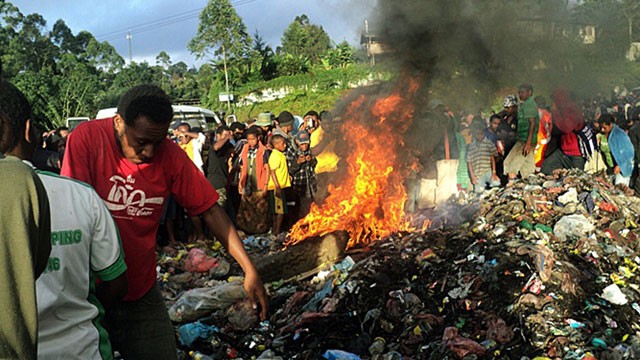
Crowds watched as a woman, accused of using sorcery and witchcraft in the death of a six-year-old boy, was burned alive in Papua New Guinea after being tortured and doused with gasoline. (Photo Courtesy of ABC News)

On Wednesday, Kepari Leniata was stripped, tortured, doused in gasoline, and set afire in front of hundreds of spectators.  Leniata, 20, was accused of using sorcery to kill a six-year-old boy in the provincial capital of the country’s Western Highlands.  The boy’s relatives carried out the public killing, and the crowd reportedly prevented police officers and firefighters from intervening.

“The case adds to the growing pattern of vigilante attacks and killings of persons accused of sorcery in Papua New Guinea,” said Cecile Pouilly, a spokesperson for the Office of the U.N. Office of the High Commissioner for Human Rights.

The U.N. human rights office in Geneva added that it was disturbed by Leniata’s killing, which came after three women and two men were accused of using sorcery to kill another person last November.  Vigilantes held the five alleged witches for nearly three weeks, torturing them with iron rods and knives heated with fire before killing them.

Rashida Manjoo, a UN investigator who visited Papua New Guinea last March, said sorcery accusations are commonly used to deprive women of their land and property.

“I was shocked to witness the brutality of the assaults perpetrated against suspected sorcerers,” Manjoo said in a statement after her visit.  “Any misfortune or death within the community can be used as an excuse to accuse such a person of being a sorcerer.”

In a statement on Friday, Amnesty International called violence against accused witches as being endemic across the country.  The human rights organization detailed a July incident in which police arrested 29 people accused of being involved in a witch-hunting gang that murdered and cannibalized suspected sorcerers.

A national police spokesperson said Deputy Police Commissioner Simon Kauba was incensed by the investigators’ failure to make an arrest by Friday.

“He was very, very disappointed that there’s been no arrest made as yet,” said spokesperson Dominic Kakas.  “The incident happened in broad daylight in front of hundreds of eyewitnesses, and yet [they] haven’t picked up any suspects yet.”

As many as 50 people are suspected of having “laid a hand on the victim,” Kakas said.  The prime suspect is Leniata’s husband, who is believed to have fled the area.  Kakas added that he was unsure of any relationship between the husband and the dead boy’s family.

For further information, please see:

The Age — UN Demands End to ‘Witch’ Deaths in PNG — 10 February 2013

ABC News — Accused Witch Burned Alive in Papua New Guinea — 8 February 2013

International Business Times — UN: We Condemn Witch Burning in Papua New Guinea — 8 February 2013

Sky News — Papua New Guinea: ‘Witch’ Burned Alive by Mob — 8 February 2013

Cherif Bassiouni: Wolfgang Friedmann Memorial Award Address


Article courtesy of:
ISISC Secretariat
ISISC- Istituto Superiore Internazionale di Scienze Criminali
International Institute of Higher Studies in Criminal Sciences
Via Logoteta 27, 96100 Siracusa, Italia
Tel.: +39 0931 414515 / 21495
Fax: +39 0931 67622
email: segreteria@isisc.org
website: www.isisc.org

Syrian Revolution Digest: Friday, 8 February 2013

Time For A Real Policy!

Let’s be clear: Syrian lives are no more or less precious than Congolese lives, but current developments in Syria have far greater implications for U.S. policies around the world than current developments in Congo. As such, the price of indecision and failure in regard to Syria is far higher. If President Obama can’t see that, then President Obama is wrong. It’s about time he realized that. Too much is at stake and too many lives have been lost that could have been saved.

Today’s Death Toll: 121 martyrs, including 2 women, 9 children and 1 under torture: 42 in Damascus and suburbs; 32 in Aleppo; 21 in Homs; 12 in Daraa; 8 in Idlib; 3 in Hama; 2 in Deir Ezzor; and 1 in Raqqa (LCCs).

Points of Random Shelling: 394 points, including 19 points that were shelled by warplanes; 1 point using cluster bombs and 1 point with Phosphoric bombs, and 1 with explosive barrels; 165 points with heavy caliber artillery, 133 points were shelled with mortar, and 83 points with rockets (LCCs).

Clashes: 135 locations (LCCs).

Rallies: 242 rallies: 54 in Hama, 51 in Deir Ezzor, 41 in Aleppo, 39 in Damascus and Suburbs, 22 in Idlib, 19 in Daraa, 11 in Homs, 5 in Hassakeh.


News

Kerry says US evaluating Syria options, won’t weigh in on issue of giving arms to rebels “We are evaluating now,” he said. “We’re taking a look at what steps, if any, diplomatic particularly, might be able to be taken in an effort to try to reduce that violence and deal with that situation.”

Fifty killed in Syria bombing: monitor group The Syrian Observatory for Human Rights said 54 people died in Wednesday’s explosion which struck their bus as they were preparing to return home at the end of their shift, and the number could rise further.

Syrian Rebels Shut Down Key Damascus Highway The latest fighting in Damascus, some of the heaviest to hit the city since July, began Wednesday with a series of rebel attacks on regime checkpoints along the main road from Damascus to northern Syria. Opposition fighters and government forces have been clashing in the area since, and regime troops have also responded by shelling a number of rebel-held districts nearby.

Assad’s forces try to beat back rebels closing on Damascus War planes fired rockets around Jobar, Qaboun and Barzeh neighborhoods, the sources said. Heavy fighting was taking place at the Hermalleh junction on the ring road just south of Jobar, which had been seized by the rebels. Rebel fighters based in the eastern Ghouta region broke through government defensive lines on Wednesday, capturing parts of the road and entering Jobar, 2 km (one mile) from security bases in the heart of the city… “We are witnessing a ‘two steps forward, one step back’ rebel strategy. It is a long way before we can say Assad has become besieged in Damascus, but when another main road is rendered useless for him the noose tightens and his control further erodes.”

‘Full-on crisis’: 5,000 refugees flee Syria daily, UN says “This is a full-on crisis,” Adrian Edwards, spokesman of the U.N. High Commissioner for Refugees (UNHCR) told a news briefing in Geneva. “There was a huge increase in January alone; we’re talking about a 25 percent increase in registered refugee numbers over a single month.” Since the conflict began two years ago, more than 787,000 Syrians have registered as refugees or are awaiting processing in the region, mainly in Lebanon, Iraq, Jordan and Turkey, he said.

Disruption of sanitation services in Syria putting children’s health at risk – UNICEF The agency found that in areas affected by the conflict, water supplies are only available at one-third of pre-crisis levels, with many people having only 25 litres of water a day, compared with 75 litres when the conflict began two years ago. “These results underline why UNICEF has prioritized assistance to the water and sanitation sector,” said the UNICEF Representative in Syria, Youssouf Abdel-Jelil. “This month we began an operation to ship 1 million litres of chlorine to provide safe water for more than 10 million people, or nearly half the national population, for three months.”

Holland spy chief: Dutch citizens fighting in Syria In a rare interview with Dutch television aired late Thursday, Rob Bertholee, head of the General Intelligence and Security Service, said the number of Dutch nationals heading to Syria is growing fast and he is concerned about their return home after fighting with radical Islamic rebels in the civil war. “In my view that is very worrying because of the combat experience they acquire, the ideological convictions and the fact that they could become traumatized there,” Bertholee told Dutch current affairs show Nieuwsuur.

Syria crisis leaves medicines in short supply More than 70% of pharmaceutical factories have had to shut because of the violence, estimates businessman Naji Ali-Adeeb. Hospitals, too, are closing down, with about 27 government hospitals now not functioning. Low-priced medicines are in short supply.


Special Reports

Syrian air attacks worry some at camps for displaced people
Several times a week, the Syrian military sends aircraft over the two major camps for the internally displaced near the Turkish border. The military tends to fly in clear weather, so those are the days people fear the most.

Syria’s Druze minority is shifting its support to the opposition
The Druze community in Syria only numbers around 700,000, out of a total population of some 21 million, and has a history of rebelling under authoritarian leaders, rising up during the rule of the Ottomans as well as the French. Although there are communities scattered across the country, the bulk of the Druze, whose secretive religion is an offshoot of Islam, live in the mountainous region of southeast Syria. In the past couple of months, according to opposition activists, there have been more than half a dozen anti-government protests in Sweida province, the ancestral homeland of the Druze in the southeast that had remained relatively quiet since the uprising began nearly two years ago. And in mid-December, rebel fighters announced the formation of the first revolutionary military council for Sweida province. The council coordinated the most significant battle in the Druze region since the conflict began.

Can Social Media Disarm Syria’s Chemical Arsenal?
In public, Secretary of Defense Leon Panetta warned what was left of the regime’s leadership to protect the state’s large stockpile of chemical weapons. Privately, the U.S. intelligence community began to worry that the Syrian officials known to have the ability to authorize the use of that arsenal were now dead or gravely injured. A scramble then ensued: who were the midlevel officers in charge of the Syrian Air Force and Army units that controlled the stocks of sarin and mustard gas the Assad regime had been compiling for decades? And who was now running the Scud missiles and bombers that would be deployed to use these chemical weapons? According to current and retired U.S. and Western intelligence and defense officials, U.S. analysts began to hunt for email addresses, Twitter handles, Facebook accounts, phone numbers, and Skype contacts for those midlevel Syrian officers. The information was then used to deliver a pointed message: the U.S. government knows who you are, and there will be consequences if you use or transfer chemical weapons.

Syria, Not Benghazi, Is Obama’s Big Security Failure
Obama’s decision to ignore the proposals of his security team on what to do in Syria is far more indicative of a major policy failure in the White House… We know from experience in Afghanistan and Iraq that the U.S. military cannot easily solve problems in the Middle East, and that an impressive U.S. intervention won’t necessarily serve U.S. interests. But on Syria Obama has shifted to the opposite extreme of refusing to use any security tool, even the covert supply of arms and grooming of friendly forces, to ensure that Syria’s implosion doesn’t damage the interests of the U.S. and its allies in the region, such as Jordan and Turkey. Putting U.S. special forces on the ground with mainstream rebels in Syria, and giving them the weaponry and training to take a lead in the fighting, would help shorten the conflict, provide the U.S. with eyes and intelligence, and ensure that Syrians don’t see Al Qaeda radicals as the only people who came to help in their time of need.

Why did Mr. Obama overrule his advisers on Syria?
Mr. Kerry and some other administration officials continue to talk up far-fetched hopes that the Syrian war will be ended by a negotiated settlement in which Mr. Assad voluntarily steps down. Even that unlikely ending would require the regime to conclude that it cannot defeat the rebels, and for moderate forces to rise among the fragmented opposition. As long as the United States and its allies refuse to directly supply those forces with money, training and more powerful weapons, that is very unlikely to happen.

Syria’s refugees: Not going anywhere
The refugees’ daily needs are met by aid agencies. The World Food Programme (WFP) distributes 15,500 tonnes of bread every day. But as thousands of refugees keep pouring in, resources are strained. The camp has seen 30,000 new arrivals since the beginning of the year, spurred by increased violence in Deraa, as well as food and fuel shortages. But money for the refugees is running short. The WFP says it has enough to last until March. Most refugees, including the Asefs, speak of returning home the moment Bashar Assad falls. They think he will be gone within months. But aid workers say that such speedy returns are unlikely. “Camps do not just disappear,” says Saba Mubaslat of Save the Children. “They live for seven years at least.”

My new paper, prepared for a briefing in Washington, D.C. that took place on January 15, 2013, is now out and is titled “Syria 2013: Rise of the Warlords.” It should be read in conjunction with my previous briefing “The Shredded Tapestry,” and my recent essay “The Creation of an Unbridgeable Divide.

Hind Aboud Kabawat: A place where Syrians all get along
Much of the commentary about Syria’s civil war suggests that the country is about to disintegrate into competing sectarian fiefdoms, each dominated by jihadists with a radical Islamist agenda. But during my own recent trip to one of Syria’s “liberated” villages, I saw little evidence that post-Assad Syria will be a failed state, nor even an Islamist one.

I can only hope that the above assertion made by my good friend Hind Aboud Kabawat is right, even though it runs contrary to the analysis I have been presenting here for the last few months. After all, being right is not as important to me as Syria being well. But, if the history of the last 15-20 years taught me anything, it’s that I am seldom wrong about things Syrian, and my good friends like Hind and so many others, are seldom right. They drown in sentimentalities and details and fail to see the big picture. Those among them who believe that they see the big picture are often watching an ideological construction emanating from their own imagination and their wishes superimposed on the reality in front of them. Syria is already a failed state, she is broken, and the future does not augur well for putting her back together again.

For the sectarianism is real, the extremism is real, and, with few exceptions, good leaders are nowhere to be found. We have to accept the reality of these realities in order to be able to manage them effectively, and help Syria emerge eventually on the scene as a viable state again.

Syria: how jihadist group Jabhat al-Nusra is taking over Syria’s revolution
It is here, behind the front lines of the war against Bashar al-Assad that a new struggle is emerging. It is a clash of ideologies: a competition where rebel brigades vie to determine the shape of post-Assad Syria. And in recent weeks it is Jabhat al-Nusra, a radical jihadist group blacklisted by the US as terrorists and a group that wants Syria to be an uncompromising Islamic state governed by sharia, that is holding sway. The group is well funded – probably through established global jihadist networks – in comparison to moderates. Meanwhile pro-democracy rebel group commanders say money from foreign governments has all but dried up because of fears over radical Islamists. The effect is changing the face of the Syrian revolution…

The Daily Telegraph gained rare access to Hajji Rasoul, the senior al-Nusra commander – or “emir” – who heads the civil program. “We have enough bread to help all the liberated areas,” he said. “We have put aside enough grain to last eight months in Aleppo.

“We are subsidising farmers so that they can prepare for the harvest and replenish the stores.”…

“We are not al-Qaeda. Just because some of our members share in its ideas, it doesn’t mean we are part of the group.”

Mr Rasoul would not be drawn on the Nusra Front’s exact plan for Syria’s future. But in rebel-held Aleppo a new sharia court is fast becoming a central power in the city. It is shared with the three other hardline Islamist groups operating in rebel territory: Ahrar al-Sham, Fijr al-Islam and Liwa Tawhid, though Jabhat al-Nusra takes the lead.

It refuses to employ judges who worked under the regime, choosing religious leaders to pass judgments.

Some sharia rulings, such as cutting off a hand for theft, are not operational in wartime. But locals complain of other rigid strictures being enforced.

Several men before the court said that their charges included “drinking alcohol” or “fraternising with women”. All this has angered many Aleppo residents, most of whom are moderate Muslims.

Note 1: Fear from getting sucked into another conflict in the Middle East has paved the way to the rise of extremist groups in Syria, ones who are gradually taking over and controlling the pace and nature of the revolution. Now it’s fear over having western funds and aid ending up with these radical groups that have dried funds and weapons going to moderate ones. So long as policies adopted by western leaders vis-à-vis the conflict in Syria continue to be based on fear of action the situation in Syria will keep getting worse. It’s time western leaders started betting on action as the way forward on Syria.

Note 2: To say that Jabhat Al-Nusra has no plans for being involved in the political processes in Syria after the fall of Assad is clearly misguided. The leaders of JAN have every intention of pushing for consolidating their hold on certain areas through involvement in local political processes, including provision of services. They genuinely want to push for the establishment of a caliphal system in Syria. They are open about it, they are serious about it, and they are getting more organized by the day, as western leaders continue to weigh their options, and opposition leaders continue to bicker.

Observers tend to forget in this regard that many of the top ideologues in the international Jihadi networks, especially Al-Qaeda, are Syrians. Now those Syrian Jihadi leaders have a golden opportunity to push for the establishment of their vision on the soil of their own homeland, across the border from Israel, and in the thick of the Sunni-Shiite battle-zone, does anyone seriously think that they will let it go to waste?

The only way this situation could be mitigated at this stage is by providing support to moderate and secular rebel groups so they can continue to have a stake in the outcome, and carve out their own territories in the mix of it all. Syria is fragmenting, and Emirates are being actively carved out, but not all of them have to be dominated by Islamist groups or pro-Assad militias, secular forces could still maintain a presence, even in Sunni-majority areas, and we need them to if we have to have any real chance of putting the pieces back together.

MICHAEL DORAN, SALMAN SHAIKH: Arm the Syrian Rebels. Now
While it may not be necessary to impose a Libya-style no-fly zone (NFZ), it is imperative to keep the threat on the table and to be willing, if required, to carry it out. An obvious alternative to an NFZ is to provide man-portable air-defense systems (MANPADs). But the legal and prudential restrictions are considerable. The use of these systems would require a stronger partnership between the FSA and key regional allies than currently exists.

In addition to weaponry, the FSA needs training, resources, and intelligence support. It currently lacks a sound military strategy. Only the Americans, working together with Arab partner nations, have the requisite diplomatic and military resources to help the FSA develop this capacity.

This policy does entail the risk of unintended consequences. Some arms may flow to al Qaeda. Some groups may take American aid and then turn against the United States. But inaction also carries risks. The current hands-off policy has hardly succeeded in preventing extremists from acquiring arms. It has simply given them time and incentive to develop their own independent sources of external support.

By establishing itself as the most important international player shaping the conflict inside Syria, the United States will lay the groundwork for helping the Syrian people forge a genuine national dialogue on the nature of their transition. This should include the creation of a national platform that brings together Syria’s diverse ethnic and religious communities — including Sunnis, Shiites, Alawis, Christians, and Kurds, as well as tribal and religious figures — to discuss the future of the country. In particular, it should include Alawis who enjoy wide legitimacy within their community, but who are also willing to talk about a post-Assad Syrian regime.

At the same time, the United States should bring together key international and regional powers to create an international steering group. This group — including China, Russia, Turkey, and key Arab and European states — should agree on a number of basic goals for the transition and set benchmarks for their effective implementation. The immediate focus should be on protecting civilians, minorities, and vulnerable groups through the creation of an international stabilization force; addressing humanitarian issues; safeguarding chemical and other unauthorized weapons; and supporting Syrian-led transitional governance and transitional justice efforts.

For this to succeed, Obama must first persuade Russia to abandon its demand that Assad play a role in the transition. If Moscow remains defiant, however, the president must be willing to pursue an independent policy — while still keeping the door open for Russian President Vladimir Putin to eventually join the international consensus.


Video Highlights

Syrian Emergency Task Force launches its Adopt A Village Project http://youtu.be/4xJaUaBi1Xw

Lt. Gen. Abdel-Jabbar Al-Oqaidi addresses a rally in Qatirji Neighborhood, Aleppo City: he reminds people that the revolution started as a nonviolent protest movement, and that it was only the violent crackdown by the regime that compelled people like him to defect and take up arms. He also admits that there are small groups out there that have committed violations, and that FSA leadership has been slow to punish them because they were trying to avoid getting into side-battles. But he promises that this will change soon and that violators will be held accountable http://youtu.be/4xJaUaBi1Xw

Meanwhile, in the majority-Kurdish neighborhood of Al-Ashrafiyeh, Kurdish rebels affiliated with PYD, a Syrian Kurdish group inspired by PKK ideology, clashed with pro-regime militias http://youtu.be/5nGiVKi__DE  The clashes from the point of view of regime supporters http://youtu.be/LbcE6RvApko

A missile falls on Massaken Hanano, destroying a passing vehicle and killing her occupants as well as passersby http://youtu.be/q8yLSaduEfo

The pounding of Al-Shaar kills many http://youtu.be/CfqMxWyJod4 The pounding targeted this rally http://youtu.be/GqenGnqy_K0 which at one point was led by the known comedian Houmam Hout http://youtu.be/SmKoLjtyW5E

An interview with Amira Ar’our, one of few women playing a leading role with rebel groups in Aleppo City http://youtu.be/APcCH-d1hKo

In Damascus City, battles for the control of the Jobar District intensifies, as regime forces mercilessly pound the neighborhood http://youtu.be/VZeebxDG49Y The building being pounded is known as the teachers tower, a housing project that has been reserved for teachers when it was first launched, it’s one of the newer structures in the District http://youtu.be/2IrD-vf0Y60 , http://youtu.be/fMEgwesdPPs Rebels close off section of the ring road passing through the District http://youtu.be/uysxhcdDJ8M While clashes continue along the road connecting the District with the famous Abbasid Square http://youtu.be/Nvwzu3qYW3A , http://youtu.be/c7ofgoEjFbk MiGs took part of the pounding as well http://youtu.be/nstKhrepEgE Children are among the dozens of locals who were killed so far http://youtu.be/07DAXYLaBCA

To the west, the town of Moadamiyeh came under heavy bombardment by regime forces http://youtu.be/H8YZJnUxmX0 , http://youtu.be/C3LHbarW_n8

In Saraqib, Idlib Province, the rivalry between Islamist and secular-leaning units is growing by the day. In today’s rally Islamist groups interrupted a rally chanting “God, Syria, Freedom,” and began chanting “Our leader forever is our Master Muhammad [the Prophet].” Secular demonstrators carried the striped green independence flags adopted by most revolutionaries, but Islamists carried black and white flags carrying the basic Islamic testament of faith: “there is no god but God, Muhammad is the Messenger of God.” Eventually, a brief scuffle broke out between some Islamists and secular demonstrators which ended with few Islamists tearing down and stomping on one of the green flags. At this point, secular demonstrators began chanting “Unity, liberty, civil state.” The rally continued without any further incident http://youtu.be/R_1xdQX33pM

In nearby Ma’arat Al-Nouman, the battle for control of the city continues, this clip shows a tank operated by rebels pounding tanks operated by regime loyalists http://youtu.be/hGN_vq2g5Kw

Clashes between rebels and loyalists take place on the outskirt of Deir Ezzor City http://youtu.be/zwIYq-OCVd4 ,http://youtu.be/QxI3nxRxpFw

Rebels in Raqqah bring down a chopper http://youtu.be/Q3Ud_Bx6rlY , http://youtu.be/IDJApsWZZ5s

Some of the rallies that took place today: Aleppo Road, Hama City http://youtu.be/ed9O8zt4yPM Yabroud, Damascus http://youtu.be/t5SboBgQhOc Douma, Damascus http://youtu.be/D5gi76VGAuo Arbeen, Damascushttp://youtu.be/zeAWWP0y3f4 Boustan Al-Qasr, Aleppo City http://youtu.be/Vpwr2SlYAbg Salqeen, Idlib http://youtu.be/NVzKsYLKl_M Sarmada, idlib http://youtu.be/wpoj_CeOPmg