Africa

Sudanese Leader Accused of Stealing Billions

 By Daniel M. Austin
Impunity Watch Reporter, Africa
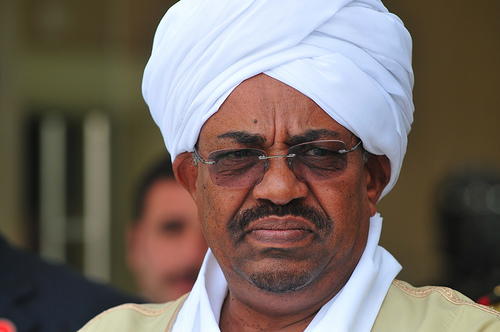
Sudans President Omar al-Bashir
Sudan's President Omar al-Bashir. (Photo courtesy of TopNews).

KHARTOUM, Sudan – The International Criminal Court’s (ICC) chief prosecutor has accused Sudan’s President of funneling billions of dollars in government funds to his personal bank accounts. Mr. Luis Moreno-Ocampo, the ICC’s chief prosecutor claims the theft could be as high as $9 billion (U.S. dollar). The Sudanese President, Omar al-Bashir has vigorously denied these accusations and believes the charges are an attempt by Western powers to overthrow his government.

The chief prosecutor’s claim was made public when WikiLeak’s released diplomatic cables between the United States and the chief prosecutor. The purported theft was confirmed by Mr. Moreno-Ocampo when he spoke with Reuters news agency. Although the ICC could not determine precisely how much was taken, President Bashir is accused of having stolen anywhere between several hundred million dollars to as much as $9 billion. It is widely believed that at least some of the money was stolen from Sudan’s thriving oil economy. If the $9 billion figure is correct, it would be a staggering sum, accounting for nearly 10% of the country GDP.

Additionally, it is not known where the stolen funds are located. The Wikileak’s cable claims the money is stashed in several banks outside of Sudan and possibly in Lloyd’s Bank in London. To further complicate matters, the chief prosecutor is unsure of the funds whereabouts and Lloyd’s Bank in London claims Mr. Bashir’s is not an account holder with their bank.

Outside of this most recent accusation, the ICC has already issued two arrest warrants for President Bashir. He has been charged with numerous crimes related to the Sudanese civil war and in particular, the humanitarian crisis that took place in the Darfur region. Specifically, President Bashir has been charged with genocide, war crimes, and crimes against humanity. The indictment handed down by the International Criminal Court represents the first time a sitting head of state has been accused by this government body.  Mr. Moreno-Ocampo claims the financial dealings of President Bashir were uncovered during a thorough investigation into the atrocities that took place during the country’s seven year civil war.

According to the United Nations, the conflict in Sudan between President Bashir’s regime in the north and rebels in the south has led to over 300,000 deaths and the displacement of two million. These figures stand in stark contrast to Sudanese government figures, which claim 10,000 people have been killed in the fighting.

For more information, please see:

BBC –- Sudan’s President Bashir ‘siphoned off millions’ – ICC –18 December 2010

Daily Telegraph — WikiLeaks: Sudan’s president ‘stashed $9 billion’ — 18 December 2010 

Sudan Tribune -–Sudan President stashed billions in secret bank accounts, says ICC prosecutor -– 18 December 2010

VOA — Sudan President Accused of Hiding Billions of Dollars –- 18 December 2010

Update: Disputed Ivory Coast Election Prompts Fears of Civil War

By Polly Johnson
Impunity Watch Reporter, Africa

Supporters of Laurent Gbagbo protest at a youth rally (Photo Courtesy of Wall Street Journal).

ABIDJAN, Ivory Coast – The United States and European Union countries have imposed a travel ban on Ivory Coast’s Laurent Gbagbo, members of his family and key members of his government after Mr. Gbagbo failed to step down after being defeated in last month’s disputed presidential election.

The United States, United Nations, African Union, and European Union have all recognized Mr. Gbagbo’s challenger, Alassane Ouattara, as the winner of the country’s November 28 run-off presidential election. Mr. Gbagbo’s refusal to concede has plunged the country into violence and prompted fears of civil war.

Violence broke out on Thursday when supporters of Mr. Ouattara clashed with security forces loyal to Mr. Gbagbo.

On Saturday, Mr. Gbagbo declared that U.N. peacekeepers must leave Ivory Coast because the U.N. had certified his opponent as the winner. A Gbagbo spokeswoman said on state television that nine thousand U.N. peacekeepers and another nine hundred French troops supporting them were to leave immediately. Despite this order to leave, the U.N. has vowed to continue its mission.

U.N. High Commissioner for Human Rights Navi Pillay said on Sunday that over fifty people had been killed in the previous three days and that armed men had abducted hundreds from their homes in nighttime raids.

“The deteriorating security conditions in the country and the interference with freedom of movement of UN personnel have made it difficult to investigate the large number of human rights violations reported,” Pillay said on Sunday, from Geneva.

A resolution adopted unanimously on Monday by the U.N. Security Council condemned Mr. Gbagbo for clinging to power. The resolution urges all Ivorian parties “to respect the will of the people and the outcome of the election.” The Council also voted unanimously to extend the deployment of U.N. troops for another six months as violence continues in Ivory Coast.

The Security Council called on all parties to recognize Mr. Ouattara as Ivory Coast’s president.

French President Nicholas Sarkozy has warned that Mr. Gbagbo could face prosecution in the International Criminal Court and echoed the calls of the international community for Mr. Gbagbo to immediately stand down.

For more information, please see:

Al Jazeera – UN warns of Cote d’Ivoire abuses – 20 December 2010

AP – UN condemns intimidation of staff in Ivory Coast – 20 December 2010

Christian Science Monitor – Death squads reemerge in Ivory Coast as president contests election results – 20 December 2010

Reuters Africa – EU agrees travel ban on Ivory Coast’s Gbagbo – 20 December 2010

Wall Street Journal – U.S. Sanctions Ivory Coast Leader – 20 December 2010

17 African Leaders Indicted By The ICC

By Laura Hirahara
Impunity Watch, Africa

Post-election violence in Kenya Photo Courtesy Roberto Schmidt, AFP

NAIROBI, Kenya- Last week the International Criminal Court (ICC) indicted a number of Africans from Uganda, Darfur, the DR Congo, and Kenya for genocide, crimes against humanity and war crimes as defined under the Rome Statute. Among those arrested are six Kenyan officials with ties to the 2008 voting violence that affected over half a million Kenyans and Sudan’s president, Omar al Bashir. Bashir has been charged with ten counts, including five counts of crimes against humanity, two counts of war crimes and three counts of genocide. The six Kenyans indicted are all members of the ruling Grand Coalition and have been implicated in the post -election violence of 2008 that left over 1,100 dead, three times as many injured and over 600,000 displaced.

To date, international arrest warrants against Bashir have not been enforced despite travelling to other ICC member African nations and being barred from attending African Union summits. ICC prosecutor Luis Moreno-Ocampo says despite doing the legal work necessary to bring Bashir to justice, he continues to commit crimes in Darfur. In a statement, Moreno-Ocampo said, “The African Union and Arab League are crucial to stop the crimes, alleviate the humanitarian situation and provide stability to the Sudan.” Bashir is not currently in custody.

Among the Kenyans arrested are Deputy Prime Minister Uhuru Kenyatta, Finance Minister Francis Muthaura, the Civil Service and Cabinet Chief and Industrialization Minister Henry Kosgey, currently suspended Higher Education Minister William Samoei Ruto, Head of Operations (KASS FM) Joshua Arap Sang, and former Police Commissioner and current Chief Executive of the Postal Corporation Mohamed Hussein Ali. The indictments against these officials stem from the violence in 2008 that lasted for over a month after their nation-wide election that many fear will be repeated after the upcoming 2012 elections. Said Prosecutor Moreno-Ocampo, “These were not just crimes against innocent Kenyans[.] They were crimes against humanity as a whole. By breaking the cycle of impunity for massive crimes, victims and their families can have justice. And Kenyans can pave the way to peaceful elections in 2012.”

Kenyans who have come forward to act as witnesses against the ICC indicted are already being threatened and face being ostracized from their own communities. In Kenya, a country marked by strong tribal and ethnic divides that correlate to political loyalties, acting against one’s own group is viewed as a serious betrayal. However, many Kenyans wish to avoid the violence of 2008 and those willing will testify that political candidates and public officials spoke at rallies, urging Kenyans to violence as a means to meet their objectives. One young witness [name omitted] said he attended a rally where Samoei Ruto encouraged “[. . . ] the youth [to] prepare for violence, that the women should start crying in public to encourage the men to do violence.”

For more information, please see;

allAfrica.com- Kenya: ICC Has Indicted 17 Africans– 15 Dec., 2010

Afrique en Ligne- Kenya: ICC Strikes Heart of Kenya’s Grand Coalition Cabinet– 19 Dec., 2010

The Christian Science Monitor- Threat to Kenya’s ICC Witnesses: Traitors Will Be Dealt With ‘Ruthlessly’– 15 Dec., 2010

MSNBC.com- Prosecutor: Kenya’s Deputy PM is War Criminal– 15 Dec., 2010

M&C News- International Prosecutor Pushes For Arrest of al Bashir– 9 Dec., 2010

WikiLeaks Exposes Southern Sudan Arms Deal

By Daniel M. Austin                                                                                                                                                                                                Impunity Watch Reporter, Africa

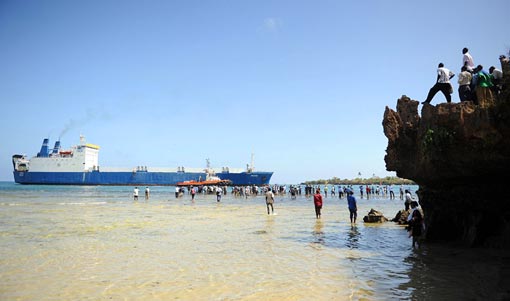
The MV Faina arrives in Kenya in February 2009. (Photo Courtesy of AFP).

KHARTOUM, Sudan – The website WikiLeaks has released diplomatic cables describing the hijacking of a merchant ship in the Gulf of Aden by Somali pirates in September 2008. This act of piracy was especially alarming because the merchant ship was transporting a large arms shipment destined for southern Sudan. The cables go on to describe both the contents of the arms shipment and the Kenyan government’s role in helping to deliver the weapons to southern Sudan.

The merchant ship attacked by Somali pirates was the MV Faina, a Belize flagged Ukrainian tanker. According to the cable, the merchant ship contained a huge arms shipment including 33 T-72 tanks, 42 anti-aircraft guns, 36 rocket-propelled grenades, six rocket launchers and 13,000 125mm rounds of ammunition. The MV Faina was bound for Kenya when it came under attack. U.S. diplomats believed that if the cargo landed in Kenya, the arms would have been off-loaded onto rail cars and transported through Uganda to Juba, Sudan. U.S. officials claim an earlier arms shipment, that included tanks, was delivered to southern Sudan along the same route.

In early 2009, the MV Faina was released after a $3.2 million (U.S. dollars) ransom was paid. After being freed, the MV Faina traveled to Kenya and unloaded its cargo. The tanks and other weapons still remain in Kenya and have not been transported outside of the country. The Wikileak’s cables also describes how diplomats and military commanders in the United States were contemplating a military strike on the  MV Faina in order to prevent the weapons from falling into the hands of al-Shabab, an Islamic militant group operating in Somalia.
 
Along with detailing the arms shipment, the diplomatic cables illuminate the work of U.S. diplomats in Africa. Specifically, the cables describe the United States tacit approval of Kenya’s effort to supply weapons to southern Sudan during the Bush administration. However, when President Obama took office in 2009, his administration reversed course and became much more critical of Kenya’s actions.

The release of these sensitive diplomatic cables is coming at a crucial time for Sudan. On January 9, 2011, a referendum will be held to decide whether southern Sudan will break away from the north and become an independent state. The referendum was part of a peace deal negotiated in 2005 after 50 years of civil war.

For more information, please see:

Associated Press — US considered military action on pirated arms ship –- 10 December 2010

BBC Africa – Wikileaks: US ‘aware of’ Kenya-Southern Sudan arms deal – 9 December 2010

New York Times — Pirates’ Catch Exposed Route of Arms in Sudan – 8 December 2010

The Christian Science Monitor — WikiLeaks documents roil Nigeria, Kenya, and South Africa – 9 December 2010

Voice of America — Leaked Cables Detail Kenya’s Role in Arming South Sudan – 9 December 2010

A Divided Ivory Coast

By Daniel M. Austin
Impunity Watch Reporter,  Africa
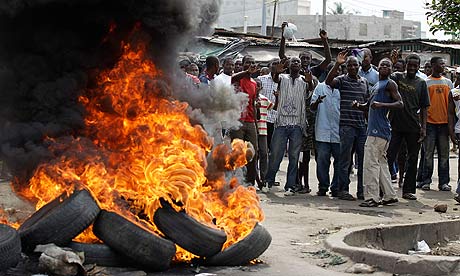
Supporters of Mr. Ouattara burn tires in Abidjan. (Photo Courtesy of AP).

ABIDJAN, Ivory Coast – The results of recently held presidential elections in Ivory Coast have thrown the west African nation into chaos. When the election results were tallied, the initial winner was the challenger Mr. Allassane Ouattara. However, a day after the country’s top election official endorsed Mr. Ouattara as the winner, the Constitutional Council which oversees elections in Ivory Coast, reversed its decision and named the sitting President Laurent Gbagbo the winner. The Constitutional Council claims there was substantial voter fraud in the northern half of the country and because of this finding, votes cast in these areas were thrown out. Coincidentally, the northern half of the country is where Mr. Ouattara is popular and drew most of his support.

According to election observers from the United Nations, and the European Union, the election process was fair and there was minimal corruption reported. Moreover, dignitaries from around the world have endorsed Mr. Ouattara including President Barack Obama and United Nations Secretary General Ban Ki-Moon. The initial election results showed Mr. Ouattara with 54.1% of the vote and Mr. Gbagbo with 45.9% of the vote.

The reversal of the election results has led to violence. After word spread that the election results were being reversed, supporters of Mr. Ouattara took to the streets and protested. The protests have turned violent in the capital city, Abidjan where at least four people have been killed in election-related attacks. It has been reported that the head of the Constitutional Council is a close friend of the sitting President and many Ivorians believe the election results has been rigged. In response to election-related violence, the country’s military has sealed off the borders, and is not allowing in any foreign media or news coverage. Government forces loyal to Mr. Gbagbo are patrolling the streets and have instituted a curfew.

In yet another strange twist, on Saturday, December 4, both candidates were sworn into office. First, Mr. Gbagbo officially was sworn into office and then several hours later Mr. Ouattara swore himself into office. With the election results uncertain and the threat of violence likely, Thabo Mbeki, the former president of South Africa has stepped in to help mediate the crisis.

For more information, please see:
Al Jazeera –  Cote D’Ivoire on the brink – 3 December 2010

BBC –- Thabo Mbeki to mediate in Ivory Coast president crisis –- 4 December 2010

CNN International — Both candidates claim presidency in Ivory Coast –- 4 December 2010

New York Times — Standoff Set Up With 2 Ivory Coast Presidents –- 4 December 2010

RFI — Gbagbo sworn-in, Ouattara swears himself in –- 4 December 2010