Africa

Despite British Objection, Nigerian Senate Passes Bill Banning Homosexuality

By Zach Waksman
Impunity Watch Reporter, Africa

ABUJA, Nigeria­ – Gay rights in Nigeria took a step backwards on Tuesday.  In the face of the United Kingdom’s threat to cut off aid to Africa’s most populous country, its Senate unanimously passed a bill that, if approved by the House of Representatives and signed by President Goodluck Jonathan, would make same-sex relationships illegal.  The action has been met with widespread approval among the general population.
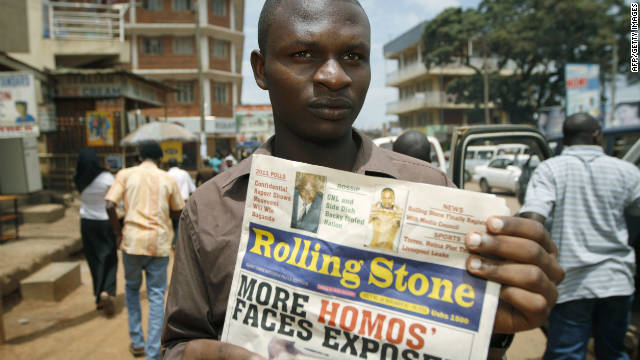
Newspaper headlines in Nigeria celebrated the Senate's passage of a bill that would make same-sex relationships illegal. (Photo courtesy of AFP/Getty Images)

The bill would have several significant effects on homosexuals.  If passed, which is expected, anyone who enters into a same-sex relationship or civil union would face a 14-year term in jail upon conviction.  Those convicted of “witness[ing], abet[ting] and aid[ing]” the performance of a same-sex marriage and “support[ing] the registration [of same]” would serve 10 years behind bars, as would anybody who registered or operated a gay nightclub or organization.  It would also invalidate any certificates of marriage for same-sex relationships issued outside of Nigeria.  Section 3 of the bill provides that “only marriage contracted between a man and a woman either under Islamic law, customary law or the marriage Act is [recognized] as valid in Nigeria.”

Last month, British Prime Minister David Cameron warned that his country would consider withholding aid to countries that discriminated against homosexuals.  In justifying the bill, Senate President David Mark considered it a way of protecting his country’s values.

“If there is any country that does not want to give us aid or assistance just because we want to hold on to our values, that country can keep her aid and assistance,” he said, in what may have been a reference to the threat.  “No country has the right to interfere in the way we make our own laws because we don’t interfere in the way others make their own laws.”

Nigeria had been debating this bill for the past month.  This morning, after the bill’s passage, The Sun Newspaper’s headline proudly declared “”Homosexuals are in trouble!”  But according to Chude Jideonwo, a Nigerian journalist, the country is already strongly homophobic.  To many, the belief is that “homosexuality is ‘of the devil,’ against our ‘culture’ and an encroachment of ‘sad Western values.’”  Even before passage, he said that there was not much demand, “even a quiet one,” for gay marriage of any form.  This raises the question of why the issue was raised in the first place.

“I can’t recall a particular place where this type of marriage has taken place in Nigeria,” said Adetokunbo Mumuni, director of the Socio-Economic Rights and Accountability Project.  “This particular thing they have assented to is a thing of no substance to Nigeria. They should focus on things that affect the majority of Nigerians.”

In international circles, the bill has not received much praise.  Andrew Lloyd, the U.K.’s High Commissioner to Nigeria, reiterated the possibility of sanctions, but added that the media may have overblown Cameron’s remarks.  On Wednesday, he spoke to journalists in Dutse to better explain the British position, which he believed would be matched by most of the Western world.

“It is wrong to punish people for mere expression of their relationships or for choosing to become what they have chosen for themselves,” Lloyd said.  “Punishment is infringement upon their fundamental human rights and the western countries would not condone the action.”

Amnesty International, a human rights group, condemned the legislation and called for the House to halt the bill’s passage.  It is concerned with the potentially massive effect the law would have on human rights for a wide variety of people besides the newly-criminalized homosexual population.

“This bill would have a chilling effect on a range of civil society organizations and events while inciting hatred and violence against anyone suspected of practicing same-sex relationships, including lesbian, gay, bisexual, and transgender people,” said Erwin van der Borght, director of the organization’s Africa Programme.  “By aiming to single out and deprive the rights of one group of people, this bill threatens all Nigerians by violating the country’s Constitution and international human rights obligations.”

According to one of its supporters, an alleged effect of the bill would be an improvement in Nigeria’s overall health.

“Same sex marriage has negative effect on the health of anyone that involved in it,” said Senator Nkechi Nwogu.  “It was unanimous decision by the Senate to pass the bill into law. It is very unfortunate that the western countries want to force their culture on us.”

With similar legislation being discussed or otherwise proposed elsewhere on the continent, this might be the right time for the continent start a dialogue on the topic, which is normally a social taboo. Many African countries depend heavily on foreign aid to remain afloat.  To some, this situation presents an opportunity to deal with the issue directly, instead of trying to suppress it.

“Now is the time to talk about it … to get our house in order.  Let’s use this opportunity to say, ‘OK, if we didn’t have aid, how would we survive?’” said Nigel Mugamu of Zimbabwe. “Let’s talk about gay rights issues. Let’s turn this into a national – African discussion.”

For more information, please see:

CNN — Anti-Gay Law: ‘Why I’m Ashamed to Be Nigerian’ — 01 December 2011

CNN — Nigerian Senate Passes Anti-Gay Bill, Defying British Aid Threat — 01 December 2011

Daily Trust — Britain Won’t Accept Anti-Gay Law, Says Envoy — 01 December 2011

Nigerian Tribune — Senate Recommends 14-Year Jail Term for Same Sex Marriage — 30 November 2011

This Day — Senate Criminalises Same-Sex Marriage — 30 November 2011

Amnesty International — Nigeria Urged to Halt Bill Banning Same-Sex Relationships — 29 November 2011

People’s Daily — Senate Outlaws Same-Sex Marriage — 29 November 2011

Vanguard — Senate Bans Same-Sex Marriage — 29 November 2011
Former Ivory Coast President Gbagbo Taken into Custody by ICC; Charges Filed

By Tamara Alfred

Impunity Watch Reporter, Africa

Former Ivory Coast President Laurent Gbagbo was taken into custody by the International Criminal Court (ICC) Wednesday to face charges of murder, rape and other crimes allegedly committed by his supporters after last year’s election.  He is scheduled to appear before judges at a hearing Monday afternoon to confirm his identity and that he understands his rights as a suspect and the charges against him.

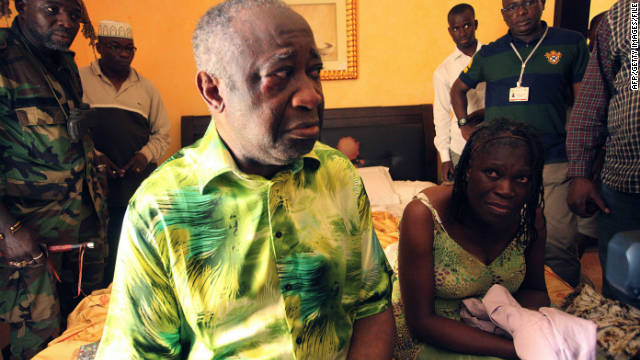
A photo taken on April 11 shows Laurent Gbagbo and his wife, Simone, after their arrest. (Photo Courtesy of CNN.)

Gbagbo, 66, is the first former head of state arrested by the court since it was established in 2002.  After having been under house arrest since his arrest in April, Gbagbo was transferred to the court in The Hague on an overnight flight on Tuesday.  He is the sixth suspect taken into custody by the court, which has launched seven investigations, all of them in Africa.  In fact, Gbagbo will now be sharing a cell block with former Liberian President Charles Taylor, who is awaiting for a verdict in his trial before the Special Court for Sierra Leone on charges of orchestrating atrocities in Sierra Leone.

“Mr. Gbagbo is brought to account for his individual responsibility in the attacks against civilians committed by forces acting on his behalf,” Prosecutor Luis Moreno-Ocampo said in a statement.

The court charged Gbagbo with individual criminal responsibility as indirect co-perpetrator, for four counts of crimes against humanity – murder, rape and other forms of sexual violence, persecution, and other inhuman acts.  In his application for authorization to investigate possible war crimes and crimes against humanity, Moreno-Ocampo cited sources who said at least 3,000 people were killed, 72 people disappeared and 520 other were subject to arbitrary arrest and detentions after Gbagbo refused to concede defeat following the presidential election last year.  President Ouattara eventually took power in April of this year after help from French and United Nations (UN) forces.

Gbagbo, a history professor, came to power in a flawed election in 2000.  He failed to hold elections when his first five-year term expired and reschedule the vote a half-dozen times before it finally went ahead in November 2010.

News of Gbagbo’s arrest sparked both elation and anger in Abidjan, which is still divided into neighborhoods supporting Gbagbo or Ouattara.

“This is a great day for Laurent Gbagbo’s victims, for the people of Cote d’Ivoire, for international justice,” said Reed Brody of Human Rights Watch.  “This is a very important message to all the leaders in the world that if they use the atrocities and crime to stay in power that they too could face justice.”

Adama Diomande, a local leader of Ouattara’s political party, says there are 42 bodies in the mass grave and a total of 91 people were killed in the neighborhood during the post-election fighting.

Moreno-Ocampo stressed, however, that both sides of the political divide in Ivory Coast committed crimes and that his investigation is continuing.  “We have evidence that the violence did not happen by chance: widespread and systematic attacks against civilians perceived as supporting the other candidate were the result of a deliberate policy,” he said.

The UN, Human Rights Watch, and Amnesty International have all documented how forces loyal to Ouattara torched villages that voted for Gbagbo, and executed those that could not run away.  The elderly and the disabled were killed by rolling them inside mattresses and then setting them on fire.

Brody said Gbagbo’s indictment was only half the story as victims of crimes by forces loyal to Ouattara have so far gone unpunished.  “This created the perception of victor’s justice.  And if the cycle of violence in Cote d’Ivoire is to stop there has to be justice that is even handed and justice for the victims on both sides.”

“Ivorian victims will see justice for massive crimes,” Moreno-Ocampo said.  “Mr. Gbagbo is the first to be brought to account, there is more to come.”

Additionally, Gbagbo’s arrest comes a week before parliamentary elections are scheduled to be held in Ivory Coast.  Three political parties in an umbrella coalition with Gbagbo’s Front Populaire Ivoirien issued a statement saying they would boycott the elections as a result of Gbagbo’s transfer.

For more information, please see:

CNN – Former Ivory Coast president in international court custody – 30 November 2011

Huffington Post – Laurent Gbagbo: International Criminal Court Charges Former Ivory Coast President With Crimes Against Humanity – 30 November 2011

Reuters – Gbagbo faces charges of crimes against humanity: ICC – 30 November 2011

Congolese Elections Proceed Despite Fears of Violence and Fraud

By Zach Waksman
Impunity Watch Reporter, Africa

KINSHASA, Democratic Republic of Congo – Despite an ongoing threat of further bloodshed, elections took place in the Democratic Republic of Congo, the world’s least developed country, Monday to determine the constitution of the war-torn country’s government.  Attacks over the weekend killed at least nine people, forcing the cancellation of some campaign events.

Voters waited hours on Monday for election materials to arrive at polling stations in some locations, such as this one in Kinshasa. (Photo courtesy of the Associated Press)

Monday’s elections were only the second in which the entire country was eligible to vote.  Up to 32 million Congolese waited out delays that marred the proceedings as officials struggled to deliver materials to the polls.  In some places, polling stations opened late, while others were so remote that helicopters were deployed to bring ballots.  Though polls were supposed to have closed, they may remain open to allow all to vote because some of them never opened.

The ballots themselves were a problem in many locations.

“It was not really a ballot paper – more like a broadsheet newspaper,” said the BBC’s Will Ross, reporting from the capital, Kinshasa.  “For the national assembly election in central Kinshasa there were 13 pages packed with candidates’ faces.”

The 500-member parliament had more than 18,000 candidates running for seats.  In some districts, the candidates were listed by number and by name, a requirement for a country where a third of the adult population can neither read nor write.  As a result, some voters brought slips of paper filled out by relatives to provide their chosen politician by number.  Even with this assistance, the numbers did not always match the names.  Problems such as this lead watchers to believe that the election’s legitimacy could be delegitimized.

“It’s like leading an animal to the slaughterhouse. It doesn’t realize until it gets there what is in store for it,” said Jerome Bonso, coordinator of the Coalition for Peaceful and Transparent Elections. “They led us into this election. The population was not prepared for it. And now there is a real risk of conflict when the results come out.”

Eleven candidates are running for a five-year term as president, including incumbent Joseph Kabila, who has been accused of attempting to rig the election in his favor.  The son of Laurent Kabila, the man who overthrew longtime dictator Mobutu Sese Seko, Kabila has seen his popularity decline since his election in 2006; Mobutu’s son is one of his opponents.  United Nations observers have reported that his backers have employed multiple underhanded tactics, including stuffing ballot boxes and voter intimidation and bribery.

Despite the questions of how free and fair the elections may be, U.S. Rep. Jim McDermott (D-WA) and MP Jeremy Lefroy (Conservative – Stafford) considered the number of registered voters and registered candidates “a triumph for democracy” in an opinion piece for the Huffington Post.   But that alone is not enough.

“Often the biggest mistake made in peace-building is the belief that, when emerging from conflict, a good election will solve everything,” they added.  “But regular and sound elections are only a first step. Free and fair elections are crucial, but it is what happens between elections that is most important.”

For more information, please see:

BBC — DR Congo Votes Amid Delays and Violence — 28 November 2011

Huffington Post — Congo at a Crossroads — 28 November 2011

Jakarta Globe — DR Congo Votes after Campaign Marred by Violence — 28 November 2011

New York Times — Millions Vote in Congo Despite Fears of Violence — 28 November 2011

Star Tribune — Violence, Late Ballots in Congo May Mar Vote in Sub-Saharan Africa’s Biggest Nation — 28 November 2011

Egyptian Blogger’s Nude Photo Launches Global Debate on Women’s Rights in Arab World

By Zach Waksman
Impunity Watch Reporter, Africa

CAIRO, Egypt – On October 23, twenty-year-old Aliaa Magda Elmahdy posted a full frontal nude photograph of herself on her blog as a complaint against a ban on nude models in Egyptian universities and books.  After the photo was removed from her Facebook page, she gave a friend of hers permission to post it on Twitter, under her own name and the hashtag #NudePhotoRevolutionary.  The tweet, first posted last week, has been viewed more than one million times, and her daring act has set off a powder keg of debate in Egypt that may affect the country’s elections scheduled for November 28.

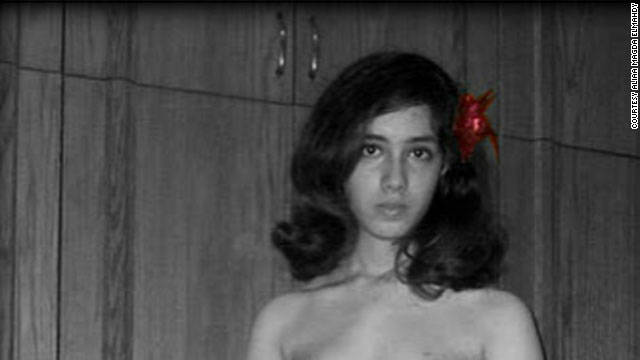
Aliaa Magda Elmahdy's decision to post a nude photograph of herself on Twitter has drawn scorn from people on both sides of the political spectrum in Egypt. She justifies her actions by calling them “echoing screams against a society of violence, racism, sexism, sexual harassment and hypocrisy.” (Photo courtesy of the International Business Times)

The mostly black and white picture depicts Elmahdy – who is naked except for a red ribbon in her hair, a pair of thigh-high stockings and red patent leather shoes – standing with her foot on a stool.  Her blog post features several other nude pictures, including a variant of the main photo that uses it in triplicate with censor bars over her eyes, mouth, and sex organs.  It is accompanied by a caption, written in both Arabic and English.

“Put on trial the artists’ models who posed nude for art schools until the early 70s, hide the art books and destroy the nude statues of antiquity,” it urges.  “[T]hen undress and stand before a mirror and burn your bodies that you despise to forever rid yourselves of your sexual hangups before you direct your humiliation and chauvinism and dare to try to deny me my freedom of expression.”

She later spoke to the media about the post and her motives.

“I accepted [my friend’s request to post the photograph] because I am not shy of being a woman in a society where women are nothing but sex objects harassed on a daily basis by men who know nothing about sex or the importance of a woman,” Elmahdy told CNN during an interview Saturday.

Since the early 1970s, Egypt has become one of the most conservative countries in the Middle East and Africa.  Its majority-Muslim population frowns upon nudity, even as an art form.  Most women wear veils to cover their heads.  Even those who go bareheaded generally keep their arms and legs covered.  In a Facebook post, Elmahdy described her actions as “echoing screams against a society of violence, racism, sexism, sexual harassment and hypocrisy.”  Continuing further, she opined that women wore veils and covered their bodies due to religious and social pressure.

“The women with head veil[s] that I know wear [them] because of their families or because they don’t want to be beaten in the streets,” she wrote in another Facebook post.  “I don’t see why they always dictate to women, and not to men, what they should wear.”

Another example of such a view of women took place during a Tahrir Square sit-in after the fall of ex-dictator Hosni Mubarak’s regime.  After breaking up the protest with a series of mass arrests, security forces subjected female dissidents to virginity tests, which Elmahdy likened to rape.  Human Rights First has issued a report that decries “a pattern of targeting politically active women” in Egypt.

“Local activists report being assaulted, stripped, sexually baited, and threatened with charges of prostitution and virginity tests,” said Human Rights First’s Brian Dooley.  “There appears to be a policy of trying to intimidate women out of the political sphere through this gender violence.”

A cropped version of the nude photograph posted by Aliaa Magda Elmahdy on her blog and Twitter. (Photo courtesy of Aliaa Magda Elmahdy)

Since posting the photo, Elmahdy has been exposed to criticism from both liberal and conservative factions in Egyptian politics, especially with the election looming next Tuesday.  The hardline Islamist Salafis have run a campaign against more liberal groups by saying that the liberals will corrupt the country’s morals.  In that sense, her post could not have come at a worse time for liberal organizations.

“This hurts the entire secular current in front of those calling themselves the people of virtue,” Sayyed El-Qimni, a prominent self-described secular figure, said referring to Islamists.  “It’s a double disaster.  Because I am liberal and I believe in the right of personal freedom, I can’t interfere,” El-Qimni said Wednesday night on one of Egypt’s most popular political talk shows, 90 Minutes.

An alleged connection between her and the April 6th Movement, a liberal organization that was instrumental in the revolt that drove out Mubarak, forced the organization into damage control mode on television.  When faced with the allegations, a party spokesman said that it urged all of its members “to be role models as far as ethics are concerned,” meaning that her outrageous behavior would have precluded her joining.  Another left-leaning party, the Egyptian Social Democratic Party, also expressed disapproval.

“Many movements in Egypt, particularly Islamist movements, are trying to benefit,” said Emad Gad, one of its parliamentary candidates. “They say, ‘We have to protect our society from things like this, and if the liberals win then this woman will become a model for all Egyptian women.'”

Among activists and commentators, Elmahdy received a considerably more favorable reaction.  Iranian-born activist Maryam Namazie was impressed by her audacity, calling the decision “the ultimate act of rebellion” against the Islamists trying to take control of the post-Mubarak Egypt.  To Egyptian-American journalist Mona Eltaway, Elmahdy served as “the Molotov cocktail thrown at the Mubaraks in our heads – the dictators of our mind – which insists that revolutions cannot succeed without a tidal wave of cultural changes that upend misogyny and sexual hypocrisy.”  Human rights activist Ahmad Awadalla also responded, tweeting: “A feminist #Jan25 revolutionary posted her nude photo on the internet to express her freedom.  I’m totally taken back by her bravery!!”

But for Elmahdy, who is suddenly a villain at home and a hero abroad, her plans are simple.  “I am a believer of every word I say and I am willing to live in danger under the many threats I receive in order to obtain the real freedom all Egyptian are fighting and dying for daily,” she said.

For more information, please see:

CNN — Egyptian Blogger Aliaa Elmahdy: Why I Posed Naked — 19 November 2011

Colombo Telegram — Egyptian Feminist’s Blog Received 2.5 Million Hits with Her Full Frontal Nude Shot — 18 November 2011

International Business Times —Aliaa Magda Elmahdy, Nude Blogger, Gains Support from Egyptian Diaspora — 18 November 2011

Daily News Egypt — Activist Posts Herself Nude, Sparks Outrage — 17 November 2011

New York Times — Nude Blogger Riles Egyptians of All Stripes — 17 November 2011

International Business Times — Aliaa Magda Elmahdy, Nude Blogger, Hits Back at Her Critics — 16 November 2011

International Business Times — Aliaa Magda Elmahdy, Nude Blogger: The Fight for Women’s Rights in the Arab Spring — 16 November 2011

Al-Masry Al-Youm — Fury Over Young Activist Publishing Nude Self-Portrait — 13 November 2011

Aliaa Magda Elmahdy’s Original Blog Post — 23 October 2011

Resurgent Islamist Party Wins Big in Tunisia’s First Democratic Election

By Zach Waksman
Impunity Watch Reporter, Africa

TUNIS, Tunisia – Monday was a historic day for Tunisia as the results of its election following January’s revolution were announced.  The moderate Islamist Ennahda party garnered 89 out of 217 seats in the country’s new constituent assembly, more than three times that of the next closest party.  The elected members face the task of assembling a government and writing a new constitution.  More than half of the electorate turned out to vote.

The victory for Ennahda, which had once been banned from taking part in Tunisian politics, marks a comeback for a strong, organized force whose ability to function had been crippled for decades.  Unlike political parties in the United States, Ennahda is also “a social movement,” according to Noah Feldman, a law professor at Harvard University.  This organization “gave it a substantial leg up when it came to organizing dedicated volunteers to motivate voters,” he wrote in a column for Bloomberg.

Ennahda is expected to form a coalition with the next two leading vote-getters, the left-wing Congress for the Republic (CPR) and the Popular Petition.  Negotiations to assemble the new government are still underway, but CPR leader Moncef Marzouki was selected as the interim president.  Marzouki’s position will be largely ceremonial, other than the possibility of mediating disputes between leading parties in the assembly.  Mustapha Ben Jaafar, head of the fourth-place Democratic Forum for Labor and Liberties, had been pushed as president, but it bogged down in negotiations.  He has since been offered the position of assembly president, but has yet to accept.  The interim government will also retain defense minister Abdelkrim Zbidi, who has gained respect among Tunisians for using the military to maintain order without being active in the political game.

Two parties ran anti-Islamist platforms, focusing on Ennahda in particular.  They won a combined 21 seats in the new assembly.

“Unlike the young secularists, many Tunisians see Islam as a defining feature of their personal and political identities,” Feldman said in an effort to explain why Ennahda faired so well.  “Islamists are also highly skilled at reaching across economic and social classes to build support. In poor rural areas, the mosque is sometimes the only gathering place, and Islam can be leveraged to provide a simple, time-tested and powerful political message.”

The elections were highly organized, even though the North African country had only four months to do so.  Kamel Jendoubi, leader of the election commission, said his group “clearly contributed to restoring the trust of Tunisians in their electoral process.”  He told the Associated Press that he planned to ask the assembly to make the commission a permanent aspect of future contests.

The assembly will hold its first meeting on November 22, and the interim government that it appoints will remain in place until the next round of elections, which has been tentatively scheduled for next year.

For more information, please see:

Washington Post — Tunisian Parties Choose Veteran Human Rights Activist as Country’s New Interim President — 15 November 2011

Al Jazeera — Final Tunisian Election Results Announced — 14 November 2011

AllAfrica.com — Tunisia: Islamists Win 89 of 217 Seats — 14 November 2011

Washington Post — Final Tunisian Election Results Confirm Win for Islamist Party — 14 November 2011

Al Jazeera — Tunisia Coalition to Be Formed in ‘Days’ — 10 November 2011

Bloomberg — Islamists’ Victory in Tunisia a Win for Democracy — 30 October 2011