Syria Watch

Syrian Revolution Digest – Sunday October 15 2012

Cluster This!

Use of cluster bombs by Assad falls short of violating the Obama Redline. As such, the development might at best generate a condemnation, but no action should be expected.

Sunday October 14, 2012

Today’s Death toll: 220. The Breakdown: death toll includes 8 children and 3 women. 140 martyrs fell in Damascus and suburbs (including 100 found in local hospital between Daraya and Moadamia), 21 in Idlib, 12 in Aleppo, 12 in Lattakia, 12 in Deir Ezzor, 11 in Homs, 9 in Daraa, 9 in Tartous, and 2 in Hama (LCC).

News

Special Reports

Turkey and Syria share a meandering border over 500 miles long, where in places the villages seem to merge, families share their names and pedigrees, if not their passports, and twisted olive trees roll out over the hillsides. Here, amid the quiet rhythms of rural life, people are witnessing what for 19 months had been one of the gravest concerns about the war next door: that it would spill over the border, draw in neighboring nations and, in a flash, become a regional conflagration. War, it becomes clearer by the day, is inching closer to home.

President Bashar Assad’s embattled regime is believed to have one of the largest chemical weapons stockpiles in the world. Fears have risen that a cornered Assad might use them or that they could fall into the hands of extremists, whether the Lebanese Hezbollah militia, an Assad ally, or al-Qaida-inspired militants among the rebels.

What are we worried about? That Syria will become a state sponsor of terrorism? That it will be hostile to the US and to Israel? That it will be a repressive dictatorship that jails and murders thousands of people? That it will be an ally of Iran, our principal enemy in the region? Syria is already all of those things.

Ammar Abdulhamid & Khawla Yusuf: The Shredded Tapestry: The State of Syria Today

Alawite Defections

In regarding to high level defections among Alawites, it should be noted that Col. Zubaidah Almiqi is not the highest ranking Alawite officer to defect. We know there are more. But Col. Almiqi seem to have been selected to come out in the open because she is one of the few Alawites who hail from the Golan Heights, an area far from the Alawite heartland along the Syrian coast. Being surrounded by rebel bases her family might be safe from loyalist retributions. As we have seen from the situation in Qardaha, dissention in the ranks will be followed by immediate clashes and retributions, as such, it requires careful management. In tactical terms, Alawites who grew disillusioned cannot just “dissent,” they have to plan an uprising and stick with it. This requires careful planning, something that might already be taking place.

Chemical Obama

If the Obama Administration were seriously concerned over the issue of Syrian WMDs falling in the wrong hand, they had a strange way of showing it. Indeed one would have expected a more proactive attitude towards managing the entire situation, including working closely with the opposition to form a transitional government and agreeing on a transitional plan, working closely with the rebels to establish a clear command structure and supervising all efforts meant at arming and training the rebels. This approach would have undercut any attempt at building radical networks by Jihadists in Syria. Instead, the Obama Administration remained aloof, and failed to lead on any front, even from behind. American officials and experts were missing in action throughout the crisis, other western officials followed their lead. This left the doors wide open for a variety of regional actors to approach the conflict on the basis of their own particularistic priorities and in the manner to which they were accustomed: building up radical Islamist networks on the ground (the main backers here are Saudi and Qatar, but always with Turkish support) and using Islamists in exile to lead all work on political transition abroad (Turkey’s work with the Muslim Brotherhood, and Gulf support going to Salafist groups and figures).

Consequently, fear of WMDs falling into the wrong hand are now more justified than they have ever been before, but, at this late stage, there may not be a way for the U.S. to secure the WMDs’ without employing a foot-on-the-ground approach. But if such an approach is used without rebel support and withoutsupporting rebels in their fight against Assad, than any U.S. involvement in this regard could have negative repercussion on the situation and will further radicalize sentiments.

The Obama Administration has recently sent troops to Jordan reportedly as part of a potential future operations meant to secure Syria’s WMDs. But it is not clear that such an operation would entail considering the fact that WMDs locations are scattered throughout the country, and seeing that contact with rebel groups remain too sporadic to allow for efficient coordination of efforts. Little can be achieved without active support from rebels, but rebels are unlikely to help the Administration achieve its objectives, if the Administration is not willing to help them achieve theirs.

By doing nothing, the Obama Administration has, in fact, done plenty to make its own worst scenario in Syria come true, and we all have to live with the consequences of its folly.

Video Highlights

In Idlib and Aleppo rebels bring down two more MIGs: Idlibhttp://youtu.be/xta_ojZbgsY

More towns and villages are being liberated by rebels in Aleppo and Idlib: Heesh (Idlib) http://youtu.be/6YTdUePAQDA

Jabhat Al-Nusrah takes part in liberating a missile base in Aleppo Provincehttp://youtu.be/vGJ50S-9ogE , http://youtu.be/3xjMXSlCvCc

Leaked video shows pro-Assad militias “arresting” a local activisthttp://youtu.be/57XVLLd78UU Another shows a cold-blooded summary executionhttp://youtu.be/uuUcuQ2wL3g

The historic Omayad Mosque in Aleppo City was set on fire as result of shelling by pro-Assad militias. The mosque was used at first as a base by pro-Assad militias who wrote offensive graffiti on its walls, leading to a push by local rebel unit to liberate it, which, in is turn, encouraged pro-Assad militias to shell it.  Like every choice made by rebels and activists since the beginning of this revolution; it always boils down to a “damned if you do, damned if you don’t” type situationhttp://youtu.be/F9m1Xb4pEAU

In this TV interview with a Gulf-based channel, the Salafist Scholar Adnan Arour, addresses the issues of foreign fighters and the nature of the desired state in Syria: he says that rebels do not need foreign fighters coming to fight and die on their land, because they have enough men. Rebels needs money, not men, he says and insists that this is the right way for interpreting Sharia law in this regard. He also says that the state that rebels want to establish and that he supports is a state that respects the right of all for dignity, freedom and justice, not an Islamic state. He adopts this point of view, he says, not because he does not believe in an Islamic state, but because he believes that it cannot be established by force but by admonishment http://youtu.be/3w5LPysbUSc. This is a marked diversion from his earlier stands: at the beginning of the revolution, Shaikh Arour even issued a fatwa against challenging the ruling regime, but, he quickly reversed his position, lent support to the revolution and called for retribution against the Alawites. He, then, reversed that position as well. Over the last few months, Shaikh  Arour seems to be trying to become a more acceptable figure to a larger swath of Syria’s Sunni population by carefully calibrating his positions and moderating his views. His strategy seems to be working: he has more followers in Syria now than he had ever enjoyed. His ability to bring material support to the rebels has boosted his popularity as well. Indeed, Arour’s recent venture into the liberated areas in the north was fruitful and resulted in the establishment of the Union of Military Revolutionary Council. Though the Union is not as large as its other Islamist rivals: the Islamic Front for the Liberation of Syria, the Tawhid Brigades, the Jabhat Al-Nusrah (the Syrian incarnation of Al-Qaeda) or its pragmatist rivals, especially the Syria martyrs Brigades, much could change in the days and weeks ahead as facts on the grounds remain in flux.

A bomb in the plush Mazzeh Autostrad Neighborhood targets In-House, a Starbucks-type coffeehouse. The explosion took place at dawn, making clear that the intention was to spread fear rather than produce casualtieshttp://youtu.be/HEHnibCOU6Y
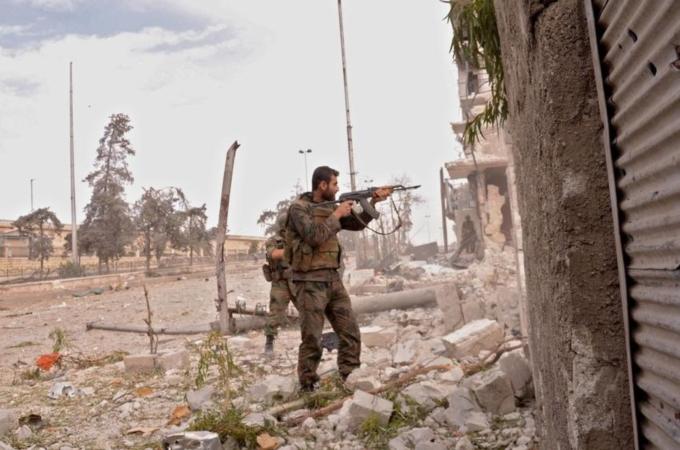
Syrian Forces Advance into Rebel Areas

By Ali Al-Bassam
Impunity Watch Reporter, Middle East

DAMASCUS, Syria — Army and rebel sources said last Monday that Syrian forces attacked rebel controlled neighborhoods in Homs City and the nearby town of Qusayr in an effort to regain control of the Idlib and  Homs provinces.

Syrian forces expect to retake Homs City and Qusayr by the end of the week. (Photo Courtesy of Al Jazeera).

A Syrian security official said that the army now expects to take back the besieged areas by the end of the week, enabling troops to focus their attention towards northern cities such as the commercial capital of Aleppo.

“It is a huge operation, and we hope to finish it off by the end of the week,” he said, speaking under the condition of anonymity.  “After that, we will concentrate on the north of Syria.”

The revolt in Homs, Syria’s largest province, began as a peaceful protest that spiraled into warfare when Assad’s forces responded to the Sunni-led movement with force.  Activists refer to it as the “capital of the revolution.”  Located near both Lebanon and Damascus, Homs’ location is of strategic importance to the rebels. It is where they coordinated with sympathizers in northern Lebanon to smuggle supplies into the the province and wounded fighters into Lebanon.  Homs has seen some of the worst violence since the revolution to remove President Bashar Al-Assad began in March last year.  The army made numerous attempts to reclaim the region, but such sieges were unsuccessful.

On Friday, Syria deployed fighter jets in the Khalidiyeh neighborhood of Homs.  Videos posted online appeared to show the jets dropping barrels of explosives on the besieged areas.  Reinforcements were sent to Homs, where the army successfully stopped food and aid from reaching rebel-held areas.  Humanitarian conditions in the area are now worsening, and those who live there continue to lose hope.

“The siege is a huge problem for us.  We are dying every day, but nobody is paying attention to us,” said Raji Rahmet Rabou, an activist in Homs.

Meanwhile, clashes continue to take place in other provinces around Syria.  The UK-based Syrian Observatory for Human Rights (SOHR) told Al Jazeera that twenty people were killed, including at least five rebel fighters, in the town of Karak al-Sharqi.  SOHR also reports that Syrian troops are to blame for purposely targeting cars ferrying wounded people to field hospitals and clinics for treatment, but Al Jazeera has been unable to confirm this due to reporting restrictions.

For further information, please see:

Al Jazeera — Syrian Forces Step up Attacks on Rebel Areas — 8 October 2012

The Business Recorder — Syria Army Steps up Homs Assault — 8 October 2012

The Daily Star — Syria Army Steps up bid to Crush Homs Rebels — 8 October 2012

Reuters — Syrian Forces Advance Into Rebel-Held Part of Homs — 8 October 2012

Syrian Revolution Digest – Sunday 7 October 2012

The Rebel Moment!

Coming under increased scrutiny, rebels prove no less fractious than the traditional political opposition. Much of their fractiousness, however, can be traced back to continued dabbling by said opposition, as well as the shifting demands and whims of external sponsors. Still, and so many reporters embedded with them have reported, the rebels’ daily experiences with death and suffering make them far more reliable as partners, especially when they work in cooperation with local political activists.

Sunday October 7, 2012

Today’s Death toll: 121. The Breakdown:  toll includes 7 children and 3 women. 62 in Damascus and Suburbs (38 found field-executed in Hameh), 23 in Aleppo, 15 in Homs, 8 in Idlib, 7 in Hama, 3 in Daraa and 3 in Deir Ezzor (LCC).

News

Special Reports

Amid the hodgepodge of groups that make up the armed opposition to Bashar Assad, one organization is coming dramatically to the fore

Across from Hermel and inside Syrian territory, a string of villages inhabited by Lebanese Shiites has been clashing with majority-Sunni villages that back the opposition in the countryside of Qusayr, on the outskirts of Homs. There have been a series of tit for tat kidnappings between the groups, and some have suggested that Hezbollah is providing military support to the Shiite villagers.

Allowing Syria’s chaos to continue will damage too many strategic American interests and, perhaps more importantly, squander an opportunity to affect precisely the kind of change that will make the world a safer place as America’s ability to “police it” inevitably fades.

People whose lives have been decimated by conflict should receive as much assistance as we can give them. Yet Palestinian refugees from Syria, escaping the same violence, destruction and dangers and seeking the same protection, relief and refuge as their Syrian counterparts, are being excluded on grounds of nationality.

Ammar Abdulhamid & Khawla Yusuf: The Shredded Tapestry: The State of Syria Today

Rania Abouzeid offers another great article on rebel groups in Syria. With this report, yesterday’s diagram by the Turkish newspaper Hurrieyt, the New Republic article on rebel groups, the study on armed opposition prepared by Joseph Holliday of the Institute for the Study of war, and my recent report andop-ed, a good and accurate picture of rebel groups is finally emerging.

Video Highlights

Shelling leaves many children dead in Ma’arrat Al-Nouman, Idlib Provincehttp://youtu.be/lfHeK0iJYjw

MIGs continue to pound the suburbs of Eastern Ghoutah, Damascus Province:Hamouriyeh http://youtu.be/1AvX77CjehU Pulling the dead from under the rubblehttp://youtu.be/NeL2H6cidso Kafar Batna http://youtu.be/0DXpODoI76Q ,http://youtu.be/avwawbqV3v4 , http://youtu.be/OYYC1MU_aTM Saqbahttp://youtu.be/F5KxHYXM39M The nearby neighborhood of Al-Qadam inside Damascus City is also targeted http://youtu.be/U8hUBAihkwY

A video showing Kurdish fighters training to defend Kurdish-majority towns in Syria, to which they refer as Western Kurdistan http://youtu.be/LKU79Uuegys

Syrian Revolution Digest – Thursday October 5 2012

Dark Overflows!

It’s not like Assad woke one morning and said: “I feel like exterminating all the Brutes.” It took a lot of active (Iran, Russia, China, Hezbollah etc.) and passive (Unites States, Europe, Arab states, Muslim states) encouragement to get him there. Now that he is there it will take nothing less than forceful intervention to make him stop. You don’t come all this way to quit. Meanwhile, our cup runneth over with blood, disappointment and discontent.

Thursday October 4, 2012

Today’s Death toll: 120. The Breakdown: toll includes 5 children and 3 women. 52 in Damascus its Suburbs, 35 in Aleppo, 11 in Homs, 9 in Deir Ezzor, 5 in Hama, 4 in Daraa, 3 in Lattakia, and 1 in Qunaitera (LCC).

News

Special Reports

VOA’s Scott Bobb traveled to the war-torn northern Syrian city of Aleppo Thursday and left with vivid impressions of a complex community wracked by suffering and fear.

A UNESCO World Heritage site is turned to rubble.

BEIRUT, Lebanon, Oct. 4 (UPI) — The killing of at least three Hezbollah fighters in Syria’s civil war adds weight to persistent allegations the Iranian-backed movement has deployed military forces to prop up one of its most important allies, beleaguered President Bashar Assad in Damascus.

Some of the fighting between forces loyal to President Bashar Assad and the Syrian rebels has moved closer to the Israeli border and several mortar rounds have landed inside Israeli territory. Israeli officials believe these mortars were not aimed at Israel.

Where there is war there is hunger. This holds true with the conflict now taking place in Syria. The UN World Food Programme, the largest food aid organization, is currently feeding 1.5 million Syrians displaced within their own country.

Some experts thought they saw signs of Russian support for Syria wavering. But now Russia is forcing the UN to water down its condemnation of Syria for its mortar attack on Turkey, suggesting that the bond is still strong.

After Syrian shells killed five civilians in a Turkish border town, Turkey’s parliament authorized military operations against Syria. But Turkey’s deputy prime minister says that this is not a declaration of war.

Had Syria been a major oil producing country chances are the US would have already dispatched military forces to impose a pax Americana and to put a stop to the horrific fighting that has been slowly, but without any doubt, ripping Syria apart and dismantling the infrastructures that make the Syrian state what it is today. Even if the war was to end today it would take years for Syria to return to its pre-war position from an economic and military perspective.

Ammar Abdulhamid & Khawla Yusuf: The Shredded Tapestry: The State of Syria Today

Skirmishes between pro- and anti-Assad Alawites clans continue in Assad’s hometown of Qardaha and nearby communities. Pro-Assad militias have reportedly arrested scores of rivals.

Judging by the spate of announcements by Turkish and western officials, it seems that whatever military option Turkey is envisioning in Syria will be limited in scope and probably restricted to occasional strikes against positions held by pro-Assad militia and troops. Increased aid to rebels is also expected, though this may not necessarily lead to arming rebels with heavy weapons. It’s not clear as well whether Turkish authorities will attempt to coordinate any future strikes with rebels to support their ongoing operations.

Video Highlights

MIGs keep pounding the restive suburbs of Eastern Ghoutah, east of Damascus City: Kafar Batna http://youtu.be/W99KW0seKko ,http://youtu.be/CowcB8QYBzU Douma http://youtu.be/rYjDDTTGcWk ,http://youtu.be/i4_747tkeEE The pounding also included restive neighborhoods in Damascus City itself: Tadamon http://youtu.be/xiwTEi3i7Hw The western suburbs of Damascus were also pounded: Al-Hamehhttp://youtu.be/kxs9OpIQ4hs , http://youtu.be/I4jR4jSwLEY Local rebels in these parts threaten the regime that should the shelling continue, they will interrupt the water supply to loyalist neighborhoods http://youtu.be/pwC7TAGLTjk

The pounding of restive neighborhoods in Aleppo city continues: Midanhttp://youtu.be/dnOwnTtS9ro

Helicopter gunships drop barrels of explosives on the town of Talbisseh, Homs Province http://youtu.be/ZCq4X8Nl0Oo , http://youtu.be/h5H8VtZ2IT0 The pounding of the town of Rastan continues http://youtu.be/6YqvuiC1s1A

The pounding of Deir Ezzor City continues http://youtu.be/fOG5i6SDQRI

The pounding of Bosra Al-Sham, Daraa Province continueshttp://youtu.be/hT127gmaM_w

I Am Syria Photos From the Middle East

Earlier this week these two photos were uploaded from the Middle East onto the “I Am Syria” webpage.  A group of young children show their support for the Syrian people by joining the campaign. 


2 Easy Steps to get Involved with the “I Am Syria” Campaign

  1. Like us on Facebook.  We can be found by typing in “Iamsyria” and our group pops up.  Make sure to enter it all as one word because there are other Syria groups.

         2. Buy a t-shirt.  They are $15 and can be paid for by paypal.  Find them at the website www.iamsyria.org