Syria Watch

Bakeries Attacked as Clashes Continue in Aleppo

By Ali Al-Bassam
Impunity Watch Reporter, Middle East

DAMASCUS, Syria — Human Rights Watch (HRW) reports that over the past three weeks, at or near at least 10 bakeries in the Aleppo province were attacked by Syrian bombs and artillery, killing dozens of civilians as they lined up to buy bread.  HRW believes that the attacks were specifically targeting civilians.

A child is treated for injuries after an air raid attack took place near a bakery in Aleppo. (Photo Courtesy of Human Rights Watch)

“The attacks are at least recklessly indiscriminate and the pattern and number of attacks suggest that government forces have been targeting civilians.  Both reckless indiscriminate attacks and deliberately targeting civilians are war crimes,” HRW said.

One of the deadliest attacks took place in the Qadi Askar neighborhood of Aleppo, where up to 60 peopler were killed and up to 70 people were wounded.  On August 21 a second attack occurred in the Bab Al-Hadid area of Aleppo, where at least 23 people were killed and 30 people were wounded.

“I was standing near the door of the bakery when the bomb hit – I just covered my head with my hands and ran for my life. I ran into a store next door and only there I realized that I was injured – in my side and left arm,” said “Fais,” a civilian who was injured during the attack.  “There was black smoke everywhere, and broken glass.  The bomb hit the corner of the street, and the shrapnel flew straight into the line – everyone still there was either killed or heavily injured.  I saw one guy on the ground without a leg, another without an arm, then a 16-year-old boy whom I knew, Rafat Makik Halak, without a head…  One of my cousins, Ahmed, lost his arm and leg, and died afterwards. My sister, who was also injured, is still in the hospital.”

“Day after day, Aleppo residents line up to get bread for their families, and instead get shrapnel piercing their bodies from government bombs and shells,” said Emergencies Researcher Ole Solvang, who recently visited Aleppo.  “Ten bakery attacks is not random – they show no care for civilians and strongly indicate an attempt to target them,” he added.  Solvang also said that the neighborhoods in which the 10 bakeries came under attack were a place where “no fighting was taking place before or during the attack.”

“Every pilot who deliberately launches a rocket at a bread line of civilians, and every commander who gives such an order, should face justice for their crimes,” Solvang said.

HRW reports that a Free Syrian Army facility located near one of the bakeries remained unharmed.

For further information please see:

The Egyptian Gazette — Syrian Forces Bombed People Queuing for Bread — 30 August 2012

Gulf News — Syrian Army Attacks on Bakeries — 30 August 2012

Human Rights Watch — Syria: Government Attacking Bread Lines — 30 August 2012

Al Jazeera — Deadly Fighting Rages on in Syria’s Aleppo — 11 August 2012
Syrian Network for Human Rights: Lost Cousin in Daraya Massacre

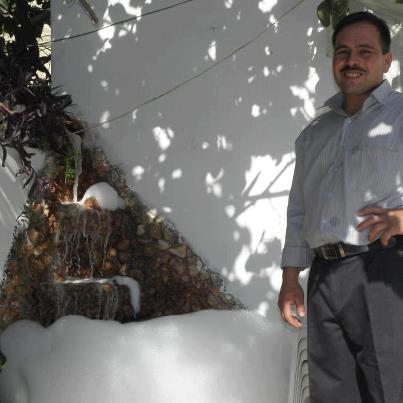
My cousin Mohammed Mustafa Al Abbar from Daraya killed by the Syrian security forces during the horriblemassacre that took place in my home town Daraya on 29 of August.  He was summoned to a security facilities for interrogation, later they released him but after two hours the security took him again, two days later his family found his body in the basement of a one of the building in Daraya.  They executed him like all the families killed in Daraya .

A recent picture of Mohamad Al Abaar, my cousin.

The security forces searched from house to house, looking for adults and young men, among the houses was my apartment in the city.  They destroyed all the furniture, but my family was lucky, the security forces left the city in the first day of the military campaign on Daraya.

I knew Mohammed very well, I remember his smile, he was struggling to provide for his family because he was responsible for his family and three children.  I still can not imagine when I will return to Daraya, hopefully soon, but when I do, he will not be there waiting for me as he used to do .

Daraya, a city of dignity, has paid a heavy price for demanding freedom. Thus far, 633 of Daraya’s sons were martyred and well over 1,755 were detained by regime forces.  Regime forces carried out one of their most barbaric attacks against a city that was made famous for its commitment to nonviolence.  The death toll has doubled in the past few days due to field executions and revenge killings, and includes those martyred in yesterday’s massacre in which well over 300 people were killed, including dozens of women and children. The regime’s military campaign, ongoing for the past 4 days, has resulted in hundreds massacred, dozens detained, and utter destruction throughout the city.


Information in this report provided by:

Syrian Network for Human Rights – Lost my Cousin in Daraya Massacre – 1 September 2012

Call for Refugee Safe Zones in Syria

By Mark McMurray
Impunity Watch Reporter, Middle East

DAMASCUS, Syria — On Thursday, Turkey asked the U.N. Security Council to create refugee safe zones within Syria.  The plea came with a strong warning from the country that it cannot handle the amount of people fleeing the crisis in neighboring Syria.

Syrian men sit on the rubble of a shop destroyed by government forces in northern Syria.  (Photo Courtesy of Winnipeg Free Press)

Thursday’s Security Council meeting, which was called by France to discuss Syria’s humanitarian crisis, was attended only by France, Britain, Colombia, Morocco, and Togo of the 15 total members serving on the committee.

UK Foreign Secretary William Hague, speaking ahead of the meeting, said there are “considerable difficulties” with the safe zones idea.  “We have to be clear that anything like a safe zone requires military intervention and that of course is something that has to be weighed very carefully,” he said.  However, he went on to add, “We are excluding no option for the future.”

Speaking in front of the Security Council on Thursday, Turkish foreign minister Ahment Davutoglu appealed for international assistance.  “The U.N. should initiate the establishment of IDP [internally displaced peoples] camps within Syria without delay.   Needless to say these camps should have full protection,” he said.

Davutoglu described the “serious difficulty” faced by Turkey in dealing with 4,000 refugees crossing the border every day.  With more than 80,000 Syrians in camps in Turkey and with 10,000 refugees waiting at the border separating the two countries, the humanitarian crisis is accelerating.

“The scale of the tragedy is growing so out of proportions that Turkey finds it increasingly difficult to cope with the ensuing challenges all by itself,” he continued.  According to the UN, over the past two weeks, the number of Syrians seeking refuge in Turkey and Jordan has jumped from 400-500 people per day to as many as 5,000 per day.

Releasing a statement ahead of the Security Council’s meeting, the opposition Syrian National Council pushed for a no-fly zone and for safe zones for refugees.  “The SNC considers that if the Security Council does not take serious measures to halt the regime’s massacres and crimes, it will have abandoned its role as guarantor of world peace and protector of people against genocide,” it read.

Responding to the human corridor appeal, U.N. officials expressed concern with the potential threat to the neutrality of humanitarian rights workers presented by military-protected zones.  The calls for safe zones “raise serious questions and require careful and critical consideration” U.N. Deputy Secretary General Jan Eliasson said.  “Bitter experience has shown that it is rarely possible to provide effective protection and security in such areas,” U.N. High Commissioner for Refugees Antonio Guterres added.

Meanwhile, refugees continue to suffer throughout the region.  Speaking from a camp housing 5,000 refugees on the border crossing into Turkey, Abdul Qadir Haj doubts the likelihood of the proposal.  “The safe zone is a dream.  It will not happen.  The world is against us,” the former Syrian policeman turned refugee said.

For further information, please see:

Al Arabiya – Syria Buffer Zone Plans Raise Serious Questions: United Nations – 30 August 2012

BBC News – ‘Difficult’ Demand for Refugee Camps in Syria Vexes UN – 30 August 2012

Christian Science Monitor – Amid Squalor and Fear on Turkish Border, Syrians Make Plea for Safe Zone – 30 August 2012

France 24 – Turkey Calls for Refugee Camps Inside Syria – 30 August 2012

Clashes Continue in Syrian Cities

By Mark McMurray
Impunity Watch Reporter, Middle East

DAMASCUS, Syria — On Thursday, Syrian forces increased efforts to reclaim areas in the capital Damascus and the city of Aleppo from rebels.  The violence resulted in the deaths of about 100 people throughout Syria, with nearly 50 civilians dying in Damascus and more than 20 government troops losing their lives.

Rebels in Syria’s northern city of Aleppo. (Photo Courtesy of Voice of America)

The military bombed the towns of Daraya and Moadamiyeh near the capital.  A London-based group, Syrian Observatory for Human Rights, reported raids on houses in Daraya and heavy fighting in the Hajar al-Aswad district of Damascus.

Activist Abu Zeid spoke with Reuters about the violence in Daraya.  “They are using mortar bombs to clear each sector then they enter it, while moving towards the centre,” he said.  In Moadamiyeh, the army used the nearby Qassioun mountain as a staging area for bombing the city.

Additionally, districts of Aleppo came under attack, with reports of foreign fighters joining the opposition.  According to the Syrian Observatory for Human Rights, the army had previously claimed that they had “cleansed” the area of rebels.  On Thursday, Syria’s state news agency, SANA, reported that government forces had again routed “terrorists” in Aleppo.

Thursday also marked the release of an 11-page report by Amnesty International detailing the treatment of civilians in Aleppo.  Syria’s largest city has witnessed the brunt of the violence since the uprising.

“Civilians are enduring a horrific level of violence in the battle between Syrian government forces and opposition fighters for control of Aleppo,” the report’s summary read.

“The use of imprecise weapons, such as unguided bombs, artillery shells and mortars by government forces, has dramatically increased the danger for civilians,” Donatella Rovera of Amnesty International added.

“As the conflict continues there are also growing concerns about increased abuses, including unlawful killings and ill-treatment of captives by opposition fighters belonging to a plethora of armed opposition groups, including the Free Syrian Army, operating in the city,” the report said.

The upheaval in Syria has continued to impact its neighboring countries.  In Lebanon, fighting broke out again on Thursday.  The Lebanese city of Tripoli saw its fourth day of violence with clashes between pro-Assad and anti-Assad forces.  A cease fire between political leaders representing the groups was broken less than 24 hours after its formation on Wednesday.

Tripoli and other parts of Lebanon have witnessed growing tensions between Sunni and Alawite Muslims who often live in neighboring communities.  Syria’s President Bashar al-Assad has enjoyed the support of most of his Alawite sect while the Sunni community supports the Sunni led revolt seeking to topple his government.

For further information, please see:

BBC News – Syria Crisis: Fighting Continues in Damascus and Aleppo – 23 August 2012

NY Times –Syrian Forces Renew Raids on Damascus Suburbs – 23 August 2012

Syria Arab News Agency – Terrorists Confronted in Aleppo and Homs – 23 August 2012

Voice of America – Syrian Forces Carry Out Assault on Damascus – 23 August 2012

Syrian Revolution Digest – Friday 10 August 2012

From the Road!

Friday August 10, 2012

Cities & Towns Under Shelling: Harasta, Arbeen, Moadamiah, Harran Al-Awameed, Deir Al-Asafeer, Ain Terma, Zabadani, Madaya, Eltal, Dmeir, Hameh, Yelda, Rankous, Qarrah (Damascus Suburbs), Sit Zeinab, Al-Qadam, Midan, Tadamon, Al-Hajar Al-Aswad, Yarmouk, Kafar Sousseh, Mazzeh, Qaboun, Barzeh, Salhiyeh, Ruknaddine, Dafelshawk (Damascus City), Daraa City, Khirbet Al-Ghazaleh, Tafas, Bostra Al-Sham, Na’eemah, Mseifrah, Jimreen, Hraak , Saida, Tal Shihab (Daraa), Rastan, Talbisseh, Houla, Tal Kalakh, Al-Qusayr, Al-Hosn, Al-Ghanto, Al-Bouaydah, Old Homs (Homs Province), Hreitan, Elbab, Eizaz, Marei, Bayanoun (Aleppo Province), Haffeh, Jabal Al-Akrad (Lattakia), Deir Ezzor City, Mouhassan, Albou Kamal (Deir Ezzor Province), Kafar Zeiteh, Hawash, Shahshabo, Hama City (Hama Province), Jabal Al-Zawiyeh, Ma’rrat Al-Nouman, Saraqib, Maar Shoureen, Ariha, Kafroumah, Al-Rami, Khan Shaikhoon (Idlib).

News

Former Lebanese minister arrested for planning attacks for Syria’s AssadMichel Samaha, a former Lebanese minister, reportedly confessed to helping plan attacks on Sunni targets in Lebanon. If true, it illustrates how far Syria’s Assad regime can reach into Lebanon.

Op-Eds & Special Reports

How, when and whether to end the war in Syria Spillover may force Washington to contemplate real solutions to the Syrian conflict, rather than indulge in frivolous sideshows. If that day comes, our choice will almost certainly be between picking a winner and leading a multilateral intervention.

Syria’s Rebel Judges Promise Sharia Justice With Mercy In Tal Rifaat, the Assad regime has been replaced by a local tribunal of clerics, guided by Islamic law and the pursuit of political reconciliation

Syria: buried besides his fields – a farmer who fought for freedom The cemetery where the Unity Brigade buried Omar Ismail looks out over the wheat-fields he once worked. One of four brothers who farmed their father’s rented land, he had volunteered for the amateur army that took him to the big city an hour away, whose lights and tourist souqs were alien to him.