Syria Watch

Syria Human Rights Violations Report: 22 April 2012

Idleb, Jabal Ez-Zawiyyaah

Dozens were injured and many were killed as the regime’s forces pounded residents’ homes with rocket shells. The injuries on this casualty victim illustrate the extent of the shelling.

Douma, Damascus suburbs

This young man was killed by a sniper on his way to work on Sunday.

At-Tal, Damascus suburbs

The family of this young man bids farewell to him after was killed by the relentless gunfire at the hands of the regime’s forces during a demonstration.

Hama, Hama Province

The killing and destruction by the regime’s forces in Hama continues after the United Nations monitors left the town. This video captures the regime’s forces on a high building gesturing and threatening residents that a violent onslaught is about to begin again.

This is leaked video footage of the regime’s forces bragging about the pictured items (the chairs, fan, etc.) which they stole from residents after killing them.

This footage shows the pain of a mother crying to the United Nations monitors that she hasn’t heard from her son in months after he was arrested by the regime’s security forces, and that they refuse to give her any information.

Dar’aa, Khirbet Ghazala

These residents, at great risk, were able to capture footage of the regime’s checkpoint at the entrance of the town, where every vehicle entering and leaving is stopped and residents are berated by the regime’s forces, who often steal what is in the vehicles.

Homs, Al-Qusair

None of the points in the Annan Plan have been respected by the regime’s forces, and the tanks, military chekcpoints and armoured vehicles remain in the streets.

Homs, Al-Holeh

Even water is being prohibited from the residents, after the regime’s forces targeted the water tanks of the town in order to force the residents to flee as one basic necessity after another is taken away by the regime from residents.

Homs, Joret Al-Shayyah

Nothing is left in the town but massive destruction after the relentless shelling attacks on a daily basis by the regime’s forces.


Videos Courtesy of:

Syrian Network of Human Rights – Violations Report – 22 April 2012


Child Torture Revelations in Syrian Conflict

By Tyler Yates
Impunity Watch Reporter, Middle East

DAMASCUS, Syria — In a twisted development to an already aberrant conflict, there is news that Syrian authorities have been detaining and torturing children.  This is coupled with previous reports that the Syrian military has routinely raped women, tortured detainees, shot unarmed civilians, and encouraged looting of houses they storm.  There have been (unconfirmed, as of yet) stories of the Syrian opposition army employing child soldiers.

The individual stories of child torture are shocking.

13 Year Old Hossam is one of many children that has been tortured by the Syrian army (Photo courtesy of Salon).

Hossam, a 13 year-old boy, talks of the “ultimate pain” of his torture when a “terrifying person” with a “huge body” drove a screwdriver up into his big toe nail before ripping it out with pliers.  The man screamed, “’You want freedom? You want to topple the regime?’” as he beat the boy.

Mohammed, a 16-year old from Duma, was tortured with electricity after being arrested, and telling his captors that he supported a Syria that benefits all Syrians.  He was beaten with a cable two or three times a day, and electrocuted on his chest, hands, legs, neck, and on his stomach, close to his genitals.

Pure physical torture of children does not cover the extent of the stories coming out of Syria.

Ayman Karnebo, a dissident who was arrested last May when the uprising against Syrian President Bashar al-Assad began, witnessed the Syrian security forces torturing a pregnant mother, her husband, and her husband’s mother in front of the couple’s infant sons.  Karnebo was sharing a cell with them at the time.

He recalls that the family was of Somali origin; having been rounded up after the revolt took hold.  All foreigners were viewed with suspicion by the Assad government, leading many, like this family, to be detained and questioned.

Karnebo describes all three adults as being tortured with electric shocks to the elbows, hands and toes in front of their terrified children.  After this round of torture the family was moved to another jail.  Their fate remains unknown.

The Assad regime has long been known for its systematic and widespread use of torture, but these new revelations have still come as a surprise.

Amnesty International recently identified 31 methods of torture being employed by Syrian authorities. Some methods have been in use for decades, include the “tire,” where the victim is forced into a large tire and beaten on the feet. There is also the “flying carpet,” where the prisoner is strapped face-up on a wooden board that is bent to stretch the spine.

There are relatively unknown apparently new and even more disturbing techniques, including using pincers to rip out flesh, anal rape with sharp objects and a form of crucifixion where the prisoner is hung from a wall by their wrists.

“The biggest lie of the regime is that there are no orders to torture,” a defected former member of Syrian Air force Intelligence told GlobalPost. “It’s a program, a routine. I saw an old man with a 6-year-old girl brought to the interrogation department. Just five minutes of what she saw there, the screams she heard will surely traumatize her for the rest of her life.”

Navi Pillay, the United Nations’ human rights chief believes that the UN Security Council has enough reliable information to refer Syria’s actions to the International Criminal Court (“ICC”).

“They’ve gone for the children — for whatever purposes — in large numbers,” the BBC quoted her as saying. “Hundreds detained and tortured… it’s just horrendous…Children shot in the knees, held together with adults in really inhumane conditions, denied medical treatment for their injuries, either held as hostages or as sources of information…I feel that investigation and prosecution is a crucial element to deter and call a stop to these violations.”

Syria is not a party to the ICC, so unless Damascus refers itself to the court’s jurisdiction, the only other way for ICC jurisdiction to be created is by a UN Security Council vote.  Given the previous vetoes by Russia and China on resolutions concerning Assad’s violent crackdown such actions are unlikely.

The United States, for its part, is urging the Syrian opposition to unite and pledge to respect minority rights should they eventually push Assad out of power.

“They must be able to clearly demonstrate a commitment to including all Syrians and protecting the rights of all Syrians,” US Secretary of State Hillary Clinton said.

More than 9,000 people have been killed in the yearlong Syrian uprising.  Both the opposition and the Syrian government have been accused of human rights abuses during the conflict, drawing international flack from NGOs and other countries alike.

A supposed cease-fire between the opposition and the Syrian government, brokered by the United Nations, is scheduled to start on April 14, but its already shaky future is now further in doubt as the Syrian government is now claiming its conditions were misunderstood.

 For more information, please see:

Miami Herald — Syria puts new conditions on cease-fire — 08 April 2012

Business Mirror — Torture of children, rape by Syrian army ‘routine,’ ex-soldiers say — 07 April 2012

Independent — Syrians tortured parents in front of terrified children — 07 April 2012

Salon — Syria’s tortured children — 04 April 2012

Kansas City Star — Torture of children, rape by Syrian army ‘routine,’ ex-soldiers say — 02 April 2012

The Independent — Assad’s forces target children, says UN envoy — 29 Mar. 2012

MSNBC — Syria is torturing children, UN human rights chief says — 28 Mar. 2012


Al-Assad’s Regime Agrees to Peace Accord, Brings Hope To End The Violence

By Adom M. Cooper
Impunity Watch Reporter, Middle East

DAMASCUS, Syria–According the spokesman for UN delegate Kofi Annan, The Syrian government has agreed in principle to accept the joint UN-Arab League envoy’s six-point plan on ending the violence in Syria. This is tremendous news for the civilians of Syrian who are desperate to see the violence end and receive proper humanitarian attention.

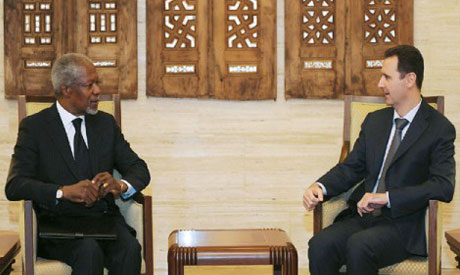
Kofi Annan and Syrian President Bashar al-Assad. (Photo Courtesy of Reuters)

“The Syrian government has written to the joint special envoy Kofi Annan, accepting his six-point plan, endorsed by the United Nations Security Council. Mr. Annan views this as an important initial step that could bring an end to the violence and the bloodshed, provide aid to the suffering, and create an environment conducive to a political dialogue that would fulfill the legitimate aspirations of the Syrian people.”

The six points of the peace plan are listed below:

1)Syrian-led political process to address the aspirations and concerns of the Syrian people

2)UN-supervised cessation of armed violence in all its forms by all parties to protect civilians

3)All parties to ensure provision of humanitarian assistance to all areas affected by the fighting, and implement a daily two-hour humanitarian pause

4)Authorities to intensify the pace and scale of release of arbitrarily detained persons

5)Authorities to ensure freedom of movement throughout the country for journalists

6)Authorities to respect freedom of association and right to demonstrate peacefully

Mr. Annan is currently in Beijing on a mission to remove any skepticism about his six-point plan so that it can be approved and implemented. Annan met with Chinese Premier Wen Jiabao, who pledged his support for the tireless efforts to bring peace to the people of Syria, and Annan has also met with Russian President Dmitri Medvedev in Moscow. It seems that support from both China and Russia should see the plan through and have the needed assistance reach the citizens of Syria immediately.

China and Russia are both close allies of Syria and already blocked two United Nations Security Council resolutions that condemned al-Assad’s regime. Their previous blocking of resolutions has drawn harsh criticism from Western nations. China continues to oppose foreign military intervention or any type of regime change after witnessing Western forces helping in the successful removal of Libya’s Moammar Gaddafi.

Russia President Medvedev stated on Tuesday 27 March 2012 that it was “short-sighted” to believe that the solution to the crisis is Assad agreeing to Western demands to step down.

As the news of al-Assad’s willingness to agree to the plan broke, opposition forces in Syria known as the Syrian National Council (SNC) met for a second day in Istanbul, Turkey to have a meeting of the minds on common objectives for their nation’s future as the weekend’s “Friends of Syria” conference looms. The opposition in Syria is fragmented and has struggled to remain united in the face of the regime’s deadly crackdown. The talks in Istanbul are aimed at bringing the members to a general consensus and securing international recognition.

Basma Kodmani, a spokeswoman for the SNC, shared these words with Reuters.

“A peaceful transition means that the regime needed to be changed. And that starts with the removal of the head of the state. Mr. Annan’s initiative for us should lead to development of clear terms of reference for negotiation on the modalities of change. Not on whether the change should happen or not.”

While al-Assad and the opposition leaders continue to talk amongst themselves, the situation on the ground has not changed at all. According to the Syrian Observatory for Human Rights, Syria forced continued their assault across the nation with at least eight people, including three women, killed overnight in battle with rebel troops. Video posted on the Internet by activists showed thick black smoke and blazing buildings in a district of Homs. There were wounded and bleeding men and women lying in a street.

The United Nations has estimated that more than 9,000 people have lost their lives in Syria’s upheaval over the past year, according to the UN Middle East envoy Robert Serry. The Syrian government has continually blamed foreign-backed terrorists for the violence and reported that 3,000 soldiers and police have been killed.

Activists in Syria have shared their skepticism for Kofi Annan’s plan, noting that the Syrian government had only partially implemented a previous Arab League-led plan to halt the violence. A rebel spokesman, identifying himself as Abu Rami, shared with Reuters from Homs, the main arena for fierce fighting between Syrian forces and protesters, that he expected the violence to continue.

“It’s like other initiatives that have been before. They did not stop the shelling.”

There is a widespread consensus among Syrians that al-Assad is simply attempting to bog down Annan and his team of mediators in a frivolous diplomatic process that will give him political cover to continue his military campaign against the opposition. One can hope that Annan’s plan and method of implementation will not allow this to happen or hope for change will dissipate. And the life of every Syrian civilian and protester will remain in imminent danger.


For more information, please see:

Ahram – Syria Accepts Annan Peace Plan – 27 March 2012

Al-Jazeera – Syria ‘Accepts’ Annan Plan To End Strife – 27 March 2012

BBC – Syrian Government Accepts Annan Peace Plan – 27 March 2012

The Guardian – Syria ‘Accepts Annan Peace Plan’ – 27 March 2012

NYT – Syria Reportedly Accepts Peace Plan as Clashes Erupt Near Lebanon – 27 March 2012

Reuters – Annan Says Syria Accepts Peace Plan – 27 March 2012

Washington Post –Syria Accepts Annan’s Peace; China, Russia Also On Board – 27 March 2012


Syrian Troops Clash With Rebels In Lebanon

By Carolyn Abdenour
Impunity Watch Reporter, Middle East

AL QAA, Lebanon – On Tuesday, 27 March, Lebanese residents and local security forces reported fighting between Syrian rebels and security forces spilled into Lebanon.  The witnesses saw Syrian troops destroy Lebanese farm buildings and fight with Syrian rebels who sought refuge in their neighboring country when the troops entered Lebanon.

A Syrian woman emotional reacts to Syrian forces attacking her home in northern Syria. (Photo Courtesy of News Times)

Over the past year, thousands of Syrians have escaped to Lebanon.  Since the Baba Amr district of Homs sustained four weeks of bombardment in early March by Syrian forces, over 1,500 Syrians fled to Lebanon.  The Free Syrian Army (FSA), who wants to overthrow Syrian President Bashar al-Assad, and smugglers also utilized this border.  Residents stated the Syrian troops followed the FSA over the border to enter Lebanon.

Abu Ahmed, a 63 year old resident of al-Qaa (a Sunni Muslim rural mountain region) said, “More than 35 Syrian soldiers came across the border and started to destroy houses.”  Another resident added troops in armored vehicles demolished one home with a bulldozer, lunched rocket-propelled grenades, and fired machineguns in a clash with rebels.  A witness also stated the forces also burned several houses.

A Lebanese security source stated the clashes occurred near a poorly marked border where people easily and frequently cross.  A Lebanese security official stated, “There is no Syrian military presence on the Lebanese side of the border.”  Two Lebanese officials asserted bullets just passed through the rural village near the border.  However, residents reported dozens of Syrian forces are presently located 200 to 500 meters inside Lebanese territory.

Residents also stated Syrian forces momentarily entered Lebanon to shadow fleeing rebels throughout the recent months.  Al-Jazeera documented cases where Lebanese residents believed Syrian troops planted landmines near populous areas.  In October, the regional English-language news organization added a Syrian army tank launched shells at military targets inside Lebanon’s territory.  Last week, Syrian shells landed in northern Lebanon.

On Monday, 26 March, Syria accused Lebanon of supporting armed “terrorist groups” with weapons.  In his letter to the United Nations (UN) Security Council and UN Secretary General Ban Ki-moon last week, Syrian UN Ambassador Basah Ja’afari wrote, “Experts, officials and observers are unanimous that weapons are being smuggled into Syrian territory from bordering States, including Lebanon.”

These clashes occur on the same day of Syria’s acceptance of a cease fire and peace plan composed by former UN Secretary General Kofi Annan.

For more information, please see:

BBC – Syria Crisis: Clashes Spill Over Lebanese Border – 27 Mar 2012

MSNBC – Annan Says Syria Accepts Peace Plan, Fighting Enters Lebanon – 27 Mar 2012

News Times – Syria Accepts UN Peace Plan But Bloodshed Persists – 27 Mar 2012

Reuters – Syrian Forces, Rebels Clash Inside Lebanon – Residents – 27 Mar 2012


Citizens of Damascus Feel The Burn of Syria’s Violence From The Ongoing Uprising

By Adom M. Cooper
Impunity Watch Reporter, Middle East

DAMASCUS, Syria–As the never-ending turmoil continues in Syria, heavy fighting has erupted between opposition fighters and security forces loyal to President Bashar al-Assad in a main district of Damascus. Witnesses report that this particular area is home to several key security installations. The intense fighting is taking place as al-Assad’s regime retains the contention that it has complete control of Damascus.

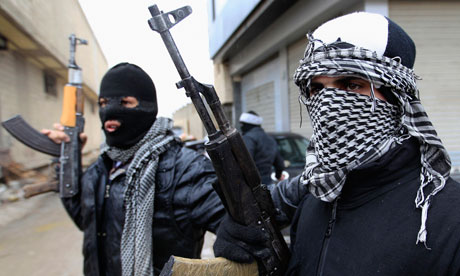
Members of the Free Syria Army in the streets of Damascus.(Photo Courtesy of Reuters)

Syrian state television stated three “terrorists” and a member of Syria’s security forces were killed in the fighting. Since the beginning of the uprising, the Syrian state television has continually held that these “terrorists” are to blame for the violence around the country and has not repeatedly acknowledged the many deaths endured by innocent civilians.

Rami Abdel-Rahman, head of the Syrian Observatory for Human Rights, stated that at least 18 security troops were wounded in the fighting that broke out before dawn in the upscale and heavily guarded Mazzah neighborhood of Damascus. According to the Observatory, more than 9,100 people have lost their lives since the uprising began against the regime last March. Abdel-Rahman shared these words with the AFP.

“The clashes were the strongest and closes to security installations in the capital since the outbreak of the revolt a year ago.”

A member of the Revolutionary Leadership council in Damascus, referring to herself as Lena and not wishing to be identified further, shared these words with Al-Jazeera about the fighting in Damascus.

“Some people came to al-Mezzah and they are trying to attack residents. They are calling them names and taking them out of their houses, people have left their homes. They are in the streets. The security forces are all around the place. Security police have blocked several side streets and the street lighting has been cut off.”

Mourtadad Rasheed, an activist living in Damascus, shared these words with Ahram about his encounter of the violence, detailing that heavy shooting could be heard in Mazzaeh as well as two other districts, Qaboon and Arbeen.

“We woke up at 3AM to the sound of heavy machinegun fire and rocket propelled grenades (RPG). The fighting last about 10 minute, then eased before starting again.”

Al-Jazeera’s own Rula Amin reported from neighboring Lebanon that many residents believe that opposition is pressing into areas around Damascus that could make al-Assad much more vulnerable than he already is.

“Residents are telling us that there was intense gunfire for hours. They could hear from loudspeakers the army and the security forces asking armed men to leave one of the buildings. Al-Mazzeh is not geographically located in the heart of the capital but it’s a very important neighborhood. It is heavily guarded. There are a lot of high-ranking officials living in Al-Mazzeh, in addition to the UN headquarters, embassies, and ambassadors. This is taking place as the government claims they have control over the capital.”

The most recent clashes in Syria came after twin car bombs ripped through two neighborhoods of Damascus on Saturday 17 March 2012, which according to the Syrian interior ministry, claimed 27 lives. Another car bomb was detonated on Sunday 18 March 2012 in a residential neighborhood of Aleppo, claiming two lives.

The international community continues to struggle with the appropriate and consensus response to the situation. Former UN chief Kofi Annan, who met with al-Assad in Damascus earlier this month, ordered a team of experts to Syria to discuss a possible ceasefire and an international monitoring mission. The Arab League previously deployed a monitoring mission into Syria but it was short-lived as organizational issues and turmoil on the ground prevented its success.

Technical experts from the UN and Organization of Islamic Cooperation were in Syria on Monday 19 March 2012 to assess the humanitarian impact of the regime’s deadly crackdown on the protests. The mission, with three OIC experts in the team, will cover 15 cities and will submit a report to the Saudi-based Islamic grouping and UN on the humanitarian needs of the Syrian people. OIC assistant secretary general Atta Al-Mannan Bakhit shared these words with the AFP about the mission.

“The joint OIC-UN mission entered Syria on Friday to carry out an evaluation of humanitarian aid.”

Jacob Kellenberger, president of the International Committee of the Red Cross, flew to Moscow for talks on Monday 19 March 2012 with Russian Foreign Minister Sergei Lavror on the “extremely difficult” humanitarian situation in Syria’s protests hubs.

“A daily ceasefire of at least two hours is imperative to allow the evacuation of the wounded.”

While the wounded wait for the proper attention, it would seem foolish for the international community to not pursue harsh action against al-Assad directly. The security forces are clearly following his direction and it is costing many civilians their lives. When the Arab League had its monitoring mission, it was very against the idea of foreign intervention into Syria. But at this juncture, foreign intervention seems like the only possible course of actions to serve the interests of the civilians, especially the wounded. Without intervention, more suffering is imminent.


For more information, please see: 

Ahram – Damascus Rocked By Fighting After Weekend Bombings – 19 March 2012

Al-Jazeera – ‘Heavy Fighting’ Shakes Syrian Capital – 19 March 2012

BBC – Syria Unrest: Fierce Firefight Erupts In Damascus – 19 March 2012

The Guardian – Syria: ‘Heavy Fighting’ In Damascus – 19 March 2012

NYT – Fighting Flares In Elite Area of Syrian Capital, Activists Say – 19 March 2012

Reuters – Syrian Captial Sees Heavist Fighting of Uprising – 19 March 2012