Syria Watch

Red Cross Denied Access to Civilians as Shelling Continues in Syria

By Adom M. Cooper
Impunity Watch Reporter, Middle East

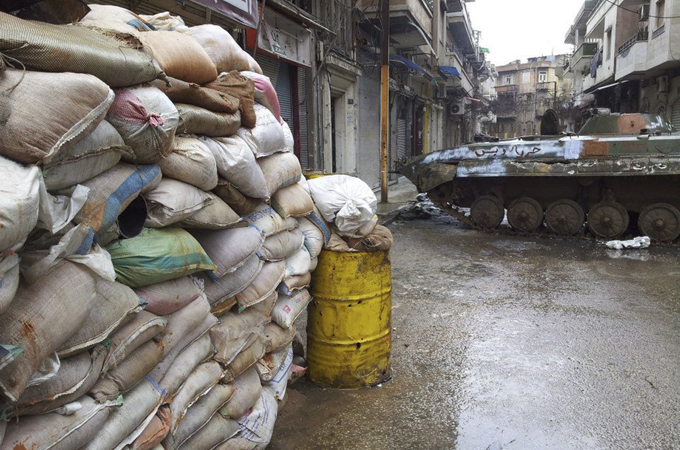
DAMASCUS, Syria – Syrian security forces resumed their attacks on the city of Homs, causing more civilian deaths and preventing relief access to the wounded. On Sunday 04 March 2012, activists reported that a bombardment came to Syria’s third-largest city of approximately one million residents as China presented a proposal to end the violence in the country. It called for an immediate ceasefire and dialogue between all of the parties but stood firm against any type of intervention by outside forces.


A member of the Syrian Free Army. (Photo Courtesy of NYT)

In addition to Homs, the Syrian security forces also descended upon the rebel-dominated city of Rastan on Sunday 04 March 2012. According to the London-based Syrian Observatory for Human Rights, four children were said to be among seven civilians killed in the shelling. The victims included as many as six family members when a rocket crashed into their home, causing the building to collapse.

The focal point of the attacks by security forces has been the western Homs neighborhood of Baba Amr, where the situation has been described as “catastrophic.” On Saturday 03 March 2012, there were reports of power outages, shortages of food and water, and no medical care for the sick and wounded. The Red Cross has desperately been trying to gain access to the city for three days, attempting to deliver aid and supplies to those in need. The closest that the organization has come to assisting Baba Amr is handing out food and blankets to those fortunate enough to have the ability to flee the city to nearby areas.

Syrian officials informed the Red Cross that Baba Amr had to be cleared of booby traps before they could enter the area. But activists reported that troops were carrying out reprisal attacks around the city, causing more death and violence at the expense of thousands of civilians. While the attacks continue to occur, the bodies of two foreign journalists who lost their lives for the sake of letting the world know what was happening on the ground left Syria and were headed to France. The bodies of Remi Ochlik and Marie Colvin were placed on an Air France flight from Damascus on the evening of Saturday 03 March 2012.

Rebels from the Free Syrian Army withdrew their forces from Baba Amr late last week, as the weeks of shelling from government forces made it increasingly difficult for the rebels to maintain their positions. The Syrian government gave the Red Cross permission to access Baba Amr but once the help actually arrived in the form of a convoy, the government refused to allow it to enter the city. BBC correspondent Jim Muir, reporting from Lebanon, stated that this is when the Red Cross decided to assist those who were lucky enough to flee Baba Amr. Muir also stated that the ICRC had dispatched a 15-man team to the Abil area, a southern part of Baba Amr.

ICRC spokesperson Hicham Hassan shared these words with Reuters about the developing situation.

“The plan is to continue to the neighborhoods of Inshaat and Tawzii in order to assist local populations and families displaced from Baba Amr. We really don’t know how many people are still in there. It’s all a bit of a mystery to us.”

The Syrian state television has been broadcasting pictures of deserted streets laden with debris, being careful not to display any strife on the part of civilians. There have been a multitude of unconfirmed reports of revenge killings and summary executions by Syrian forces in Baba Amr. Opposition activists believe that a government-wide cover up is responsible for the delay in bringing these reports to public attention. The reports detail mass arrests of males over the age of 11, with the local cooperative building being transformed into a detention facility.

Another report detailed that truck full of bodies was seen driving away from Baba Amr.

Sunday Times photographer Paul Conroy, who fled Syria after being wounded while working in Homs, told the BBC that what he saw on the ground in Baba Amr classified as “systematic slaughter.”

“I’ve done a fair few wars, I’ve never seen anything on this level.”

Activists have reported that approximately 7,500 people have lost their lives since the demonstrations and protests against President Bashar al-Assad began almost a year ago. The government had repeatedly and staunchly blamed “terrorists and armed gangs” for the violence. Regardless of who the government chooses to throw the blame on, the people of Syria continue to pay a fatal toll as each day goes by.

The international community continues to debate the appropriate course of action and each day seems to bring a new idea to the table. The proposal by China and Turkey strictly rules out the use of foreign intervention, a theme that seems so necessary at this point but will not be used. Turkish Foreign Minister Ahmet Davutoglu said that the lack of consensus among the international community has only emboldening the Syrian government to proceed with its crackdown. Davutoglu stated that the gravity of the killing closely resembles the bloodshed of the Balkans war of the 1990s.

He described the actions of al-Assad’s regime as “crimes against humanity.” And these crimes will only continue while the rest of the world watches and reports on the situation, instead formulating and agreeing on a plan to end it.


For more information, please see: 

Ahram – China Demands End To Violence As Syria Blocks Aid – 04 March 2012

Al-Jazeera – Syrian Forces Renew Assault On Homs – 04 March 2012

BBC – Syria Crisis: Red Cross Pushes For Baba Amr Access – 04 March 2012

CNN – Rockets Fall On Syrian City of Rastan, Opposition Activists Say – 04 March 2012

The Guardian – Syria: Red Cross Blocked Again From Baba Amr – 04 March 2012

NYT – Bearing Witness in Syria: A Correspondent’s Last Days – 03 March 2012


Amid Chaos and Violence, Syria Holds Vote For New Constitution For Its Citizens

By Adom M. Cooper
Impunity Watch Reporter, Middle East

DAMASCUS, Syria–As the crackdown against civilians continued across the nation, the Syrian government called its citizens to the polls on Sunday 26 February 2012 to vote on a new constitution. Although the new text of the constitution ends the legal basis for the five-decade stranglehold o power for the ruling Baath party, it still leaves the executive powers in the hands of President Bashar al-Assad. This is a tremendous problem for the situation and had already been criticized by the opposition.

Voters in Damascus submit their votes on Sunday 26 February. (Photo Courtesy of Reuters)

The opposition stated that the changes offered were entirely cosmetic and that only the removal of al-Assad from power will bring the desired changes. After 11 months of crackdowns, human rights groups have reported that more than 7,600 individuals have lost their lives, with more deaths occurring every day.

According to the Syrian Observatory for Human Rights, on Saturday 25 February 2012, 98 individuals were killed and 72 of them were civilians.

On Sunday 26 February 2012, the polls opened at 7:00AM local time (5:00 GMT). Reports from the around Syria stated that more than 14 million people over the age of 18 eligible to vote appeared at the 13,835 polling stations.

Louay Safi, a leading member of the Syrian National Council, an opposition group, said that the new constitution would be fruitless in bringing about the desired change because it is being promulgated and offered by the current government. The same government that continues to violate its own laws in its ongoing efforts to crush the uprising.

“The major problem is that the government is violating the current constitution. What we fear is if the regime stays intact, the new constitution will be meaningless. So the real step to have a new constitution is to have a new or transitional government.”

In the capital of Damascus, opposition activists claimed that they would try to hold protests near polling stations and even burn copies of the new constitution. One activist named Omar shared these words with Al-Jazeera on Sunday February 26 2012.

“No one is going to vote. This was a constitution made to Bashar’s tastes and meanwhile we are getting shelled and killed. More than 40 people were killed today and you want us to vote in a referendum? No one is going to vote.”

Another activist, Waleed Fares, shared these words from the Khalidiyah district of Homs.

“What should we be voting for, whether to die by bombardment or bullets? This is the only choice we have.”

On the reverse angle, Adel Safar, the country’s prime minister, stated on Sunday 26 February 2012 that the opposition’s call for a boycott displayed a lack of interest in a substantive dialogue for change.

“If there was a genuine desire for reform, there would have been movement from all groups, especially the opposition to start dialogue immediately with the government to achieve the reforms and implement them on the ground.”

While the voting was underway, the violence did not take a break to visit the polls. According to the Syrian Observatory for Human Rights, government forces shelled residential areas in Bab Amr for the 26th day in a row, claiming at least nine lives. The group stated that rebel soldiers had also killed at least four government troops in the city.

Al-Baath, the ruling party’s newspaper, stated in an editorial this week that the new constitution “does not represent a loss for the party and just keeps up with political and social evolution.” The new text does eliminate all references to Syrias as a social state. But Article 60 maintains the mandate that half of the deputies must be “workers and farmers.”

Al-Assad would remain in power under the new constitution, keeping several important responsibilities such as naming the prime minister and the ability to veto legislation. Another provision in the new constitution that has drawn negative attention in Article 3, which states that the president should be a Muslim and that “Islamic jurisprudence shall be a major source of legislation.”

Sunni Muslims makeup 75 percent of Syria’s population of 22 million, while the Alawite community accounts for another 12 percent. President al-Assad comes from the Alawite community and this further exacerbates his refusal to relinquish his power.

Article 88 of the new constitution also states that the president can be in office for two seven-year terms. But subsequent Article 155 states that these conditions would only take effect after the next election for the head of state, which is set for 2014. This would allow al-Assad to theoretically stay in power for another 16 years. This is unacceptable for the Syrian people and quite frankly, would be a nightmare for all of them.

Syrian specialist Thomas Pierret said stated that regardless of the proposed and debated changes, the type of government and political system in Syria does not matter in a country “dominated by the intelligence service.”

“Nothing indicates that this would change under the current regime.”


For more information, please see:

Ahram – Syria Puts New Constitution To Vote In Thick of Unrest – 26 February 2012

Al-Jazeera – Syria Holds Vote On New Constitution – 26 February 2012

BBC – Syria Votes On New Constitution Referendum Amid Unrest – 26 February 2012

CNN – Syria Says Referendum Results Coming Monday; Vote Punctuated By New Violence – 26 February 2012

The Guardian – Syria Votes On New Constitution As Shelling Of Homs Continues – 26 February 2012

NYT – Syria Offers A New Charter As Battles In Cities Continue – 26 February 2012

Reuters – Syria Referedum Goes Ahead Amid Military Onslaught – 26 February 2012


UN Panel Lists Syrian Officials to Investigate

By Carolyn Abdenour
Impunity Watch Reporter, Middle East

DAMASCUS, Syria – On Thursday, 23 February, the United Nations (“U.N.”) panel announced it delivered a sealed list naming Syrian officials, including President Bashar Assad, whose actions may merit investigation by the U.N. High Commissioner for Human Rights to Geneva.  The U.N.-appointed Independent International Commission of Inquiry on Syria found the country “manifestly failed” to protect its citizens.

Homs has sustained its 20th straight day of shelling. (Photo Courtesy Al Jazeera).

The U.N. panel issued a report documenting reliable evidence exists to hold commanding officers and high-level government officials responsible for ordering security forces to commit crimes against humanity and gross human rights violations.  Since protests began in March 2011, security forces have killed approximately 8,000 people.  The U.N. Human Rights Council will meet in Geneva next week to review the panel’s report.

Brazilian professor Paulo Sergio Pinheiro, leader of this panel of experts, added the list includes armed opposition groups that committed gross abuses “not comparable in scale and organization with those carried out by the state.”

The U.N. panel relied on information from human rights activists and Syrian army defectors to compose the list because Syria denied the U.N. panel’s request to enter the country.  The government believed the panel exceeded the UN mandate and ignored official information.

The panel’s report asserts the ruling Baath Party’s National Security Bureau initiated the systematic arrest or killing of citizens by translating government policies into military operations.  The report also notes the country’s intelligence and security agencies “were at the heart of almost all operations.”  Furthermore, it describes how Shabbiha, informal pro-government militias, received funding and arms from businessmen.

Moreover, the report highlights the Syrian army and government ordered security forces to shell residential communities, kill unarmed women and children, and torture wounded protesters receiving hospital care.

The international community has sought avenues to support Syria’s citizens.  U.N. Secretary General recently expressed his desire for his humanitarian chief to negotiate access to Homs in Syria.  The U.N.’s top human rights official previously asked the International Criminal Court to review the situation in Syria.  This week the International Committee of the Red Cross requested a cease-fire in the worst affected areas to aid trapped and wounded victims.

UK Foreign Secretary William Hague noted the European Union could tighten its sanctions against Syria further.  “It is a deeply frustrating situation that people have been dying in [the] thousands…that the Assad regime has continued to act seemingly with impunity – but I think we can agree to a wider set of measures across a large group of nations,” he said.

For further information, please see:

Al Jazeera – UN Report Says Syria Committing War Crimes – 23 Feb 2012

BBC – UN Panel Draws Up Syria Crimes Against Humanity List – 23 Feb 2012

Haaretz – Assad, Top Syria Officials Could Face Crimes Against Humanity Charges, UN Report Says – 23 Feb 2012

San Francisco Chronicle – UN Panel Draws Up List of Syria Leaders To Probe – 23 Feb 2012


Syrian Officials Fall in Damascus and Physicians Become Targets, As The Protests Continue

By Adom M. Cooper
Impunity Watch Reporter, Middle East

DAMASCUS, Syria–In the northwest province of Idlib, several gunmen opened fire on a car carrying a senior Syrian state prosecutor and a judge, killing both of them and the driver. State news agency SANA reported that Idlib provincial state prosecutor Nidal Ghazal and Judge Mohammed Ziadeh were killed instantly in the attack. The deaths of these two Syrian officials are merely the latest casualties claimed by the perpetual chaos occurring in the country.

Protesters gather in the Mezze neighborhood of Damascus.(Photo Courtesy of Reuters)

Earlier in the day, SANA reported that gunmen took the life of Jamal al-Bish, a member of the city council of the nearby northern city of Aleppo, which happens to be Syria’s largest. SANA stated that al-Bish was killed outside the city, a center of support for al-Assad that has been relatively quiet since the uprising began.

Syrian activists called for a “day of defiance” in Damascus on Sunday 19 February 2012 after security forces shot and killed a mourner at a funeral that turned into one of the largest anti-regime protests ever conducted in the capital. In a message to Damascus residents on their “Syrian Revolution 2001” FaceBook page, activists said: “The blood of martyrs exhorts you to disobedience,” after approximately 6,000 people have lost their lives since the demonstrations and protests began against the regime of President Bashar al-Assad erupted in March 2011. Deeb Al-Dimashqi, a member of the Syrian Revolution Council based in the capital, claimed that Syrian forces clamped tight security around the city. He shared these words with the AFP.

“We expect huge demonstrations. There is a large security presence.”

A large security presence was seen all throughout Syria. According to the Britain-based Syrian Observatory for Human Rights, security forces shot dead a woman when they stormed the town of Sukhna in the Homs province in an attempt to track down wanted activists. It also reported that a man was shot dead at a checkpoint in the northern province of Aleppo.

Opposition activists also reported that police and armed patrols fanned out in the Syrian capital’s Mezze district to prevent a repeat of protests against al-Assad that have threatened his grip on Damascus. On Sunday 19 February 2012, the body of young protester Samer al-Khatib was buried in Mezze early in the morning. Security forces maintained a heavy presence to try and prevent the funeral from turning into an anti-Assad demonstration, according to opposition activists contacted by Reuters.

Fifteen pick-up trucks carrying security police and armed pro-Assad armed men, known as “shabbiha,” surrounded the funeral as the funeral was quietly conducted. Police cars and militia jeeps patrolled Mezze while secret police agents spread out on foot, stopping civilians at random and checking their identification cards. Activist Moaz al-Shami shared these words with Al-Jazeera about the situation in Mezze.

“Walking in Mezze now carries the risk of arrest. The area is quiet and even the popular food shops in Sheikh Saad are empty.”

In addition to the crackdown on potential demonstrations and protests, opposition activists have offered more disturbing information: at least 295 doctors have been arrested. The activists are calling it a “fierce” campaign to shut down the work of physicians. In many situations, doctors have been overwhelmed with trying to treat the wounded and save lives without the proper medical supplies or equipment. The majority of them work in makeshift trauma clinics covertly, for fear of being shot.

A faction of Syrian doctors were in the United States this week to urge action that will allow critical medical attention to reach those in need of it. They claim that the regime’s interference amounts to a violation of the Geneva Conventions that is meant to protect victims of armed conflict. Dr. Monzer Yazji shared these words with reporters at the National Press Club in Washington.

“We lost last week two people carrying medicine. They killed them. Just carrying medicine inside.”

On the international community front, China has emerged as a leading play in the efforts to end the bloodshed in Syria and is one of al-Assad’s main backers. The Xinhua commentary shared these words with Al-Jazeera.

“China believes, as many others do, there is still hope that Syria crisis can be resolved through peaceful dialogue between the opposition and the government, contrary to some Western countries’ argument that time is running out for talks in Syria.”

Meanwhile, the West has ruled out any type of military intervention in Syria like what happened with Libya. British Foreign Minister William Hague supported this view with BBC on Sunday 19 February 2012.

“We cannot intervene in the way we did in Libya, we will do many other things. I am worried that Syria is going to slide into a civil war and that our powers to do something about it are very constrained because, as everyone has seen, we have not been able to pass a resolution at the UN Security Council because of Russian and Chinese opposition.”

Syria’s main opposition groups have rejected a newly drafted constitution that could end nearly five decades of single-party rule, and have urged voters to boycott a 26 February referendum on the charter. The opposition feels that until the requisite attention is given to its activists and civilians, there will not be a consensus. With doctors being targeted for trying to help wounded demonstrators and protesters, it seems that the chaos will continue until the proper attention is directed in the proper direction.


For more information, please see:

Ahram – Syrian Activists Call Mass Protests In Damascus – 19 February 2012

Al-Jazeera – Syrian Officials Killed as Protests Continue – 19 February 2012

CNN – Homs a ‘Bleeding Wound’ As Medical Aid Dire – 19 February 2012

The Guardian – Syrian Security Forces Increase Pressure on Damascus Protesters – 19 February 2012

NYT – Frustrated Protesters Fill The Streets in Syria’s Capital – 19 February 2012

Reuters – Syrian Security Forces Clamp Down on Damascus – 19 February 2012


As Syria Rejects Arab League Peace Plan, The Horror Continues

By Adom M. Cooper
Impunity Watch Reporter, Middle East

DAMASCUS, Syria–After Damascus rejected an Arab plan to send a peacekeeping force in a desperate attempt to quell the unrest, regime forces resumed their assault on the Syrian protest city of Homs on Monday 13 February 2012. According to the Syrian Observatory for Human Rights, just before sunrise, the military launched mortars into Baba Amr, a rebel stronghold in the central city, as forces swept through the southern province of Daraa, arresting dissidents. The Britain-based Observatory shared these words in a statement released to the AFP.

An activist stands in front of a destroyed building in Homs. (Photo Courtesy of BBC)

“The neighborhood of Baba Amr has been subjected to sporadic sheeling since 5:00AM (03:00 GMT) by the Syrian army. Forces launched an assault and are arresting people in Basra Al-Sham after an explosion in Dael, in Daraa province. There were fierce clashes between defectors and the army which stormed Lajat and arrested the mothers of four dissidents.”

Activists and rights groups claim that al-Assad’s forces have killed at least 500 individuals in Homs since they began attacking the central city on 4 February 2012 with a barrage of tank shells, mortars, and rocket-propelled grenades.

As the number of deaths continues to mount, the international community still is trying to find a way to end the violence in Syria. Yusuf Ahmed, Syria’s envoy in Cairo, said that the Arab League’s plan calling for a joint Arab-UN peacekeeping mission to end Syria’s 11-month conflict “reflected the hysteria of these governments.” The European Union backed the Arab League’s plan but Russia came forward and said that the violence must end before any peacekeepers could be sent. Michael Mann, spokesman for EU foreign policy chief Catherine Ashton, said these words with BBC.

“We welcome these bold decisions and the strong and clear commitment and leadership that the Arab League is taking to resolve the crisis in Syria. The EU’s first goal is an immediate cessation of killings and therefore we are very supportive of any initiative that can help achieve this objective, including a stronger Arab presence on the ground in co-operation with the UN to achieve a ceasefire and the end of the violence. We renew our urgent calls on members of the Security Council to be constructive and act with responsibility at this crucial moment.”

The UN General Assembly started its own debate on the Syrian crisis. UN Human Rights Chief Navi Pillay, who has been very critical of the actions of al-Assad’s regime, is set to address the assembly in New York this week. The Arab League stated in a statement to the AFP that it was ending all diplomatic cooperation with Syria and promised to give “political and material support” to the opposition.

“We will open channels of communication with the Syrian opposition and offer full political and financial support, urging the opposition to unify its ranks. We also plan to ask the UN Security Council to issue a decision on the formation of a joint UN-Arab peacekeeping force to oversee the implementation of a ceasefire.”

Burham Ghalioun, leader of the opposition Syrian National Council, welcome the moves as a “first step” towards the fall of the regime. As the military continued its destruction on Homs, refugees made their way across the border to Lebanon, hoping to escape the carnage. Abu Ibrahim, a resident of Homs, shared these words with the AFP. He made a point of bringing up his 10-year-old daughter, who has refused food since witnessing dead bodies in the streets of Homs.

“The army of Bashar al-Assad destroyed our homes. Before, we were bombarded by mortars or rocket-propelled grenades, but now they are using tanks and helicopters.”

The Syrian Aran Red Crescent and the International Committee of the Red Cross stated that their volunteers are “distributing food, medical supplies, blankes, and hygiene consumables to thousands of people in Homs.”

“The population, particularly the wounded and sick, are bearing the brunt of the violence.”

On Sunday 12 February 2012, Syrian state television showed an official funeral for the 28 people authorities say were killed two days earlier in twin car bombs in the northern city of Aleppo. The government still stands by its allegation that the blame for the attacks should be placed on foreign-backed “terrorists.” But the rebel Free Syrian Army had accused the regime of carrying out the bombings to divert attention away from its brutal offensives elsewhere.

Regardless of who is responsible for the attacks on Syrian civilians, the fact remains that deaths are still occurring every day without any sort of reason. The Arab League ended its observer mission last month, leaving the people of Syria at the complete mercy of al-Assad’s regime. Until countries such as Russia and China decide that it is acceptable to send help in, it does not appear that the violence will stop and civilians will continue to suffer as the international community stands on the sidelines. With al-Assad’s regime still calling the plays on the field in the form of bombings, there seems to be no chance for the violence against the people of Syria to cease.


For more information, please see:

Ahram – Syria Resumes Shelling After Rejecting Peace Force – 13 February 2012

Al-Jazeera – Russia ‘To Consider’ Syria Peacekeeping Plan – 13 February 2012

BBC –Syria Rejects New Arab League Peace Mission Proposal – 13 February 2012

The Guardian – Syria Rejects Arab League Call For Peacekeeping Mission – 13 February 2012

NYT –Rejecting Arab League Pressure, Syria Resumes Shelling, Reports Say – 13 February 2012

CNN – Arab League Proposes Peacekeeping Force, Support for Syrian Rebels – 12 February 2012