Syria Watch

‘Homs Offensive’ Claims More Lives in Syria, As International Community Continually Debates Resolution

By Adom M. Cooper
Impunity Watch Reporter, Middle East

HOMS, Syria–One day after a UN Security Council resolution aimed at ending the bloodshed in Syria was vetoed by China and Russia, the Syrian army has increased its attacks on opposition fighters in Homs. The Syrian Revolution General Commission, an opposition group, stated that 15 individuals were killed in Homs on Monday 06 February 2012 and at least three others were killed in Aleppo. Al-Jazeera received video from opposition activists that depicted apparent devastation caused by a military offensive in the Bab Amr neighborhood of Homs.
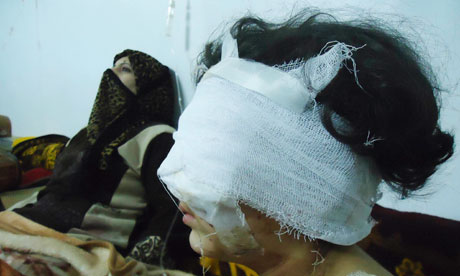
A wounded woman in Bab Amr with a bandage on her head.(Photo Courtesy of The Guardian)

Activists and witnesses said the army had been shelling the neighborhood “indiscriminately” since the morning of Sunday 05 February 2012. Abu Abdo Alhomsy, an activist of a revolutionary council in Homs, shared these words with Al-Jazeera on Monday 06 February 2012 concerning the attacks.

“It is horrible right here. Rockets are falling. There are massive explosions that shook buildings. We don’t know really what to do. It’s a massive attack-a new massacre is happening here. Nobody can go out, we don’t know how many homes have been hit or how many people died.”

Danny Abdul Dayem, a resident of Homs, shared these words with Al-Jazeera concerning the shelling in Bab Amr. Video images have surfaced showing people who have been shot and hit by shrapnel, including children sustaining fatal injuries.

“It has been terrible. There is non-stop bombing with rockets, mortar bombs, and tank shells. There were more than 50 people injured in Bab Amr today. I saw with my own eyes kids with no legs, and a kid who lost his whole bottom jaw. It is terrible.”

Dayem also indicated that only one field hospital with four doctors was still operating in the city and that it was virtually impossible to get additional medication for anything short of a gunshot wound.

The Syrian state television has denied that there had been any such bombardment in the country. It stated that residents were setting fire to piles of rubbish on the roofs of their homes in an attempt to trick the world into believing that there was an attack. The phrase “terrorist gangs” was used to describe whom was responsible for the blown up buildings in Homs. The government has come out and said that it is fighting foreign-backed armed groups

According to the Syrian Observatory for Human Rights (SOHR), a London-based rights organization, army deserters in the northeast region of the country destroyed a military control post early on Monday 06 February 2012, killing three officers and capturing 19 soldiers. The fighting occurred in the village of Al Bara in the Edleb region and that none of the army deserters involved in the skirmish lost their lives.

The death toll in Syria rose to at least 88 people over the weekend, deemed one of the bloodiest since the demonstrations and protests against al-Assad’s regime began nearly 11 months ago. The chaos and turmoil in the country has claimed at least 6,000 lives total in Syria, according to various opposition groups.

The international community continues to react to the situation in Syria instead of taking a proactive approach. According to French authorities, The European Union (EU) is set to strengthen sanctions imposed on Syria in a bid to boost pressure on the government. Alain Juppe, the French foreign minister, shared these words with BFMTV television on Sunday 05 February 2012.

“Europe will again harden sanctions imposed on the Syrian regime. We will try to increase this international pressure and there will come a time when the regime will have to realize that it is completely isolated and cannot continue.”

The United States closed its embassy in Syria and pulled out its remaining staff on Monday 06 February 2012, citing serious security concerns as al-Assad’s regime increased its crackdown, causing more bloodshed. The State Department released a statement containing the following on the decision to close the Syrian embassy.

“The United States has suspended operations of our embassy in Damascus as of 06 February. Ambassador Robert Ford and all American personnel have now departed the country. The recent surge in violence, including bombings in Damascus on 23 December and 06 January, has raised serious concerns that our embassy is not sufficiently protested from armed attack.”

With all of the attacks and death occurring the around the nation, it can only be extremely disheartening to Syrian civilians to see nations such as China and Russia veto a UN Security Council resolution and the US close its embassy. Regardless of what the “big-time” actors are doing, people are still suffering and dying on the ground. These are the same people that are continually at the mercy of al-Assad’s regime. It would seem that the only way for these people’s voices to be heard and acted on is the permanent absence of al-Assad’s regime. Much like Hosni Mubarak of Egypt and Moammar Gaddafi of Libya, the permanent absence of a multi-decade dictator is the only way for the demonstrations and protests to actually mean something for change.


For more information, please see: 

Ahram – US Closes Syria Embassy, Pulls Out All Staff – 06 February 2012

http://english.ahram.org.eg/NewsContent/2/8/33861/World/Region/US-closes-Syria-embassy,-pulls-out-all-staff.aspx

Al-Jazeera – Syrian Army ‘Steps Up Homs Offensive’ – 06 February 2012

http://www.aljazeera.com/news/middleeast/2012/02/20122614732355122.html

BBC – Syria Crisis: Army Steps Up Homs Shelling – 06 February 2012

http://www.bbc.co.uk/news/world-middle-east-16902819

CNN – US Closes Embassy As Fighting Rages In Syria – 06 February 2012

http://www.cnn.com/2012/02/06/world/meast/syria-unrest/index.html?hpt=imi_c1

The Guardian – Syrian Forces ‘Kill At Least 50’ In Homs Bombardment – 06 February 2012

http://www.guardian.co.uk/world/2012/feb/06/syrian-forces-homs-bombardment

Reuters – Syria Bombards Homs; West Scrambles For New Strategy – 06 February 2012

http://www.reuters.com/article/2012/02/06/us-syria-idUSTRE80S08620120206
Russian and Chinese Vetoes Prevent Passage of UN Resolution Condemning Syrian Violence

By Tyler Yates
Impunity Watch Reporter, Middle East

DAMASCUS, Syria — Russia and China voted against a draft resolution that would have condemned a crackdown on anti-government protests in Syria and called on Bashar al-Assad, the Syrian president, to step aside.

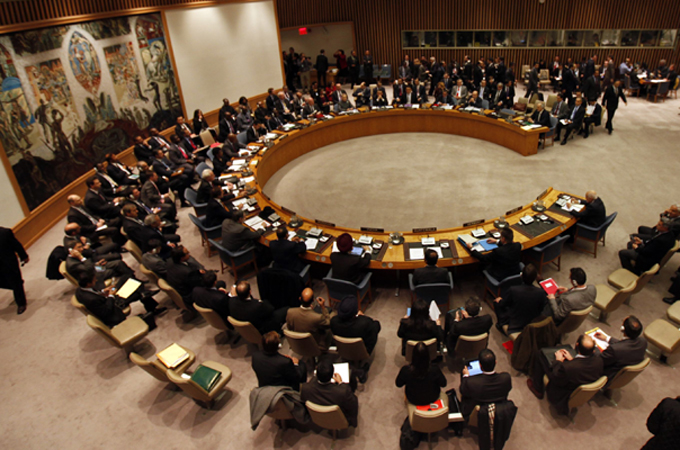
The United Nations Security Council (Photo Courtesy of Al Jazeera).

The countries, two of the United Nations Security Council’s permanent members, have veto power over resolutions put before the Council.

A statement from the Russian ambassador to the United Nations said the resolution, “sent an unbalanced signal to the Syrian parties” by not condemning violence on the part of the armed opposition to the same degree that it did for the Syrian government.

Internationally, the vetoes received tremendous criticism.  Qatar’s minister of state for foreign affairs said the vetoes sent “ a very bad signal to [President Bashar al-Assad] that there is a license to kill.” Other Western and Arab leaders echoed Qatar’s reaction.

Europe will strengthen sanctions imposed on Damascus in a bid to boost pressure on the regime, France said on Sunday. The United States has vowed to block funding and arms supplies to Syria.

“We will work to seek regional and national sanctions against Syria and strenghten the ones we have. They will be implemented to the fullest to dry up the sources of funding and the arms shipments that are keeping the regime’s war machine going,”  US Secretary of State Hillary Clinton said on Sunday.

Despite these international efforts the opposition in Syria is now forced to attempt to stop the government crackdown by itself.

Colonel Riad al-Asaad, commander of the FSA, said that “there is no other road” except military action by his fighters to topple Assad.

Iran welcomed the vetoes from China and Russia, calling the sanctions “just.”

“The Security Council has become a tool for the West’s bullying … of other nations, and this time Russia and China stood up against it,” one of Iran’s top diplomat said.

The Syrian government also saw the vetoes as a victory, saying that the result should be an acceptance of the regime’s program for solving the evolving crisis.

The Tishreen, a state run newspaper, called the vetoes an incentive for Damascus to continue with its announced political reforms, which include drafting a new constitution, allowing the formation of new political parties, and holding parliamentary elections.

It further suggested that the international community support talks between the government and the opposition.

At the same time, it declared that the government would continue with its crackdown, saying it would “restore what the Syrians enjoyed for decades and what they are demanding today which is stability and security and confronting all forms of terrorism.”

For more information, please see:

Al Jazeera —Qatar says UN veteos sent “bad signal” —  05 Feb. 2012

Al Jazeera — Veto power at the UN Security Council — 05 Feb. 2012

Huffington Post — Russia, China Veto Of Syria UN Resolution Sparks Outrage — 05 Feb. 2012

NPR — Syria Veto “Outrageous” Says UN Envoy Susan Rice — 05 Feb. 2012

Reuters — Clinton calls UN Syria vote a “travesty” — o5 Feb. 2012


As Arab League Vacates Syria, Civilians Continue To Pay The Toll

By Adom M. Cooper
Impunity Watch Reporter, Middle East

DAMASCUS, Syria–The Arab League suspended its mission in Syria on Saturday 28 January 2011, opening the door for more unabated violence in the country. The Syrian military has launched an offensive to regain control of the suburbs east of Damascus. Soldiers stormed neighborhoods and clashed with groups of army deserters in fighting that has caused civilians to bear the burden.

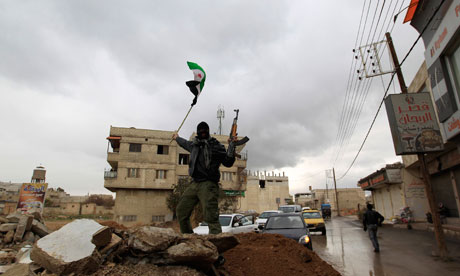
A Syrian army defector holds his rifle and independence flag in the Damascus suburb of Saqba.(Photo Courtesy of Reuters)

Activist groups say that at least three civilians were killed on Sunday 29 January 2012 in the eastern region of Damascus. Six soldiers were also killed when a roadside bomb detonated near a bus line they were traveling on in the south of the capital. According to the Syrian Observatory for Human Rights, at least 66 people, including 26 civilians, were killed across the country. The London-based right group reported that 26 soldiers, five other members of the security forces, nine army deserters were also among those killed as regime soldiers cracked down on protesters.

Al-Jazeera correspondent Anita McNaught spoke with activists in Al-Ghouta, approximately 10 kilometers from the city center of Damascus, and shared these sentiments. Al-Ghouta is historically known for being a hub of dissent against al-Assad’s regime and the crackdown appeared to deter any sort of mass-movement resembling what has occurred in Egypt’s Tahrir Square.

“People we’ve spoke to are too frightened to leave their homes, they’re locked themselves in.”

Dozens of amateur videos have surfaced from Al-Ghouta and Zamalka depicted tanks rolling into both cities. In the southern province of Deraa, there were reports that security forces had killed two students when they broke into a school in the town of Jasim.

The international community has come out with a strong response against the Arab League’s decision to end its observer mission in Syria. Considering the escalating violence, the Arab League said that the situation demands additional deployment of monitors and not their suspension. Sergei Lavrov, the Russian foreign minister, offered strong words of criticism against the Arab League’s decision to end the mission.

“We would like to know why they are treating such a useful instruments in this way. I would support an increased number of observers. We are surprised that after a decision was taken on prolonging the observers’ mission for another month, some countries, particularly Persian Gulf countries, recalled their observers from the mission.”

Since the Arab League ended its observer mission on Saturday 28 January 2012, allowing a spike in bloodshed to occur in the crackdowns on anti-regime protests. In the past four days alone, several hundred individuals have lost their lives. Jim Muir, reporting for the BCC in Lebnanon, stated that both the upsurge and suspension mean that even more attention to be put on the UN Security Council’s attempts this coming next to get a tough resolution on Syria.

The Syrian government expressed its own concern with the surprise and disagreement over the Arab League’s decision to end its observer mission. The Syrian Television gave the following statement concerning the exodus of the observers.

“Syria regrets and is surprised at the Arab decision to stop the work of its monitoring mission after it asked for a one-month extension of its work. This will have a negative impact and put pressure on the Security Council’s deliberations with the aim of calling for foreign intervention and encouraging armed groups to increase violence.”

Nabil Elaraby, the Arab League chief, headed to New York City on Sunday 29 January 2012, hoping to win support from the United Nations Security Council for a plan to end violence in Syria by asking President Bashar al-Assad to step down. He shared the following words with reporters in Cairo concerning his visit to New York City.

“We will hold several meetings with representative from members of the Security Council to obtain the council’s support and agreement to the Arab initiative.”

As the international community continues to debate the future of Syria, its people continue to suffer and perish under the current conditions. One activist in the town of Saqba discussed the deplorable conditions.

“They cut off the electricity. Petrol stations are empty and the army is preventing people from leaving to get fuel for generators or heating.”

In December 2011, the UN reported that more than 5,000 people had been killed since the demonstrations and protests began against the government of President al-Assad first began in March. On Tuesday 24 January 2012, Arab nations voted to extend the mission for another month. In less than a week, the Arab League has gone back on its decision to extend the mission.

The ban on international journalists that has been imposed for the last 10 months is already expected to extend its “authority” again. Journalists had been allowed in on short visas in recent weeks per partial fulfillment of Assad’s deal with the Arab League. But since the observers are departing, the agreement protecting the journalists seems to already be fading.

A western diplomat shared the following words with The Guardian concerning the absence of observers and the media in Syria.

“With no Arab observers and not much media presence left things could now get a lot worse. Any constraining hand has gone. It makes it all the more urgent to achieve something at the UN this week and that can’t be taken for granted.”


For more information, please see: 

Ahram – Syrian Forces Kill 33 In Attack On Rebel-Town Residents – 29 January 2012

Al-Jazeera – Syrian Army In Offensive Near Damascus – 29 January 2012

BBC – Syrian Army Moves To Wrest Damascus Suburbs From Rebels – 29 January 2012

CNN – Arab League Suspends Syria Mission Amid Violence – 29 January 2012

The Guardian – Syria Hurtling Towards A Bloodier Crisis – 29 January 2012

NYT – Sharp Rise In Violence Halts Monitoring By League In Syria – 28 January 2012


Arab League Struggles To Win Legitimacy in Syria

By Adom M. Cooper
Impunity Watch Reporter, Middle East

DAMASCUS, Syria–In the latest development coming out of Syria, the country has condemned a new Arab League initiative that calls on President Bashar al-Assad to relinquish his power by holding early elections and forming a “national unity government.” After a meeting of the 22-member body in Cairo, Qatar’s prime minister, Sheikh Hamad bi Jassim Al Thani, stated that the group came to a consensus on the political initiative that would hopefully result in the “peaceful departure of the Syrian regime.”

Arab League monitors, wearing orange vests, oversee the release of Syrian detainees as they leave Adra Prison near Damascus.(Photo Courtesy of BBC)

“After the establishment of the government of national unity, the Arab League will call on the international community to support this national unity government to fulfill its functions. We are looking into an Arab solution for this. We are not looking for a military intervention.”

The Arab League called for the government to begin a dialogue with the opposition within two weeks and for the new government to be formed within two months. The unity government should, within three months, prepare to elect a council that will write a new constitution and prepare for parliamentary and presidential elections.

The Syrian state television released the following statement from a government official, claiming that the resolution was part of a conspiracy against the Syrian people.

“Syria rejects the decisions taken which are outside an Arab working plan, and considers them an attack on its national sovereignty and a flagrant interference in internal affairs.”

In addition to a call for national unity, Al Thani announced that the Arab League’s observer mission in Syria would be extended for another month and the observers would be given additional equipment after Genera Mohammed Ahmed Mustafa al-Dabi of Sudan, the head of the monitoring mission, desired for his mandate to be bolstered.

On Sunday 22 January 2012, Saudi Arabi announced that it was pulling out of the Arab League’s 165-monitor mission in Syria because Damascus had broken several promises on peace initiatives. The decision to extend the mission for a month has been heavily criticized by several analysts and the Saudi decision to leave has cast the mission long-term future into serious doubt. Saudi Arabia is one of the key funders of the league’s projects.

Al-Jazeera correspondent Mike Hanna, reporting from Cairo at the headquarters of the Arab League, shared these words about the situation.

“We understand that al-Dabi has said to the Syrian committees that the mission has not gained enough momentum yet to get a full judgment on it. He said that he needed more time with the added monitors that he’s received in recent weeks and the added geographical places in which the monitoring mission is now extended to see if this mission can in fact work.”

The Syrian Revolution General Commission (SRGC), an anti-regime activist group, claimed on Sunday 22 January 2012, that at least 840 Syrians have been killed since 23 December 2011, the date that the Arab League observers entered Syria. The SRGC also stated that the Arab League has failed to limit the bloodshed or successfully implement the Arab League Peace Plan.

While the Arab League continues to deliberate on how to deal with al-Assad’s regime, the violence did not wish to take a hiatus and deliberate as well. Activists reported that on Sunday 22 January 2012 battles between government troops and army defectors in Douma, a suburb of Damascus. Syria’s Local Coordination Committees reported that at least five individuals were killed.

Arab League Secretary-General Nabil el-Araby stated that the Syrian government has not complied with some parts of an Arab League agreement specifically aimed at ending a violent crackdown on demonstrators and protesters. el-Araby also stated that Syrian officials are treating the crisis as a security problem, noting that armed opposition factions controlling some areas make it increasingly difficult for observers to do their jobs. But he did state that overall, the presence of the monitors has resulted in improvements around the nation.

“The presence of the Arab monitors provided security to opposition parties, which held an increase in number of peaceful protests in areas where the monitors were present.”

But there has been a stark contrast regarding the presence of the Arab League monitors. Burham Ghailoun, head of the opposition Syrian National Council (SNC), stated that the monitors have not seen the full extent of what is going on and thus, cannot adequately address the problems.

“The Arab monitors indicated that the regime did not follow protocol, did not release the detainees, did not remove all military tanks, did not allow press to travel freely, did not recognize even once the peaceful protests, and the massacre of Idlib yesterday is proof of that. The regime let down the Arab League, and Arab nations have the responsibility to respond.”

The UN has reported that more than 5,000 individuals have lost their lives since the anti-regime demonstrations and protests began in March 2011. Syria’s ban on international journalists remains in full effect, continuing to make it difficult to confirm and verify reports that occur around the nation.

If the Arab League wishes to save face and retain any sort of legitimacy, the ban on international journalists needs to be lifted and addressed as it continues to put plans together. The chances of things being hidden from the eyes of Arab League monitors can only decrease with the eyes and ears of experienced international journalists present.


For more information, please see: 

Al-Jazeera – Syria Rejects Arab League Transition Plan – 23 January 2012

BBC – Syria Unrest: Arab League Urges Assad To Reform – 23 January 2012

CNN – Arab League Calls For Unity Government In Syria – 23 January 2012

Ahram – Arabs Set To Extend Syria Mission, Rebels ‘Overrun Town’ – 22 January 2012

The Guardian – Saudi Arabia To Withdraw Arab League Monitors From Syria – 22 January 2012

NYT – Arab League Floats Ambitious New Peace Plan For Syria – 22 January 2012

Reuters – Arab League Proposes New Plan For Syria Transition – 22 January 2012


Syria Arrests American Without Reason

By Carolyn Abdenour
Impunity Watch Reporter, Middle East
DAMASCUS, Syria – On Friday, 20 January, the United States’ (“US”) State Department confirmed suspicions that Syrian officials arrested Abdelkader Chaar, a 22 year old U.S. citizen, from his home in Aleppo on 8 January.  Sam Chaar, Abdelkader’s uncle, stated Syrian officials have not disclosed why they arrested Chaar or identified the charges against his nephew.
22 year old Abdelkader Chaar arrested in Syria. (Photo Courtesy of CNN)

Born in Syracuse, New York in 1989, the Chaar family moved to Aleppo, Syria when he was six years old.  Chaar currently attends medical school at Aleppo University.Chaar’s father has contacted the US Embassy in Damascus and New York Senator Charles Schumer.

The State Department has received notification of Mr. Chaar’s arrest.  Victoria Nuland, spokesperson for the US State Department, said “We’ve been in contact with Syrian authorities and have requested confirmation of the arrest and requested consular access.”  Since the Chaar family did not sign a US Privacy Act waiver, Ms. Nuland did not provide more details about Chaar’s status.

Senator Schumer’s spokesperson Matt House added, “We have had multiple contacts with the State Department and are doing everything we can to find out the details of Mr. Chaar’s situation…We will continue to work with American and Syrian officials to assist in any way we can.”Syrian officials confirmed Chaar’s arrest in conjunction with Friday’s protests demanding the release of political detainees.  Opposition activist group Local Coordination Committees of Syria reported at least ten people died during Friday’s protests.

Furthermore, the Arab League has uged President Bashar al-Assad to free political detainees, remove tanks and weapons from cities, cease violence against citizens, and permit outsiders and international journalists to move freely throughout the country.

Syrians have held anti-government protests throughout the country since mid-March.  The United Nation (“UN”) stated over 5,000 people have died during the ten months of protests, but opposition groups in Syria estimate the clashes have led to over 6,000 deaths.

The United States has warned Americans to avoid travel in Syria and encouraged those traveling in the country to leave immediately before transport options evaporate.

Sam Chaar said his nephew plans to practice medicine in the US after he completes a six week rotation at the Cleveland Clinic that begins on February 11.

For further information, please see:
CNN – Official: American Arrested in Syria – 20 Jan 2012

Focus News – AFP: US Probes Reports Of US Citizen Arrested in Syria – 20 Jan 2012

The Post Standard – Liverpool Family Seeks Help For Nephew Reportedly Seized in Syria – 20 Jan 2012

YNN – Syracuse Native Detained In Syria? – 20 Jan 2012