Syria Watch

In The Midst of Protests and Violence, Al-Assad Offers ‘Amnesty’ To Opposition

By Adom M. Cooper
Impunity Watch Reporter, Middle East

DAMASCUS, Syria–In the latest developments coming out of Syria, President Bashar al-Assad has officially offered amnesty to anyone accused of crimes in connection with demonstrations and protests that have occurred in the last 10 months of anti-regime unrest and ensuing violence. al-Assad has previously made similar statements on three previous occasions in May, June, and November of 2011.
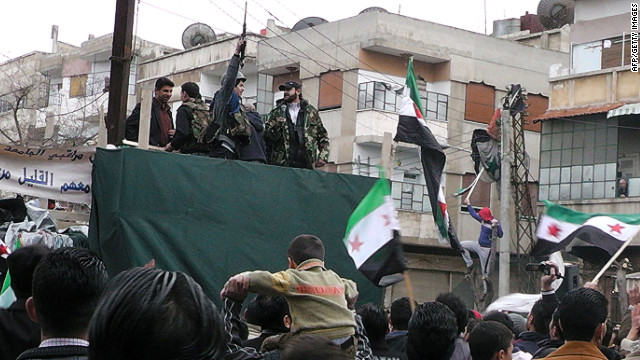
Anti-regime individuals cheer for Arab League monitors in Zabadani. (Photo Courtesy of CNN)


This time, al-Assad made the announcement on the official SANA news agency and broadcast on state television. According to the announcement, it would apply to army deserters who turned themselves in before the end of January, peaceful protesters, and those who handed in unlicensed weapons. The statement included the following segment.

“Amnesty is granted for crimes committed in the context of the events taking place since March 1, 2011, till the date of issuing the decree.”

Opposition groups did not respond immediately to the amnesty pledge, as this is the first time that al-Assad has made it since forces loyal to him have lost control of parts of Syria’s cities and towns.

Since the demonstrations and protests began in March 2011, SANA has reported that al-Assad has freed approximately 3,952 prisoners. The opposition claims that there are thousands more in Syrian prisons and said that 26 people had died on Sunday 15 January 2012, including a policeman and soldier killed by security forces for refusing to fire upon protesters. Among the individuals who lost their lives on Sunday 15 January 2011, five were factory workers killed when their bus was hit by a bomb in the northern province of Idlib.

In the past year, tens of thousands of people have been detained in the past year. The UN estimates that at least 5,000 people have been killed since initial peaceful protests against al-Assad’s regime turned violent. Many demonstrations and protests were met with brutal security crackdowns, which ignited an ongoing armed conflict that has seen both the military and the opposition orchestrate attacks.

UN chief Ban Ki-Moon released a statement on Sunday 15 January 2012 concerning the ongoing situation in Syria.

“Today, I say again to President Assad of Syria: Stop the violence. Stop killing your people. The path of repression is a dead end. The lessons of the past year are eloquent and clear. The winds of change will not cease to blow. The flame ignited in Tunisia will not be dimmed. Let us remember as well, none of these great changes began with a call for a regime change. First and foremost, people wanted dignity.”

Residents in the town of Zabadani, approximately 50 km (30 miles) northwest of Damascus, cheered as Arab League monitors visited their area. These residents, according to CNN, stated that their water and electricity had been cut off from the past three days and displayed fresh wounds from conflicts with pro-government forces.

When the monitors were ready to leave after their inspection of this designated area, many thousands of residents implored them to stay, stating that the attacks would resume once they had left. Many of the residents offered to show the monitors where Syria tanks were hidden in fields surrounding the city. al-Assad’s regime was required to pull its heavy weaponry out of the cities under the agreement that was signed with the Arab League in November 2011. But the residents of Zabadani claimed that the tanks were only absent when the Arab League monitors were present.

Fares Mohammed, a spokesman for the Local Coordination Committees of Syria, claimed that about 100 armored vehicles had surrounded the city for three days. Also, that the power and water were cut off, while the city faced sub-freezing temperatures. A member of the Free Syria Army, which is composed primarily of deserters who are siding with the opposition, stated that there were about 70 lightly armored fighters in Zabadani. He gave this statement to CNN, asking not to be named for security purposes.

“The situation is very bad. The siege is choking us, and even air is running out.”

Despite its large presence, the Arab League continues to struggle with its mission of holistically quelling the violence in Syria. The current delegation in the country has not stopped drawing fierce criticisms from both sides of the conflict and a general consensus exists that the mission has failed. However, there is also a general consensus that it is important to keep away intervention from outside of the Arab world, the same intervention in Libya that helped bring down Muammar Gaddafi.

Amr Moussa, who left the Arab League leader’s chair last year, showed support for a Qatari proposal to send Arab troops in Syria to deal with the violence. He shared these sentiments with a correspondent from The Guardian.

“This is a very important proposal. The Arab League should begin to study this possibility and begin consultations on this issue.”

The ruler of Qatar, Sheikh Hamad bin Khalifa Al Thani, shared these words with US news outlet CBS in his support of sending in Arab troops.

“For such a situation to stop the killing, some troops should go to stop the killing.”

It appears that the more al-Assad talks about making changes for his people, the more of them seem to suffer or be put at risk to suffer.


For more information, please see:

Ahram – Syrian President Grants General Amnesty – 15 January 2012

Al-Jazeera – Assad Offers ‘Amnesty’ For Opposition – 15 January 2012

BBC – Syria Crisis: Assad ‘Gives Amnesty For Uprising Crimes – 15 January 2012

CNN – Syria Toll Rises To 25; Monitors Cheered In Besieged Town – 15 January 2012

The Guardian – Syria Offers Second Amnesty to Anti-Regime Protesters – 15 January 2012

NYT – Fear of Civil War Mounts in Syria as Crisis Deepens – 14 January 2012
 

As the Arab League’s Mission In Syria Continues, One Monitor Quits and Labels It a ‘Farce’

By Adom M. Cooper
Impunity Watch Reporter, Middle East

DAMASCUS, Syria–In the midst of the Arab League’s mission to discover what exactly is happening inside Syria since the protests began, one monitor decided to call it quits after what he witnessed. Anwar Malek, an Algerian member of the monitoring team, has called the Arab League’s mission to the country a ‘farce.’


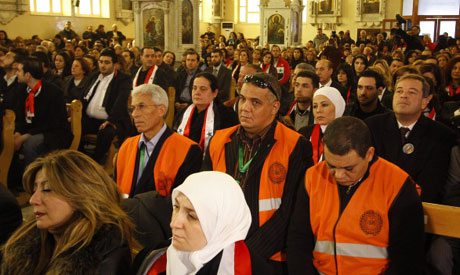
Arab League observers attend a mass prayer for individuals were killed during the violence. (Photo Courtesy of the AP)

Malek stated that he resigned due to what he saw and that the mission itself was falling apart. He also stated that security forces did not withdraw their tanks from the streets, but rather hid them and chose to redeploy them after the observers had gone. He shared these sentiments with an Al-Jazeera correspondent.

“What I saw was a humanitarian disaster. The regime is not just committing one war crime, but a series of crimes against its people. The snipers are everywhere shooting civilians. People are being kidnapped. Prisoners are being tortured and none were released. The mission was a farce and the observers have been fooled. The regime orchestrated it and fabricated most of what we saw to stop the Arab League from taking action against the regime.”

Meanwhile, President Bashar al-Assad addressed a rather large gathering of his followers and supports in the Syrian capital, Damascus. In his second speech in as many days, al-Assad stated again his accusations that the “homeland was reeling under the brunt of conspiracy.”

“You are standing against a desecration of our identity, and you are confirming your steadfastness and support for the armed forces, whose martyrs are falling every single day so you can live in safety.We will triumph over this conspiracy. It is dying; it’s the end of their plot.”

The United Nations has declared that more than 5,000 civilians have lost their lives since the protests began against al-Assad in March 2011. Conversely, al-Assad has declared that “terrorists” have killed some 2,000 members of his security forces.

A senior UN official informed the UN Security Council on Tuesday 10 January 2012 that Syria had accelerated its killing of pro-democracy demonstrators and protesters after the Arab League monitors had arrived. Susan Rice, the US ambassador to the UN, delivering the following statement concerning the increased death of civilians since the Arab League monitors began their observance.

“The under-secretary-general noted that in the days since the Arab League monitoring mission has been on the ground, an estimated additional 400 people have bee killed, an average of 40 a day, a rate much higher than was the case before their deployment. That is a clear indication that the government of Syria, rather than using the opportunity to end the violence and fulfill all of its commitments to the Arab League, is instead stepping up the violence. The Arab League has failed for six decades to take a position in the Arab interest.”

The Arab League condemned an attack on Monday 9 January 2012 in which 11 of its monitors were hurt by demonstrators and protesters in the province of Latakia. The monitors were upset, saying that Syria breached its obligation to protect them. al-Assad’s regime claimed that it was continuing to provide security for the observers and also condemned any act that would obstruct their mission’s work. The Arab League released the following statement concerning the attacks on its monitors.

“Failing to provide adequate protection in Latakia and other areas where the mission is deployed is considered a serious violation by the government of its commitments.”

Malek further expressed his disgust what the situation, stating that the government was not assisting the observers with their requests. He also stated that those who were supposedly freed and were shown on television, were actually people who had been randomly grabbed off the street.

“The regime didn’t meet any of our requests, in fact they were trying to deceive us and steer us away from what was really happening, towards insignificant events. The people were detained for four or five days in tough conditions and later released as if they had been real prisoners.”

“Around some of the buildings, there were even army officers in front of the building, while snipers were on the roof. Some on our team preferred to maintain good relations with the regime and denied that there were snipers. From time to time, we would see a person killed by a sniper. I have seen it with my own eyes. I could not shed my humanity in such situations and claim independence and objectivity.”

One can only wonder what the civilians on the ground are really going through if one of the Arab League’s monitors, sent to help their situation, felt so repulsed by what he saw that he had to resign. The civilians of Syria need all the attention that they can get so the violence against them ceases. But as long as the violence rages on, the voices for freedom will continue to be silenced.


For more information, please see: 

Ahram – UN Says Syria Killings Rise After Monitors Arrive – 11 January 2012

Al-Jazeera – Arab Observer Calls Syria Mission a ‘Farce’ – 11 January 2012

BBC – Ex-Arab League Monitor Labels Syria Mission a ‘Farce’ – 11 January 2012

CNN – Al-Assad Revs Up Pro-Regime Rally – 11 January 2012

The Guardian – Arab League Official Attacks Syria Mission as ‘Farce’ – 11 January 2012

Reuters – Arab Monitor Quits Syria Mission in Disgust – 11 January 2012


As Arab League Monitors Arrive in Syria, Mass Protests Continue

By Adom M. Cooper
Impunity Watch Reporter, Middle East

DAMASCUS, Syria–Arab League monitors have arrived in Syria to observe three key protest sites as the international community urges al-Assad’s regime to allow full access to the country. The observers must be able to adequately determine if the country is implementing a plan to end crackdowns on demonstrations and protests.


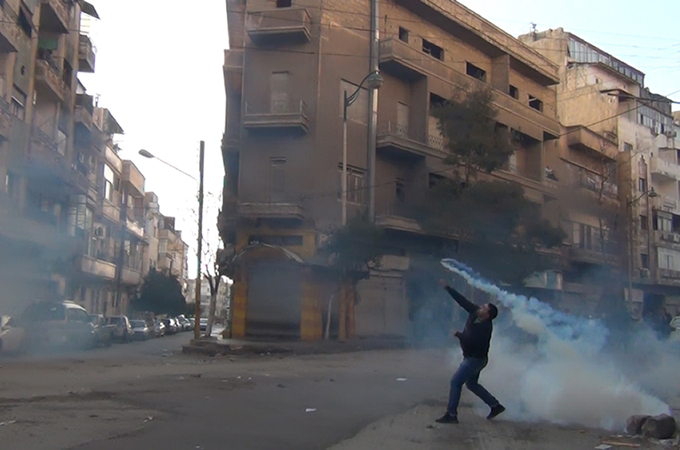
A Syrian protester in the city of Homs. (Photo Courtesy of Al-Jazeera)

The UN has stated that more than 14,000 people are in detention and estimated that more than 5,000 people have been killed in the government crackdown since anti-government demonstrations and protests began earlier this year in mid-March.

All of the detained demonstrators and protesters should be freed under a peace plan created by the Arab League.

Anti-government protests festered violence that continued on Wednesday 28 December 2011. Video shared by activists depicted the central city of Hama with gunshots being fired and black smoke rising above the city.

Dozens of men were seen marching through the streets, chanting and shouting, “Where are the Arab monitors?”

More violence was reported in the southern province of Deraa, where the Britian-based Syrian Observatory for Human Rights stated that army defectors killed at least four Syrian soldiers. The organization also reported that at least one person was killed in the city of Homs.

On Tuesday 27 December 2011, activists stated that Syrian police used tear gas to disperse an estimated 70,000 people who took to the streets of Homs as the monitors arrived. Some demonstrators were fired upon with live ammunition as they made their way to Sa’a square, and four were wounded, one of them critically.

Before joining the march on Al-Sa’a square, some tens of thousands of protesters staged a sit-in in the al-Khalidiyeh neighborhood, according to the Syrian Observatory for Human Rights. There were also demonstrations that took place in the Bab Dreib and Jub al-Jandalia districts of the country. On Monday 26 December 2011, at least 34 civilians were reportedly killed in Homs’ Baba Amro district. T

Mustafa al-Dabi, the head of the Arab League’s mission, stated on Wednesday 28 December 2011, that monitors would head to Hama and to Iblib, on Syria’s nortern border with Turkey. These two areas have endured intense fighting between security forces and fighters who support the protesters. al-Dabi shared these words with Al-Jazeera about the monitors’ arrival.

“Yesterday was quiet and there were no clashes. We did not see tanks but we did see some armored vehicles. There were some places where the situation was not good. But there wasn’t anything frightening, at least while we were there. But remember, this was only the first day and it will need investigation. We have 20 people who will be there for a long time.”

The Arab League plan endorsed by Syria on 2 November calls for the withdrawal of the military from towns and residential districts, a halt in violence against civilians, and the release of detainees. A Syrian security officer in Homs told Human Rights Watch (HRW), a US-based rights organization, that after the government signed the Arab League protocol authorizing the observer mission, between 400 and 500 prisoners were moved out of his facility to other places of detention, including a nearby missile factory in Zaidal. The official shared these words with HRW.

“The transfers happened in installments. Some detainees were moved to civilian jeeps and some in cargo trucks. My role was inside the prison, gathering the detainees and putting them in the cars. My orders from the prison director were to move the important detainees out.”

Other witnesses corroborated the official’s account. HRW spoke with a detainee who claimed that a transfer of other detainees took place from the Military Security detention facility in Homs on the night of 19 December.

“There were about 150 detainees. They took them out around 1:30 or 2:00 in the morning. These guys were in detention the longest. Not criminals, but people who worked with journalists, or were defectors, or involved in protests.”

HRW has accused al-Assad’s regime of hiding from the monitors hundreds of detainees held in its crackdown on dissent. HRW’s Middle East director Sarah Leah Whitson released a statement about the hiding of detainees.

“Syria’s subterfuge makes it essential for the Arab League to draw clear line regarding access to detainees, and be willing to speak out when those lines are crossed. Syrian authorities have transferred perhaps hundreds of detainees to off-limits military sites to hide them from Arab League monitors now in the country.”

Sergei Lavrov, the Russian foreign minister, has urged Syria to give the monitors the maximum amount of freedom as they move throughout the country to complete their mission.

“We constantly work with the Syrian leadership calling on it to fully cooperate with observers from the Arab League and to create work conditions that are as comfortable and free as possible.”

The Local Coordination Committees in Syria stated that seven people had been killed so far on Wednesday 28 December 2011, four in Homs, two in Hama, and one in Aleppo.

The ban on international journalists in Syria continues to be in effect, making it increasingly difficult to independently verify casualty figures and other information.


For more information, please see:

Ahram – Observers to Deploy in More Syria Protest Hubs – 28 December 2011

Al-Jazeera – Arab Monitors in Syria Flashpoint Towns – 28 December 2011

BBC – Syria ‘Release 755 Detained During Unrest – 28 December 2011

Reuters – ‘Nothing Frightening’ Seen in Syria Protest Hotbed – 28 December 2011

The Guardian – Arab League Monitors Visit Homs – 27 December 2011

Human Rights Watch – Syria: Detainees Hidden From International Monitors – 27 December 2011


“Scores” Reported Killed in Syria, As Al-Assad’s Regime Continues to Fester Violence

By Adom M. Cooper
Impunity Watch Reporter, Middle East

IDLIB, Syria–Less than a week before the Arab League delegation is due to visit Syria as part of a deal hoping to end the bloodshed, as many as 200 individuals are reported to have lost their lives in the last two days across the country. There are various reports coming from Syria about the situations involving the death tolls.

Demonstrators holding placards against al-Assad's regime in Idlib. (Photo Courtesy of Reuters)

Activist groups have reported the deaths on Tuesday 20 December 2011 after heavy fighting had occurred primarily in the province of Idlib, near Syria’s northern border with Turkey. On Monday 19 December 2011, activists claimed that as many as 110 people lost their lives in fighting acorss the country, including 60-60 army deserters who were apparently gunned down by machine-gun fire close to a village called Kafrouaid in Idlib.

More violence was reported in the region of the Zawiya Mountains on Tuesday 20 December 2011, with the Local Coordination Committes stating that 25 individuals had died close to the same village by machine-gun fire and shelling.

Many of the towns and cities located within Idlib are without Internet and mobile phone connections. Others are with electricity.

Rula Amin, an Al-Jazeera correspondent reported from Beirut, shared these sentiments about the violence.

“Activists and opposition figures say killings in Idlib area are very large. Dozens have been killed but people differ who were among those killed; some say they were defectors, others say armed men who oppose the government.”

The Syrian Observatory for Human Rights, a British based organization, stated on Monday 19 December 2011, more than 60 army deserters had been shot and killed as their tried to flee their base. Also, it reported that al-Assad had decreed the death penalty for anyone caught distributing arms “with the aim of committing terrorist acts.”

The state news agency SANA reported that security forces in Idlib had killed at least one “terrorist” and wounded several others.

Wissam Tarif, a well-known activist based in Beirut, stated that accounts from hospitals and witnesses suggested that some 260 individuals had been killed in Idlib alone on Tuesday 20 December 2011. He said that most of these individuals were defecting soldiers but also included some 93 loyalist soldiers and six civilians.

In the town of Jabal al-Zawiya alone, Tarif claimed that more than 3,000 soldiers had defected and that 10,000 had defected across Syria.

The Syrian National Council (SNC), the opposition umbrella group, stated that 250 individuals lost their lives between Monday 19 December and Tuesday 20 December. It released a statement urged the international community to act against the “horrific massacres.”

A team of observers from the Arab League is scheduled to arrive in Damascus later this week, as part of a signed deal between al-Assad’s regime and the Arab League in order to end the violence. The team is comprised of security, legal, and administrative observers, with human rights experts expected to follow.

Nabil el-Araby, the Arab League chief, stated that the initial team would go to Syria on Thursday 22 December 2011 while the rest will arrive by the end of December. He also stated that the Arab League desires to have 500 monitors in Syria by the end of the month and shared these sentiments with Reuters.

“It’s a completely new mission and it depends on implementation in good faith. In a week’s time, from the start of the operation, we will know if Syria is complying.”

The US and the EU have already imposed sanctions upon Syria, which combined with the unrest itself has pushed Syria’s economy into a free-fall. The Syrian pound fell nearly 2 percent on Tuesday 20 December 2011 to over 55 pounds per dollar, 17 percent down from the official rate before the crisis erupted.

In response to this economic depravity, Al-Baath newspaper reported that Prime Minister Adel Safar had instructed ministries to cut their expenditures by 25 percent. These cuts affected spending on elements such as fuel, stationery, and hospitality. Arab League chief el-Araby stated that the sanctions would stand until the League’s monitors begin reporting back on what they have seen on the ground.

The Arab League has threatened to request the UN Security Council to adopt its peace plan for Syria. This would considerably broaden the chances for international action inside Syria.

Syrian opposition leader Burham Ghalioun was not enamored by the actions of the Arab League thus far by allowing al-Assad’s regime to sign a proposal to end the violence.

“The Syrian regime is playing games and wants to buy time. We are quite surprised that the Arab League is allowing this to take place. This regime had proven time and time again that it is a regime built on lies and force. We need a safety zone to protect and prevent efforts by the regime to transform the crisis into a civil conflict.”

The UN has claimed that more than 5,000 individuals have been killed in Syria since the ant-Assad demonstrations and protests began in March, not missing the opportunity to be part of the Arab Spring. The Syrian government has reported that more than 1,100 security personnel have lost their lives to foreign-backed “armed terrorist gangs.”

The ban on international journalist inside Syria still stands, preventing all casualty claims from being independently verified.


For more information, please see:

Al-Jazeera – ‘Scores killed’ in Syria Violence – 21 December 2011

BBC – Syria crisis: ‘Nearly 200 Lives Lost’ In Last Two Days – 21 December 2011

Ahram – Deaths Mount in Syria as Arabs Move On Peace Plan – 20 December 2011

CNN – More Die in Syria After Deadliest Known Day – 20 December 2011

Reuters – Dozens Killed in Syria as Arab Peace Team Due – 20 December 2011

NYT – Syria Agrees To Allow Outside Observers, But Activists Remain Wary – 19 December 2011


Opposition Led Strike in Syria Results in Bloodshed

By Tyler Yates
Impunity Watch Reporter, Middle East

DAMASCUS, Syria — Renewed clashes in Syria have resulted in the deaths of at least 23 people as opposition activists initiate a general strike.

The general strike called by the opposition activists was being observed in southern Syria on Sunday with school children and civil servants staying at home.  Fear of pro-government militias did keep some shopkeepers from joining the strike.

Many shopkeepers who didn’t open on Sunday had their property burned by troops.

There were reports of heavy machine-gun fire and pre-dawn clashes between activists and loyalist forces.

The Syrian National Council, an opposition umbrella group, has been warning of a potential bloodbath for days in the city of Homs, where tanks and checkpoints have been massing for days.  The government has denied that a conflict is imminent.

The Syrian government has long blamed the bloodshed on Islamic militants and armed gangs, which it says are supported by outside states.

The Syrian state news agency SANA said that the deaths on Sunday occurred as authorities confronted members of “an armed terrorist group.”

Syria allows only severely restricted access to foreign media so it is hard to verify the content of its reports.

The United Nations estimates that over 4,000 individuals have died thus far in the over nine-month conflict.

Syrian President Bashar al-Assad is currently under international pressure to end his continued crackdown on the anti-government protesters.

It is reported that the Arab League will hold two emergency meetings in the coming day to discuss Damascus’s response to a League plan to send monitors into Syria.

Last month the League suspended Syria’s membership to protest the continued government crackdown on the protests.

The country’s economy is already beginning to hurt from economic sanctions imposed by the European Union, Arab League, United States, and Turkey, however it is still getting support from Iran, Russia, and China.

In neighboring Jordan there have been some violent protests at the Syrian embassy, in the capital city of Amman.  The embassy said that protesters stormed the building and attacked staff, however sources close to the protesters argue that they were assaulted when they went into the embassy wearing opposition flags.

For more info, please see:

Al Jazeera — Syrian army and defectors ‘battling in south’ — 11 Dec. 2011

BBC — ’18 killed’ in fresh Syria clashes, say opposition — 11 Dec. 2011

Los Angeles Times — General strike launched in Syria amid fierce clashes — 11 Dec. 2011

Day Press — Opponents, Supporters of Syrian Gov’t — 10 Dec. 2011