Syria Watch

Arab League Unveils Sanctions on Syria, Hoping to End Violence Against Protesters

By Adom M. Cooper
Impunity Watch Reporter, Middle East

CAIRO, Egypt–On Sunday 27 November 2011, The Arab League approved a set of sanctions to impose immediately on Syria, a move that it hopes will pressure the government to cease its eight-month crackdown on pro-democracy and anti-regime protesters.

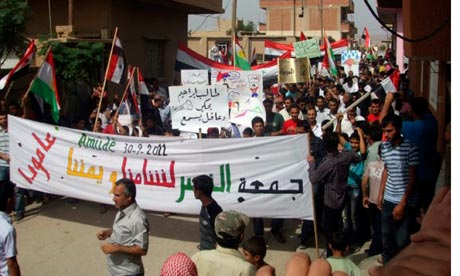
Protesters in Deir Balaba supporting the continued demonstrations in the city of Homs. (Photo Courtesy of NYT)

Qatari Prime Minister Sheikh Hamad bin Jassim Al Thani reported at a press conference in the Egyptian capital that 19 of the League’s 22 member nations had approved the sanctions, leaving only three member states in opposition. The sanctions include: cutting off transactions with the Syrian central bank, a stop to Arab government funding for projects within Syria, a stop to trade exchange with the Syrian government, and a travel ban on Syrian officials.

Sheik Hamad expressed these sentiments during the press conference, reiterating that the Arab League desire a regional solution and do want foreign intervention.

“Today is a sad day for me, because we still hope our brothers in Syria will sign the document of the protocol and stop the killings, and to release the detainees and withdraw its military from Syrian districts. The position of the people, and the Arab position, is that we must end this situation urgently. We are trying to prevent any foreign intervention into Syria. All the work we are doing is to avoid this interference.”

Syria, one of the founding members of the Arab League, responded immediately and called the sanctions a betrayal of Arab solidarity. The Syrian state television described the sanctions as “unprecedented measures aimed at the Syrian people.”

The Arab League had previously set a Friday 25 November 2011 deadline for Syria to permit human rights monitors into the country and withdraw tanks from the streets or face sanctions. The ultimatum did not elicit a satisfactory and substantial response from Syrian officials, prompting the Arab League to convene and agree on which sanctions it would impose.

Iraq and Lebanon, two nations that are neighbors to Syria, abstained from the vote. As Syria’s second-biggest trading partner accounting for 13.3% of Syria’s trade, Iraq claimed that an economic blockade would not be practical with Syria.

Iraqi Deputy Foreign Minister Labeed Abbawi shared these words with Reuters about Iraq’s decision to abstain.

“Iraq has reservations about this decision. For us, this decision will harm the interests of our country and our people as we have a large community in Syria.”

The United Nations estimated that approximately 3,500 people have died since the pro-democracy and anti-regime protests began earlier this year in March. Turkey, which attended the Arab League’s meeting as a visitor since it is not an Arab state, declared that it would nonetheless act in accordance with the Arab League’s sanctions. Turkish Prime Minister Ahmet Davutoglu shared these sentiments about the developing situation and concern for the thousands of civilians that have lost their lives protesting for change.

“When civilians are killed in Syria and the Syrian regime increases its cruelty to innocent people, it should not be expected for Turkey and the Arab League to be silent. We hope the Syrian government will get our message and the problem will be solved within the family.”

While the Arab League was announcing these sanctions, activists and protesters continued to display their displeasure and desperation for change. According to the Syrian Observatory for Human Rights, a UK-based opposition group, in the city of Homs on Sunday 27 November 2011, security forces loyal to the government were matched up against army defectors.

“Violent clashes occurred this morning between Syria’s regular army and groups of deserters in the region of Talbiseh. Two troop transporters were destroyed. The regular army is using heavy machineguns in its operations in Talbiseh, four civilians have been wounded.”

While nations around the Arab world attempt to force change upon Syria, many inside Syria fear that the sanctions will only further exacerbate the situation. The Local Coordinating Committees, a group that leads the anti-government demonstrations, supported a collective move to pressure the regime, but feared that the government would find avenues to evade the restrictions.

A 23-year-old Damascus student, who did not wish to be identified for fear of reprisal, shared these words about the sanctions.

“I think it is time the world realized that economic sanctions are not affecting anyone but the Syrian people. Those who couldn’t afford buying bread, now can’t afford even smelling bread.”

It appears that the interests of those involved in the demonstrations and protests might further be harmed by these sanctions, even though they are designed to do precisely the opposite.

According to Al-Jazeera correspondent Nisreen El-Shamayleh, who is currently reporting on the situation from the neighboring nation of Jordan, quoted the Syrian Revolution General Commission (SRGC) that 26 individuals lost their lives on Sunday 27 November 2011. The SRGC is part of the Syrian National Council, another opposition group.

Syria continues to uphold its ban on international journalists, making it impossible to report facts on the ground. Reports coming out of Syria cannot be independently confirmed and verified.


For more information, please see:

Al-Jazeera – Arab League Approves Syria Sanctions – 27 November 2011

BBC – Syria Unrest: Arab League Adopts Sanctions in Cairo – 27 November 2011

Reuters – Arabs Impose Sanctions On Syria Over Crackdown – 27 November 2011

NYT – Arab League Punishes Syria Over Violent Crackdown – 27 November 2011

Ahram – Cracks Emerge Before Arab Vote on Syria Sanctions – 27 November 2011

CNN – Arab League Proposes Sanctions Against Syria, Including Freezing Assets – 26 November 2011


Syria Calls for Arab League Meeting to Discuss Political Solution to Unrest

By Tyler Yates
Impunity Watch Reporter, Middle East

DAMASCUS, Syria — Syria is calling for an emergency meeting of the Arab League’s heads of state to discuss the continuing unrest throughout the country.  The request comes a day after the regional organization threatened to suspend its membership if Syria did not stop its deadly crackdown on anti-government protests.

Syrian protesters continue to rally despite the harsh government crackdown (Photo courtesy of the United Nations News Centre).

The Arab League gave Syria three days to end its crackdown or face sanctions.  The action, which is the Arab League’s strongest against Syria since the violence began in mid-March, does not amount to a full suspension of Syria’s membership from the organization.

Human Rights Watch (HRW) recently classified the systematic nature of abuses by Syrian government forces as an indication of crimes against humanity.  It urged the United Nations Security Council to impose an arms embargo and sanctions, as well as referring Syria to the International Criminal Court.

The report released by HRW focused on abuses in the Syrian city of Homs and its surrounding areas. Homs has become the focal point for insurgencies against Syrian President Bashar al-Assad, and in the period between mid-April to August security forces killed approximately 587 civilians.  Since 2 November at least another 104 people have been killed.

“Homs is a microcosm of the Syrian government’s brutality,” said Sarah Leah Whitson, the Middle East director at HRW.

Security forces have conducted large-scale military operations in the area surrounding Homs.  These operations involve the usage of heavy machine guns and anti-aircraft guns to fire into neighborhoods with the intention of frightening people.  The security forces have also cut off communications, and restricted the movements of people, food, and medicine by establishing checkpoints.

Throughout Syria, people have been subjected to arbitrary arrests, enforced disappearances, and systematic torture in detention.  Most are released after several weeks in detention, but many are still missing.  The detainees are mainly composed of young men in their 20s and 30s, but witnesses report that people in their 60s and 70s have also been detained.

Allegations of torture of detainees are rampant throughout Syria.  Former detainees report the use of heated metal rods to burn various parts of their body, the use of electric shocks, the use of stress positions for hours or even days, and the use of improvised devices such as car tires to force detainees into positions that make it easier to torture specific sensitive body parts.

There are a large number of reported deaths occurring in custody.  HRW was able to confirm around 17 such deaths independently, and in many of the cases it reviewed video or photos of the bodies that revealed signs of torture.

The Syrian government has repeatedly argued that armed terrorist gangs funded from outside countries are carrying out the violence.

The United Nations human rights office reports that the death toll in Syria has surpassed 3,500.

For more information, please see:

Al Jazeera — Syria calls for Arab League meeting — 14 Nov. 2011

CNN — Report says Syrian crackdown amounts to crimes against humanity — 11 Nov. 2011

Human Rights Watch — Syria: Crimes Against Humanity in Homs — 11 Nov. 2011

United Nations — Death toll passes 3,500 as Syrian crackdown continues, says UN human rights office — 08 Nov. 2011

Security Forces Kill Fifteen After Agreement to Halt Protester Violence

By Carolyn Abdenour
Impunity Watch Reporter, Middle East

DAMASCUS, Syria – On Friday, 4 November, Syrian security forces killed at least fifteen people after Friday prayers.  To prevent demonstrations, the security forces surrounded mosques and used gunfire throughout Syria.  The demonstrators gathered to challenge the promise the government made to the Arab League on Wednesday to halt intense confrontations with demonstrators.

Protest in Homs on Friday. (Photo Courtesy of Al Jazeera)

Syrian-based human rights lawyer Mustafa Osso commented, “This regime is not serious about ending its brutal crackdown. . . .  Today was a real test for the intentions of the regime and the answer is clear to everyone who wants to see.”

At Abu Bakr mosque in Baniays, security forces assaulted people as they exited the mosque and trapped hundreds inside to block protests.  The Local Coordinating Committees (“LCC”), a body that assists in organizing protests, reported government snipers observed demonstrations in Hasakeh and Hama from commercial markets and mosques.  The Syrian Observatory for Human Rights documented forces using gunfire in Deir Ezzor and explosives in a Daraa neighborhood.  Forces also showed a presence near the Fattahi mosque in Lattakia.  In Bab Amro, forces prevented ambulances from accessing the area where launch and shell attacks continued.  In Homs, medics report over 100 bodies arrived in the past 48 hours after tanks shelled parts of the city.

Meanwhile, SANA, Syria’s official news agency, noted engineers dismantled two two-remote controlled bombs in Deir Ezzor.  Thirteen soldiers and police also died in Hama, Homs, and Idlib fighting armed terrorist groups.

Syria’s Interior Minister announced on Friday a one-week amnesty period for “citizens who carried weapons, sold them, delivered them, transported them or funded buying them, and did not commit crimes.”  Citizens who handed themselves into the nearest police station would be freed immediately as a part of the general amnesty.

Journalists face difficulty confirming the violence on the ground because the government has limited foreign journalist activity and independent reporting.  They must rely on witness accounts, amateur videos posted online, and information gathered by activist groups.

On Wednesday, the Arab League announced at an emergency meeting that Syria agreed to release political prisoners, remove tanks and armored vehicles from the cities, and cease violence towards protesters.  Moreover, Syria also agreed to permit Arab League representatives, journalists, and human rights groups to monitor the situation.  The agreement emphasized “the need for the immediate, full and exact implementation.”

If the government abides by the Arab League agreement, groups such as the Free Syrian Army committed to follow the agreement.  If the government derogates from the agreement, the group stated, “We will be compelled to protect the protesters and work on bringing down the regime no matter how much that will cost us.”

For more information, please see:

Al Jazeera – ‘Deadly Clashes’ Continue in Syria – 4 November 2011

BBC – Syria: Homs Military Attacks Continue, Say Activists – 4 November 2011

Boston Globe – Syrian Troops Fire During Protests; 9 Killed – 4 November 2011

CNN – 15 Civilians Killed in Latest Syrian Clashes, Activist Group Says – 4 November 2011

Amnesty International Reports Patients Tortured in Syrian Hospitals

By Carolyn Abdenour
Impunity Watch Reporter, Middle East

DAMASCUS, Syria – On Tuesday, 25 October, Amnesty International issued a report that claims security forces and the medical staff in government-run hospitals in Baniyas, Homs, Tell Kalakh and a military hospital in Homs subjected patients to torture and other ill-treatment.  The report entitled “Health Crisis: Syrian Government Targets the Wounded and Health Workers” alleges the government converted hospitals into instruments of repression and targeted patients and medical staff members to quash anti-government opposition.

Patients in a Syrian Hospital. (Photo Courtesy of Global Post)

The report notes the government directed those injured from anti-government activities to receive treatment at the military hospital where they considered patients detainees and held them incommunicado.  The medical staff also denied care to some of the patients injured in uprising-affiliated incidents, a gross violation of medical ethics.

Amnesty researcher Cilina Nasser reports security forces appear to have free reign of the hospitals.  The report also claims security forces obstructed ambulances with a patient en route to the hospital and interrogated patients while in the ambulance.

Nasser found it disturbing that people reported feeling safer not treating their major wounds rather than seeking treatment at a proper medical facility.  The report adds injured people prefer “to seek treatment either at private hospitals or at poorly equipped makeshift field hospitals.”

Furthermore, since the Ministry of Defense controls the blood bank, the hospital must deliberate to contact the blood bank for an injured patient.  A medic at a private hospital stated if they contact the Central Blood Bank, “the security would know about him and we would be putting him at risk or arrest and torture, and possibly death in custody.”

Doctors protested hospital raids and attacks, but hospital workers also face arrest and torture.  Ahmed, a doctor from Homs, reported many patients disappeared from his hospital.  Moreover, he saw a nurse beat a 14-year-old patient with bullet wounds.  After he alerted the hospital manager, the nurse told officials Ahmed was a member of an Islamic organization.  Rather than following the officials’ request to visit the security building, Ahmed chose to leave Syria.

The government denies torturing its opponents; however, President Assad has promised reform.  His critics do not believe the reforms will go far enough, if the government implements them at all.

During a hospital raid in September, security forces failed to find an alleged opposition armed field commander in Homs.  They arrested eighteen wounded people; one of these patients was unconscious and needed his ventilator detached before removing him from the hospital.

For more information, please see:


BBC – Syria ‘Using Hospital for Torture’ – Amnesty – 25 Oct 2011

Dalje – Syria Accused of Hospital Repressions – 25 Oct 2011

Haartez – Amnesty: Syria Regime Using Torture in Hospitals to Repress Opposition – 25 Oct 2011

Now Lebanon – Amnesty Condemns “Climate of Fear” in Syrian Hospitals – 25 Oct 2011

Syrian Government Warns International Community Against Supporting Newly-Formed National Council

By Adom M. Cooper
Impunity Watch Reporter, Middle East

DAMASCUS, Syria–Authorities from President Bashar al-Assad’s regime have warned the international community that it will retaliate against any country that chooses to formally recognize the recently established Syrian National Council (SNC). The SNC is compromised of individuals opposed to al-Assad’s rule and its formation was announced on Monday 03 October.

Anti-regime protesters in the province of Qamishli. (Photo Courtesy of The Guardian)

The formation of the SNC has been met with encouragement by many Western nations, including the United States and France. But the international community has yet to offer the SNC any sort of formal recognition, unlike Libya’s Transitional Council (NTC), the council established by Libyan warriors who overthrew Muammar Qadhafi.

Activists and officials in the international community have come to the consensus that there are few differences between the SNC and NTC.

The SNC has formally rejected the use of foreign military intervention, but has urged the international community to “protect the Syrian people.” Chairman Burham Ghalioun stated that the group was an “independent group personifying the sovereignty of the Syrian people in their struggle for liberty.”

Walid al-Moualem, the Syrian foreigner minister, released the following statement at a news conference broadcast by Syrian national television on Sunday 09 October.

“We will take tough measures against any state which recognizes this illegitimate council.”

In the latest occurrences of violence on the streets of Syria, activists claimed that security forces opened fire on tens of thousands of mourners at a funeral of a prominent Kurdish opposition figure, Meshaal Tammo, on Saturday 08 October. As a result, the security forces killed at least seven individuals, according to the London-Based Syrian Observatory for Human Rights.

Moualem detailed Meshaal Tammo as a “martyr” killed by “terrorists,” insinuating that he was targeted because he chose to oppose foreign intervention in Syria. The Tammo family has blamed Syrian authorities for his death. He was expected to play a pivotal role in the SNC.

Turkey has condemned the assassination of Tammo as well as attacks on other leading opposition figures in Syria. Tammo was gunned down on Friday 07 October in the northern town of Qamishli and his funeral became a mass rally with more than 50,000 demonstrators calling for the end of al-Assad’s rule, various activists groups have reported.

The Turkish foreign ministry released a written statement on Saturday 08 October, which contains the following excerpt.

“We strongly condemn the attempts aiming to suppress the Syrian opposition and the increase in attacks targeting main representatives of the opposition. Turkey is deeply sorry for the loathsome assassination of Tammo, as well as the wounding of prominent dissident Ryad Seif who was injured after being beaten on Friday in Damascus.”

CNN reported that on Sunday 09 October, Syrian police were preventing Turkish citizens from entering Syria at the border town of Nusaybin, a few kilometers north of Qamishli where Tammo was killed, due to increased tensions in the area. Turkish Prime Minister Tayyip Erdogan has claimed that he plans to impose sanctions on Syria and has launched military exercises in the Hatay province, where Syria has a longstanding territorial stake.

Meanwhile, Syrian foreigner minister Moualem went on further to criticize European countries, singling out Germany and Switzerland, noting that protesters had attacked Syrian embassies. He claimed that if they did not meet their obligations to protect foreign missions, Syria would respond in a similar fashion.

Protesters have stormed Syrian diplomatic properties in the German cities of Berlin and Hamburg. The Syrian mission in United Nations building in Geneva also fell victim to protesters on Friday 07 October.

The Syrian foreign minister made these statements while speaking at a joint news conference with ministers from five Latin American countries. The ministers from these countries had come to show their support for al-Assad’s regime.

“If they are not committed to implementing this Geneva Convention agreement and provide security for our missions, we will treat them the same way. The West will not attack Syria because no one will pay the bill. The West chose economic sanctions to starve our people, under the pretext of protecting human rights.”

The government in Damascus has kept promising reforms, but chosen to increase crackdown on the protesters and civil unrest, blaming the activity on armed gangs. Some 2,700 are believed to have lost their lives since the protests began in March.

The ban on international journalists inside Syria continues and reports cannot be independently verified.

For more information, please see:

Al-Jazeera – Syria Warns Against Recognizing Opposition – 09 October 2011

BBC – Syria Warns Against Recognizing New Opposition Council – 09 October 2011

CNN – Syria Warns Against Recognizing Opposition Council – 09 October 2011

Reuters – Syria Warns Against Recognition of Opposition Council – 09 October 2011

The Guardian – Syria’s Protesters Turn to Facebook to Expose ‘Citizen Spies’ – 08 October 2011

NYT – Leading Syria Opposition Figure Killed, and Another Publicly Beaten – 07 October 2011