Syria Watch

Syria Continues Suppression of Dissenters in Defiance of World Leaders

By Zach Waksman
Impunity Watch Reporter, Middle East

DAMASCUS, Syria – The international community escalated its pressure on embattled Syrian President Bashar al-Assad on Thursday.  Numerous countries, including the United States, and the European Union issued statements calling for him to relinquish his post after his use of violence against protesters drew worldwide scorn.  But even in the face of such opposition, Syria continued its efforts to suppress opposition.  Armed forces opened fire on a demonstration in the southern Dara’a Province Friday; at least 18 were killed, including soldiers who refused to fire.

A tank roams the streets of a Syrian city. At least 2,000 people are believed to have been killed since March. (Photo courtesy of Al Jazeera)
A tank roams the streets of a Syrian city. At least 2,000 people are believed to have been killed since protests against Assad's regime began in March. (Photo courtesy of Al Jazeera)

This new insistence from world leaders comes on the heels of a United Nations report on Assad’s use of force against dissenters that was released on Thursday.  While the investigators were not allowed into the country, they were able to obtain witness accounts of incidents that have taken place in Syria since March of this year.  In addition to descriptions of individual events, the report takes note of the security forces’ modus operendi in crushing opposition to Assad’s government.  Though Syria has repeatedly called the protesters “terrorist armed groups” and similar phrases, the report indicates that participators in the rallies made a point of indicating that they were unarmed.  Despite this, the forces indiscriminately shot to kill civilians, including women and children.  Torture was also used.

U.S. President Barack Obama was one of several world leaders to issue a statement calling for Assad to resign.  “The future of Syria must be determined by its people, but President Bashar al-Assad is standing in their way. His calls for dialogue and reform have rung hollow while he is imprisoning, torturing, and slaughtering his own people,” Obama said.  “We have consistently said that President Assad must lead a democratic transition or get out of the way.  He has not led.  For the sake of the Syrian people, the time has come for President Assad to step aside.”

Obama also announced that he and the European Union had imposed new sanctions against the Syria, including the freezing of assets and a ban on importation of Syrian petroleum.

France, Germany and the United Kingdom issued a joint statement on the matter.  “We urge the Syrian regime to stop all violence immediately, to release all prisoners of conscience and to allow free access to the United Nations for an independent assessment of the situation,” their statement said.

Later Thursday, the UN announced that it would send a humanitarian team to Syria to investigate, having been promised full access.  The country’s UN ambassador and President Assad both promised that military operations had stopped.  But Friday, a new rally was snuffed out, as armed forces again fired at demonstrators.  Gunfire was reported in several provinces.  Today, CNN reported that the Syrian government took steps to clean up evidence of violence at one of the crackdown sites the humanitarian team was to visit.

SANA, Syria’s official news agency, issued a press release today that reiterated Assad’s stance that the Western world, with particular emphasis on the United States, was interfering in the country’s internal affairs.  The release, which cited several legal scholars within the country, considered these actions to be in violation of the UN charter.  With regards to President Obama and French President Nicolas Sarkozy, it called these conspiratorial efforts to take control of Syria a “return to the colonial mentality to save themselves,” making reference to the two politicians’ declining approval ratings.

For more information, please see:

CNN — Source: Syria ‘whitewashing’ bloody crackdown before U.N. team arrives — 21 August 2011

SANA — Intellectuals and Jurists: Foreign Interference in Syria’s Affairs Disrupt Reform, Show Failure of Conspirators — 21 August 2011

Al Jazeera — UN report slams Syria’s use of force — 19 August 2011

New York Times — Syria Said to Fire on Protest in Defiance of Global Rebuke — 19 August 2011

BBC News — Syria unrest: UN to send humanitarian mission — 18 August 2011

BBC News — Syria unrest: World leaders call for Assad to step down — 18 August 2011

British Prime Minister’s Office — Joint UK, French and German statement on Syria — 18 August 2011

White House — President Obama’s statement calling for Syrian President Assad to step down — 18 August 2011

Office of the High Commissioner for Human Rights — Report of the Fact-Finding Mission on Syria pursuant to Human Rights Council resolution S-16/1 — 17 August 2011

IN SPREADING TOWARDS THE TURKISH BORDER, AL-ASSAD’S REGIME EXTENDS ITS DESTRUCTION AND DISREGARD FOR THE VALUE OF CIVILIAN LIVES

By Adom M. Cooper
Impunity Watch Reporter, Middle East

DAMASCUS, Syria–Deciding that expanding to Deir el-Zour was not satisfactory, the Syrian government ignored Turkish pressure to cease its activities and continued to pummel through towns further east. As recently as today, 11 August 2011, The Syrian Observatory for Human Rights (SOHR) reported that the Syrian army entered the town of Saraqeb in northwestern Idlib province, detaining as many as 100 individuals.

Damaged vehicles and buildings in Hama. (Photo Courtesy of BBC)

The Local Coordination Committees of Syria, activists whom help organize and catalog the protests, reported explosions and gunfire were heard after the army descended upon the area. A resident of Saraqeb who fled the area relayed these remarks to an Al-Jazeera correspondent.

“Around 14 tanks and armored vehicles entered Saraqeb this morning, accompanied by 50 buses, pick-ups and security cars. They started firing randomly and storming houses.”

On Wednesday 10 August 2011, SOHR reported that the government assault on civilians also had extended to the towns of Taftanaz and Sermin, when 12 tanks and armored vehicles entered both towns. During this expansion, SOHR reported that at least one woman was killed and 13 were injured.

Taftanaz and Sermin are located approximately 30 kilometers (18.64 miles) east from Syria’s border with Turkey. Saraqeb is located approximately 50 kilometers (31.07 miles) southeast of Turkey’s Iskenderun province.

Further in the south of the county, rolling government crackdowns also victimized the central province of Homs. The town of Qusayr saw columns of tanks enter its borders and many activists reported that individuals were desperately trying to escape while communications with the city have been severed.

“Residents fled into the fields and all communications have been cut with the town.”

BBC reported that seven civilians were killed during the invasion, as Syrian security forces carried out mass arrests.

Syrian army units reportedly left central Hama today on 11 August 2011, as the state-run Syrian Arab News Agency (SANA) conveyed these remarks on the situation.

“The military departed after restoring the security and stability to the city that have been through tough times due to the acts of killing, terrorizing, and sabotage that were done by the armed terrorists groups.”

The Local Coordination Committees of Syria reported that clusters of individuals were killed during a siege that lined up with last week’s start of the Muslim holy month of Ramadan. After evening prayers on Wednesday 10 August, opposition activists claimed that demonstrators poured into the streets in the southern part of the city. Also, activists claimed that security forces opened fire and killed two people.

Reports of this incident could not be confirmed.

Turkish Foreign Minister Ahmet Davutoglu said on Wednesday 10 August, Turkey’s envoy to Syria, Omer Onhon, journeyed to Hama and was able to confirm that the tanks and heavy weaponry had withdrawn from the city.

The international community continues its efforts to compel al-Assad’s regime to cease its actions. On Wednesday 10 August 2011, the UN Assistant Secretary-General Oscar Fernandez-Taranco briefed the 15 members of the Security Council behind closed doors about the situation. Last week, the UNSC called for an “immediate” halt to the violence, a call that apparently did not reach or did not matter to al-Assad.

Bashar Jaafari, Syria’s ambassador to the UN, said the sovereignty of his country must never be challenged.

“Our sovereignty is a red line that must not be crossed. We know our commitments, our obligations but at the same time we know what are our rights. And our rights do not stem from any political pressure. They stem from our own political will.”

The U.S Treasury Department, taking its own measures, on Wednesday 10 August announced a block of the mobile phone operator Syriatel, the Commercial Bank of Syria, and the Syrian Lebanese Commercial Bank. Also, it declared that Americans are “generally prohibited from engaging in commercial or financial transactions with the companies. It is expected that U.S. President Barack Obama will formally call for al-Assad to step down in the next few days.

Other countries such as Saudia Arabia, Bahrain, and Kuwait have recalled their ambassadors from Damascus.

The nation-wide crackdowns have claimed some 2,000 lives since the protests began in mid-March, according to various rights groups. But with the restriction on international journalists in Syria, these reports cannot be independently confirmed.

For more information, please see:

Al-Jazeera-Syrian forces ‘storm border town’-11 August 2011

BBC-Syrian security forces ‘kill seven in Homs province’-11 August 2011

CNN-Syrian forces push into Saraqib, death toll escalates, group says-11 August 2011

New York Times-Support for Assad Government Shows Signs of Weakening-10 August 2011

The Guardian-Obama to toughen stance on Syria with call for Assad’s departure-10 August 2011

Syria Defies U.N. Condemnation, Continues Attacks on Civilians

By Zach Waksman
Impunity Watch Reporter, Middle East

DEIR EL-ZOUR, Syria –The Syrian government launched new attacks against civilians today, continuing a siege on the eastern city of Deir el-Zour that had been ongoing for over a week.  At least 52 people have been killed so far.  The attacks come just days after the United Nations condemned the Middle Eastern country’s shocking strikes against protesters in Hama.

The Hama campaign, which killed an estimated 76 people last Sunday, drew international scorn.  Since then, anti-government protests have begun in coincidence with the beginning of Ramadan, a holy month on the Muslim calendar.  During this time, in an effort to prevent such sentiment from growing into a revolution, the government has placed Hama and Deir el-Zour under siege.  Today’s attack is an escalation of the siege; power and phone lines have reportedly been cut.

According to one activist in Deir el Zour who spoke anonymously to the Washington Post, “Humanitarian conditions in the city are very bad because it has been under siege for nine days.  There is lack of medicine, baby formula, food and gasoline. The city is totally paralyzed.”

This action took place despite widespread disapproval from multiple sources.  Wednesday, the United Nations Security Council issued a unanimous presidential statement that “condemned the widespread violations of human rights and the use of force against civilians by the Syrian authorities.”  Today, the Arab League joined the many who spoke out against the actions taken by Syrian President Bashar al-Assad, calling for a national dialogue.

Human Rights Watch, an independent organization that observed the situation, considered the resolution a sign of isolation by the Syrian government.  “The Security Council’s unanimous statement shows that Syria can no longer count on even its close allies to support its crackdown on peaceful protesters,” said Peggy Hicks, the organization’s global advocacy director. “President Bashar Assad needs to listen to the council’s strong message, and end the attacks by his security forces in Hama and across the country.”

Yesterday, Assad spoke to United Nations Secretary-General Ban Ki-Moon by telephone.  Ban was concerned about the mounting violence and civilian casualties.  During the talk, he called for an immediate end to the attacks.

In response to the condemnation, Assad defended the sieges by saying that the country was making progress and that the government had an obligation to deal with dissenters.  “Syria is on the path to reforms,” he said, quoted by state news agency SANA. “To deal with outlaws who cut off roads, seal towns and terrorise residents is a duty of the state which must defend security and protect the lives of civilians.”  As an example of such “outlaws,” SANA reported that earlier this morning, an armed terrorist group ambushed and fired on a military convoy.  An officer and two soldiers were “martyred” as a result.

The next message for Assad will be delivered Tuesday, when Foreign Minister Ahmet Davutoglu will meet with Syrian officials to discuss his present concerns.

For more information, please see:

Al Jazeera — Syrian army launches fresh assaults — 7 August 2011

SANA — Officer, Two Soldiers Martyred in Ambush Set by Armed Terrorist Group East of al-Rastan — 7 August 2011

Washington Post — Syrian troops intensify crackdown on eastern city, activists say at least 52 killed — 7 August 2011

CNN — Ban calls for an end to use of force on Syrian civilians — 6 August 2011

Human Rights Watch — UN: Syria Should Heed Council’s Call to End Attacks — 4 August 2011

Impunity Watch — Syrian death toll sparks condemnation and foretells future violence — 2 August 2011

THE SITUATION IN SYRIA CONTINUES TO DETERIORATE, BUT NOT THE RESOLVE OF ITS ACTIVISTS

By Adom M. Cooper
Impunity Watch Reporter, Middle East

DAMASCUS, Syria–The volatile situation in Syria has shown absolutely no signs of cooling down, as at least 11 individuals have been killed when military forces backed by tanks stormed a small town of Kanaker near the capital of Damascus.

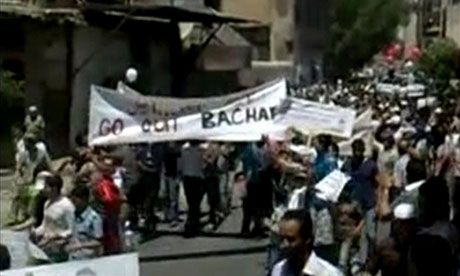
Protesters in the streets of Damascus. (Photo Courtesy of Reuters)

The Syrian Observatory, based in Britain, reported that four tanks and a bulldozer entered Kanaker on 27 July 2011, while 14 other tanks surrounded the town. The raid on the city took place after electricity and phones lines were cut off in the area. This activity is merely the latest swing in the crackdown on protests against President Bashar al-Assad. Residents threw stones and set fire to tires of vehicles in an attempt to stall the advance of troops.

Rami Adubl-Rahman, a correspondent for the Syrian Observatory, reported this recollection of the raid to CNN:

“At 3AM Wednesday, Syrian security forces and army soldiers stormed Kanaker amid heavy gunfire. Some residents threw rocks at the tanks and burned their tires as many chanted ‘Allah is the Greatest’ in the west part of the town where seven tanks took positions there.”

Kanaker is located 30 kilometers (approximately 18.64 miles) southwest of Damascus.

The Syrian National Organization for Human Rights reported that military intelligence agents arrested some 300 individuals in Kanaker and took them away in 11 buses. Ammar Qurabi, a key opposition figure, leads this group.

The restriction on international journalists in Syria has made it increasingly difficult to verify the accuracy of reports given by the various human rights groups active in the country.

This recent crackdown appeared to come as a result of two organizations in France threatening to file legal complaints against President al-Assad and other members of the ruling Baath party. The two organizations, Sherpa and Transparency International France, said on 26 July 2011 that they wish the French government to make all of its findings public. They are primarily concerned with discovering if al-Assad and members of his party own any assets in France.

“The object is get an investigation open that would then identify assets that they may own in France either in their own name or through intermediaries and then to freeze them so they are not transferred to uncooperative jurisdictions.”

According to various human rights groups, more than 1,600 civilians have lost their lives and some 20,000 others imprisoned by Syrian security forces in the countrywide crackdown on the protests since March.

But these numbers are not lowering the spirits of the activists and protesters in the least. Moaz Al Sibaai, the coordinator for the Syrian activists’ network, reported to CNN that the opposition is always working to find ways to improve its work. He specifically highlighted improving communication with the media, developing secure telecommunications that cannot be hacked or tracked, and teaching how to lobby against the regime by documenting human rights violations.

“The harsher the regime is with its crackdown, the more creative we become in finding ways to cover the revolution.”

For more information, please see:

Al-Jazeera-Syrian troops in ‘deadly crackdown’-27 July 2011

BBC-Syrian forces kill eight in Kanaker raid: rights groups-27 July 2011

CNN-Activists: 8 slain in Syrian protest-27 July 2011

The Guardian-Syrian protesters ‘forcibly disappeared’ at rate of one every hour, say activists-28 July 2011

CHAOS AND DEATH DESCEND ON THE STREETS OF SYRIA

By Adom M. Cooper
Impunity Watch Reporter, Middle East

HOMS, Syria–The focal point of the uprisings against President Bashar al-Assad has turned fatal for civilians. Syrian troops and armed factions have spawned fear and turmoil on the streets of the city of Homs. Witnesses said that armed forces opened fire on 18 July 2011 outside the Khaled Bin al-Waleed mosque during funeral services for people killed in the past 24 hours. A local resident described these factions as “death squads.”

A funeral service for policemen in Homs. (Photo Courtesy of BBC)

Homs is located about 100 miles north from Damascus and rests in one of the country’s poorest regions. The sectarian violence indicates a precarious turn in the protests that have lasted since March, increasing tensions between different portions of Syria’s diverse religious makeup. The majority of Syrians are Sunni Muslims, while President al-Assad and his ruling clan are Alawites.

Syrian rights activist Rami Abdulrahman, director of the London-based Syrian Observatory for Human Rights offered these words on 18 July 2011 to describe the situation.

“Thirteen civilians were killed yesterday and today in several parts of Homs when the army opened fire as it carried out an operation in the city. These clashes are a dangerous development that undermines the revolution and serves the interests of its enemies who want it to turn into a civil war.”

A Homs resident spoke to a Reuters correspondent via telephone on 19 July 2011 and described the situation.

“There are troops and armored vehicles in every neighborhood. The irregular forces with them are death squads. They have been firing indiscriminately since dawn with rifles and machine guns. No one can leave their homes.”

The Syrian Observatory for Human Rights reported that 30 civilians lost their lives in Homs during riots. Bodies of the minority Alawite sect, which President al-Assad is a member, were found mutilated.

In totality, activists are reporting that the Syrian government’s onslaught on pro-democracy and anti-regime protests have claimed the lives of some 1,400 civilians. Thousands more are imprisoned for their participation while some 350 security forces personnel have died since the protests began.

Due to restrictions on international journalists reporting in Syria, the specific details of these events cannot independently be confirmed or verified. But human rights groups and activists have tried their best to relay an accurate depiction of what is really happening on the ground.

The international community already well on its way in applying diplomatic pressure on al-Assad. Qatar, a previously major backer of al-Assad, recently closed its embassy in Damascus.

The EU has imposed travel bans and engaged asset freezes on some 34 Syrian individuals and entities. But after a meeting in Brussels of EU foreign ministers, the Hague is ready to take things a step further and expressed these sentiments.

“Until the unacceptable violence against civilian population is halted…the EU will pursue and carry forward its currently policy, including through sanctions.

For more information, please see:

Al-Jazeera-‘Death squads’ on streets of Homs-19 July 2011

BBC-Syrian troops ‘kill mourners in Homs assault’-19 July 2011

CNN-Activists: Syrian forces shoot at funeral procession-19 July 2011

New York Times-At Funerals for Protesters, More Syrians Are Fatally Shot-19 July 2011