Syria Watch

Syrian government tries to curb unrest in symbolic city

By Tyler Yates
Impunity Watch Reporter, Middle East

HAMA, Syria — After anti-government protests last Friday, Syrian troops began a now continuing barrage of raids and arrests, aimed at quelling the country’s unrest in many of its more notorious trouble spots.
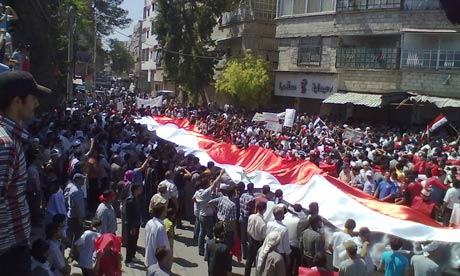
Thousands protest in Hama (Photo courtesy of The Guardian).

Hama, a city of around 800,000 people, still quaking with scars from a previous governmental onslaught of nearly a generation ago, is one of those trouble spots. The city, located in a corridor between Damascus and Aleppo, has become a symbolic center for what has become a four-month uprising against the ruling Assad family.

Recently, the city’s protests have been gaining momentum.  This was clearly evidenced on Friday, by a demonstration of tens of thousands; gathering in Hama’s appropriately renamed Freedom Square.

Hama is considered by some to be liberated, but this did not stop the Syrian security forces from raiding the city’s outskirts and making numerous arrests on Monday.

One resident saw “at least 30 buses carrying soldiers and security police.”  The soldiers were “firing randomly in residential neighborhoods.” The random shooting has injured at least 21 people, and killed around 7.

The city’s inhabitants are not taking the military’s actions sitting down.  Activists threw rocks, while others attempted to build barricades out of whatever they could find – burning tires, stones, and trash bins.  There are accounts of self-defense committees being created to patrol some of the neighborhoods.  Their purpose appears to be both to maintain order and to protect from governmental crackdowns.

The Syrian forces retreated almost as quickly as they appeared, but the people of Hama don’t think they are gone for good.  “People are waiting.  They can’t control Hama unless they wipe out the people here,” said a 24-year-old student who identified himself only as Abdel-Rahman.

Prior to Monday’s events the government had cited Hama as an example of the leadership’s good will, allowing dissent as long as it didn’t cause too much harm.  This recent uprising has shown that Hama is in reality a vexing problem for the government.

The city’s name echoes with memories of the government’s historic brutality.  In 1982, the Syrian military stormed the city to suppress an armed Islamic opposition group, killing at least 10,000 people.  For this reason, the government has gone out of its way to avoid stirring too much trouble in the city.  In June, after around 73 people were killed during a protest in Hama, the government ordered a military withdrawal and fired a group of security officials.

Despite this reluctance for the government to fight the conflict in the very city that symbolizes the opposition’s struggle, it appears it was inevitable.  The opposition has deep roots in Hama, and the uprisings momentum shows no sign of letting up.

For more information, please see:

Al Jazeera — Several ‘shot dead’ in Hama crackdown — 5 July 2011

Al Jazeera — ‘Shooting and arrests’ in Syrian city — 4 July 2011

BBC News — Syria unrest: ‘Arrests in Hama as tanks move on Idlib’ — 4 July 2011

New York Times — Fears Rise With Arrests in Restive Syrian City — 4 July 2011

PROTESTERS IN SYRIA STRUGGLE TO HAVE THEIR VOICES HEARD

By Adom M. Cooper
Impunity Watch Reporter, Middle East

DERAA, Syria– In furtherance of the trend calling for freedom across the Middle East, protesters in Syria are doing whatever they can to make their voices heard. In Syria, the voices cry for the ouster of President Bashar al-Assad. The recent eruption of distaste with the government galvanized after revelations that Syrian authorities had apparently tortured and murdered a 13 year-old boy last month near the protest hub of Deraa.

Protesters hold up a picture of Hamza al-Khatib (Photo courtesy of BBC)

Human rights groups have estimated that more than 1,000 people have been killed in Syria since the protests began in March. But the bruised and mangled body of Hamza al-Khateeb has served as a new lightning rod for the masses of Syria. After family relatives had received the body, wounds were found consistent with those of electric shock devices and cable whippings as well as bullet wounds. On 28 May, hundreds of protesters chose to ignore the perpetual military siege of Deraa. One protester relayed this message to an Al-Jezerra correspondent:

“It was the people of Deraa who started this revolution and the people of Deraa will not stop. Despite their anger, people are still insisting on facing this barbarianism with peaceful protests. Despite the tears in our eyes, we are facing them with smiles on our faces, because we know we are right.”

But the death of al-Khateeb created a real rise in the protesting. On 29 May, Syrian forces killed two people and wounded many more in the central towns of Rastan and Talbisa. Tanks backed these military forces as they moved through the two cities, searching houses for protesters in an attempt to quell the outbreaks. Residents of both towns said that basic utilities such as water and electricity were cut early Sunday morning as the troops, tanks, and helicopters moved in.

Rastan, a town known for its agricultural prosperity, is located on the main northern highway leading from Damascus to Aleppo. Talbisa is located near the major city of Homs.

The European Union has announced sanctions against Syria on 23 May. US President Barack Obama said in his speech on the Middle East earlier this month that al-Assad needed to cease the killing and lead a peaceful route to democracy or “get out of the way.” President al-Assad had promised changes in response to the protests much like changes that have occurred in Tunisia and Egypt. But to date, the Syrian population has seen no more than the 45 year-old ruler lift emergency laws while still banning all opposition and political freedoms since 1963.

For more information, please see:

BBC  Syria: Restive town ‘surrounded’ by tanks 29 May 2011

Bloomberg  Syrian Death Mount After Army Helicopter Attacks; Eight Killed in Homs 29 May 2011

The Jerusalem Post  At least 8 killed as Syrian protesters defy gov’t crackdown 29 May 2011

Reuters  Eleven killed in wider Syria military push: lawyer 29 May 2011

Violence Continues in Syria Despite US Sanctions

By R. Renee Yaworsky
Senior Desk Officer, Middle East

A fire hose is turned on protesters. (Photo courtesy of LA Times)

DAMASCUS, Syria—Dozens of people have been killed by security forces in Syria in various cities throughout the country.  The continued violence comes even as the US attempts to increase pressure against Syria by sanctioning President Bashar al-Assad.

On Friday, at least 34 people were killed by Syrian forces and plainsclothes militiamen.  The government forces have been targeting areas where pro-democracy activists have been protesting and demonstrating in the streets.  The security forces used live ammunition and tear gas in efforts to disperse the protesters.  In some cases, homes and businesses of suspected activists were burned down.

In the city of Homs, in central Syria, about 11 people—including a child–were killed.  In Maarat al-Numan, a northwestern city, over 13 people were killed.  According to one protester who spoke with AFP, “The victims in Maarat al-Numan were gunned down at the entrance of the city where many people were converging from other nearby towns to join the protests.”

There were also six deaths in the smaller towns of Daraya and Barza near Damascus, four deaths in Latakia, Hama and Deir al-Zour, and two deaths in Sanamein.

The UN has reported that over 850 people have died as a result of the violence in Syria since March 15.  About 5,000 refugees have poured into Lebanese border towns seeking security.  A UN spokesman explained, “Most of the people who have crossed the border in recent weeks are women and children.  In addition to their immediate need for food, shelter and medical help, they also need psycho-social support.”

On Wednesday, President Obama stepped up sanctions against Syria by adding Assad to a list of officials subject to travel bans and asset freezes.  On Thursday, Obama criticized Syria’s use of force against demonstrators and said, “President Assad now has a choice.  He can lead that transition [towards political reform] or get out of the way.”

SANA, the official news agency of Syria, retorted that “Obama is inciting violence when he says that Assad and his regime will face challenges from the inside and will be isolated on the outside if he fails to adopt democratic reforms.”

For more information, please see:

Deutsche Welle-Dozens killed in Syria as Washington increases political pressure-20 May 2011

LA Times-Syrian protests: Syrian troops fire on protesters, 34 killed-20 May 2011

Al Jazeera-Syrian protests draw deadly fire-20 May 2011

Syrian Military Forces Seize Control of City Mosque


By Eileen Gould
Impunity Watch Reporter, Middle East

DARAA, Syria – Syrian military forces stormed a mosque in the southern town of Daraa on Saturday, killing at least four.  Opponents of President Bashar al-Assad’s regime had turned the mosque into a temporary hospital for those who were injured in the military’s assault on the town.

In the early morning hours, soldiers, backed by tanks and helicopters, attacked Daraa and seized control of the mosque.  According to witnesses, snipers took positions in the mosque’s minaret.  In addition, this incident was the first time helicopters were used against the opposition.  Three helicopters were used in the attack.

Witnesses indicated that Daraa is running out of food and medicine.  Water, electricity and telephones have been cut off for almost a week.  Residents of Daraa have remained in their homes. Men were forbidden from leaving their homes, but women were allowed to leave to search for bread. News about the crackdown is transmitted from one house to the next through windows.

It is difficult to determine precisely how many people have been killed at this time as the government has limited the number of foreign journalists to only a few foreign journalists and has restricted them.  Families have been unable to retrieve bodies from the streets and have put the bodies in a temporary morgue, according to human rights groups.   Since the conflict began in mid-March, it is estimated that 535 people have died.

To address the worsening situation in Syria, the United Nations Human Rights Council met and approved a resolution, requesting that the UN high commissioner for human rights investigate the human rights abuses in Syria on April 29. This special session was requested by sixteen members of the Human Rights Council, including the United States, Mexico, South Korea, Zambia and Senegal.  Seven members abstained from the vote, which passed twenty-six to nine.  Jordan, Qatar, Bahrain and Angola did not attend the session.

This incident came only a day after nearly sixty-five people were killed, most of them in Daraa, where several teenagers put anti-government graffiti on a wall, inciting a violence uprising.  The efforts of military forces to end the uprising have become increasingly brutal.  The government’s actions have been condemned by the international community.  Britain’s Prime Minister David Cameron has described the crackdown as “completely disgraceful and unacceptable”.

For more information please see:
Sydney Morning Herald – Syrian Soldiers Storm City Mosque – 02 May 2011

The Guardian – Syrian Regime’s Shells Pound Deraa’s Roman Quarter – 01 May 2011

Human Rights Watch – UN: Syria Should Heed Call to End Violence – April 30, 2011

Washington Post – Syrian Troops Overwhelm Protest Town – 30 April 2011

US Imposes Sanctions Against Syrian Officials For Human Rights Violations

By Eileen Gould
Impunity Watch Reporter, Middle East

DAMASCUS, Syria – Syrians protested in cities and towns across Syria to stage a “Day of Rage” in opposition to the government’s crackdown on the opposition.  The United States imposed sanctions on officials responsible for human rights violations in Syria.  The new sanctions in the executive order signed by President Obama on Friday builds on the sanctions that were imposed on Syria beginning in 2004 and calls on the United Nations human rights officials to investigate Syria for violations of international law.

The order named Maher al-Assad, brother of President Bashar al-Assad and an army commander, as one of the parties responsible for the incidents in Daraa.  It also named Assad’s cousin, Atif Najib, who was the head of the Political Security Directorate for Daraa in March, when a large number of protesters were killed by security forces.

Another party named in the sanctions order is the Iranian Quds Force, as being involved in providing “material support to the Syrian government related to cracking down on unrest in Syria”.

According to human rights groups, at least twelve people were killed as security forces fired on protesters in two cities – Latakia, and Homs.  In Daraa, a southern town, shots fired on protesters allegedly caused some casualties.  The protesters gathered in the streets after leaving noontime prayer at the mosques.

In Homs, the protesters were shouting “leave, leave” to President Assad.  The protests began in March as a democratic movement but have recently turned into more of a rebellion.

In response to demonstrations that occurred a week ago, Syria sent tanks into Daraa.  Water, electricity and communications have been cut off there.  According to human rights groups, at least thirty-eight individuals have died, although that number may in fact be much higher.  On the other hand, state television reported that four army soldiers have been killed.  The government has depicted the demonstrations as a rebellion by armed Islamist extremists.

The UN Human Rights Council approved the United States’ statement condemning the violence in Syria.  China, Russia, and several African countries voted against this statement primarily because these nations oppose taking action similar to that which was done in Libya with Muammar Qaddafi.

For more information please see:
Christian Science Monitor – UN Council Issues Tepid Rebuke of Syria – 29 April 2011

Reuters – White House Calls on Syria Leader to Change Course – 29 April 2011

Washington Post – Syrian Troops Open Fire on Protesters; U.S. Imposes Sanctions – 29 April 29, 2011