Uncategorized

When Parents Disagree, Prioritization of Paternal over Maternal Surname Ruled Discriminatory

By: Sallie Moppert

Journal of Global Rights and Organizations, Associate Articles Editor

STRASBOURG, France — In a Chamber judgment handed down on October 26, 2021 by the European Court of Human Rights, it was ruled that Spain’s practice of prioritizing the paternal surname over the maternal surname in parental disputes was discriminatory. The case before the court was León Madrid v. Spain and it arose from legislation in Spain that required, in a dispute between parents, a child would be given the father’s last name first, followed second by the mother’s last name.

Members of the European Court of Human Rights appear in Chamber. Photo courtesy of Jean-Francois Badias.

In 2005, Josefa León Madrid gave birth to a child whose name was entered into the registrar of births using the two surnames that Josefa had, León Madrid, (Josefa’s father’s last name, followed by Josefa’s mother’s last name). After a non-marital paternity suit in 2006, the judge in the case ruled that the child in question would, in accordance with Spanish Law under Article 194 of the Regulation Implementing the Law on the registration of births, marriages and death, would be given two last names, her biological father’s first, followed by her mother’s second, due to parental disagreement. León Madrid challenged the ruling by the judge, requesting an inversion of her daughter’s last name (mother’s surname, then father’s), but the request was denied.

The Court found that the Spanish law prioritizing the father’s surname over the mother’s was discriminatory against women under Article 14 of the European Convention of Human Rights, which prevents discrimination. The lack of equal protection under the law, the Court found, led to a difference in treatment exclusively due to the person’s gender: “The Court noted that two individuals in a similar situation – the applicant and the child’s father – had been treated differently and that the distinction was based exclusively on grounds of sex.”

The Spanish government denied the existence of discrimination in this practice, stating that the daughter could change her last names upon turning 18 years old. However, the Court found that the lack of ability to change the surname order of a child could have far-reaching impacts that go beyond equal protection under the law and gender discrimination:  beside the “unquestionable impact that a measure of such duration could have on the personality rights and identity of a minor, who would be obliged to give precedence to the surname of a father with whom she was only biologically related, the Court could not overlook the repercussions on the applicant’s life too: as her legal representative who had shared her daughter’s life since her birth, the applicant suffered on a daily basis from the consequences of the discrimination caused by the inability to change her child’s name.”

Article 194 has since been amended by Law no. 20/2011, which would allow a “civil status judge” to decide the order of surnames in parental disagreement, but, at the time of the case, because León Madrid’s daughter was already 16 years old, the amendment did not apply to her.

For further information, please see:

European Court of Human Rights – Automatic imposition of surname order, paternal followed by maternal, when parents disagree, is discriminatory – Oct. 26, 2021

Law Euro – León Madrid v. Spain (European Court of Human Rights) – Oct. 26, 2021

International Criminal Court opens investigation into alleged crimes against humanity in Venezuela

By: Christopher Martz

Journal of Global Rights and Organizations, Managing Editor

The International Criminal Court opened a formal investigation at the beginning November into allegations of torture and extrajudicial killings committed by Venezuelan President Nicolás Maduro and his security apparatus. This is the first time a country in Latin America is under investigation for possible crimes against humanity from the ICC.

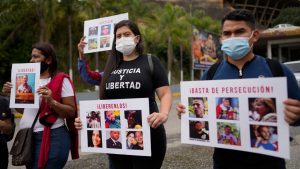
Andreina Baduel wears a T-shirt that reads in Spanish “Justice and Freedom” and holds a sign with pictures of people during a protest against political prisoners outside the Bolivarian National Intelligence Service (SEBIN), known as the Helicoide, in Caracas, Venezuela, Wednesday, Nov 3, 2021. Andreina’s father, former Defense Minister Raúl Isaías Baduel, died while in prison. The sign at right reads “Enough persecution!.” Photo courtesy of AP Photo and Ariana Cubillos.

On November 3rd, standing next to Maduro, ICC Prosecutor Karim Khan said he was aware of the political “fault lines” and “geopolitical divisions” that exist in Venezuela.  He continued, stating “I ask everybody now, as we move forward to this new stage, to give my office the space to do its work… I will take a dim view of any efforts to politicize the independent work of my office.”

The ICC announcement follows a lengthy preliminary probe started in February 2018 — later backed by Canada and five Latin American governments opposed to Maduro — that centered on allegations of excessive force, arbitrary detention, and torture by security forces during a crackdown on antigovernment protests in 2017.

The announcement was celebrated by human rights groups and the U.S.-backed opposition. Notably, since its creation two decades ago, the ICC has mostly focused on atrocities committed in Africa.

Jose Miguel Vivanco, the Americas director for Human Rights Watch described the announcement as turning point. He stated that the investigation can provide hope to the many victims of Maduro’s government while also serving as a reality check that Maduro could be held accountable for crimes committed by his security forces and others with total impunity in the name of the Bolivarian revolution. However, It could be years before any criminal charges are presented as part of the ICC’s investigation.

Maduro responded that he disagreed with Khan’s criteria in choosing to open the probe, but expressed optimism that a three-page letter of understanding he signed with Khan allows Venezuelan authorities to carry out their own proceedings in search of justice, something allowed under the Rome statute. Maduro emphasized the importance of the letter of understanding, stating that collaboration was key to obtaining justice.

Maduro’s government last year also asked the ICC to investigate the U.S. — which is not among the ICC’s 123 member states — for its policy of economic sanctions focused on removing Maduro. Venezuela considers the U.S. sanctions tantamount to “unlawful coercive measures” that have subjected millions of Venezuelans into poverty.

United Nations investigators have repeatedly reported patterns of rights abuses in the authoritarian country that constitute “crimes against humanity.”

A report by the United Nations’ top human rights body last year concluded that Maduro, and members of his administration, coordinated activities and supplied resources for arbitrary detentions, torture, disappearances and extrajudicial killings. It recommended that the findings be probed by international courts.

One political detainee told U.N. investigators of being held in a coffin-like vessel in the basement of intelligence police headquarters. Another female witness who was arrested following street protests told a U.N. panel she was tortured with electric shocks and threatened with rape.

For further information, please see:

Reuters – ICC prosecutor says he will open investigation into Venezuela  – 03 Nov. 2021

The Washington Post –International Criminal Court opens probe into alleged crimes against humanity in Venezuela – 04 Nov. 2021

Your Basin – International Criminal Court to probe abuses in Venezuela – 03 Nov. 2021


Progress in Recognition of Climate Refugees

By: Michelle Leal

Journal of Global Rights and Organizations, Notes and Comments Editor

NEW ZEALAND – On January 7, 2020, the UN Human Rights Committee took a step towards protecting future climate refugees in its ruling of Ioane Teitiota v. New Zealand

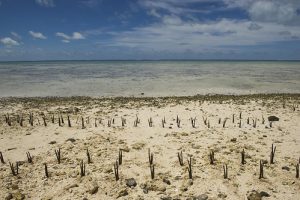
Island Nation of Kiribati Affected by Climate Change. Photo Courtesy of Oxford Human Rights Hub.

Ioane Teitiota, a national of Kiribati, sought refugee status in New Zealand. Teitiota claimed refugee status based on the changes to Kiribati’s environment caused by sea-level rise associated with climate change. A refugee and protection officer declined to grant Teitiota refugee status. Teitiota appealed, but the Immigration and Protection Tribunal (IPT) dismissed Teitiota’s case in June 2013. Over the next two years, Teitiota applied to the High Court, Court of Appeal, and Supreme Court for leave to appeal the IPT’s decision. However, all three refused to grant leave to appeal. In September 2015, Teitiota and his family were deported from New Zealand to Kiribati. 

In February 2016, Teitiota brought a case against the New Zealand government at the UN Human Rights Committee (HRC). Teitiota claimed that by forcibly returning him to Kiribati, New Zealand violated his right to life under Article 6 of the International Covenant on Civil and Political Rights. Specifically, Teitiota argued that the rise in sea level and other climate change effects had caused Kiribati to be uninhabitable. Further, Teitiota claimed that there were violent land disputes caused by the increasingly scarce habitable land. Finally, Teititiota argued that environmental degradation made subsistence farming difficult, and saltwater contaminated Kiribati’s freshwater supply. 

The HRC noted that while the right to life under Article 6 of the Covenant must be interpreted broadly, there is a high threshold for proving a real risk of a violation exists. With the high threshold in mind, the HCR ultimately rejected Teitiota’s claim. 

Notably, the HRC expressly recognized the sudden-onset and slow-onset events caused by climate change that created a real risk that Kiribati may become submerged. However, the HRC found that this risk was not imminent as required for a violation under Article 6. Further, the HRC highlighted the Kiribati Government’s current efforts to curb climate change and noted that there was still time for intervening acts by the international community to combat climate change. 

Additionally, the HRC rejected Teitiota’s claim regarding violent land disputes caused by increasing unhabitable land. The HRC stated that Article 6’s “risk to life” must be personal and that a situation of general violence was not enough. Since Teitiota was never personally threatened or involved in an instance of land violence, the land violence failed to be a violation under Article 6. Finally, the HRC determined that while farming and freshwater access became increasingly difficult, it was not impossible, and therefore, Teitioa’s deportation did not violate Article 6. 

Although Teitiota’s claim was unsuccessful, many regard the HRC determination as ground-breaking. The ruling set forth new standards that could facilitate the success of future climate refugee claims. Namely, the standard that states must consider human rights violations caused by the climate crisis when considering asylum seekers’ deportation. With this landmark first step towards recognizing climate refugees and the number of climate-related refugees likely rising, it will be interesting to see how states handle these claims in the future. 

For further information, please see:

Amnesty International – UN Landmark Case for People Displaced by Climate Change – 20 Jan. 2020

New Security Beat – Climate Migration and Cities: Preparing for the Next Mass Movement of People – 19 Oct. 2020

Oxford Human Rights Hub – Teitiota v New Zealand: A Step Forward in the Protection of Climate Refugees under International Human Rights Law? – 28 Jan. 2020

UN Human Rights Committee, Refworld – Ioane Teitiota v. New Zealand – 7 Jan. 2020

Christopher Jones v. Tanzania Reparations Ruled On

By: William Krueger

Impunity Watch Staff Writer

ARUSHA, Tanzania – On October 1st, 2002 Christopher Jones and Erasto Samson were alleged to have stolen valuables from Habibu Saidi and assaulted him with a machete strike to the face. Jones was a second-hand clothes street trader in Dar es Salaam, Tanzania.

Image of the African Court on Human and People’s Rights. Photo Courtesy of the African Court.

After a trial in the Morogoro District Court, Jones and Samson were found guilty of the charges on February 13th, 2004, and were both sentenced to thirty years in prison and twelve cane strokes, a form of corporal punishment. Jones had filed appeals for his conviction to the High Court of Tanzania on February 26th, 2004 but was dismissed. Jones then filed with the Court of Appeal of Tanzania on September 21st, 2005. The Court of Appeal of Tanzania responded on March 27th, 2009 by amending his sentence to remove the twelve cane strokes but otherwise denying action on his thirty-year term of imprisonment.

Jones had alleged to the African Court on Human and Peoples’ Rights in an application received by the Court on May 11th, 2015 that he was wrongly convicted of the offense against Habibu Saidi as the victim incorrectly identified some of the stolen items. Jones argued that the applied sentence was incorrect because the statute used in his conviction was amended in 2004 to allow a sentence of thirty years. Finally, Jones alleged that the United Republic of Tanzania failed to provide him with counsel or any form of legal assistance as promised under the 1977 Constitution of the United Republic of Tanzania. For the injustices Jones alleges to have suffered he asks for his guilty verdict to be reversed, to be immediately released from prison, and to issue Tanzania to pay an order of reparations.

Tanzania’s response to the Court states that Jones has not invoked the jurisdiction of the court and should be dismissed. Tanzania goes further and says that even if jurisdiction was invoked then Jones’ complaint should be dismissed for being inadmissible under Rules of the Court and that the Court itself has no jurisdiction to compel Tanzania to release Jones from prison via order. Tanzania asks for the Court to find that its treatment of Jones did not violate the African Charter on Human and Peoples’ Rights and the 1977 Constitution of the United Republic of Tanzania. Tanzania also requests that the court find Jones’ sentence to not be excessive or discriminatory.

In the final judgment of the case by the Court, it found that Jones was not wrongly convicted as there was testimony by multiple witnesses beyond Habibu Saidi and he was apprehended on the scene of the robbery by authorities. On the allegation that Jones was not provided legal assistance by Tanzania, the Court found that Jones was never offered legal aide and thus Tanzania had violated Article 1 and 7 (1) (c) of the Charter. The Court ruled that Jones’ thirty-year sentence for armed robbery was correct as Tanzania had allowed a minimum sentence of thirty years for armed robbery since 1994. The Court ruled that Jones would be able to seek reparations for the failure of Tanzania to provide him with legal assistance.

On September 25th, 2020 the Court released its ruling on the reparations for Jones. Jones was not ordered to be set free as his conviction was found to be just by the Court. The only reparation to be granted to Jones was 300,000 Tanzanian Shillings for not being granted legal aid by Tanzanian authorities.  

For further information, please see:

African Court on Human and Peoples’ Rights – Judgment (Reparations) – 25 Sept. 2020

African Court on Human and Peoples’ Rights – Judgment Summary – 25 Sept. 2020

African Court on Human and Peoples’ Rights – Judgment – 28 Sept. 2017