South Korean Indicted Over Twitter Posts
By Greg Donaldson
Impunity Watch Reporter, Asia
SEOUL, South Korea – Twenty-three year old Park Jung-geun was indicted last Tuesday on charges that he violated South Korea’s controversial National Security Law. The National Security Law broadly bans “acts that benefit the enemy” referring to North Korea. However, the law does not explain what acts are violations of the law. If convicted, Park could receive up to seven years in prison.

Park is a well-known social media and freedom-of-speech activist and a member of the Socialist Party. Park, who runs a photo studio in Seoul where he specializes in taking pictures of babies, was arrested last month for re-tweeting messages posted on the Twitter account of North Korea’s Committee for the Peaceful Reunification of Korea.
Park reposted messages such as “Long live Kim Jong-Il” and “Dear General Kim Jong-Il is the genius of the military and the symbol of victory who the entire world looks up to and follows,” according to South Korea’s Yonhap news agency.
In his personal postings on Twitter, Park has compared himself to “The Young General ,” referring to Kim Jong—un, because he inherited his photo studio from his father. Park has also posted links to North Korean propaganda songs and a North Korean poster that he altered. Park transformed the soldier’s face to his own and replaced the soldier’s gun with a bottle of whiskey.
Park, whose Twitter profile picture shows him standing in front of a red-starred North Korean flag with a near-empty bottle of whiskey in his hand, says he re-tweeted posts from Pyongyang’s Twitter account that he thought were ridiculous. In an interview last December, Mr. Park said “it was humiliating and ludicrous to have to wear a straight face and explain all my jokes to the detectives.”
The South Korean government has taken Mr. Park’s actions very seriously. When investigators searched Park’s apartment they copied computer hard drives and confiscated books and photographs. After five interrogation sessions Mr. Park was arrested.
Sam Zarifi, Asia-Pacific director of Amnesty International, called the charges “ludicrous” and said they should be dropped immediately. She further explained, “This is not a national security case; it’s a sad case of the South Korean authorities’ complete failure to understand sarcasm.”
The United Nations Human Rights Commission and Amnesty International have called for the National Security Law to be diluted or repealed. Rajiv Narayan, a researcher for Amnesty International, has said the law has a “chilling effect on critics of the government’s North Korea policies. Proponents of the National Security Law defend it vigorously explaining that the law is a defense against North Korea and it is especially important as Kim Jong Un gains power.
For more information please see:
Los Angeles Times – South Korean Security Law is used to Silence Dissent, Critics Say – 5 February 2012
CBC News – South Korean Charged for Re-Tweeting North Korean Posts – 2 February 2012
New York Times –South Korean Indicted Over Twitter Posts from North—2 February 2012
Washington Post – South Korean Indicted for Re-Tweeting Messages from North Korean Government – 2 February 2012
South Africa’s Ruling Party Upholds Suspension of Youth Leader
By Zach Waksman
Impunity Watch Reporter, Africa
JOHANNESBURG, South Africa – The African National Congress (ANC), South Africa’s governing party, upheld the suspension issued to Julius Malema, president of the ANC’s Youth League (ANCYL), on Saturday. The controversial firebrand was given a five-year suspension from involvement in the party in November 2011. ANCYL deputy president Ronald Lamola, treasurer general Pule Mabe, secretary general Sindiso Magaqa, deputy secretary general Kenetswe Mosenogi; and spokesperson Floyd Shivambu were also given suspensions.

Malema, 30, had once been a key player in President Jacob Zuma’s ascent to power in 2007. He said he would kill for Zuma. But since then, he had changed his mind, throwing his support behind Thabo Mbeki, the president that Zuma unseated. Comments like these were the basis for his November suspension, as he was found guilty of “sowing division within the ANC and of bringing the party into disrepute.”
This was not the first time Malema had drawn a suspension from the party. At his first disciplinary hearing in 2010, he pleaded guilty to the same charge, drawing a two-year suspension; that sentence was suspended. It will soon begin and run concurrently with the five-year ban. He will be stripped of his power and position and banished from the party.
The once powerful youth president made numerous provocative statements from his post. A black nationalist, Malema called for many policies that drew criticism. The ANC has a majority-black electorate, but his call for seizure of white-owned land for redistribution to poor blacks placed his party in conflict with both its constituents and the business community. In July 2009, he recommended that South Africa seize control of its mining industry, ostensibly to end white domination of the economy.
“[W]hen the imperialist forces are accepting the failures of capitalism, we should ask whether the time has not arrived for the government to make sure that the state owns the mines and other means of production,” Malema said about the policy.
But the last straw for his continued service to the ANCYL came last July. During a speech, he appeared to recommend that the neighboring country of Botswana change its government, which is democratically elected. To some, he may have been advocating an invasion.
“Botswana is in full co-operation with imperialists,” he had said in reference to the country’s strong relationship with the United States.
The appeals panel that conducted the hearing believed it had no choice but to uphold the sentence.
“Discipline is one of the key pillars in the life of the ANC,” said Cyril Ramaphosa, a senior party official who led the panel.
Though the panel overturned a sentence for “barging” into an ANC meeting, it considered most of the ANCYL’s arguments to have little merit.
“The appellants’ argument that individual members [of the disciplinary committee] could exert pressure to bear on the NEC and the ANC itself to decide the issues of nationalization and expropriation of land in a particular way and that the exclusion of the appellant would facilitate this outcome is both naïve and absurd,” Ramaphosa said.
In about two weeks, Malema has the opportunity to argue for a reduction of his sentence. The ANC will also be able to make an argument, only for an increase in punishment. He will remain in his capacity as President of the ANCYL until the mitigation hearings are complete. Malema’s chances at obtaining a reduction are considered slim.
“The chances of a reduced sentence are zero[,]” wrote political analyst Eusebius McKaiser in an online article for Politicsweb. “And all that (arguments in mitigation) will achieve is to keeping Malema politically on a life support system for a little while longer. It will not stave off the eventual outcome – political demise.”
The news of the appeal’s failure was cause for celebration in Malema’s hometown of Seshego, where youths viewed him as a dictator. Residents set fire to a Malema t-shirt and car horns resonated across the town.
“I have many responsibilities[;] I don’t care what happened to him… I have my own problems. I want to go back to school and I don’t have money, if I cry for him what will I get?” asked a local resident who did not consider the matter worthy of concern. “They [the ANCYL] talk about economic freedom and nationalization but we [are still] struggling…”
For more information, please see:
Al Jazeera — S. Africa’s ANC Denies Appeal of Youth Leader — 06 February 2012
Cape Times — Malema Hangs on by Thin Thread — 06 February 2012
Mail & Guardian — A League of His Own: ANC Grants Juju a Stay of Execution — 06 February 2012
The Times (Johannesburg) — Malema’s Hometown Celebrates His Failed Appeal — 06 February 2012
BBC — Julius Malema: S. Africa’s ANC Youth Leader Loses Appeal — 04 February 2012
Mail & Guardian — Malema’s Appeal Denied by Disciplinary Committee — 04 February 2012
New York Times — A.N.C. Keeps Suspension of a Leader — 04 February 2012
The Times (Johannesburg) — Guilty! — 04 February 2012
BBC — South Africa’s Julius Malema in His Own Words — 10 November 2011
‘Homs Offensive’ Claims More Lives in Syria, As International Community Continually Debates Resolution
By Adom M. Cooper
Impunity Watch Reporter, Middle East
HOMS, Syria–One day after a UN Security Council resolution aimed at ending the bloodshed in Syria was vetoed by China and Russia, the Syrian army has increased its attacks on opposition fighters in Homs. The Syrian Revolution General Commission, an opposition group, stated that 15 individuals were killed in Homs on Monday 06 February 2012 and at least three others were killed in Aleppo. Al-Jazeera received video from opposition activists that depicted apparent devastation caused by a military offensive in the Bab Amr neighborhood of Homs.

Activists and witnesses said the army had been shelling the neighborhood “indiscriminately” since the morning of Sunday 05 February 2012. Abu Abdo Alhomsy, an activist of a revolutionary council in Homs, shared these words with Al-Jazeera on Monday 06 February 2012 concerning the attacks.
“It is horrible right here. Rockets are falling. There are massive explosions that shook buildings. We don’t know really what to do. It’s a massive attack-a new massacre is happening here. Nobody can go out, we don’t know how many homes have been hit or how many people died.”
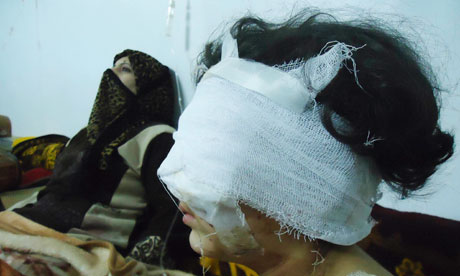
Danny Abdul Dayem, a resident of Homs, shared these words with Al-Jazeera concerning the shelling in Bab Amr. Video images have surfaced showing people who have been shot and hit by shrapnel, including children sustaining fatal injuries.
“It has been terrible. There is non-stop bombing with rockets, mortar bombs, and tank shells. There were more than 50 people injured in Bab Amr today. I saw with my own eyes kids with no legs, and a kid who lost his whole bottom jaw. It is terrible.”
Dayem also indicated that only one field hospital with four doctors was still operating in the city and that it was virtually impossible to get additional medication for anything short of a gunshot wound.
The Syrian state television has denied that there had been any such bombardment in the country. It stated that residents were setting fire to piles of rubbish on the roofs of their homes in an attempt to trick the world into believing that there was an attack. The phrase “terrorist gangs” was used to describe whom was responsible for the blown up buildings in Homs. The government has come out and said that it is fighting foreign-backed armed groups
According to the Syrian Observatory for Human Rights (SOHR), a London-based rights organization, army deserters in the northeast region of the country destroyed a military control post early on Monday 06 February 2012, killing three officers and capturing 19 soldiers. The fighting occurred in the village of Al Bara in the Edleb region and that none of the army deserters involved in the skirmish lost their lives.
The death toll in Syria rose to at least 88 people over the weekend, deemed one of the bloodiest since the demonstrations and protests against al-Assad’s regime began nearly 11 months ago. The chaos and turmoil in the country has claimed at least 6,000 lives total in Syria, according to various opposition groups.
The international community continues to react to the situation in Syria instead of taking a proactive approach. According to French authorities, The European Union (EU) is set to strengthen sanctions imposed on Syria in a bid to boost pressure on the government. Alain Juppe, the French foreign minister, shared these words with BFMTV television on Sunday 05 February 2012.
“Europe will again harden sanctions imposed on the Syrian regime. We will try to increase this international pressure and there will come a time when the regime will have to realize that it is completely isolated and cannot continue.”
The United States closed its embassy in Syria and pulled out its remaining staff on Monday 06 February 2012, citing serious security concerns as al-Assad’s regime increased its crackdown, causing more bloodshed. The State Department released a statement containing the following on the decision to close the Syrian embassy.
“The United States has suspended operations of our embassy in Damascus as of 06 February. Ambassador Robert Ford and all American personnel have now departed the country. The recent surge in violence, including bombings in Damascus on 23 December and 06 January, has raised serious concerns that our embassy is not sufficiently protested from armed attack.”
With all of the attacks and death occurring the around the nation, it can only be extremely disheartening to Syrian civilians to see nations such as China and Russia veto a UN Security Council resolution and the US close its embassy. Regardless of what the “big-time” actors are doing, people are still suffering and dying on the ground. These are the same people that are continually at the mercy of al-Assad’s regime. It would seem that the only way for these people’s voices to be heard and acted on is the permanent absence of al-Assad’s regime. Much like Hosni Mubarak of Egypt and Moammar Gaddafi of Libya, the permanent absence of a multi-decade dictator is the only way for the demonstrations and protests to actually mean something for change.
For more information, please see:
Ahram – US Closes Syria Embassy, Pulls Out All Staff – 06 February 2012
Al-Jazeera – Syrian Army ‘Steps Up Homs Offensive’ – 06 February 2012
http://www.aljazeera.com/news/middleeast/2012/02/20122614732355122.html
BBC – Syria Crisis: Army Steps Up Homs Shelling – 06 February 2012
http://www.bbc.co.uk/news/world-middle-east-16902819
CNN – US Closes Embassy As Fighting Rages In Syria – 06 February 2012
http://www.cnn.com/2012/02/06/world/meast/syria-unrest/index.html?hpt=imi_c1
The Guardian – Syrian Forces ‘Kill At Least 50’ In Homs Bombardment – 06 February 2012
http://www.guardian.co.uk/world/2012/feb/06/syrian-forces-homs-bombardment
Reuters – Syria Bombards Homs; West Scrambles For New Strategy – 06 February 2012
http://www.reuters.com/article/2012/02/06/us-syria-idUSTRE80S08620120206
Rival Palestinian Leaders Agree To Team Up, But Their Populations Continue to Suffer
By Adom M. Cooper
Impunity Watch Reporter, Middle East
GAZA CITY, Gaza–The leaders of rival Palestinian factions Fatah and Hamas signed a deal on Monday 06 February 2012 in Qatar to form a unity government. The government would be independent of West Bank and Gaza, currently led by Palestinian President Mahmoud Abbas.

Israeli Prime Minister Benjamin Netanyahu issued a statement shortly after the agreement was signed, stating that Israel would not come to the table so long as Hamas was on the Palestinian side.
“Hamas is a terrorist organization which strives to destroy Israel and relies on support from Iran. I have said many times in the past that the Palestinian Authority must choose between an alliance with Hamas and peace with Israel. Hamas and peace don’t go together.”
As the never-ending peace talks between Israel and Palestine continue to prove fruitless, the agreement signed is hoping to pave the way for Palestinian presidential and parliamentary election as a possibility later this year. Also, there is focus and hope on substantively rebuilding Hamas-ruled Gaza Strip, following a 2008-2009 Israeli offensive against Hamas.
This deal comes just one weekend after dozens of Palestinians staged hostile protests as the convoy of visiting UN chief Ban Ki-Moon entered Gaza from Israel. Many of the protesters were relatives of Palestinian prisoners in Israeli jails and came to express their anger at Mr. Ban’s refusal to meet with them to discuss the prisoners’ situation. According to the BBC, the protesters were expressing their disgust on behalf of approximately 4,000 Palestinian prisoners.
Some protesters threw shoes at the convoy while others held signs, one which displayed the text, “enough bias for Israel.” Mr. Ban’s visit to the region was supposed to ignite stalled peace negotiations between the two sides. An entire month of “exploratory talks” ended last week without any major or expected breakthroughs.
When Mr. Ban’s armoured convoy entered Gaza, approximately 50 protesters gathered on the Gaza side of the Erez crossing as the convoy came through. According to the AP news agency, the protesters formed a human chain in an attempt to hold up the UN chief’s progress but Hamas security forces removed them from the area. After passing through the protest, Mr. Ban traveled to Khan Younis, where he reportedly was scheduled to visit a school and a Japanese-funded housing project.
As both Israeli and Palestinian authorities continue to make statements, the focus on the region really needs to be placed on the people on the ground. The Israeli populations appear to be functioning properly, while the Palestinian population appear dysfunctional and desolate. According to a Human Rights Watch report released over the weekend, Israeli policies on Palestinian residency have arbitrarily denied thousands of Palestinians the ability to live in, and travel to and from, the West Bank and Gaza. The 90-page reported dubbed “Forget about Him, He’s Not Here” goes into great detail about the arbitrary exclusion by the Israeli military of hundreds of thousands of Palestinians since 1967 and further documents the impact that said exclusion continues to have on individuals and families.
The Israeli military has a list that deems certain Palestinians as lawful and legitimate residents of the West Bank and Gaza has had a plethora of adverse effects on the Palestinian population. According to “Forget about Him, He’s Not Here,” it has separated families, caused individual to lose jobs as well as educational opportunities, barred people from entering the Palestinian territories, and trapped others inside them.
Sarah Leah Whitson, Middle East director at Human Rights Watch, shared these sentiments concerning the report and what it details.
“Israel has never put forth any concrete security rationale for blanket policies that have made life a nightmare for Palestinians whom it considers unlawful residents in their homes. The current policies leave families divided and people trapped on the wrong side of the border in Gaza and the West Bank. Israel should revise these policies and process requests for families to reunite, so that Palestinians can live with their families where they want.”
Israel requires Palestinians to be included in the population registry in order to be considered lawful residents and possess Israeli-approved identification cards and passports. In the West Bank, Palestinians need the ID cards for almost everything, including traveling internally, attending schools, finding employment, admittance to hospitals, and to visit relatives. Israeli security forces controlling checkpoints requires these cards before allowing passage and those controlling the West Bank borders also required Palestinians who are entering or leaving the territory to present an ID card or passport.
Until the conditions and issues surrounding Palestinian populations is substantively pushed to the front of any peace talks, it is very difficult to see how any change will occur. Many words can be written on agreements and signed but until those words mean no more requirements on Palestinians to carry ID and be arbitrarily separated from their relatives, the situation will continue to worsen.
For more information, please see:
NYT – Palestinian Factions Reach Unity Deal – 06 February 2012
Reuters – Palestinian Rivals Agree To Form Unity Government – 06 February 2012
Human Rights Watch – Israel: End Restrictions On Palestinian Residency – 05 February 2012
Al-Jazeera – Two Palestinians Wounded in Israeli Airstrike – 03 February 2012
CNN – Protesters Pelt U.N. Chief’s Vehicle With Shoes In Gaza – 02 February 2012
BBC – Palestinian Protesters Target UN Chief Ban Ki-Moon – 02 February 2012