
Report Says Thousands Died Needlessly in Somalia Famine; Chance for Redemption in Sudan
By Tamara Alfred
Impunity Watch Reporter, Africa
Aid agencies have released a report stating that thousands of people, more than half of them children, died needlessly while millions of dollars were wasted because the international community did not respond to early warnings of an impending famine in East Africa. The report also warned of a new hunger crisis in West Africa.
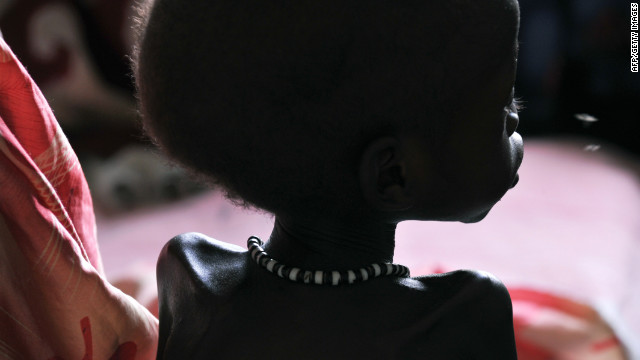
The report by Oxfam and Save the Children says that a food shortage was predicted as early as August 2010, but most donors did not respond until famine was declared in parts of Somalia in July 2011. The agencies said many donors wanted to first see proof that there was humanitarian catastrophe, which led to a funding shortfall that delayed any response to the crisis.
“We all bear responsibility for this dangerous delay that cost lives in East Africa and need to learn the lessons of the late response,” said Oxfam head Barbara Stocking.
The report says the delays in East Africa caused thousands of deaths and increased costs for aid agencies. The British government estimates that between 50,000 and 100,000 people have died from the famine, mostly in Somalia. More than half of those who died are believed to be children.
On Friday, it will be six months since the United Nations declared famine in Somalia. The organization says tens of thousands will have died of starvation by the time the famine ends, while 250,000 Somalis are still at risk of starvation and more than 13 million people need aid.
“Children will have suffered the most,” said U.N. aid chief in Somalia, Mark Bowden. “[M]alnutrition rates in Somalia were the highest in the world, and I think the highest recorded…up to 50% of the child population suffered from severe or acute malnutrition.”
“The world knows an emergency is coming but ignores it until confronted with TV pictures of desperately malnourished children,” said Save the Children head Justin Forsyth.
However, Kenyan economist James Shikwati believes that it would have been difficult to prevent the famine in south-central Somalia because the region is controlled by al-Shabab, an insurgent group that has greatly limited the work that aid agencies can do in the region. “I don’t think the solution to famine is just sending money in good time,” said Shikwati. “Even if you have all the money in your pocket and all the grain in your store, unless al-Shabab allows you to access their areas then people there are still going to starve.”
Shikwati’s comments may prove to be true sooner rather than later in war-torn Sudan. United States envoy to Sudan Princeton Lyman warned today that half a million people will face an emergency bordering on famine by March if international humanitarian organizations are not allowed into areas of Sudan that are mired in conflict. The government in Khartoum argues that the border areas of South Kordofan and Blue Nile are too dangerous for NGOs to operate in.
Lyman said a lack of leadership, a history of vicious ethnic violence and the indictment of Sudan’s President Omar al-Bashir by the International Criminal Court are all factors that have complicated the crisis in that country. He further lamented the lack of a mechanism for Sudan and newly independent South Sudan to resolve conflicts, “despite the two sides having been in a unity government for five years and having participated in years of peace talks.”
Since South Sudan gained independence from the north in July 2011, fighting has continued in the border regions of South Kordofan, Blue Nile, Unity State and Upper Nile. Countless lives have been lost and hundreds of thousands have been displaced, exacerbating an already desperate humanitarian crisis.
The Sudanese ambassador to South Africa, Ali Yusuf Alsharif, warned that the situation in his country could become worse than Somalia. However, he also cautioned that outside pressure may further complicate the situation.
“The world has looked at Somalia, not knowing what to do,” Alsharif said at a conference. “But if you push everyone [in Sudan], you could have a situation worse than Somalia.”
For more information, please see:
CNN – Sudan faces potential famine, U.S. envoy warns – 18 January 2012
Huffington Post – Somalia Famine Response Too Slow, Thousands of People Died Needlessly: Report – 18 January 2012
BBC News – Somali famine ‘will kill tens of thousands’ – January 15 2012
ICTJ World Report January 2012 Issue 8
Woman Flees Forced Sterilization
By: Jessica Ties
Impunity Watch Reporter, Asia
BEIJING, China– A woman in China has narrowly avoided being forcibly sterilized after giving birth to her second child.

The attempt was carried out by family planning officials in the Chinese province of Fujian who held the woman down on an operating table.
The woman, Huang Yongchun, explains her experience by stating “they took me over there this morning, and about eight of them held me down on the operating table.”
Huang has already given birth to two children which exceeds the one child allowed under Chinese law. Huang reported that this attempt was preceded by an initial attempt made in 2010. While the first attempt was thwarted by Huang’s health problems, the second attempt was cancelled by a doctor after seeing Huang’s frantic reaction.
“The doctor didn’t want to do the operation because I was terrified…I was shuddering there on the operation table because I felt so helpless” reports Huang.
In response, Village chief Chen Renhe explained that, “they didn’t comply with family planning regulations…in our country the policy is that people who don’t comply are not forced, but we have to do ideological work with them.”
Forced sterilization and abortion have become common in rural areas of China where family planning officials attempt to avoid being fined for exceeding local birth quotas.
Rights lawyer Tang Jingling has reported that sterilizations, peer pressure and financial incentives are commonly used to convince women to comply with the one-child policy. For example, “if one person in a work unit has an extra child, then the whole organization…could lose out on economic benefit” stated Tang.
China’s one-child policy was instituted by the Communist government in the 1970’s to curb the growing population. Under this policy, couples living in urban areas are allowed only one child while couples living in rural areas are allowed two children if the first child is a female.
The one-child policy has sparked controversy not only internationally but nationally as well. One of China’s most well-known activists, rights lawyer Chen Guangcheng, has endured over six years of harassment, persecution and physical abuse because of his investigative reported of forced sterilization and abortion in China.
Chen and his wife are currently under house arrest and have been forbidden from leaving their home for over a year. During this time they have suffered beatings and frequent raids on their home by Chinese authorities.
In December American actor Christian Bale was criticized by the Chinese government for engaging in an altercation with Chinese police who physically thwarted his attempts to visit Chen while he was in town to attend the opening ceremony of his latest filed “The Flowers of War”.
For more information, please see:
Radio Free Asia – Woman Flees Forced Sterilization – 12 January 2012
Lifenews – Biden to Head Obama China Policy but Ignored Forced Abortions – 3 January 2012
New York Daily News – China Says Christian Bale Should be Embarrassed – 21 December 2011
The Guardian – Chen Guangcheng: Amnesty Urgent Action – 12 November 2011
Nigeria Fuel Strike Appears Over with Subsidy Reinstated
By Zach Waksman
Impunity Watch Reporter, Africa
LAGOS, Nigeria – The past week in Nigeria was marked by a nationwide labor strike that began after the government ended a subsidy on gasoline, which caused its price, and that of many other essentials, to more than double. On Monday, President Goodluck Jonathan announced a partial rollback on the cost of fuel, which led unions to suspend the strikes for now. Labor leaders warn that they are willing to resume strikes at a later date.
For Africa’s most populous country, the announcement comes as a small return to normalcy as the country’s markets reopened for the first time since the strike began on January 9. But the situation remains fragile, as the partial rollback does not address the full effect of the initial revocation. The subsidy’s removal on January 1 marked the beginning of a chain reaction in the economy of Africa’s most populous country. Products such as onions, peppers, and watermelon seeds also saw a substantial increase in price due to the cost of transporting them to market.
Nigeria is Africa’s largest producer of oil, but it must import most of its refined fuel products due to a lack of its own refineries. Despite this wealth, most Nigerians live on about one dollar per day, while the petroleum profits are spread among the elite. The only benefit that most see is a lost fuel cost, the result of a national subsidy. The subsidy’s suspension caused the price of gasoline to jump from N65 (N is for “naira,” the national currency.) per liter on December 31 to N141-145, the equivalent of a spike from $1.70 per gallon to $3.50 per gallon in the United States.
“Government will continue to pursue full deregulation of the downstream petroleum sector,” Jonathan said in a televised address. “However, given the hardships being suffered by Nigerians, and after due consideration and consultations with state governors and the leadership of the National Assembly, government has approved the reduction of the pump price of petrol to N97 per litre.”
Following Jonathan’s announcement, Nigeria Labour Congress chief Abdulwahed Omar said that the unions would formally suspend the strike, protests, and rallies. The decision comes in part due to fears that the rallies could be hijacked for other purposes. At least ten people were killed during the week-long strike, and at least 600 were treated for injuries.
Talks between the government and labor leaders are still ongoing. Senate President David Mark held a meeting at his home on Sunday. After it adjourned, Governor Rotimi Amaechi of Rivers State, one of the attendees, spoke to the media and appeared certain that a permanent answer would be found soon.
“I believe that solutions would be found to the strike. I believe that we are at the verge of finding a solution to it,” he said. “We have held a meeting and we have looked at the solutions and we think that with Labour, we can find a joint solution to the problem and you must realize first that the President is patriotic in his decision and all of us in government are backing him. Labour agrees to deregulation. I don’t know if there is any point that they are not part of deregulation. Their argument is how and when and we are sorting out all those fine details and we will find [a] solution to it.”
What that solution is, however, remains unknown. But for the people of Nigeria, this move will not be sufficient to mollify an already disgusted population.
“When the equation is still Hobbesian, people are not going to participate,” said Ricardo Soares de Oliveira, a lecturer at Oxford University and an expert on Nigerian oil politics, referring to the grimness of daily life in Nigeria. “People perceive this as a raid on their resources.”
For more information, please see:
BBC — Nigerian Fuel Subsidy: Strike “Suspended” — 16 January 2012
Guardian — Jonathan, Govs, N’Assembly in Frantic Search for End to Strike — 16 January 2012
New York Times — Amid Strikes, Nigeria Rolls Back Gasoline Price — 16 January 2012
Nigerian Tribune — FG Pegs Fuel at N97 per Litre; Labour Suspends Protests, Continues Strike — 16 January 2012
Washington Post — Labor Union Announces Suspension of Strike over Fuel Prices in Nigeria amid Violence — 16 January 2012