Fledgling South Sudan Faces Humanitarian Crisis

By Zach Waksman
Impunity Watch Reporter, Africa

JUBA, South Sudan – Six months after its recognition as a sovereign state, South Sudan already faces a massive humanitarian crisis.  Since then, long-dormant ethnic tensions have resurfaced in the newly independent country.  Thousands of people have died, and efforts to stem the tide of bloodshed have failed.  Thursday, Murle youths from Pibor County killed 37 people in Uror County of Jonglei State.

Displaced Pibor residents make their way home following last week's attack by Lou Nuer fighters. (Photo courtesy of the New York Times)

The Murle and Lou Nuer, rival ethnic groups in Jonglei State, have a long-standing conflict that subsided in 2009 for purposes of gaining independence for South Sudan.  But in August, only a month after independence became reality over 600 Lou Nuer died at the hands of Murle forces, who also abducted dozens of children.  On January 3, 2012, John Boloch of South Sudan’s Peace and Reconciliation Commission told the BBC that he estimated at least 150 deaths during the first two days of the year.  Pibor was a particular nexus of the conflict, with 6,000 Lou Nuer fighters surrounding the town last week.  That outnumbers the combined forces of the country’s army and a contingent of peacekeepers from the United Nations.

Due to this lack of firepower, the UN felt that, other than warning villagers of the coming assault, which the Lou Nuer publicly announced prior to their attack, it could not do anything to protect the Murle from its rival.

“Protection of civilians in the rural areas and at larger scale would only have been possible with significantly more military capacity,” said Hilde F. Johnson, head of the UN mission in South Sudan.

Part of the problem may be that politicians in the area used incited violence for their own gains.  Boloch wondered why peacekeepers were protecting government buildings instead of people. Government spokesman Dr. Barnaba Marial addressed the media earlier this week, announcing that the government was forming a committee to investigate and arrest those who used their positions for such a purpose.

“[T]hose politicians trying to incite conflicts between our communities are warned that this is not the way to do it,” he said.  “There are certain politicians who are trying to agitate for demonstration. Please let us help our government to develop instead.”

Because of the conflict, which has claimed an estimated 2,000 lives, many have fled Pibor and the surrounding area.  According to Liz Grande, humanitarian affairs coordinator of the UN office for Coordination of Humanitarian Affairs (UN-OCHA), at least 60,000 South Sudanians have been displaced from Jonglei, with still more fleeing as best they can.  Addressing the situation will be difficult, as South Sudan lacks an extensive road system that would make delivery of aid easier.  It will instead have to be brought in by air, which is much more expensive.  Grande called the present situation the worst humanitarian crisis the region has faced since the signing of a peace agreement six years ago.

“This emergency operation is going to be one of the most complex and expensive in South Sudan since the Comprehensive Peace Agreement was signed in 2005,” Grande said.

For more information, please see:

Gurtong Trust — 37 Killed in Uror County of Jonglei State — 12 January 2012

Gurtong Trust — Government Warns Politicians over Conflict Instigation — 12 January 2012

New York Times — Ethnic Killings Fray Unity Marking Birth of South Sudan — 12 January 2012

Voice of America — South Sudanese Continue to Flee Violence Along Border — 09 January 2012

New Nation — South Sudan Facing Worst Humanitarian Crisis since CPA — 08 January 2012

BBC — South Sudan’s Jonglei Clashes: UN Begins Aid Effort — 07 January 2012

BBC — South Sudanese “Massacred” after Fleeing Pibor — 03 January 2012

A Decade of Gitmo, A Decade of Shame: We Must Close This Symbol Of Torture

By Morris Davis And Rev. Richard Killmer
Originally published by The New York Daily News on 11 Jan 2012

One of us is a career military officer and former chief prosecutor for the military commissions at Guantanamo Bay, Cuba; the other is a minister and the executive director of an interfaith coalition.

We have seen the power of symbolism.

Religious symbols inspire people of faith to do good and courageous acts. Some religions even see God in their symbols.

An American military uniform has always symbolized honor and humanity. When Iraqi troops encountered American soldiers during the Persian Gulf War in 1991, tens of thousands of Iraqis lowered their weapons and rushed forward to surrender rather than fight. The Iraqis knew the U.S. military’s reputation, and by surrendering, they felt certain they would be ensured humane treatment.

But a symbol can also be destructive. The power of negative symbols to foment harm is at least as great as the power of positive symbols to foster good.

The detention camp at Guantanamo, opened 10 years ago today, stands as an internationally recognized symbol of a dark period in our nation’s history. For a country built on a foundation of courage and hope, one that is supposed to stand as a bright light on a hill and an example for the world to follow, Guantanamo symbolizes the exploitation of fear that enabled some to say no to the rule of law.

In the months between the terrorist attacks on 9/11 and the arrival of the first prisoners at the detention camp, Bush administration lawyers worked to rationalize turning our backs on what for two centuries was America’s unique strength — the law. The results of their work led to conclusions that detainees in the fight against terrorism were neither criminals nor prisoners of war and therefore had no rights under the laws of war or the Constitution — and that interrogation methods that did not produce pain equal to death or major organ failure did not rise to the level of torture.

Many of those interrogation methods — including the simulated drowning known as waterboarding — were practiced on suspected terrorists held in legal limbo at Guantanamo Bay.

Although President Obama banned torture shortly after taking office — and pledged to close the Guantanamo Bay detention camp within a year of becoming President — the facility remains open. Congress has resisted bringing detainees to the U.S. to be held and tried; Obama has failed to win the argument.

This is an outrage. The enduring, infamous symbolism of Guantanamo weakens our influence around the world and puts our troops and our citizens abroad in danger.

Even now, as we continue to hold 171 prisoners in indefinite detention on Cuban soil at our prison at Guantanamo, we undermine the credibility of our demand for the Cuban government to release American Alan Gross from two-plus years of confinement in a Cuban prison. How then, do we condone the continued indefinite detention on the other side of the island of so many people who have not been charged with crimes — or even, in the case of 89 of them, have been approved for release?

We may have allowed a legitimate fear of terrorism to cause the needle of our collective moral compass to waver for a moment, but our fundamental principles remain centered on true north. As a nation founded on religious and moral values, we cannot begin to move past the shameful symbol of the past decade until we ensure that U.S. government-sponsored torture never occurs again.

We take a major step on that path when we turn out the lights at Guantanamo.

Davis is former chief prosecutor for the military commissions at Guantanamo Bay and is now on the faculty of the Howard University School of Law. Killmer is executive director of the National Religious Campaign Against Torture.

R2P Monitor January 2012 Issue 1

R2P Monitor January 2012

Report Wants Investigation and Prosecution of Bush Administration Officials

By Brittney Hodnik
Impunity Watch Reporter, North America

WASHINGTON, United States – On 2 January 2012, Human Rights USA released a report detailing planned and authorized acts of torture against terror suspects.  After the September 11 attacks, many terror suspects were detained and unlawfully treated.  These alleged acts of torture were in violation of domestic and international law.

Guantanamo Bay has now been open for 10 years, many detainees remain there. (Image Courtesy of Associated Press)

The 270-page report is entitled Indefensible: A Reference for Prosecuting Torture and Other Felonies Committed by U.S. Officials Following September 11th.  It outlines all of the evidence that indicates illegal interrogation techniques under the Bush Administration.  According to a press release from Human Rights USA, the report is a multi-year collaborative effort between Human Rights USA and the International Human Rights Law Clinic at American University in Washington, D.C.

According to the same press release, the courts still have not held a top government official accountable for any act of torture.  Although some torture survivors have sought judgments against these officials, none has prevailed.

Although the Bush Administration authorized this kind of lawless behavior, the Obama Administrations has similarly failed.  Obama has not investigated these allegations of torture and other inhumane treatment, nor created a Special Counsel for its investigation.

This report was released less than two weeks before Guantanamo Bay’s 10th anniversary of opening.  Although President Obama set a deadline to close Guantanamo, no detainee has left in over a year because of restrictions on transfers, according to USA Today.  Furthermore, indefinite military detention has now become enshrined in U.S. law.

Allison Lefrak, litigation director of Human Rights USA said, “Our country’s legal system relies on the fundamental principle that no one is above the law – even top government officials.”  She believes that nothing will be fixed until the responsible officials are actually held accountable for their actions.

“Repudiation of torture and accountability for the government officials who authorized it is essential in order to restore the rule of law in the United States and prevent similar acts of torture from being repeated in the future,” she said.

Just one example of supposed torture victims is Saudi national, Mohammed al-Qahtani.  He claims he was the victim of “torture and other profoundly cruel, inhuman, and degrading treatment,” according to Newser.  His lawyers are calling for the release of ‘sickening’ videos of his torture at Guantanamo Bay.

Overall, the report is a cry for help; it seeks to encourage people to recognize the atrocities that happened under the Bush Administration after the horrendous attacks on September 11.  Furthermore, the report seeks to point out the current administration’s avoidance of prosecuting those individuals in power.

The full report can be found at: Indefensible

For more information, please visit:

Human Rights USA – Press Release — 4 Jan. 2012

Newser — ’20th Hijacker’ Sues for Gitmo Torture Tapes — Videos are Sickening Says Lawyer — 11 Jan. 2012

USA Today — Guantanamo Closure Hopes Fade as Prison Turns 10 — 11 Jan. 2012

As the Arab League’s Mission In Syria Continues, One Monitor Quits and Labels It a ‘Farce’

By Adom M. Cooper
Impunity Watch Reporter, Middle East

DAMASCUS, Syria–In the midst of the Arab League’s mission to discover what exactly is happening inside Syria since the protests began, one monitor decided to call it quits after what he witnessed. Anwar Malek, an Algerian member of the monitoring team, has called the Arab League’s mission to the country a ‘farce.’


Arab League observers attend a mass prayer for individuals were killed during the violence. (Photo Courtesy of the AP)

Malek stated that he resigned due to what he saw and that the mission itself was falling apart. He also stated that security forces did not withdraw their tanks from the streets, but rather hid them and chose to redeploy them after the observers had gone. He shared these sentiments with an Al-Jazeera correspondent.

“What I saw was a humanitarian disaster. The regime is not just committing one war crime, but a series of crimes against its people. The snipers are everywhere shooting civilians. People are being kidnapped. Prisoners are being tortured and none were released. The mission was a farce and the observers have been fooled. The regime orchestrated it and fabricated most of what we saw to stop the Arab League from taking action against the regime.”

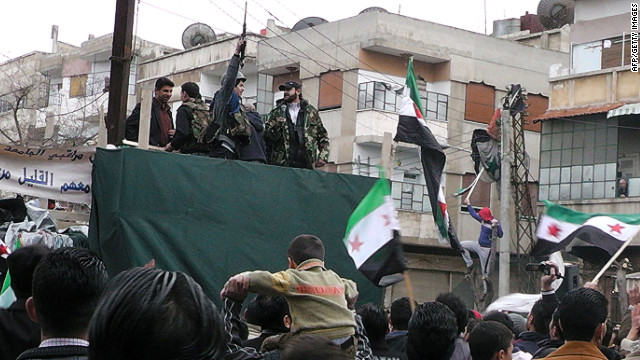
Meanwhile, President Bashar al-Assad addressed a rather large gathering of his followers and supports in the Syrian capital, Damascus. In his second speech in as many days, al-Assad stated again his accusations that the “homeland was reeling under the brunt of conspiracy.”

“You are standing against a desecration of our identity, and you are confirming your steadfastness and support for the armed forces, whose martyrs are falling every single day so you can live in safety.We will triumph over this conspiracy. It is dying; it’s the end of their plot.”

The United Nations has declared that more than 5,000 civilians have lost their lives since the protests began against al-Assad in March 2011. Conversely, al-Assad has declared that “terrorists” have killed some 2,000 members of his security forces.

A senior UN official informed the UN Security Council on Tuesday 10 January 2012 that Syria had accelerated its killing of pro-democracy demonstrators and protesters after the Arab League monitors had arrived. Susan Rice, the US ambassador to the UN, delivering the following statement concerning the increased death of civilians since the Arab League monitors began their observance.

“The under-secretary-general noted that in the days since the Arab League monitoring mission has been on the ground, an estimated additional 400 people have bee killed, an average of 40 a day, a rate much higher than was the case before their deployment. That is a clear indication that the government of Syria, rather than using the opportunity to end the violence and fulfill all of its commitments to the Arab League, is instead stepping up the violence. The Arab League has failed for six decades to take a position in the Arab interest.”

The Arab League condemned an attack on Monday 9 January 2012 in which 11 of its monitors were hurt by demonstrators and protesters in the province of Latakia. The monitors were upset, saying that Syria breached its obligation to protect them. al-Assad’s regime claimed that it was continuing to provide security for the observers and also condemned any act that would obstruct their mission’s work. The Arab League released the following statement concerning the attacks on its monitors.

“Failing to provide adequate protection in Latakia and other areas where the mission is deployed is considered a serious violation by the government of its commitments.”

Malek further expressed his disgust what the situation, stating that the government was not assisting the observers with their requests. He also stated that those who were supposedly freed and were shown on television, were actually people who had been randomly grabbed off the street.

“The regime didn’t meet any of our requests, in fact they were trying to deceive us and steer us away from what was really happening, towards insignificant events. The people were detained for four or five days in tough conditions and later released as if they had been real prisoners.”

“Around some of the buildings, there were even army officers in front of the building, while snipers were on the roof. Some on our team preferred to maintain good relations with the regime and denied that there were snipers. From time to time, we would see a person killed by a sniper. I have seen it with my own eyes. I could not shed my humanity in such situations and claim independence and objectivity.”

One can only wonder what the civilians on the ground are really going through if one of the Arab League’s monitors, sent to help their situation, felt so repulsed by what he saw that he had to resign. The civilians of Syria need all the attention that they can get so the violence against them ceases. But as long as the violence rages on, the voices for freedom will continue to be silenced.


For more information, please see: 

Ahram – UN Says Syria Killings Rise After Monitors Arrive – 11 January 2012

Al-Jazeera – Arab Observer Calls Syria Mission a ‘Farce’ – 11 January 2012

BBC – Ex-Arab League Monitor Labels Syria Mission a ‘Farce’ – 11 January 2012

CNN – Al-Assad Revs Up Pro-Regime Rally – 11 January 2012

The Guardian – Arab League Official Attacks Syria Mission as ‘Farce’ – 11 January 2012

Reuters – Arab Monitor Quits Syria Mission in Disgust – 11 January 2012