FBI Expands its Definition of Rape

By Brittney Hodnik
Impunity Watch Reporter, North America

WASHINGTON, United States – For the first time in 80 years, the FBI has amended its definition of “rape” under federal law.  After years of push from both women’s rights groups and gay advocacy groups, Attorney General Eric Holder finally announced the new definition.  The FBI expanded the definition tremendously from the antiquated 1929 version.

Robert Mueller, Director of the FBI, officially announced the change for the definition of rape last week. (Image courtesy of FBI Files)

The previous definition of rape was “the carnal knowledge of a female, forcibly and against her will.”  Over the years, this definition did not protect men who found themselves victims of rape, nor did it protect other forms of sexual assault against women.

The new definition, which expands rape to include men and non-vaginal penetration, reads as follows: “The penetration, no matter how slight, of the vagina or the anus with any body part or object, or oral penetration by a sex organ of another person, without the consent of the victim.”

Every year, the FBI compiles data about crime in the United States in its Uniform Crime Report (UCR).  Previously, thousands of rapes against men and women alike were not included in the data because the acts did not fit the narrow definition of rape that many police departments use. 

For example, the current prosecution of Penn State assistant coach Jerry Sandusky would not have been included in the UCR, even though he is being investigated for the rape of 10 young boys.  Additionally, in 2010, the Chicago Police Department reported about 1,400 sexual assaults, but none of them were included in the UCR.  According to The Huffington Post, the sexual assaults did not fit the government’s definition of rape so they were not included in the report.

“If you can’t measure it accurately, you can’t monitor it and you can’t direct appropriate resources to deal with the problem,” said Carol Tracy, executive director of the Women’s Law Project, according to USA Today.

Although every state has its own definition of rape, the FBI is hopeful that the change in the federal standard will cause the states to follow suit, according to The Daily Activist.

The change comes from advocacy by Vice President Joseph Biden, according to The Seattle Times.  In 2010, the FBI reported an estimated 84,767 rapes and it anticipates that the number will increase.  FBI Director Robert Mueller said that the previous definition was “unworkable” and “not fully applicable to the types of crimes that it should cover,” according to The Huffington Post.  The new definition will take a couple of years to be fully implemented.

For more information, please visit:

The Daily Activist — Human Rights: FBI Redefines Rape After 80 Years — 9 Jan. 2012

The Seattle Times — Rape Redefined for FBI to Include Male Victims — 9 Jan. 2012

USA Today — FBI Changes Definition of Rape to Include Men — 6 Jan. 2012

The Huffington Post — FBI Director Robert Mueller: Agency Will Update Definition of Rape — 15 Dec. 2011

French Legislature To Mull Ban On Armenian Genocide Denial

By Terance Walsh
Impunity Watch Reporter, Europe

PARIS, France – The upper house of France’s parliament is preparing to vote on a measure that would criminalize the denial of the Armenian genocide.  The proposed law has drawn the ire of Turkey as well as free speech proponents.

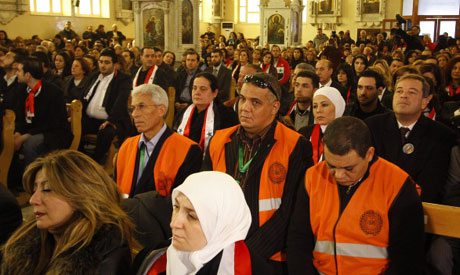
French Senate, where bill banning denial of Armenian Genocide will be debated (Photo courtesy of Azatutyun.am)

The law would prescribe a maximum one-year prison sentence and a € 45,000 penalty to those who would violate it.  This penalty is equal to the law that criminalized the denial of the Holocaust.  French government minister Patrick Ollier reasoned that “There is no reason to punish the denial of one genocide but not the other.  This is a simple coordination of punishment.”

According to Armenia the Armenian genocide took place in 1915 when 1.5 million Armenians were killed by Ottoman Turks.  France officially recognized the Armenian genocide by passing a law in 2011.  Turkey objects to the description of genocide and comparison to the Holocaust, reasoning that there was substantial loss of life on both sides.

French President Nicholas Sarkozy, whose signature is necessary to ratify the bill, has thrown his support behind the bill.

Some French Members of Parliament stand in opposition to the bill.  Foreign Minister Alain Juppe slammed the bill, calling it “a futile and counterproductive bill, which will have serious consequences on bilateral ties with Turkey.”  French Senator Nathalie Goulet has declared that she will “go on a crusade” against the proposed anti-denial law.

The National Assembly, France’s lower house approved the bill last month.  The passage of the law prompted Turkey to recall its ambassador and suspend all contracts and military cooperation with France.  Turkey’s Prime Minister Tayyip Erdogam slammed the bill, calling it “politics based on racism, discrimination and xenophobia” and accused France of committing genocide in Algeria and being complicit to genocide in Rwanda.

The French law has also come under fire for its assault on free speech.  William Bauer of Policymic argued against the sensibility of denying genocide, but added “the act of genocide denial, written or verbal, must never be made an illegal, criminal act.”

Protests of about two dozen people of Turkish descent have taken place in front of the French embassy in New York City on January 5th to oppose the ratification of the bill.  Protestors want an open and fair discussion to find out what truly happened in 1915.  “The Turkish government [are] always asking Armenia [to] open the books, let’s discuss on both sides,” protestor Mae Somnez said. “But they never open the books…we never can discuss archives and what is the truth.

Supporters of the bill cite the protection of the dignity of those who perished as reason enough to restrict speech.  An appeal signed by famous singer Charles Aznavour, director Robert Guédiguian, lawyer Serge Klarsfeld, philosophers Bernard-Henri Lévy, Michel Onfray, and Turkish writer Erol Özkoray was published in Le Journal du Dimanche.

“As Elie Wiesel has written, the denial of the genocide is killing its victims for the second time. We welcome the adoption of the bill on racism, discrimination and denial by the French National Assembly on December 22.

Our target is the ban of denial on state level that the Turkish authorities bring up to France. In order the text to become a law, we call the French President, the government and the leading parties to confirm their gesture and let the Senate ratify the bill.”

The Senate will debate the bill on January 10th.  This will be followed by discussion by the Constitutional Court sometime between January 23rd and January 30th.  If the bill passes it will go to President Sarkozy’s desk where he will have the opportunity to sign the bill into law.  The bill poses the difficult balance between allowing freedom to discuss controversial issues and reverence for horrific events in human history.

For more information please see:

Hurriyet Daily News — French Senator To Launch ‘Crusade’ On Genocide Law — 6 January 2012

Radio Free Europe/Radio Liberty — France Said To Speed Up Vote On Armenian Genocide Bill — 6 January 2012

Radio Free Europe/Radio Liberty —  Protest Held In NYC Over France’s Armenian Genocide Legislation — 6 January 2012

Azatutyun — French Senate To Vote On Armenian Genocide Bill — 5 January 2012

Euractiv — Turkey Pressues France To Stop Armenian Genocide Bill — 5 January 2012

PanARMENIAN — Sarkozy Approves Genocide Bill — 5 January 2012

Policymic — France’s Armenian Genocide Bill An Assault On Free Speech — 4 January 2012

NEWS.am — Aznavour, Philosophers, Turkish Writer Call French Senate To Ratify Bill Penalizing Armenian Genocide — 2 January 2012

Chile Accused Of Whitewashing Pinochet’s Dictatorship

By Paula Buzzi
Impunity Watch Reporter, South America

SANTIAGO, Chile — President Sebastian Pinera has been accused of attempting to “whitewash history” by his left wing opposition parties after the National Education Council formally announced its decision last week to refer to General Augusto Pinochet’s controversial rule as a “regime” rather than a “dictatorship” in school textbooks. The council had approved of this change in December during a special session but it became known to the general public only on Wednesday after an El Dinamo report.

General Augusto Pinochet ruled Chile from 1973 to 1990 where over 3,000 members of the opposition were killed. (Photo Courtesy of BBC).

Education Minister Harald Beyer defended the change on Wednesday stating that the decision to change the way textbooks refer to Pinochet’s rule was not politically motivated, but rather was  based on the fact that “regime” is a more general term used around the world that would be better understood by children in the first through sixth grades.

“This has nothing to do with partisans or detractors. It is about using the same expression used in schools around the world, a more general term such as military regime,” Beyer stated. He added that he personally has no problem acknowledging Pinochet’s regime as a dictatorship.

Left-wing opposition parties, however, are outraged by the decision. During Pinochet’s rule from 1973 to 1990, over 3,000 members of the opposition were killed or disappeared and around 37,000 were tortured or illegally held. President Pinera’s majority in parliament  relies in part on the backing of Pinochet’s former political base, the right-wing Independent Democratic Union.

According to the director of the Museum of Memory, Ricardo Bordsky Baudet, the term “Military regime” is a euphemism which hides something relevant. Deputy RN party president, Manuel Jose Ossandon believes history should be left to the historians. “If my father had been detained and disappeared, this change would be an insult to me,” he stated.

Senator Isabel Allende, whose father had been detained and murdered, believes the change is unacceptable. “It goes against all common sense, because the whole world knows that for 17 years what we had in Chile was a ferocious dictatorship with the most serious violations of human rights,” she said. Allende’s father, President Salvador Allende, was killed in 1973 when he was overthrown by Pinochet’s regime.

Former President Eduardo Frei also believes the change is a mistake. “History cannot be changed by a decree or a law. There is only one history and it is clear: it was a dictatorship, full stop.”


For further information, please see:

The Washington Post – Chile Replaces ‘Military Dictatorship’ With ‘Regime’ in Official Textbooks – 04 January 2011

BBC News – Pinochet “Dictatorship” Textbook Row Erupts in Chile – 05 January 2012

Herald Sun – Chile Downgrades Pinochet Era to a ‘Regime’ Rather Than a Dictatorship – 05 January 2012

The Financial Times – Chile Axes ‘Dictatorship’ From School Books – 05 January 2012

The Telegraph – Chile Accused of Airbrushing Augusto Pinochet History – 05 January 2012


Clash in China Turns Deadly

By: Jessica Ties
Impunity Watch Reporter, Asia

BEIJING, China –A confrontation between Chinese authorities and a group of Uighurs fleeing China resulted in at least seven deaths and the detention of children as young as seven years old.

A clash between Uighurs and Chinese authorities took place in Xinjiang where a large number of Uighurs live (Photo Courtesy of PBS).

According to the chief of one of the Mukula village hamlets, Memet Eziz Hapiz, two of those killed and at least two of those detained were from his hamlet.

Hapiz states that “[a]ll of them were firm in their beliefs. That is why they were unhappy and unsatisfied with the country’s religious policy.”

Minever Ehmet, Mukula village chief, told Radio Free Asia that two of the seven individuals killed were women and “their bodies are being held by the county Public Security Bureau.”

Minever Ehmet also stated that “the four captives are children aged seven to seventeen years of age. One child is an elementary school student in second grade. They are being interrogated by the county.”

When asked about the condition of the seven year old child, the village chief responded that he was “still alive” giving the impression that the child may have been seriously injured in the clash.

According to accounts by government authorities, the police attempted to block the “traitors”, who they accused of being terrorists, from crossing the border into an “enemy” country and opened fire when the Uighurs resisted arrest.

Although the police were civil, an argument eventually ensued and resulted in the stabbing of a police officer who grabbed the wife of one of the individuals.

Despite the official account, doubts have been raised about the legitimacy of official statements regarding events in Xinjiang.

For example, in 2008 officials claimed that two Uighur men were responsible for killing sixteen paramilitary officers by using machetes, explosives and trucks. Witnesses, however, claimed that it appeared that government actors had been the aggressors.

The Uighurs, which are the Turkish speaking and Muslim population in China, have often been accused of being the source of terrorism due to their resentment of Chinese rule and the control the government exercises over their religion and culture.


For more information, please see:

China Daily – Seven Kidnappers Killed, Police Officer Dies – 30 December 2011

New York Times – Reports Describe Deadly Clash in Restive China Region – 30 December 2011

Radio Free Asia – Women Killed, Children Captured in Standoff – 30 December 2011

Press Release: Hermitage Releases List of 14 Russian Judges Who Illegally Refused Sergei Magnitsky’s Mother Access to Justice in 2011 in the Murder of Her Son in State Custody

29 December 2011 – Today, Hermitage Capital Management published a list of 14 Russian judges who illegally refused Sergei Magnitsky’s mother access to justice throughout 2011 in the murder in Russian state custody of her son. The list will be submitted to the U.S. Helsinki Commission and the Council of Europe’s Consultative Council of European Judges. The list comprises nine judges of the Moscow City Court, three judges of the Tverskoi district court and two judges of the Basmanny district court in Moscow.

Topping the list is Olga Egorova, chair of the Moscow City Court, who, on November 18, 2011 rejected Mrs. Magnitskaya’s complaint seeking an independent medical evaluation into her son’s death. Her denial was based on the assertion that there was no need for an independent medical evaluation because the findings of state bodies could not be questioned.

Another person on the list is Alexei Krivoruchko, judge of the Tverskoi District Court of Moscow who refused on August 30, 2011 to consider a complaint from Mrs. Magnitskaya about the illegality of the posthumous prosecution of her son. As a result, the Interior Ministry proceeded to prosecute a man who had been dead for two years in spite of the fact that
there is no legal precedent in modern times for prosecuting someone after they are dead. Judge Krivoruchko is the same judge who sanctioned this their participation in year’s arrests of opposition figures Alexei Navalny and Sergei Udaltsov who protested against voting fraud in the December 4th Parliamentary elections.

Also on the list is Igor Alisov, recently appointed chair of the Tverskoi District Court of Moscow, who on September 12, 2011 rejected another complaint of Mrs. Magnitskaya protesting the prosecution of her son after his death by the Russian Interior Ministry. In March this year, the same Judge Alisov in an expedited procedure, closed to the public – and ignoring the evidence of Magnitsky’s colleagues and journalists – considered the case about the theft of $230 million from the budget exposed by Sergei Magnitsky prior to his arrest. Judge Alisov found one guilty party in this
crime – a jobless person Vyacheslav Klhebnikov, and recognized as “victims” the tax officials, who approved the multi-million dollar illegal tax refunds in one day and began buying $2 million apartments in Dubai shortly after the illegal tax refunds were granted.

“On fifteen different occasions this year, Sergei Magnitsky’s mother went to Russian courts to uphold her rights and each time she faced a wall of injustice. This story shows that Russian judges are not acting independently and the judicial system in Russia is not working. The plight of Mrs. Magnitskaya is a well-evidenced example that Russian courts are entirely politically directed,” said a Hermitage Capital representative.

During the twelve months of 2011, Moscow courts have refused all fifteen applications from Mrs. Magnitskaya seeking justice for her son. In particular, the judges rejected her application for an independent medical evaluation of causes of her son’s death in Russian police custody and her requests for access to her son’s tissues archive, stating there was no
ground to doubt the findings of state appointed experts. The judges also rejected her complaints against the Russian Investigative Committee for the concealment of her son’s case files, claiming she had no right to inspect those files. Similarly, the judges refused her complaint against the
Russian General Prosecutor’s Office and Interior Ministry for the reopening of the prosecution against her dead son and for the falsification of evidence in the case. Finally, the judges refused to compel investigators to prosecute high-ranking Russian officials for the illegal arrest, torture and murder of her son in state custody.

Judge Mushnikova of the Bamanny District Court in Moscow rejected two applications from Mrs. Magnitskaya this year. On 19 July 2011, Judge Mushnikova rejected an application from Mrs. Magnitskaya seeking access to her son’s tissues archive for an independent medical examination. On 8 December 2011, judge Mushnikova rejected Mrs. Magnitskaya’s complaint
against the Russian Investigative Committee for withholding case files from the relatives and separating the case against two medical personnel of Butyrka detention center.

Another judge of the Basmanny District Court Karpov on December 13, 2011 rejected the lawsuit from Mrs. Magnitskaya seeking to compel the Russian Investigative Committee to open an investigation into the illegal arrest, torture and murder of her son based on evidence she submitted to the Russian authorities this September. In her application, Mrs. Magnitskaya named high-ranking officials of the Interior Ministry, General Prosecutor’s Office, the FSB, the penitentiary system and judges.

On December 9, 2011 Judge Kovalevskaya of the Tverskoi District Court refused the lawsuit filed by Nikolai Gorokhov, the lawyer for Mrs. Magnitskaya, against the Russian Interior Ministry for the falsification of evidence in the case against Sergei Magnitsky by convicted criminals who
Magnitsky had exposed prior to his arrest for acting in collusion with law enforcement officers to misappropriate his client’s companies and $230 million they had paid in taxes to the Russian government.

Finally, Moscow City Court Judge Selina, Abbazov, Gorba, Bondarenko, Martynova, Khatuntseva, Lovchev and Ishmuratova upheld the decisions of judges from Tverskoi and Bassmanny district courts rejecting all complaints of Magnitsky’s mother this year.

For further information please contact:

Hermitage Capital