Oct. 30th, 2017
Welcome to our weekly summary of Syria Deeply’s top coverage of the crisis in Syria.
For Syria Deeply’s ongoing feature, Expert Views, we’re gathering fresh insight and commentary from our expert community. This week, we will focus on how the capture of resource-rich territory from ISIS has altered the playing field for Syria’s oil and gas. We invite you to share your insights here.
Talks resume A fresh round of talks kicked off in the Kazakh capital of Astana on Monday. Delegations from the Syrian government and some armed opposition groups, as well as representatives from Russia, Turkey and Iran, were expected to attend the talks.
Talks in Astana are expected to focus on securing the four de-escalation zones, as well as hostage releases, aid deliveries to besieged areas and the fate of those missing in Syria, according to Al Jazeera.
Last week, United Nations special envoy for Syria Staffan de Mistura announced that the eighth round of Syria peace talks in Geneva are scheduled to begin on November 28.
De Mistura held talks with United States secretary of state Rex Tillerson on Thursday. Following the meeting, Tillerson told reporters: “The U.S. wants a whole and unified Syria with no role for Bashar al-Assad in the government … We do not believe that there is a future for the Assad regime and Assad family. The [family] reign is coming to an end. The only issue is how that should be brought about.”
Deir Ezzor casualties Dozens have been killed in fierce clashes between pro-government forces and the so-called Islamic State in Deir Ezzor over the weekend.
At least 50 ISIS militants and some 23 pro-government fighters have been killed in the 24 hours between Saturday and Sunday, after ISIS reportedly launched an attack in the provincial capital. The Syrian Observatory for Human Rights (SOHR) reported that fighting was ongoing on Monday, and had documented the deaths of at least seven civilians, but expected the death toll to rise.
Pro-regime forces, backed by Russian airstrikes, made strategic advances over the weekend, taking control of parts of al-Hamidiyah neighborhood. ISIS carried out counterattacks in the area overnight on Saturday, but pro-regime forces continued their advance, targeting the neighborhoods of Arfi and Ommal, SOHR reported on Monday.
The fierce fighting began after pro-government forces on Thursday seized the T2 oil pumping station west of the ISIS stronghold of Boukamal near the border with Iraq.
Shelling in Damascus suburbs Pro-regime shelling on the Saqba and Hamouriyah districts north of Damascus on Sunday killed at least 11 civilians, including two women, a child and a media activist.
The Eastern Ghouta suburbs of Damascus are part of a designated de-escalation zone, but violence and siege conditions have persisted in the area nonetheless.
On Friday, U.N. human rights chief Zeid Ra‘ad al-Hussein said at least 350,000 people were trapped in the area, calling on all parties to allow food and medicine deliveries. Earlier last week, UNICEF said that more than 1,100 children in the enclave are suffering from acute malnutrition.
Read our Daily Executive Summaries
MOST POPULAR
This Week’s Top Articles
Inside Rukban Camp, One of Syria’s Most Desperate Settlements
The situation in the Rukban camp for internally displaced persons near the border with Jordan is rapidly deteriorating. International humanitarian groups are close to being overwhelmed, despite local NGOs and rebel groups trying to help out as well.
Eyes on Damascus: Electricity, Pharmacists, Siege and Sports
As the Syrian government and foreign powers look to wind down the war in Syria, we are closely monitoring developments on the ground in the capital for our monthly report from Damascus.
OPPOSITION GROUPS & REBEL FORCES
Hostility Toward Militants Grows in Idlib as Turkey Deploys Troops
Residents of Syria’s Idlib province have welcomed Turkey’s latest cross-border campaign and many say they would side against HTS militants if a confrontation were to occur.
EDITOR’S PICKS
Community Insight
Analysis: What the Reconstruction of Raqqa Could Mean for Syria’s War
Aron Lund, Freelance Journalist and Analyst Specializing in Syria
After the dangerous process of demining Raqqa is completed, the question of who will govern and rebuild the city will become even more crucial and could impact the endgame of the war, writes Syria expert Aron Lund in IRIN News.
Washington’s Partner Problem in Syrian Battle Against ISIS
Barak Barfi, Research fellow, New America Foundation
Radicalization, attrition and defections mean only questionable partners remain for the U.S. government in the campaign against ISIS in Syria, warns New America Foundation fellow Barak Barfi.
FIRST LOOK
Upcoming coverage
We are always looking for new writers, experts and journalists who are covering the crisis in Syria and are interested in writing about a variety of topics. Please send us your ideas, story pitches and any other thoughts about our coverage via email, Twitter or Facebook.


Syria Justice and Accountability Centre: The Whack-a-Mole Strategy Against ISIS Carries a Civilian Toll
|


|

Human Security Centre: Kurdish Fears of New Iranian-Backed Genocide ‘Must Be Taken Seriously,’ Expert Urges
The Algemeiner
October 25, 2017
by Ben Cohen
Kurdish warnings that they face a potential genocide at the hands of the Iranian-backed forces that have swept through Iraqi Kurdistan over the last ten days “need to be taken seriously,” a leading expert on Kurdish affairs said on Wednesday.
“There is a great fear among the Kurds that they could face another genocide at the hands of the Iraqi government and the Shia militia forces backed by Iran,” Julie Lenarz — the executive director of the Human Security Centre, a London-based think-tank with extensive contacts in Kurdistan — said on a conference call organized by The Israel Project, a US group that closely tracks Iran’s growing military power and support for terrorist proxies in the Middle East.
Strongly criticizing US President Donald Trump’s policy of “neutrality” in the face of the Iranian onslaught that has resulted in the loss of 40 percent of the territory controlled by the Kurdish Regional Government (KRG), Lenarz said there was a serious risk of US and Western “complicity” in a looming civil war “in which we will see the Kurds crushed again.”
Lenarz was speaking hours after the Patriotic Union of Kurdistan (PUK) — one of the main Kurdish political parties — issued a statement noting that “after defeating the Islamic State (ISIS), Kurds are now being drawn into a new wave of sectarian violence by certain radical Shia armed groups that want to impose themselves.”
“If the United Nations, Iraq, and the US do not gain control of the situation, the flames of sectarian conflict might lead to the risk of a Kurdish genocide in the Kurdistani disputed areas,” the PUK warned, as it pleaded for urgent help for thousands of civilians in the Kurdish town of Tuz Khurmatu, which lies south of Kirkuk, the main Kurdish city conquered by Iran and its allies last week.
Shalal Abdul, the mayor of Tuz Khurmatu, said in an interview with Kurdish broadcaster NRT TV that thousands of Kurdish homes and shops had been burned and looted by Iraqi troops and Shia fighters serving under the banner of the Hashd al-Shaabi militia — known in English as the Peoples’ Militia Units (PMU). The KRG’s Independent Commission for Human Rights has accused Hashd al-Shaabi of committing “war crimes” in areas under its control.
Lenarz underlined that the presence of Gen. Qasem Soleimani — commander of the Qods Force of the Islamic Revolutionary Guard Corps (IRGC) — in Iraqi Kurdistan over the last week was “no coincidence.” Soleimani is reported by some observers to have explicitly threatened the Kurds with the use of overwhelming force if they refused to withdraw from Kirkuk.
“Wherever Solaimani goes, he leaves a trail of death and destruction, and it’s no different this time,” Lenarz said.
Lenarz remarked that the Trump administration’s refusal to side with the Kurds meant that “Iran is laughing while a long term US ally is humiliated and defeated.” Meanwhile, she said, her Syrian Kurdish contacts have expressed fear that they are next in line to be abandoned by the US to the Iranians, now that Raqqa — the capital of the ISIS “caliphate” — has fallen to Kurdish and Syrian opposition forces.
Lenarz also denounced the use of military equipment supplied by the US to the Iraqi government for external defense — including humvee military trucks and M1 Abrams tanks — in the assault on the Kurds. Earlier this week, hundreds of Kurds demonstrated outside the US Consulate in Erbil, the capital of the KRG, holding signs alerting Americans to “Iranian aggression with your weapons.”
“It’s hard to overstate what the Iranians have pulled off over the last two weeks,” Lenarz remarked. “By denying the clear evidence of Shia militia activities on the ground, and by abandoning the Kurds, Washington effectively legitimized Solaimani’s scheme.”
Originally promised independence by Britain and France at the end of World War I, the Kurds were instead divided between Turkey, Iraq, Iran and Syria in 1923. Since that time, their history has been marked by continued attempts to gain independence with little outside assistance, and often resulting in persecution, ethnic cleansing and genocide.
In 1988, Saddam Hussein’s regime in Baghdad launched “Operation Anfal” in the same territories now occupied by Iranian-backed forces, using chemical weapons and high-explosive air attacks against the Kurdish population that left thousands dead, around 1.5 million destitute and more than 3,000 communities razed to the ground.
Commenting on the Operation Anfal atrocities, the British historian David McDowall wrote that at the time, “the West was generally inclined to dismiss Kurdish claims of genocide, either because they were politically inconvenient, or because it was suggested such reports were probably wild exaggerations.” McDowell went on to note that evidence collected by human rights groups after the First Gulf War “showed that previous Kurdish claims were not only incontrovertible, but also in many cases an understatement of the ordeal through which Iraq’s Kurds were then passing.”
The latest assault against the Kurds comes at the close of the military campaign against ISIS, in which Kurdish forces in both Iraq and Syria have played a critical role. On September 25, ninety-three percent of participants in an independence referendum in Kurdistan voted in favor of a sovereign Kurdish state. Kurdish leaders have now offered to “freeze” moves to implement the referendum in the hope of securing an end to the violence.
Copyright 2017 The Algemeiner
Violence at Independence Vote in Catalonia Injures Hundreds
By Jenilyn Brhel
Impunity Watch Reporter, Europe
BARCELONA, Spain – Nearly 900 civilians and over 400 police officers were injured in clashes sparked by the Catalan independence referendum on October 1st.

Videos at the scene show police dragging people out of voting stations, throwing them down stairs and kicking them. Rubber bullets were also fired at civilians.
Human Rights Watch, a human rights organization based out of New York, sent a representative to Barcelona to investigate the allegations of police brutality, declaring that the Spanish state “has a duty to protect the rights to peaceful assembly and free expression.”
Government officials in Spain defended the police action and called it proportional to the threat. Force was used under orders from Madrid to shut down voting stations and seize ballot boxes.
Citizens of Catalonia have long harbored a desire for independence from Spain. Catalonia is a region in Spain with its own language and culture. However, Spain’s constitution of 1978 gives the government exclusive power to hold referendums, and it considered the referendum to be unconstitutional.
Spanish Prime Minister Mariano Rajoy had promised to do anything in his power to stop the referendum from taking place. He thanked the police for their “firmness and serenity” in the situation.
Over two million people were able to vote despite the violence. Of those, 90 percent voted for the secession of Catalonia. Many were prevented from casting their votes.
Eyewitnesses report that police were indiscriminate in who they targeted. There were reports of children and elderly people being injured.
“The police didn’t beat just people who were going to vote ‘Yes,” they forced and kicked at everybody, old people included,” said Pau Subira Zirita, a witness.
Violence also ensued between the Catalan regional police and the Civil Guards, a paramilitary force sent in from around Spain.
The Council of Europe’s Commissioner for Human Rights, Nils Muiznieks, urged Spain to conduct “swift, independent and effective” investigations into the conduct of the police and their use of force in the situation.
“I urge you to ensure, in co-operation with other authorities in charge of law enforcement, that swift, independent and effective investigations are carried out into all allegations of police misconduct and disproportionate use of force during the events of 1 October 2017 in Catalonia,” he said.
Anais Franquesa Griso, a human rights lawyer, is working with several organizations, including Human Rights Watch, to collect information from those injured or whose rights were deprived. This information will be reported to international human rights organizations.
For more information, please see:
Aljazeera – Catalan Vote: Claims of Police Brutality Probed – 3 October 2017
Los Angeles Times – Amid Scenes of Chaos and Violence, Catalonia Independence Vote is Projected to Pass Overwhelmingly – 1 October 2017
The Local – Council of Europe Human Rights Chief Urges Spain to Launch Probe Into Police Action in Catalonia – 9 October 2017
The New York Times – Catalonia Leaders Seek to Make Independence Referendum Binding – 2 October 2017
Reuters – Madrid Representative in Catalonia Apologizes for Police Violence During Independence Vote – 6 October 2017
Possible body of missing activist found before Argentina’s midterm election
By: Emily Green
Impunity Watch Reporter, South America
BUENOS AIRES, Argentina – Candidates in Argentina suspended their campaigns after a body was discovered in a river on Wednesday, October 18. Many believe it to be the missing activist, Santiago Maldonado, who was last seen close to that location.
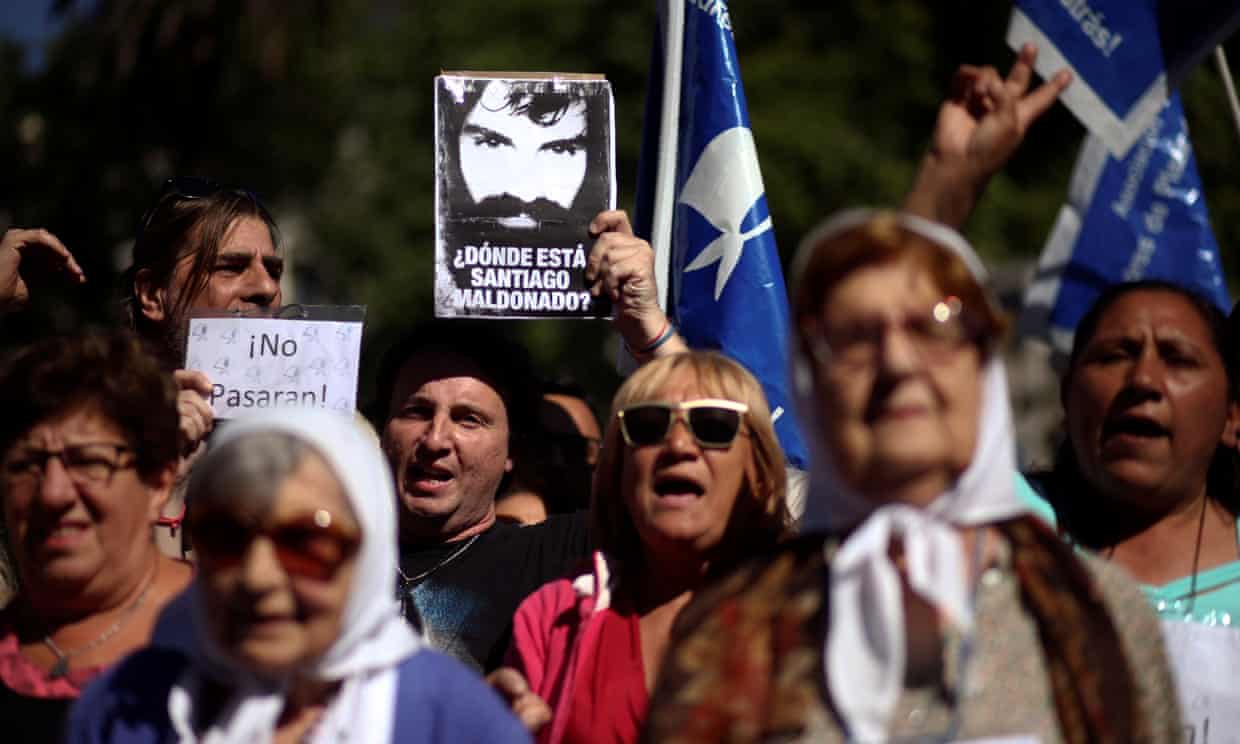
Maldonado disappeared in August during a protest for indigenous rights when the federal police force was called in to put down the rally. According to a witness, Maldonado was knocked unconscious by security forces and put into a car.
The remains were found about 1,500 meters from the community guard of the Indigenous Mapuche community in Pu Lof. The body was on the riverbed of the Chubut River.
An expert hired by Maldonado’s family reported that the clothing on the body matches the description found of Maldonado’s clothes from the day of his disappearance. Also, he claims to have found a document in one of the pockets with his name on it. Regardless, his family is not convinced and distrusts the government. They are staying by his body in anticipation of DNA identification. The autopsy will be carried out on Friday in Argentina’s capital.
However, many question this discovery. That area of the river had previously been checked by authorities three separate times, and they have no explanation as to why they found it on the fourth dredging of the river. Maldonado’s lawyer, Veronica Heredia, remarked “we do not understand … we have no physical or legal explanation of why that body was found yesterday.”
Additionally, several other circumstances have raised suspicions that the body was planted. The remains were found only 300 meters from where the protest occurred, and his family questions how Maldonado could have been found upstream from where he went missing.
On top of that, it was recovered only days before Argentina’s legislative election on Sunday. Major parties running in the mid-term congressional election suspended their campaigns as a result. There is tension and disagreement over who actually harmed Maldonado and which party’s campaign will suffer more. As a result of the discovery, an emergency survey revealed that 12% of voters have decided to change their vote.
As a known activist for the Mapuche people, Maldonado spoke out against the Italian fashion giant, Benetton. The company owns 2.2 million acres of land which the indigenous people claims as part of their ancestral land. There have been numerous protests over the forcible eviction of community members from their homes.
Maldonado’s disappearance is a grim reminder of the 1976-1983 dictatorship that ruled Argentina. During that time, around 30,000 young activists vanished after being taken into custody by security forces.
For more information, please see:
Guardian – Body found in icy river could sway Argentina’s midterm elections – 19 October 2017
Herald Tribune – Argentines Wait To Learn If Body is That of Missing Activist – 19 October 2017
BBC News – BBC Minute: On Argentina’s missing activist – 19 October 2017
Telesur – Family of Missing Activist Santiago Maldonado: We Await Autopsy Results – 18 October 2017