US Government Sanctions Further Russian Human Rights Violators Under Magnitsky Act

9 January 2017 – The US Government has sanctioned further individuals in the Magnitsky case, including its most high-profile designation to date – Alexander Bastrykin, head of the Russian State Investigative Committee.
“The Magnitsky sanctions are the most effective tool available today for fighting the impunity of corrupt officials in Russia. Today’s release of the new names includes the highest level government official to date, Alexander Bastrykin. In addition to the role he played in the Magnitsky case, he has been responsible for many other shocking human rights abuse cases. His inclusion on this list is a major victory in our fight for justice in Russia,” said William Browder, leader of global Magnitsky justice campaign.

Alexander Bastrykin, in his capacity as head of the Investigative Committee, personally oversaw the investigations into the false arrest, torture and death in Russian police custody of Sergei Magnitsky who had uncovered the US$230 million theft by Russian officials.

In spite of the conclusions of the Russian President’s Human Rights Council on the wrongful arrest of Sergei Magnitsky and the conflict of interest of implicated officials, the Bastrykin-led Investigative Committee closed the death investigation, finding no crime was committed by any Russian officials.

Bastrykin directed and publicly justified the exoneration of all officials involved. In his interview to the Russian state newspaper, Rossiiskaya Gazeta, on 7 September 2010, Alexander Bastrykin said:

“There is no ground to think that his [Magnitsky’s] death was connected to actions of officials who prosecuted him. There is no objective information showing that he was prosecuted illegally or that the physical and psychological pressure was applied to him.”
Another sanctioned official under today’s designations is Stanislav Gordievsky from the Russian Investigative Committee, to whom Sergei Magnitsky gave testimony on 5 June 2008 and 7 October 2008 identifying the officials and organised criminals involved in the theft of companies and the US$230 million of tax monies from the Russian government.

The names in Magnitsky’s testimony included Lt Col Artem Kuznetsov, Major Pavel Karpov, lawyers working for the criminal group Andrei Pavlov and Yulia Mairova and others. Instead of properly investigating the fraud and bringing the officials exposed by Magnitsky to justice, investigator Gordievsky requested one of the main named suspects – Lt Col Kuznetsov – to investigate himself – and then Gordievsky exonerated Kuznetsov from any wrong-doing.

In the subsequent testimony of 14 October 2009 from pre-trial detention, Sergei Magnitsky described this cover up in great detail:

“The same authorized operative Kuznetsov …provided the operational assistance on the case …initiated by the Investigative Committee… on the subject of the theft of the companies. In addition, he was providing operational assistance on the criminal case under which I was accused. I believe that the criminal prosecution against me is the above person’s revenge against me, because during my meetings with investigator S.E. Gordievsky… I …expressed my opinion that Kuznetsov …. should be interrogated about the circumstances of stealing…., instead of being allowed to perform operational assistance on the case investigated by S.E. Gordievsky.”

A third individual included today in the US Government’s Magnitsky list is Gennady Plaksin. Gennady Plaksin was a member of the Klyuev Organised Crime Group, and chairman of the board and nominal shareholder of Universal Savings Bank on behalf of Dmitry Klyuev, who is already subject to Magnitsky sanctions. Mr Plaksin appeared as a nominal claimant in a collusive court case orchestrated by the criminal group to steal US$230 million from the Russian government. Plaksin was involved in the creation of US$325 million of fictitious liabilities. Despite the evidence of his role in the US$230 million theft uncovered by Sergei Magnitsky, Mr Plaksin was exonerated in Russia.

The US$230 million fraud was a sophisticated criminal conspiracy perpetrated in Russia to steal US$230 million of taxes paid by the three Russian companies of the Hermitage Fund, at the time the largest portfolio investor in Russia. The planning of the fraud scheme took place abroad, and money laundering of a substantial portion of the US$230 million fraud proceeds also took place outside of Russia and involved multiple international banks and accounts.

Hermitage’s outside lawyer Sergei Magnitsky uncovered the US$230 million fraud scheme and testified against those involved, including Andrei Pavlov.

Shortly thereafter, the Russian authorities arrested Sergei Magnitsky, and tried to force him to change his testimony subjecting him to cruel and degrading treatment during 358 days in pre-trial detention. When their attempts failed, Sergei Magnitsky was killed in Russian police detention at the age of 37, leaving a wife and two children.

The events of the Magnitsky case are described in the New-York Times best-seller “Red Notice” by William Browder and in a series of Magnitsky justice campaign videos on Youtube channel “Russian Untouchables.”

For more information, please contact:

Justice for Sergei Magnitsky

+44 207 440 1777

e-mail: info@lawandorderinrussia.org

www.lawandorderinrussia.org

billbrowder.com

twitter.com/Billbrowder

Catalan Leader Promises Independence Referendum in 2017

By Sarah Lafen

Impunity Watch Desk Reporter, Europe

MADRID, Spain — In a televised New Year’s speech, Catalan President Carles Puigdemont promised that the region of Catalan will hold a “legal and binding” independence referendum vote by September 2017.  Puigdemont emphasized that “Catalans will freely decide” their own future.”  Catalonian government officials maintain that they will hold the referendum with or without consent from the Spanish central government, however they would prefer the vote to be consensual.

Catalan President Carles Puigdemont announces the 2017 independence referendum (Photo Courtesy of The Local ES)


Puigdemont’s announcement was ratified via a resolution voted on by the majority-separatist regional parliament of Catalan.  The Spanish Constitutional Court, however, has since suspended the resolution pending a five-month time period in which it will decide whether to ban the vote for good.  Puigdemont assured listeners that the referendum would be made “in accordance with the mandate of [Spanish] laws,” however it remains unclear how this will be accomplished if court bans the referendum.

In his own press conference, Spanish Prime Minister Mariano Rajoy ruled out the possibility of a Catalonian referendum.  Rajoy recently commented that “[i]t is not possible to hold a referendum that will do away with national sovereignty and the equality of Spaniards.”  Instead, Rajoy maintains his platform of keeping an open line of communication between Catalan and the rest of Spain – a measure which he believes is much more “reasonable” than the alternative referendum.

After both Puigdemont’s and Rajoy’s speeches, Catalan separatists participated in a peaceful rally on Friday in Palma to show their support for the independence referendum.  Protestors carried different versions of the Catalan flag, with mottos such as “The Catalan Countries” and “One village, one fight, one future” written on them.

The Spanish government has offered to compromise and negotiate a list of economic and social demands with Puigdemont, however it refuses to discuss the proposed referendum.  Catalan held a symbolic independence vote in 2014 after the Spanish government legally prevented a formal vote from occurring.  The symbolic vote went unrecognized by Spain.  Many senior ranking political officials participated in the symbolic vote, and have since faced sanctions for participating in separatist measures which were deemed illegal by Spain’s central government.

Despite this announcement by Puigdemont, a recent poll showed that support for Catalan’s secession from Spain has decreased over the past six months amongst Catalonians.  The number of Catalans who oppose secession stood at 46.8% in December, which is an increase from the 45.1% in November, and the 42.4% in June.


For more information, please see:

BBC — Catalonia Leader Vows 2017 Referendum on Spain Independence — 31 December 2016

DW — Catalan Chief Pledges ‘Binding’ Independence Referendum in 2017 — 31 December 2016

The Local ES — Catalan President Pledges Referendum in New Year Address — 31 December 2016

PressTV — 100s Rally in Support of Catalonia’s Secession from Spain — 31 December 2016

Reuters — Catalan Independence Referendum ‘Not Possible’ – Spanish PM — 30 December 2016

Israeli Soldier Who Fatally Shot Injured Palestinian Convicted of Manslaughter

by Yesim Usluca
Impunity Watch Reporter, Middle East

JERUSALEM, Israel — An Israeli soldier was convicted of manslaughter on January 4th after he fatally shot an unarmed, wounded Palestinian attacker laying on the ground. The trial, which lasted for several months, was one of the most divisive in Israel’s history.

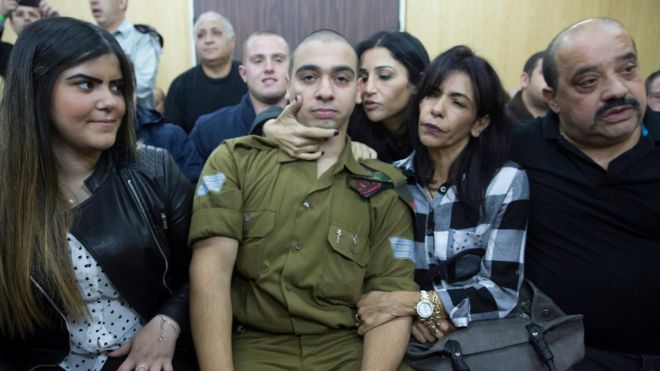
Sgt. Elor Azaria was convicted of manslaughter after fatally shooting an immobilized Palestinian soldier in the head (Photo courtesy of BBC News)

The Israeli soldier, Sgt. Elor Azaria, was caught on video shooting the 21-year-old Palestinian, Mr. Abdul Fattah Shariff, as he was lying on a road. The incident occurred at a military checkpoint, where Mr. Shariff and a “companion,” Mr. Ramzi al-Qasrawi, attacked the Israeli troops with knives, injuring one Israeli soldier. The Israeli troops retaliated by shooting both individuals, upon which Mr. al-Qasrawi was killed, and Mr. Shariff was injured. In the recording, Sgt. Azaria is then seen calmly walking up to Mr. Shariff’s motionless body and shooting him in the head.

During the trial at a military court, the prosecution argued that Sgt. Azaria was in full control of his actions when he shot Mr. Shariff, and that he was acting in retaliation for the stabbed Israeli soldier. Sgt. Azaria’s lawyers, however, argued for self-defense, stating that he feared Mr. Shariff could have detonated a concealed suicide vest.

The trial for Sgt. Azaria was presided over by a three-judge panel, which delivered its verdict in two-and-a-half hours, holding that he had “needlessly” shot Mr. Shariff in the head. The panel held that Mr. Shariff had been subdued after the knife attack, and did not pose a threat at the time he was fatally shot. The court indicated that Sgt. Azaria had stated “he deserves to die” immediately after shooting Mr. Shariff. While delivering the verdict, the court stated “the fact that the man on the ground was a terrorist does not justify a disproportionate response.” It further indicated that “one cannot use this type of force, even if we’re talking about an enemy’s life.”

Sgt. Azaria’s trial has created a sharp divide within Israel. A member of the prosecution, Lt. Col. Nadav Weissman, stated that despite the favorable ruling, “there were no grounds for celebration.” He added that the “offense was severe,” and the ruling was “important, clear, [and] decisive.” On the other hand, while the verdict was being read, hundreds of Israelis protested outside the military court, demanding Sgt. Azaria to be released. Furthermore, others believe Sgt. Azaria is innocent of any crime, and sympathize with Israeli soldiers because of the mandatory military service for the Jewish majority.

While Sgt. Azaria’s family condemned the verdict, Israeli officials urged the public to remain calm following the verdict. Ms. Sharon Gal, the media adviser for Sgt. Azaria and his family, stated that the court did not “give any weight to the evidence.” She further indicated that the court ignored the “fact that this was the area of an attack,” and treated Sgt. Azaria’s act as if he had “picked up the knife from the ground and stabbed it in the back of all the soldiers.” Mr. Avigdor Lieberman, the Israeli Defense Minister, however, stated that everyone must “honor the court’s decision and [] show restraint.”

Furthermore, Human Rights Watch had issued a report on January 2nd, in which it claimed that “some senior Israeli officials have been encouraging Israeli soldiers and police to kill Palestinians they suspect of attacking Israelis even when they are no longer a threat.”

Sentencing for Sgt. Azaria will be held at a later date. Israeli law provides for a maximum prison sentence of 20 years for individuals convicted of manslaughter. However, it is anticipated that Sgt. Azaria will be sentenced to a shorter term.

For more information, please see:

USA Today—Court convicts Israeli soldier who killed wounded Palestinian attacker—4 January 2017

The Wall Street Journal—Israeli Soldier Convicted in Death of Palestinian Attacker—4 January 2017

BBC News—Israeli soldier Elor Azaria convicted over Hebron death—4 January 2017

Huffington Post—Israeli Soldier Convicted Of Manslaughter In Killing Of Immobile Palestinian Assailant—4 January 2017

178 Breaches in the First Week of the Ankara Ceasefire Agreement

11 Individuals at least Killed in the First Week of the Ceasefire Agreement including Two Children and a Fetus

SNHR has published its fifth report monitoring the breaches of Ankara Ceasefire Agreement in Syria. The report documents the breaches that were recorded in one week since the Agreement went into effect. The report says that 11 individuals, including one woman, two children, and one fetus, have been killed since 30 December 2016; most of them were killed by the Syrian regime forces.
The report draws upon the monitoring and documentation processes in addition to speaking to survivors, victims’ families, or with eyewitnesses to some of the incidents.

The report sheds light on every breach committed by the parties that are bound by the truce agreement (Government forces, Russian forces, and armed opposition factions) in areas under the control of armed opposition factions and areas under a joint control (armed opposition factions and Fateh Al Sham Front). The report doesn’t include any combat operations in ISIS-held areas.

The report says that on Monday 2 January 2017, armed opposition factions that agreed to the ceasefire agreement released a statement in which they announced that they will suspend any talks regarding the ceasefire agreement in response to the breaches that were committed by the Syrian regime forces and its ally the Iranian regime.

The report monitors 178 breaches including 169 breaches through combat operations in addition to nine through arrest operations. 160 breaches, out of the 178, were committed by Syrian regime forces. Most of the breaches took place in Hama governorate where 55 breaches were documented, followed by Homs with 30 breaches, Aleppo and Daraa with 19 breaches, and then Idlib with 14 breaches. Additionally, the report records 14 breaches by Russian forces including six in Aleppo, whereas three breaches were committed in Hama and five breaches were committed in Idlib by Russian forces to a total of 14.

Furthermore, the report says that four breaches by armed opposition factions were documented in Aleppo and Hama governorates.
The report stresses that most of the breaches documented up until now were committed by the Syrian regime and its ally on the ground the Iranian regime, which the report considers to be the most affected by any political agreement that aim towards a comprehensive settlement. Furthermore, the report calls on the Russian regime, being a primary sponsor of the agreement, to apply pressure on the Syrian-Iranian regime in order to compel it seriously commit to the agreement’s provisions. Otherwise, the ceasefire will ultimately fail.

Also, the report emphasizes that Russian forces have to adhere to the agreement, and cease bombing civilians because any other breaches by the Russian forces, who should supposedly oversee the implementation of the agreement, will demolish the credibility of any future Russian sponsorship.
Lastly, the report calls on the Turkish government, seeing that it is the other party sponsoring the Agreement, to follow-up with the breaches committed by armed opposition factions, and insure that they won’t reoccur in order to preserve the success of the truce.

This article was originally posted on Syrian Network for Human Rights’ website and the full report can be read here.

U.N. Officials Fear South Sudan is on the Brink of Genocide

By Samantha Netzband 

Impunity Watch, Africa Desk Reporter 

JUBA, South Sudan– Officials at the United Nations are growing concerned that the situation in South Sudan could possibly turn into a genocide.  This conclusion comes as the newest country in the world has experienced increased violence since its creation.  Two years of violence has left about 50,000 people dead.

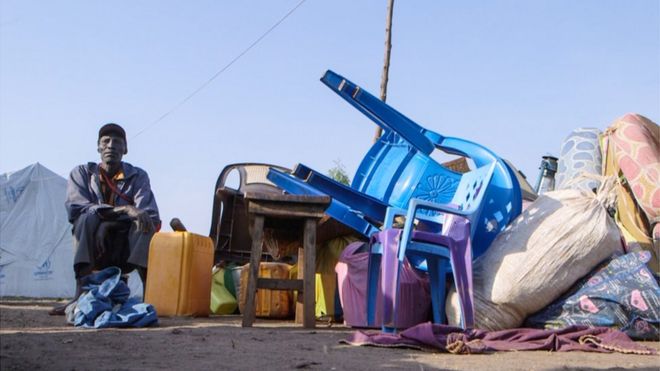
A refugee sits waiting at a reception centre in a Uganda settlement

A refugee sits in a camp in Uganda, displaced from the conflict in South Sudan. (Photo Courtesy of BBC Africa)

Since South Sudan was created the country has seen widespread violence.  Although violence has been present for two years things have picked up since July when aid workers were killed in the capital in Juba and violence increased in the capital city.  The conflict in South Sudan is the result of a rift between President Salva Kiir and Riek Machar and other oppositition groups.

For more information, please see: 

BBC Africa – South Sudan refugee crisis: The wooden bridge between death and safety – 16 December 2016

Newsy – How Genocide In South Sudan Could Be Prevented – 21 December 2016

NPR – U.N. Worries South Sudan Is On the Brink of Genocide – 21 December 2016

Radio Tamazuj – Ban Ki-moon warns of imminent genocide in South Sudan – 21 December 2016