Poland to Consider Proposed Law Criminalizing Abortions

By Sarah Lafen

Impunity Watch Desk Reporter, Europe

WARSAW, Poland — Polish legislators have proposed a law which would criminalize abortions. If passed, the law would apply to both women seeking abortions as well as doctors and other medical staff who are involved in the performance of the procedures.  These parties would be subject to jail time between three months and five years for causing “the death of a conceived child.”  The proposed legislature was drawn up by a rightwing think-tank, with the support of the Catholic Church and the Law and Justice governing party.
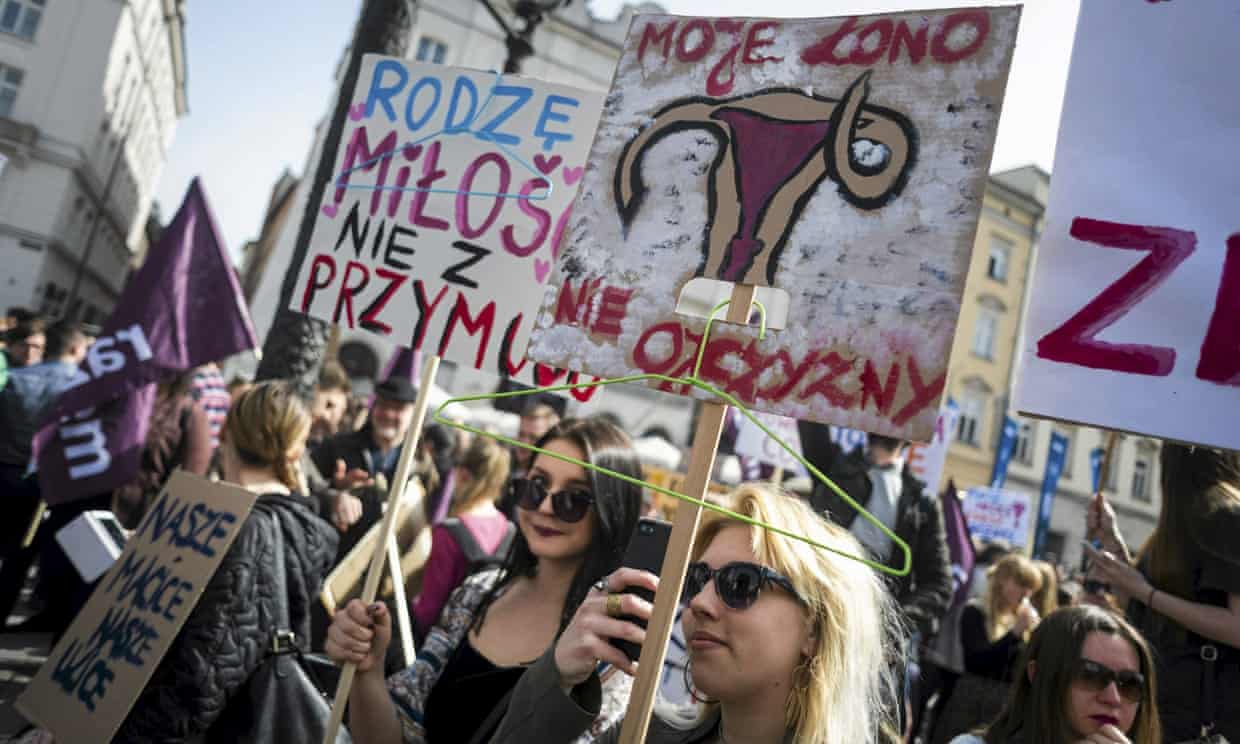
Women in Kraków , Austria in April protested proposed anti-abortion legislation set to be considered in Poland (Photo Courtesy of The Guardian)

Current abortion laws in Poland permit abortion only in the cases of rape, when the fetus is diagnosed with a severe or irreversible disability or an incurable illness which is threatening its life, or if the woman’s life is in danger.  The new proposed law would permit abortions only when the mother’s life is in danger.

Protesters have staged demonstrations in opposition to this proposed legislation in cities across Europe.  Thousands of human rights activists gathered in Warsaw, Poland outside of the Polish parliament on Sunday, while another demonstration occurred outside of the Polish embassy in London, England.  Pro-abortion campaign called “Save Women” compiled approximately 215,000 signatures in opposition of the proposed legislature.  These protestors argue that if passed, this bill would encourage women to have “dangerous, back alley abortions.”

On the other side, the pro-life bill has collected approximately 450,000 signatures.  Mariusz Dzierżawski, head of Poland’s “Stop Abortion” committee, claims that 58% of Poles currently back the proposed legislature.  Dzierżawski says that the legislature is necessary because “about 1,000 unborn children are legally killed in Poland each year.”  In April, the Catholic Church voiced its support for the passing of the proposed legislature.  Polish bishops want the bill passed in order to “protect every person’s life from conception to natural death.”

Official studies estimate that less than 1,000 legal abortions are performed each year in Poland as it is – as doctors are scared of suffering the repercussions of performing the procedure.  However, other independent research groups have estimated that 80,000-190,000 women undergo the procedure annually in Poland, whether through the “back alley” methods, or by traveling abroad.

Polish legislators are set to consider the bill on Wednesday.


For more information, please see:

Life News — Poland Proposes New Law Banning All Abortions and Protecting Unborn Children — 19 September 2016

New Europe — Poland Tables New Bill to Criminalize Abortion — 19 September 2016

The Guardian — Thousands Protest Against Proposed Stricter Abortion Law in Poland — 18 September 2016

Motto — This Polish Law Would Imprison Women Who Have Abortions — 16 September 2016
South Sudan to take Legal Action after Corruption Report

By Samantha Netzband

Impunity Watch Reporter, Africa

JUBA, South Sudan–The South Sudanese government is planning on taking legal action against the Sultry group after the publication of what they believe is an incorrect corruption report.  The Sultry group was founded by American actor George Clooney and activist John Prendergast.  The group was also a key player in gaining South Sudan’s independence.

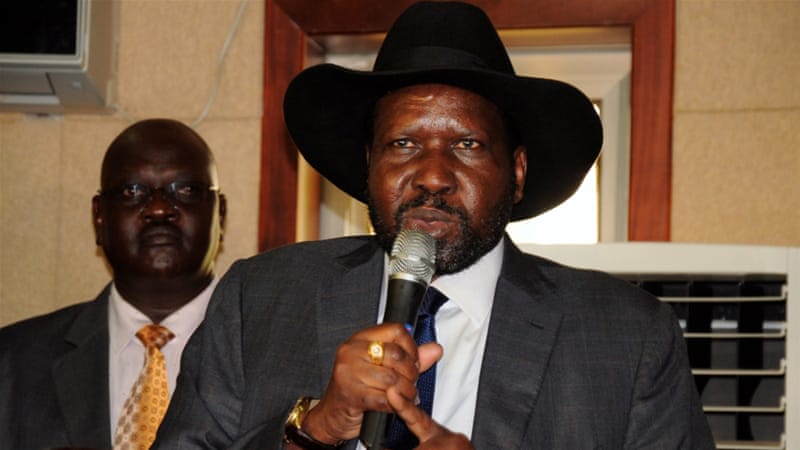
President Kiir seen giving a speech. (Photo Courtesy of Aljazeera)

The report, which was published by the Nation Mirror, alleges that President Kiir and opposition leader Riek Machar amassed wealth throughout the time of the Sudanese conflict.  This wealth includes luxury cars, foreign properties, and stakes in oil and business ventures.  Both President Kiir and Riek Machar’s spokespeople have said that these allegations are “rubbish”.  This then lead to the closing of the Nation Mirror and the pursuance of a lawsuit.

There are already calls to reopen the Nation Mirror, the newspaper that published the report.  Given the lack of independent and critical newspapers in the region those in the media in South Sudan would like to see the newspaper reopened.

Those who belief the report are suggesting that the United States threaten sanctions until reform is made.  This stems from the fact that George Clooney, the partner in the Sentry group, is an American actor.  Countries on the outside looking in are taking these allegations seriously considering war profiteering is a serious crime, and the conflict in South Sudan has displaced a million people.

For more information, please see:

Africa News – South Sudan urged to reopen newspaper that published corruption report – 16 September 2016

Al Jazeera – South Sudan to take legal action after corruption report – 13 September 2016

CNBC Africa – South Sudan: Actor George Clooney against the Kleptocrats – 17 September 2016

Fox News – South Sudan challenges US watchdog’s report on corruption – 17 September 2016

Global Centre for the Responsibility to Protect: Atrocity Alert: Syria and South Sudan

Atrocity Alert, No. 21

Atrocity Alert is a weekly publication by the Global Centre for the Responsibility to Protect highlighting and updating situations where populations are at risk of, or are enduring, mass atrocity crimes.

Syria

On 6 September Syrian government forces were accused of dropping barrel bombs filled with chlorine gas on the Al-Sukari neighborhood in eastern Aleppo. These accusations come one week after the UN Security Council met to discuss the report of the UN-Organization for the Prohibition of Chemical Weapons (OPCW) Joint Investigation Mechanism (JIM) on responsibility for chemical weapons use in Syria, and less than a month since at least three people were killed during a reported chlorine attack on the opposition-held Zubdiya neighborhood of Aleppo on 10 August. It was reported that at least 70 people were injured during Tuesday’s attack, including women and children. The recent JIM report concluded that Syrian government forces had carried out at least two chemical weapons attacks since 2013. The use of chemical weapons constitutes a war crime and is in clear contravention of Security Council Resolution 2118, which threatened possible Chapter VII measures in the event of non-compliance.

The latest report of the Human Rights Council-mandated Commission of Inquiry (CoI) on Syria was published on 6 September. The CoI condemns the increase in indiscriminate attacks on civilians and medical facilities following the breakdown of February’s cessation of hostilities and asserts that “without a return to the peace process, the Syrian conflict, and the violations and abuses it has nourished, will continue.”

South Sudan

Following renewed fighting in Juba during July and the UN Security Council’s authorization of the deployment of a Regional Protection Force (RPF), South Sudan is at a critical juncture for the prevention of further mass atrocity crimes. The UN Security Council visited South Sudan from 2 to 5 September to discuss with government officials, UN representatives and civil society how to improve the security and humanitarian situation across the country. The Transitional Government of National Unity and UN Security Council members issued a Joint Communique on 4 September in which the government consented to the deployment of the RPF as part of the UN Mission in South Sudan (UNMISS). UN Security Council Resolution 2304 threatened an arms embargo on South Sudan if the government impeded the deployment of the RPF. Ensuring UNMISS’ free movement and establishing the Hybrid Court for South Sudan, in cooperation with the African Union, are other essential commitments that the Transitional Government of National Unity should uphold in order to prevent further atrocities.

Connect With Us

Syria Justice and Accountability Centre: Justice for Victims and the War on Terror

SJAC Update | Sept 7, 2016
Camp Delta, Guantanamo Bay detention camp. Photo from Wikipedia

Justice for Victims and the War on Terror

Since September 11, 2001, terrorism and the resulting War on Terror has dominated the headlines and preoccupied global national security efforts. Nowhere has the effects of terrorism been felt more acutely than in the Middle East, and the response from governments in the region has often been erratic and heavy handed. Iraq is a case in point. On August 21, the Iraqi government executed 36 men following a conviction last year by Iraq’s central criminal court in Baghdad. The men were hanged for their involvement in a 2014 mass killing of around 1700 people claimed by the Islamic State of Iraq and al-Sham (ISIS).

Many human rights groups criticized the trial and subsequent hangings because the defendants did not have access to their lawyers and the evidence against them primarily relied on confessions made under duress and the accusations of secret informants. Because the executions took place in the wake of international criticism that Iraq has been too soft on ISIS, the trial’s brevity and lack of due process made the executions seem more akin to vengeance killings than justice. It was also a missed opportunity to thoroughly air the grievances of Iraqi victims who have suffered immensely as a result of ISIS’s atrocities.

Even in Western democracies, individuals suspected of ties with terrorism are held and tried secretly under obscure national security laws. As we approach the fifteenth anniversary of 9/11, Khalid Sheikh Mohammed, the alleged mastermind behind the attacks, and his co-defendants are still awaiting trial by a military commission in Guantanamo Bay. Not only does this delay undermine the accused’s right to a speedy trial, but the victims of 9/11 and their families have grown frustrated at the lack of a judicial resolution. Both the US Congress and the Department of Defense fought to keep the trials out of civilian courts by claiming security concerns, but in civilian courts, basic human rights standards would have been upheld, the defendants would have been convicted years ago, and victims would have gotten much needed closure.

READ MORE
The Syria Justice and Accountability Centre (SJAC) is a Syrian-led and multilaterally supported nonprofit that envisions a Syria where people live in a state defined by justice, respect for human rights, and rule of law. SJAC collects, analyzes, and preserves human rights law violations by all parties in the conflict — creating a central repository to strengthen accountability and support transitional justice and peace-building efforts. SJAC also conducts research to better understand Syrian opinions and perspectives, provides expertise and resources, conducts awareness-raising activities, and contributes to the development of locally appropriate transitional justice and accountability mechanisms. Contact us at info@syriaaccountability.org.