Voters in Uruguay to Decide Whether to Hold Referendum on Repealing Abortion Law

By Ellis Cortez
Impunity Watch Reporter, South America

MONTEVIDEO, Uruguay – Voters in Uruguay are deciding whether to hold a referendum to repeal its national abortion law.

Uruguay_Abortion.jpg
Pro-abortion activists demonstrate in front of the Uruguayan Congress in Montevideo, Uruguay. (Photo courtesy of AP)

If 25 percent of Uruguay’s electorate votes on June 23rd, officials would have 120 days to set a date for a binding referendum on whether to uphold or repeal the abortion law.

Independent groups as well as some members of Uruguay’s right-wing Colorado Party and the centrist National Party are leading the effort to overturn the measure, which authorized elective abortions in the first three months of pregnancy.

The Uruguay law permits abortions, but requires that women seeking abortions justify their request before a panel of at least three professionals — a gynecologist, psychologist and social worker — and listen to advice about alternatives including adoption and support services for a child. Women must then wait five days before receiving confirmation on whether they can go ahead with the procedure or not.

The ruling Broad Front coalition of President Jose Mujica argued that the law would save many women from the risk of death or complications from illegal abortions.

“I want to defend the law because this issue has been debated for almost 100 years and many women paid with their lives … during that long time that it was being discussed,” lawmaker Monica Xavier said on the Broad Front’s website.

However, opposition to the measure remains strong, and some doctors have refused to perform abortions for religious or ethical reasons.

“This is not an issue that only pertains to women,” said National Party congressman Pablo Abdala. “We can’t forget about the conceived (baby) … with organs, DNA, a heart. And then there’s the father. This law doesn’t take into account the opinion of the father.”

“About 400 abortions a month have been conducted since the new law came into force,” said Deputy Health Minister Leonel Briozzo.

It’s uncertain how many abortions were carried out before the law. “We don’t have trusted statistics because it is a social practice that is not accepted and up until recently it was a crime,” Constanza Moreira, a ruling-party lawmaker, told local radio.

Passage of the law was widely seen as a landmark for a region in which many countries outlaw abortion in all circumstances. Cuba is the only other country in the region where women have access to first-trimester abortions. Colombia allows abortion when there is proof of fetal malformation. Mexico City has legalized first-trimester abortions, but there are restrictions in most other parts of the country.

For more information please see:

El Mundo Uruguay decide si lleva la ley del aborto a las urnas 23 June 2013

Fox News Latino Uruguay Votes To Decide Whether or Not To Repeal Abortion Law 23 June 2013

The New York Times – Uruguayans Decide if Abortion Goes to Referendum  23 June 2013

The Washington PostUruguayans decide whether to hold referendum on repealing abortion law 23 June 2013

UN Report Accuses Israeli Forces of Using Palestinian Children as Human Shields

By Kathryn Maureen Ryan
Impunity Watch, Middle East

A report assembled by the United Nations Committee in the Rights of the Child accused Israeli military forces of abuses against Palestinian children that include torture, sexual assault, threats of death and solitary confinement in Israeli persons. In the report the committee voiced its “deepest concern about the reported practice of torture and ill-treatment of Palestinian children arrested, prosecuted and detained by the military and the police.”

UN report finds abuse of Palestinian children by Israeli forces. (Photo courtesy of Aljazeera)

The Committee’s report claims that Israeli soldiers have “used Palestinian children to enter potentially dangerous buildings ahead of them and to stand in front of military vehicles in order to stop the throwing of stones against those vehicles.” The report cited evidence offered by the United Nations’ Special Rapporteur on the Promotion and Protection of Human Rights and Fundamental Freedoms while Countering Terrorism to back its claim.

According to the report Palestinian youth are arrested regularly during night raids with the children often having their hands tied behind their backs before being transferred to detention centers without their parents being informed of their arrest.

The report goes on to say that an estimated 7,000 children aged from 12 to 17 years and even as young as 9 years old, have been arrested, interrogated and detained in Israeli prisons since 2002. Most of the arrested children were arrested after being accused of throwing stones at Israeli forces or settlers, an offense which can carry a 20-year penalty.

The Israeli government has denied the allegations made by the UN Committee in its report. Aaron Sagui the spokesman for the Israeli Embassy in Washington DC claimed that the report “is based on the recycling of old accusations, based on political biases – and not based on direct investigation on the ground – with the intention of bashing Israel.” Sagui went on to claim that the goal of the report was not to address legitimate concerns faced by Palestinian children but only to make headlines.

The Committee on the rights of the child expressed its “deepest concern that children on both sides of the conflict continue to be killed and injured,” and acknowledges the severity of Israel’s national security challenges, however it contends that Palestinians suffer a disproportionate amount of victimization as the result of what it calls Israel’s “illegal long-lasting occupation of Palestinian territory.” The committee believes that the plight of children on both sides of the conflict must be addressed for true peace to develop between Israel and Palestine.

For further information, please see:

CBS News – UN Report Accuses Israeli Forces of Using Palestinian Children as Human shields, Abusing Children in Custody – 21 June 2013

The Telegraph – Israel Furious at UN Report Detailing Torture of Palestinian Children – 21 June 2013

Aljazeera – Palestinian Authority PM Offers Resignation – 20 June 2013

Aljazeera – UN: Israeli Forces Abuse Palestinian Children – 20 June 2013

United Nations Office at Geneva (UNOG) Committee on the Rights of the Child – Committee on the Rights of the Child Issues Concluding Observations – 20 June 2013

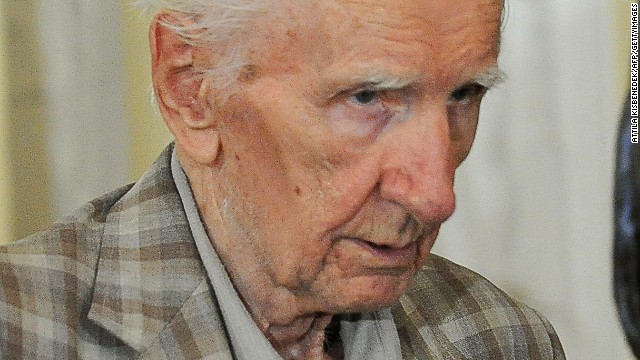
Accused Hungarian Nazi War Criminal Awaits a Trial That May Never Come

By Ben Kopp
Impunity Watch Reporter, Europe

Hungarian prosecutors have charged Laszlo Csatary with war crimes, including the deportation of Jewish people to Auschwitz in WWII. Authorities state that the 98-year-old man tops the Nazi-hunting Simon Wiesenthal Center’s wanted list.

Laszlo Csatary has been placed on house arrest since July 2012, as he awaits trial for war crimes during WWII. (Photo courtesy of CNN International)

Nevertheless, some criticize the Hungarian authorities for refusing to extradite Csatary to Slovakia, where a court sentenced him to death in 1948.

In 1944, Csatary commanded the Kosice internment camp, where authorities claim that he beat and whipped approximately 12,000 Jews before sending them to Auschwitz for execution. Additionally, before sending Jews to Auschwitz in a cramped railcar, he refused to allow other officers and soldiers to drill ventilation holes in the railcars’ walls. Following the Second World War, Slovakia sentenced Csatary to death for his involvement in the genocide. However, the Slovak court order was made in abstentia because Csatary had already fled to Canada.

Csatary obtained Canadian citizenship in 1955 by telling authorities that he was a Yugoslav national. Until authorities discovered his lie, Csatary worked as an art dealer in Montreal. In 1997, authorities deported him to his native Hungary.

Until recently, Csatary lived undisturbed in Budapest. Only after a Jewish organization that specializes in bringing suspected Nazi war criminals to justice, the Simon Wiesenthal Centre alerted Hungarian authorities did prosecutors charge Csatary.

The prosecution released a statement that “Csatary willfully assisted in the unlawful execution and torture of the Jews deported from Kosice to concentration camps in territories occupied by the Germans.”

The case of accused Nazi war criminal Sandor Kepiro appears to be precedent for Csatary. In July 2011, Hungary acquitted Kepiro, who admitted his involvement with raids and denied knowledge that such raids involved the massacre of about 400 Jews and 800 Serbs. In a hospital two months later, Kepiro died while prosecutors appealed the decision.

Since July 2012, Csatary has been returned to house arrest in Budapest.

Efraim Zuroff, head of the Wiesenthal Centre’s Jerusalem office, plans to attend the trial in three months. “We welcome the indictment and call upon authorities to expedite the trial in light of the defendant’s advanced age,” Zuroff said. “This is a very strong reminder of the importance of achieving justice even many years after the crimes were committed.”

Lucia Kollarova, a spokeswoman for the Federation of Jewish Communities in Bratislava, the capital of Slovakia stated that “We would prefer the war criminal Laszlo Csatary to be extradited to Slovakia. We don’t believe that given his age there is a realistic chance [he would be imprisoned in Hungary].”

Nevertheless, Slovakia has not requested extradition in light of the pending trial.

Weighed against the imminence of death from advanced age, the decision to conduct thorough trials against war criminals in the name of justice will only become more difficult unless we can decide whether any such criminals have suffered since.

For further information, please see:

The Jerusalem Post – Hungary Criticized for Not Extraditing War Criminal – 20 June 2013

Times of Israel – Already-Condemned Nazi Faces New Trial in Hungary – 20 June 2013

The Windsor Star – Hungary Accuses Ex-Canadian Citizen, 98, of Nazi-Era War Crimes – 19 June 2013

CNN International – Hungarian Prosecutors Charge Man with Nazi War Crimes – 18 June 2013

The Independent – Hungary Charges Nazi Police Chief Suspect Laszlo Csatary with War Crimes – 18 June 2013

Reuters – Hungarian Man, 98, Charged with World War II Crimes: Prosecutors – 18 June 2013

Kuwait To Hold Parliamentary Snap Elections on July 25

By Thomas Murphy
Impunity Watch Reporter, Middle East

KUWAIT CITY, Kuwait – Kuwait is preparing for its sixth round of parliamentary elections in seven years after the Constitutional Court ruled that the parliament’s election in December was unconstitutional based on procedural grounds. The cabinet held an emergency meeting after the country’s top court announced its decision.

Protesters filled the streets after the Constitutional Court upheld changes to the parliamentary voting process. (Photo Courtesy of Reuters)

“At an extraordinary meeting . . . the cabinet approved a draft decree setting July 25th as the date for parliamentary elections,” Cabinet Minister Sheikh Mohammad al-Mubarak al-Sabah told Kuwait’s state-run Kuna news agency on Thursday.

Emir Sheikh Sabah al-Ahmed al-Jaber al-Sabah is expected to officially announce the decree as he has final say in all state matters. The emir also appoints the prime minister, who in turn has the authority to appoint cabinet members, many of whom are members of Al-Sabah family.

The decree will pit the emir and the Western-backed government against the opposition which includes the Popular Action Bloc, and other liberal and Islamist parties. Although political parties are illegal in Kuwait, the constitution does not prohibit them.

The court ruled the December parliamentary results invalid after a total boycott of the elections by the opposition parties. The opposition parties opposed a controversial new law, which forced voters to choose only one candidate. Voters were previously allowed choose four candidates.

The court upheld the controversial new law, which resulted in protesters flooding the streets of Kuwait City. The opposition parties believe that the new law makes it easier for the government to interfere with elections results and promotes the interests of the ruling party.

Kuwait provides its people more political freedom than most gulf states despite the emir’s ultimate authority. The people have the power to elect the parliament which creates laws and can hold government officials accountable.

The snap election will continue a line of political turmoil that has lasted since 2006. The turn over and lack of consistency in government has resulted in the delay of important economic reform and infrastructure  development in the oil-rich gulf state.

For further information, please see:

ABC – Kuwait Schedules July 25 Parliamentary Election – 20 June 2013

Al Jazeera – Kuwait sets date for elections – 20 June 2013

BBC  – Kuwait cabinet calls snap election on July 25 – 20 June 2013

Kuwait News Agency – Cabinet calls for new elections July 25, 2013 – 20 June 2013

Reuters – Kuwait to hold snap parliamentary election on July 25 – 20 June 2013


Open Letter to President Obama Reignites Interest in Closing Guantanamo

By Michael Yoakum
Impunity Watch Reporter, North America

HAVANA, Cuba – Negative press continues to mount for the Obama administration amidst details of the treatment of prisoners in Guantanamo Bay.  The Lancet medical journal published a letter signed by more than 150 doctors that called upon President Obama to use doctors that Guantanamo inmates could trust.

The US military has been force feeding protesting Guantanamo inmates for three months. (Photo courtesy of Al Jazeera)

The letter, published Wednesday, was a response by medical practitioners to new information that has come to light detailing the US military’s practice of force feeding prisoners.  The force feedings began three months ago when inmates began a hunger strike prompted by the implementation of tougher prison searches.

Ahmed Belbacha, an Algerian detainee, told BBC through his attorney that enduring the forced feedings “hurts a great deal.”  Belbacha was detained in 2001 and cleared to be released in 2007.  He remains in Guantanamo because Belbacha says he cannot return to Algeria and the US has been unable to find a country willing to accept him.

Belbacha states that he told the military doctors that force feeding him violated medical ethics but the doctors said they had no control in the matter.

The doctors who authored Lancet article said that detainees had “very good reason” not to trust the US military doctors because they must follow orders from their military superiors.  The doctors who signed the article offered a solution: allow them to travel to Guantanamo and treat the hunger-striking inmates.

The doctors’ request is likely in response to an open letter sent by 13 inmates to the UK-based newspaper, the Guardian, in May.  The letter begins “Dear Doctor, I do not wish to die, but I am prepared to run the risk . . .because I am protesting the fact that I have been locked up for more than a decade, without a trial, subjected to inhumane and degrading treatment and denied access to justice.”  The letter continues, “For this reason, I am respectfully requesting that independent medical professionals be allowed in to Guantanamo to treat me.”

President Obama campaigned in 2008 on a platform that promised to close Guantanamo.  Since the hunger strike began, President Obama has renewed efforts to permanently close Guantanamo but has been met with resistance from Congress.

For further information, please see:

BBC News – Guantanamo detainee describes ‘ordeal’ of force feeding – 19 June 2013

CNN – Doctors to Obama: Let us treat hunger-striking detainees at Guantanamo – 19 June 2013

Fox News – As hunger strike roils Guantanamo, ex-prisoner talks of his long protest and forced feeding – 15 June 2013

The Guardian – Guantánamo Bay prison detainees protest – open letter full text – 31 May 2013

Al Jazeera – Physician dismisses force-feeding concerns – 21 May 2013

Reuters – Analysis: In force-feeding detainees, Obama has courts on his side – 26 April 2013