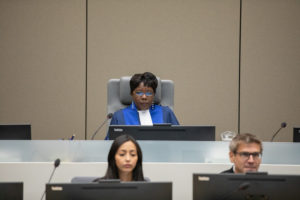
African Court Dismisses Unemployment Case Against Rwanda

By: Hannah Gabbard
Impunity Watch Reporter, Africa

ARUSHA, Tanzania – On May 11, 2018, the African Court of Human and Peoples’ Rights (AfCHPR) dismissed Chrysanthe Rutabingwa’s claim against the government of Rwanda as invalid.

Spectators at the African Court of Human and Peoples’ Rights. Photo Courtesy of AfCHPR on Twitter.

In 2001, Rutabingwa was fired from his position as an Audit and Evaluations Expert at the Ministry of Finance for allegedly disclosing confidential documents. Rutabingwa claimed that his dismissal was unfair and unconstitutional. In particular, Rutabingwa claimed that the Republic of Rwanda, for failing to solve Rutabingwa’s unemployment, violated his right to equality and equal protection, right to be heard, right of access to public services, right to work in equitable conditions and right to equal pay, and right to enjoy favorable work conditions.

Rutabingwa appealed to AfCHPR on November 10, 2014 against the Republic of Rwanda. He sought reimbursement of salaries dating back to 2001, government provided housing, reinstatement of public service employment, and $1,000,000 U.S. dollars for damages and humiliation.

In Rwanda, Rutabingwa filed in a court of first instance. Following their judgement, the High Court dismissed Rutabingwa’s claim. Rutabingwa never appealed to Rwanda’s highest court, the Supreme Court. AfCHPR dismissed Rutabingwa’s case for failing to exhaust local remedies in Rwanda before appealing to AfCHPR in Tanzania.

AfCHPR has ruled on four cases against the Rwandan government. As Rwanda’s withdrawal from the declaration that provides the court with jurisdiction took effect in 2017, AfCHPR can only proceed with cases filed prior to 2017.

For further information, please see:

African Union – Chrysanthe Rutabingwa vs. Republic of Rwanda Order – 11 May 2018

African Union – Chrysanthe Rutabingwa vs. Republic of Rwanda Judgement – 11 May 2018

The East African – Rwanda government wins longstanding court feud with sacked employee – 16 May 2018

EHCR Condemns Greece for Inhumane Treatment of Underage Migrants

By: Brianna Ferrante
Impunity Watch News, Europe

PARIS, France – The European Court of Human Rights (ECHR) has condemned Greece for their treatment of children refugees in a series of cases dating back as early as 2016.

Unaccompanied minors awaiting processing at detainment center in central Greece. Photo courtesy of Socrates Baltagiannis Photo

In its February 28th decision, the ECHR’s judgment ordered Greece to pay a total of €4,000 to each of nine migrants who were between the ages of 14 and 17 at the time of their detainment. Six of the individuals were from Syria, two were from Iraq, and one was from Morocco.

Investigation discovered the police and border cells that underage migrants and refugees were being held in post-arrival were entirely unsustainable and isolated living conditions, particularly for the period of time they were held there which ranged from 21 to 33 days.

Complainants alleged that while in this period of “protective custody,” they were subjected to overcrowding within cells, a lack of heating, adequate ventilation or lighting, poor food quality, no outside time, and having to sleep on the floor. There was additionally little to no medical care. The migrants were later transferred to the Diavata refugee camp, and later to separate special facilities for minors.

The ECHR determined that given the length of the holding period, the conditions were degrading and constituted unlawful detention.

In its judgment of this matter: H.A. and Others v. Greece, the ECHR unanimously held Greece liable for violations of: 1) Article 3 prohibition on inhumane or degrading treatment; 2) Article 13 ensuring a right to effective remedy for Article 3 violations; and 3) Articles 5 §§ 1 and 3 ensuring a right to liberty and security / a right to speedy decision on the lawfulness of a detention measure.

The complainants also sought remedy on allegations the Diavata camp was similarly uninhabitable. However, the Court concluded the living conditions at the camp had not exceeded the threshold of seriousness necessary for being actionable under Article 3.

The court gave significant deference to a statement from the National Service of Social Solidarity (“EKKA”), a European committee against the torture and detainment of unaccompanied minors. The statement was in regards for living conditions for minority aged refugees: “holding minors for several days or weeks without providing adequate psychological or social assistance was unacceptable and an actionable deprivation of liberty protected under Article 5 § 1.

In rendering this judgment, the court’s reasoning parallels to its 2012 decision in which it condemned Italy for breaching fundamental human rights when the country’s coastguards intercepted Eritrean and Somali migrant vessels and mandated their recourse. This decision communicated that the facets of the European Convention are expected to be applied in the realm of migration control and treatment.

For more information, please visit:

The National Herald- ECHR Orders Greece’s Payment of Judgment to Migrants- March 1, 2019.

INFOMigrants- ECHR Slams Greece & France for its Treatment of Migrant Children- March 1, 2019.

DPA International- France & Greece Condemned For Treatment of Minor Refugees- February 28, 2019.

The Globe Post- Migrant Containment at All Costs- What is Left of European Humanity?- Feb. 14, 2019.

African Court and United Nations to Strengthen Relationship

By: Skylar Salim
Impunity Watch News, Africa

ADDIS ABABA, Ethiopia — On February 9, 2019, an agreement was signed between the United Nations and the African Court on Human and People’s Rights (ACHPR) at the 32nd Ordinary Session of the Assembly of Heads of African States in Addis Ababa. The UN High Commissioner for Human Rights, Michelle Bachelet, and the president of the African court, Sylvain Oré, met and signed the Memorandum of Understanding (MoU).

Sylvain Oré and Michelle Bachelet at the signing the MoU at the African Union‘s 32nd Ordinary Session of the Assembly of Heads of African State and Government. Photo courtesy of CaptialFM.

In September, 2018, ACHPR judges and UN human rights experts met to discuss the issue of the death penalty. This meeting in September drove the UN and the Court to negotiate and sign the MoU. The agreement is designed to strengthen the working relationship between the United Nations and the African Court. The African Court is an institution composed of judges from the African Union that meets four times a year.  The court works to enhance and protect human rights in Africa. Bachelet has noted that, “The Court is a critically important mechanism for the promotion and protection of peoples’ and human rights in Africa, and it is an invaluable partner in the region”. During the signing ceremony for the MoU, Oré stated, “The Court and the UN Office share common values on humanity, including the culture of promoting and protecting human rights.”

Through the agreement, the UN and the court will work toward supporting each other on international and regional levels. The agreement indicates that the institutions will work together when it comes to conceiving and implementing human rights standards in Africa, and what practices are best suited for regional courts such as the ACHPR. Possible activities discussed in the agreement include the UN increasing their knowledge of the practice and jurisprudence of the ACHPR, while the Court will work to understand the work done by the UN Treaty Bodies. Bachelet observed that, “[the UN] already had a good relationship with African human rights system as a whole.” She went on to note that, “however, with this agreement, we are taking it to another level. It will enable us to improve the synergies between the two organizations. The Court is a critically important mechanism for the promotion and protection of peoples’ and human rights in Africa, and it is an invaluable partner in the region.”

For further information, please see:

CapitalFMKenya — African Court Signs MoU with UN to Strengthen Relations — 11 February 2019

CNBC Africa — UN Human Rights Office and African Court on Human and People’s Rights Sign Cooperation Agreement — 11 February 2019

IPP Media — African Court and UN Rights Office Sign MoU to Strengthen Relations — 11 February 2019

African Court Upholds Tanzanian Court Sentence

By: Hannah Gabbard
Impunity Watch Reporter, Africa

ARUSHA, Tanzania – On May 11, 2018, the African Court of Human and Peoples’ Rights (AfCHPR) unanimously ruled that the United Republic of Tanzania did not violate George Maili Kemboge’s right to equality or the right to enjoy the best attainable state of mental and physical health pursuant to the African Charter on Human and Peoples’ Rights.

African Court of Human and Peoples’ Rights. Photo Courtesy of AfCHPR.

In August 2006, Kemboge was convicted by the District Court of Tarime for the rape of a fifteen year old girl. He was sentenced to thirty years in prison, twelve cane strokes, and a fine of five hundred thousand Tanzania Shillings.

In 2013 the High Court of Tanzania upheld the sentence and the Court of Appeal of Tanzania affirmed in 2014. Kemboge filed an appeal with the African Court of Human and Peoples’ Rights in 2016 alleging that his right to equal protection of the law and right to enjoy the best attainable state of physical and mental health had been violated. Kemboge appealed to the Court to quash the conviction and sentence and grant reparations.

On the merits, Kemboge argued that the Court of Appeal only considered procedural matters and did not consider the “interests of justice” and that equal protection of the law was violated. Kemboge presented three arguments he alleged the Court of Appeals did not consider. Here, the Court ruled that Kemboge’s allegation of a equal rights protection was dismissed because Kemboge did not demonstrate how the arguments were not properly raised before the lower courts.

Secondly, Kemboge alleged that his right to enjoy the best attainable state of physical and mental health was violated because he was not recognized as married to the victim. The Court ruled that state’s refusal to recognize an alleged marriage to the victim does not violate his right to enjoy the best attainable state of physical and mental health and therefore, dismissed the allegation.    

The Court did not find any violation of rights and dismissed Kemboge’s appeal for reparations.

For further information, please see:

African Union – The Matter of George Maili Kemboge v. the United Republic of Tanzania – 11 May 2018

African Governance Architecture – Press Release: African Court on Human and Peoples’ Rights to Render Six Judgements – 09 May 2018

African Union – Executive Summary of the Application – 3 November 2015

EHCR Rejects Said Mansour’s Request to Block Denmark Deportation

By: Brianna Ferrante
Impunity Watch News Reporter

RABAT, MOROCCO- The European Court of Human Rights has unanimously rejected Moroccan Said Mansour’s appeal against being deported from Denmark for his terror-related convictions in fear of being subjected to torture.


Said Mansour prior to his deportation from Denmark. Photo courtesy of Carl Redhead

A court in Denmark had previously convicted Mansour in July of 2015 on charges related to the editing and publishing of three books and multiple Facebook posts considered to be terrorist propaganda.

The works were written and distributed by Mansour for the purposes of praising Osama Bin Laden and encouraging readers and followers to join an al-Queada affiliate in Syria known as the al-Nursa Front. Mansour was sentenced to four years in prison and had his Denmark citizenship revoked.

Additionally, the Moroccan ambassador to Denmark has previously stated Mansour is suspected for his alleged involvement in a 2003 terror attack that claimed the lives of 42 people in Casablanca. Since his release from prison, he was deported to Morocco on January 4th.

Mansour’s appeal to the ECHR was premised on Article Three of the European Convention on Human Rights, which he alleged his deportation would directly conflict with.

Article 3 prohibits anyone from being subjected to torture, inhumane or degrading treatment of punishment. Mansour argued that he would be in danger in the north African country, due to his publicized criticisms of its king and the government.

The ECHR rejected this claim unanimously, relying  on international reports that the human rights situation in Morocco has generally improved over several years, and that the authorities have been working to improve and increase compliance with internationally mandated human rights standards.

For more information, please see:

The Local Denmark- European Court of Human Rights Upholds Danish Deportation of Former Citizen Who Incited Terror. February 14, 2019. 

Morocco World News- ECHR Rejects Said Mansour’s Request Against Deportation. February 15, 2019.

Yaabiladi English- European Court of Human Rights Endorses Mansour’s Deportation. February 15, 2019.