War Criminal Bosco Ntaganda Appears Before The ICC

By Hannah Stewart
Impunity Watch Reporter, Africa

THE HAGUE, Netherlands — Bosco Ntaganda, a Congolese warlord known as “the Terminator” who evaded arrest on war crimes charges for seven years, denied guilt when he appeared for the first time at the International Criminal Court (ICC) on Tuesday.
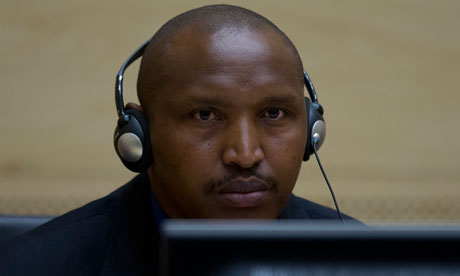
Bosco Ntaganda during his first appearance before judges of the ICC in The Hague. (Photograph Courtesy of The Guardian via Peter Dejong/AP)

Ntaganda shocked the international community when he entered the U.S. Embassy in Kigali, Rwanda last week, removed his disguise, and asked to be sent to the ICC.  Within days he was put on a plane to The Hague.

Ntaganda allegedly led rebels who terrorized eastern Congo in brutal fighting from 2002 to 2003.  Moreover, he is accused of various war crimes over a fifteen-year period of fighting in Rwandan-backed rebellions in eastern Democratic Republic of the Congo (DRC).

The litany of charges includes ten counts of war crimes and crimes against humanity, accusing him of conscripting and using child soldiers, using rape as a weapon of war, keeping women as sex slaves, and massacring at least 800 people in 2002 and 2003.

Dressed in an ill-fitting dark blue suit, blue shirt, and tie – attire most likely provided by the court – Ntaganda appeared uneasy in the courtroom on Tuesday.  He hunched forward and kept his eyes downcast as the hearing began.

Judge Ekatarina Trendafilova asked Ntaganda to state his profession.  He responded simply: “I was a soldier in the Congo.”

After a court official read out the charges against him, Ntaganda confirmed his name, stated his age of thirty-nine and said, “I was informed of these crimes, but I plead not guilty.”

Judge Trendafilova interrupted Ntaganda, stating that the purpose of the hearing was inform Ntaganda of the pending charges and to inform him of his rights.

The judge said that on September 23 the ICC will hold a hearing to assess the strength of prosecutors’ evidence.  After that hearing, the judges will decide whether the case should go to trial.

While many of the Court’s suspects, including Ugandan warlord Joseph Kony and Sudanese President Omar al-Bashir, remain at large and beyond its reach, Ntaganda’s arrival was especially welcome to prosecutors and activists.

International commentators remain hopeful that Ntaganda’s appearance before the ICC after years of impunity will lead to justice for victims of war crimes perpetrated in the DRC.  Geraldine Mattioli-Zeltner of Human Rights Watch said, “Ntaganda’s detention in The Hague shows that no one is above the law.”

For more information, please see:

BBC – DR Congo: Bosco Ntaganda Appears Before ICC – 26 March 2013

The Huffington Post – Bosco Ntaganda Pleads Not Guilty to War Crime Charges Before ICC – 26 March 2013

The New York Times – War Crimes Suspect Tells the Court He Was Just “a Soldier” – 26 March 2013

The Telegraph – Bosco Ntaganda in the ICC: Profile of the Terminator – 26 March 2013

Human Rights Groups Condemn UAE Pretrial Conditions

By Dylan Takores
Impunity Watch Reporter, Middle East

ABU DHABI, United Arab Emirates – A coalition of human rights groups condemned allegedly “unfair” pretrial conditions imposed upon ninety-four political activists set for trial in the UAE’s Supreme Court.

International observers and journalists barred from viewing trial proceedings. (Photo Courtesy of BBC)

Reportedly “credible” sources informed the trial judge, Falah Al Hajiri, that the detainees were subjected to torture while in detention.  The coalition of human rights groups issued a report arguing that the judge breached his obligation to prevent pretrial torturing by failing to investigate the allegations.

The activists were arrested in a series of raids last year by UAE authorities and are charged with planning a coup against the government.  The government further alleged that the activists possess ties to Al-Ishlah, a group associated with the Muslim Brotherhood.

The coalition consists primarily of four human rights groups: the Gulf Centre for Human Rights, the International Federation for Human Rights, the Arab Network for Human Rights Information, and the Cairo Institute for Human Rights Studies.

The coalition issued an initial statement opposing the ongoing “crackdown” on citizens’ freedom of speech in January, 2013.  They issued a report yesterday exposing “flagrant disregard of fair trial guarantees.”  The report primarily contended that the judge should have investigated the possible incidences of pretrial torture.

Sarah Leah Whitson, Middle East Director of Human Rights Watch, claimed the “shamelessly unfair judicial process . . . makes a mockery of justice.”  Whitson reported that the government targeted and arrested prominent human rights leaders including lawyers, judges, teachers, and students.

In addition, members of Reporters Without Borders voiced their concern regarding the lack of the trial’s media coverage.  The Emirati government imposed a news blackout, refusing to allow international reporters to observe any part of the trial.  The government did not permit family members of the detainees to witness the fifth and most recent trial proceeding.

UAE Attorney General Ali Salim al-Tenaji denied that the detainees were tortured.  He maintained that authorities treated the detainees in “accordance to the law.”

If convicted, the activists could receive up to fifteen years in jail.  The activists do not have the right to appeal the court’s decision.  The next proceeding will take place today at the Federal Supreme Court in the nation’s capital.


For further information, please see:

BBC News –Human rights groups: UAE trial ‘flagrantly unfair’  – 26 March 2013

Gulf News – UAE Human rights group attends trial of 94 accused of threatening national security – 25 March 2013

Reporters Without Borders – News blackout imposed on trial of 94 activists on national security charges – 25 March 2013

Al Jazeera – UAE coup plot trial begins in Abu Dhabi – 4 March 2013

Reporters Without Borders – Human rights groups call for an end to the crackdown on human rights defenders and political activists as UPR begins – 28 January 2013

Irish Family Shocked After Irish Woman’s Murderer Receives Light Sentence

By Alexandra Sandacz
Impunity Watch Reporter, Europe 

DUBLIN, Ireland – Last week, Nicola Furlong’s family was left “disgusted” when they heard the man who murdered their daughter could only face a five-year jail sentence.

Irish woman’s murder receives a maximum of 10 years in jail. (Photo Courtesy of The Independent)

A Tokyo District Court found 19-year-old, Richard Hinds, an American, guilty of strangling Nicola Furlong to death last year. Since Hinds was a minor when he was arrested, the court sentenced him to 5 to 10 years in jail. Furthermore, James Blackston, a 23-year-old, was sentenced to three years for sexual assault.

Nicola Furlong’s mother, Angela, broke down as the jail term was announced. She called the court’s decision “a travesty”. She stated, “It’s not enough, given the pain he caused Nicola. We’re not leaving here believing we have justice. We still don’t know the truth of what happened in that hotel room.”

Nichola’s sister, Andrea, stated the Japanese criminal justice system let her family down. She said, “I’m absolutely disgusted and so angry and so hurt. We had so much faith in the Japanese doing justice for us and I don’t feel we got it.”

Hinds and Blackston met Nicola Furlong and a friend after a concert in Tokyo. According to the prosecution, after the concert, the four traveled to a bar where the two women were drugged.

Furthermore, prosecution entered taxi footage that shows Blackston sexually assaulting Furlong’s friend as they travelled to the Keio Plaza Hotel. The footage also shows the men borrowing wheelchairs to get the unconscious women to a room.

Prosecutors later stated Hinds strangled Furlong with a towel to keep her quiet after she regained consciousness.

Delivering the verdict, the lead judge, Masaharu Ashizawa stated that the fact that Furlong was “strangled with force for several minutes” showed Hinds had murderous “intent.” Furthermore, Judge Ashizawa stated, “the tendency of sentencing in juvenile cases [means that] we can’t choose the death penalty or life imprisonment.”

Nonetheless, Judge Ashizawa, called the murder “atrocious and vicious in nature” and said Hinds’ version of what happened was “not credible”. Judge Ashizawa continued, “The defendant has continually given irrational explanations in his defense that have dishonored the victim.”

Hinds argued that Furlong voluntarily went to the hotel with him and willingly engaged in “rough sex”. His defense also argued that it was a “synergistic combination” of alcohol and prescription drugs that caused her death.

Although Hinds did not react when the verdict was declared, he smiled at his family as he walked out.

For further information, please see:

BBCNews – Richard Hinds Guilty of Nicola Furlong Murder in Tokyo – 19 March 2013

The Independent – Killer of Irish Woman in Japan Gets Light Sentence – 19 March 2013

Irish News – Nicola Furlong Family Angered At Japanese Justice System – 19 March 2013

The Japan Times – A Violent Death, Some Justice, Few Answers in Furlong Case – 19 March 2013

Palestinian Protest Camp Dismantled by Israeli Security Forces

By Ali Al-Bassam
Impunity Watch Reporter, Middle East

JERUSALEM, Israel — Last Sunday, Israeli security forces dismantled a Palestinian protest camp that was constructed during President Obama’s recent visit to Israel in protest to the expansion of settlements in the controversial site known as E-1, a corridor that connects the West Bank with East Jerusalem.

Around 50 demonstrators were released by Israeli forces in the Palestinian controlled portion of the West Bank, while four others were questioned in an Israeli police station. (Photo Courtesy of Al Jazeera)

Police Spokesman Micky Rosenfeld said that, just before dawn, around 200 Israeli officers removed some 40 demonstrators from the camp.  Police said that no weapons were used, and  that they were deployed to the area after activists refused to leave.  Forces arrested four people, including two women charged with violating military orders and resisting arrest.  Also among the arrested was the event organizer, Palestinian legislator Mustafa Barghouti.  Arrestees were taken to Maale Adumim Police Station and were later released on bail.  Barghouti said that around 50 other protesters were placed on a bus and later released in the Palestinian-controlled portion of the West Bank.

Dubbed “Ahfad Younis,” the camp was pitched last Wednesday on a hill adjacent to another camp site known as Bab al-Shams, which was erected earlier this year before eventually being taken down by security forces on the grounds of “public disorder.”  The camps are an attempt to draw attention to Israeli plans to expand settlements into the controversial E-1 corridor.  Critics of the expansion say that the plan to build 3,500 housing units in E-1 would “cut off the northern part of the West Bank from the south, and would leave Palestinian areas of Jerusalem surrounded by a chain of Jewish ones, threatening the vulnerability of a future Palestinian state.”

Similar encampments have sprouted throughout the region, but were taken down quickly by security forces.

During his visit to Israel, Obama acknowledged that the expansion into E-1 would be “particularly problematic.”  “Israelis must recognize that continued settlement activity is counterproductive to the cause of peace, that an independent Palestine must be viable with real borders that have to be drawn,” said Obama in a speech to students in Jerusalem last Thursday.

The international community itself has urged Israeli Prime Minister Binyamin Netanyahu and his government to reconsider the expansion.  Early in Obama’s first term, Netanyahu agreed to a ten-month slow down.  Talks then resumed briefly in 2010.  Afterwards, talks went stale as Netanyahu refused to extend the slowdown and construction continued.  Palestinians might increase their efforts for international recognition if Israel continues to construct settlements in the West Bank.  “We have to focus on the steadfastness of our people, and we have 63 international agencies we can join,” said Palestinian negotiator Saeb Erekat, referring to the Palestinian plan for international recognition.

For further information, please see:

Al Bawaba — Israel Dismantles Palestinian ‘Bab al-Shams’ Protest Camp — 24 March 2013

Al Jazeera — Israel Dismantles Palestinian Protest Camp — 24 March 2013

Haaretz — Israel Dismantles Palestinian Tent City Built at Start of Obama Visit — 24 March 2013

San Francisco Chronicle — Palestinians Cool to Partial Settlement Freeze — 24 March 2013

Britons Want Blair Tried for War Crimes

By Madeline Schiesser
Impunity Watch Reporter, Europe

LONDON, U.K. – A decade after the invasion of Iraq, more than a fifth (22%) of the British public believes that former British Prime Minister Tony Blair should be tried for war crimes, according to a recent YouGov survey.  Additionally, over half of Britons (53%) believe the decision to go to war was wrong, while just more than a quarter stand by the decision (27%).  In 2003, at the time of the invasion, just over half of Britons (53%) supported military action.

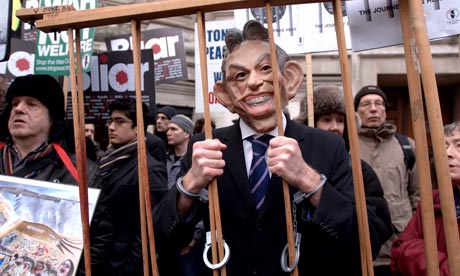
Demonstrators outside the Chilcot inquiry call for Blair’s arrest in 2011, when polls showed 37% of Britons supported trying the former PM for war crimes. (Photo Courtesy of The Guardian)

Critics have claimed that Blair and former U.S. president George W. Bush misled their respective publics by promising that Iraqi dictator Saddam Hussein was illegally hiding weapons of mass destruction (WMDs), that there was an urgent need to liberate Iraq from the control of Hussein, who was purported to be in league with al-Qaeda, and that the Iraqi people would welcome this liberation.  After the invasion, it became clear that there were no WDMs in Iraq, and while Hussein was quickly ousted, military involvement in the country descended into a quagmire due to entanglements with insurgents and militia groups.

Britain sent 45,000 troops to Iraq to take control of the southern provinces, sacrificing the lives of 179 British service personnel.  In the ten years since the invasion, at least 112,000 Iraqi civilians have been killed, in addition to several thousand policemen and soldiers.

The YouGov poll revealed that half of the questioned Britons say Blair deliberately mislead the British public about the threat posed by WMDs, while just less than a third (31%) think he genuinely believed Hussein possessed a stockpile of WMDs, and a little fewer (29%) say Blair was right to warn the public of the dangers of the Hussein regime.  1,684 British adults were polled.

However, Blair maintains that the decision to invade was correct when made, even if when he rarely appears in public he is accosted by protesters who want him tried as a war criminal.

“I still believe it was right to remove Saddam,” Blair told Britain’s ITV television. “We sometimes forget now what the regime was actually like and the devastation it caused.”

Nonetheless, Blair concedes that hindsight suggests the invasion was a mistake, even if his actions were right.  In his 2010 autobiography, “A Journey”, Blair wrote: “Many supporters will acknowledge I did it for the correct motives, but still regard it as ‘the stain’ on an otherwise impressive record.”  He concludes that “All I know is I did what I thought was right.”

Even so, a majority (53%) of the polled Britons expressed concern that the war had increased the risk of terrorist attacks against Britain.  However, two in five believe Iraqis are better off now than they were a decade ago under Saddam Hussein, while one in five maintain Iraqis would have been better off under the dictator.  Nevertheless, over two-thirds (71%) agreed Iraq is likely to suffer permanent instability in the coming years.

As for former U.S. President Bush, he has remained largely out of the public eye in the United States, particularly when compared with the post presidential lives of his predecessors.  He also rarely ventures out of the United States, and in 2011, and trip to Switzerland had to be canceled when human rights groups announced plans to submit a 2,500-page case against the former president to pressure authorities in Geneva to arrest Bush for torture and other human rights abuses.

When asked about his approval of water-boarding,  a method of torture condemned in most countries under the Convention on Torture, Bush defends his approval of the practice.  “I’d do it again,” he says, “to save lives.”

For further information, please see:

Press TV – Bush, Blair Must Stand Trial for Iraq War Crimes: Analyst – 18 March 2013

Global Post – Decade on, Blair Adamant Iraq Invasion was Right – 17 March 2013

The Independent – George W Bush: the President who Started the Iraq War 10 Years Ago is Nowhere to be Seen – 15 March 2013

The Guardian – 53% of Britons Think Iraq Invasion was Wrong, Poll Shows – 14 March 2013

Returns – Bush’s Swiss Visit off after Complaints on Torture – February 5 2011