Syrian Revolution Digest: Thursday, 7 March 2013

Enough Bullshit!

Let’s stop kidding ourselves, for the disintegration of Syria to stop a no-fly zone is needed. Anything less will not do. You cannot create a provisional government, or prepare people to handle the challenges of local governance if the air is insecure. Rebels and activists have been trying to do that for months now, and failing. Every potential success story in this regard is being pounded into oblivion by helicopters, MiGs and now Scuds. So, until the international community develops the will, the balls, the moral backbone to do it, the bleeding and the disintegration will continue.

Today’s Death Toll: 111 martyrs, including 5 women, 8 children and 2 martyrs under torture. 23 martyrs reported in Damascus and Suburbs, 23 in Aleppo, 18 in Homs, 17 in Idlib, 12 in Daraa, 9 in Deir Ezzor, 8 in Hama and 1 martyr in Raqqa (LCCs).

Points of Random Shelling: 395 points. Warplane shelling was reported in 19 points with the fiercest in Homs. 3 areas were targeted using cluster bombs in each of Talbesa in Homs; Heesh and Sermeen in idlib. 1 point was shelled using Surface- to- Surface missile. 5 points were targeted by detonating barrels while mortar shelling was reported in 117 points and artillery shelling in 147 points, 107 points were documented as targets of missile launchers. In addition ,Launching of 6 Scud Missiles by the regime Brigade located in Qutaifa was also documented (LCCs).

Clashes: 122. Successful rebel operations include downing a MiG in areas south of Idlib Province. In Daraa, fierce clashes were reported in the Golan, as FSA rebels succeeded in liberating Aljazeerah Detachment. In Damascus Suburbs, the FSA managed to repel attempts made by regime forces to storm Daraya as the siege enters its 115th consecutive day. In Damascus City, rebels also fought off regime attempts to take back control of the Jober-Abbasid Square Road considered to be the eatern gateway to the city. In Besieged Homs, several regime attempts to invade rebel strongholds were repelled. In Raqqa City, rebel forces continue their battle to assert their full control over the city (LCCs).


News

Video of Captive U.N. Peacekeepers in Syria

In the video, a man who identified himself as a captain in the Philippine battalion of the United Nations mission that patrols the cease-fire line in the region said the group was “safe in this place.” He said that the group had been rescued by “civilian people” during bombing and artillery fire near a United Nations observation post close to the village of al-Jamlah. Speaking in English, the captain said: “Civilian people helped us, for our safety and distributed us in different places to keep us safe. And they gave us good accommodation and gave us food to eat and water to drink.”

Syria rebels want troop pullback before freeing U.N. men “They will be passed to safe hands when possible – because the area is surrounded and the Assad regime is bombarding it,” said Abu Essam Taseel, from the media office of the “Martyrs of Yarmouk” rebel brigade which detained the Filipino peacekeepers… Wednesday’s detention of the peacekeepers by around 30 gunmen will also reinforce Western concerns that any weapons supplied to rebels fighting to overthrow Assad could end up being turned against Western interests.

Hezbollah backs end of Syria suspension from Arab League The show of support is the latest example of the Lebanese group’s increasing intrusion into the conflict on behalf of Syrian President Bashar Assad. A rise in clashes between Hezbollah fighters and Syrian rebels along the border of Lebanon indicates that the massive militia, which the U.S. designates a terror group, is getting more active in defending its ally.

Germany says EU right not to arm Syria rebels, risks too high “The decision of the EU not to lift in total the embargo was wise and was right. But it is necessary to show more flexibility and to understand that we have of course to support the … opposition in a responsible way,” German Foreign Minister Guido Westerwelle told reporters at a briefing in London. “We have to avoid a conflagration in the whole region,” he added.

Syria’s healthcare system in tatters, aid group warns Almost two years of violence have devastated Syria’s once-extensive healthcare system and left many Syrians unable to access even basic services, representatives of the international aid group Doctors Without Borders said Thursday. “The situation for Syrian civilians inside Syria is catastrophic,” Christopher Stokes, the group’s general director, told reporters in a conference call. “The aid system is way too limited, and the health system inside Syria has collapsed.”

Thousands Flee Northern Syria After Latest Airstrikes A new flood of Syrian refugees is streaming into southern Turkey after the Syrian air force bombed the city of Raqqah, a provincial capital that the government lost control of earlier this week. The Syrian rebels overran Raqqah, capturing several high-ranking prisoners, including the provincial governor. Many residents supported the rebels, but when the air strikes began, they packed in a hurry and fled, believing it was safer to make a dash for the border than stay at home.

Syria opposition to pick interim PM next week Meeting to choose leader who will oversee creation of interim government is to be held in Turkish city of Istanbul.

Syria: Israel Spy Devices Allegedly Found In Coastal Region Syrian authorities have discovered Israeli spying devices that were apparently hidden in objects that resembled rocks, Syria’s state news agency said Thursday. SANA’s report said the devices are designed to photograph, register and transfer data. The agency said the objects were uncovered in Syria’s coastal regions, but gave no further details. The Israeli military declined comment.


Special Reports

That bike is the bomb: repurposed weapons of war in Syria
There are so many things to hate about Syria’s brutal civil war. But here’s a very small one to like: photos on Facebook of Syrians transforming war’s leftovers into useful everyday objects. It turns out that reclaimed bomb casings are great for making everything from motorcycle frames to water storage tanks. This is a glimpse of what hope looks like in the middle of one of the world’s bloodiest war zones…

Syria’s expensive fight for freedom
The common man is paying the price for a brutal regime, pathetic opposition and an international society that cares only about its own national interests… Given the inhomogeneous societies of the Levant, Al Assad’s intention might be to get the region involved in a grand sectarian war. To survive, he may even decide to play his final card — starting a regional war. On several occasions, he threatened to set the whole region on fire should his regime collapse. His arsenal of Scud missiles with approximately 700 warheads can hit deep inside Turkey. His arsenal of chemical weapons is also frightening and, should he approach the end of his political life, he might choose to use it. This is what many dub as the Samson Option — the choice in the absence of choices.

WHEN A CRIMINAL LEADS A COUNTRY
Surely the present Assad regime reads the splits about Syria policy on the U.N. Security Council, and the hesitancy of the Obama Administration to involve itself deeply in the war by supplying weapons to the opposition, in a similar way. “He’s not going to give up,” Al-Abdallah said of Assad. “He’s not going to leave the country. He’s going to stay until he dies or somebody forces him to leave power.”… This is no time to yield the arguments about international justice to the pessimists. Syria proves that stability built on cynicism and expediency is not stability at all.

Syrian and Iraqi Conflicts Show Signs of Merging
Washington should also push back on Baghdad’s emerging narrative that Sunni protests in Iraq are simply “spillover from Syria,” as National Security Advisor Falih al-Fayadh intimated on February 25. His statement that “the divisiveness in Syria might affect the unity of Iraq” conceals the fact that Baghdad’s own failure to support sectarian reconciliation since 2009 has been a key driver of Sunni unrest and should be corrected. The current wave of “preventive” arrests in and around Sunni portions of the capital only increases the risk of the spillover Fayadh warned against. The Sunni community would be reassured if Baghdad dealt firmly with new Shiite vigilante groups such as the al-Mukhtar Army, which seeks to exploit growing sectarian dread in the Shiite community by threatening to purge Sunnis from mixed neighborhoods.

In Kafranbel, Witty Slogans and Encroaching Islamists
Islamic extremism is the top priority for Fares and his secular-minded peers these days. He met with a local emir of Jabhat Al Nusra, which the U.S. designated a terrorist organization with ties to Al Qaeda in Iraq, a few weeks ago, and the emir said he wanted to raise their flag at Kafranbel’s protests. Fares refused, and now the town holds two protests each week. “They don’t like being called extremists but the truth is they are,” Fares said. “They want to impose their views on everyone. They see Islam through a pinhole and I see it through a window.” Fares said Jabhat Al Nusra was gaining followers because it’s organized, and has an established hierarchy that holds its members accountable, unlike the disorganized civilian activists and the Free Syrian Army. Nusra also has access to weapons, and is delivering much needed humanitarian aid, which the secular opposition can’t match due to a lack of resources. The confrontation in Kafranbel today is in the realm of ideas, and Fares hopes that it will remain that way. Nusra and other extremist groups have a “totalitarian vision for Syria that is the same as the regime’s and I fought the regime,” he said. Nusra and its followers deny the existence of a revolution in Syria, Fares said, claiming that revolution is “just a word invented by Che Guevara, and that we are in jihad. I’m not a jihadist, I’m a revolutionary.”

How Michel Kilo Negotiated a Tenuous Truce in Ras Al Ayn
Syria’s northern towns and villages, with their complex ethnic and religious divisions, are a tinderbox for internecine fighting. They contain fault lines between ethnic groups, Kurds and Arabs, and among competing forces within each group — battle lines that could trigger a disintegration of the Syrian state. Ras Al Ayn is a microcosm of them, arguably the most complex town in the region.

One on One: They’re Crating Up the National Museum
Syria Deeply: As part of our series of interviews with journalists covering the Syria crisis, we reached out to ABC News correspondent and “Nightline” anchor Terry Moran, who reported last month from the streets of Damascus. Here, he discusses the changes he saw in the Syrian capital. “Part of the horror of what’s happening in Damascus,” he says, “is just… the demoralization.”

Lt Col S. Edward Boxx, USAF: Observations on the Air War in Syria (PDF)
Giulio Douhet, Hugh Trenchard, Billy Mitchell, and Henry “Hap” Arnold were some of the greatest airpower theorists in history. Their thoughts have unequivocally formed the basis of modern airpower.1 However, their ideas concerning the most effective use of airpower were by no means uniform and congruent in their determination of what constituted a vital center with strategic effects. In fact the debate continues to this day, and one may draw on recent conflicts in the Middle East to make observations on the topic. Specifically, this article examines the actions of one of the world’s largest air forces in a struggle against its own people—namely, the rebels of the Free Syrian Army (FSA).

Max Boot: Syria Is a Regional Disaster
In the case of Syria the only realistic option is to hasten Assad’s downfall through the provision of weapons and training to the rebels and the use of Western airpower to create a no-fly zone and to assist the rebels with close air support in their operations. Those options may not seem very palatable (especially at a time when sequestration is badly hurting military readiness) but unless the administration changes course, the spillover and slaughter will continue to worsen.

My new paper, prepared for a briefing in Washington, D.C. that took place on January 15, 2013, is now out and is titled “Syria 2013: Rise of the Warlords.” It should be read in conjunction with my previous briefing “The Shredded Tapestry,” and my recent essay “The Creation of an Unbridgeable Divide.


Video Highlights

Some of the captured UN observers are seen in this video saying they are safe in and being held by civilians http://youtu.be/_6E-ATZa8qk

Brining down a MiG in Jabal Al-Zawiyeh, Idlib http://youtu.be/f1a18p1oLXQ Meanwhile regime force pound nearby Heesh with explosive barrels http://youtu.be/XlT-TQn3w5A MiGs pound the town of Saraqib http://youtu.be/IrmLwPCxvn0

Yarmouk Camp, Damascus City: this Palestinian woman, we are told, discovers soon after her sister was killed in the pounding of the neighborhood that her brother-in-law was a regime informant. She reports him to the rebels and witnesses his execution http://youtu.be/DGC-_dujA5w The pounding of the restive neighborhoods soon continues http://youtu.be/NHlezkWqp5g

Meanwhile, the pounding of rebel strongholds in Eastern Ghoutah and adjacent neighborhoods in Damascus City continues http://youtu.be/GR5cwSpeEKw , http://youtu.be/bsRl9q32tEI

Rebels in Raqqah City show some of their prisoners: Sunni soldiers from different provinces doing their compulsory service: http://youtu.be/Bq9ScGAJ-Ic

Rebels document signs of shelling of the historic temple of Bel in Palmyra City http://youtu.be/A0O6n9N1I5E

The aerial pounding of rebel strongholds in Homs City continues http://youtu.be/NRZYoUQOZtQ , http://youtu.be/PpmpLNEDnTo , http://youtu.be/1kUEG1DVSQY , http://youtu.be/09bSwkGeo9M , http://youtu.be/OY96eZiX7DQ , http://youtu.be/E6-jn8RAneU

The aerial pounding of Deir Ezzor City continues http://youtu.be/dMKRJ0d8Ds8 , http://youtu.be/vkSON4w0zZo

The pounding of Daraa City continues http://youtu.be/HvAOIukSbko

HRW Report Details Persisting Horrors of Child Marriage in South Sudan

By Ryan Aliman
Impunity Watch Reporter, Africa

JUBA, South Sudan – On Tuesday, Human Rights Watch (HRW) released a report urging the South Sudanese government to increase efforts to protect girls from child marriage.

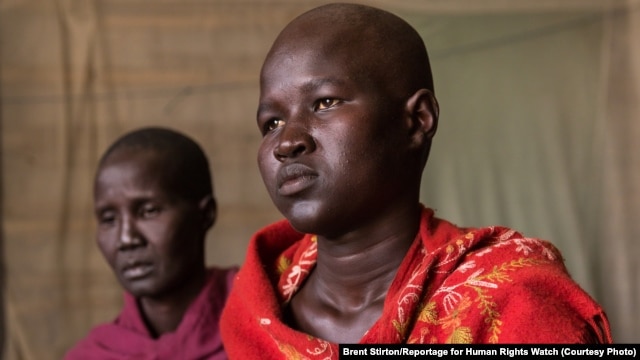
Sixteen-year old Akuot was beaten for three days after she refused to be married off to an old man who offered a dowry of 200 cows. (Photo courtesy of Voice of America/Brent Stirton/Reportage for Human Rights Watch)

In the 95-page report, “‘This Old Man Can Feed Us, You Will Marry Him:’ Child and Forced Marriage in South Sudan,” the human rights group reveal that almost half of South Sudanese girls between 15 and 19 are married, with some marrying as young as age 12. Most of these girls are married off by their families against their will. This practice, according to HRW, “exacerbates South Sudan’s pronounced gender gaps in school enrollment, contributes to soaring maternal mortality rates, and violates the right of girls to be free from violence, and to marry only when they are able and willing to give their free consent.”

One girl among the 87 who were interviewed told HRW that her relatives pressured her to marry in exchange for the dowry. “I refused him but they beat me badly and took me by force to him. The man forced me to have sex with him so I had to stay there,” she said as she recalled her experience.

When asked why they did not ask for help, most of the girls replied that they did not know that they had the right to do so. The other girls added that if they resisted from being married off, they would “suffer brutal consequences at the hands of their families – including verbal abuse and physical assault, and sometimes even murder.”

“Girls who have the courage to refuse early marriages are in dire need of protection, support, and education,” said Liesl Gerntholtz, HRW women’s rights director. “The South Sudan government must make sure that there is a coordinated government response to cases of child marriage and more training for police and prosecutors on the right of girls to protection.”

The HRW report suggested some courses of action the government can take such as: setting 18 as the minimum age for marriage; ratifying the Convention on the Elimination of all Forms of Discrimination Against Women (CEDAW), the Convention on the Rights and Welfare of the Child (CRC), and other human rights treaties; and passing comprehensive family legislation on marriage, separation, and divorce.

“The global problem of child marriage strips women and girls of their livelihoods and creates a high risk of violence,” Gerntholtz pointed out. “South Sudan’s government must make good on its pledges of gender equality by putting human rights of women and girls at the heart of its development agenda,” she added.


For further information, please see:

All Africa – South Sudan: End Widespread Child Marriage – Government Should Protect and Support Girls Who Refuse Forced Marriage – 7 March 2013

Oye! Times – Human Right Watch Report Calls For An End To Child Marriage – 7 March 2013

Sudan Tribe – South Sudan: End widespread child marriage – 7 March 2013

Voice of America – End Child Marriage, Rights Group Tells South Sudan – 7 March 2013

Human Rights Watch Report Alleges Rising Religious Intolerance in Indonesia

By Irving Feng
Impunity Watch Reporter, Asia

JAKARTA, Indonesia – Human Rights Watch (HRW), a New York-based human rights watch dog, recently released a report highlighting Indonesia’s rising religious intolerance and failure to protect religious minorities.

Police try to disperse a crowd of religious minorities. (Photo Courtesy of the BBC)

The one hundred and seven page report was compiled using research conducted from August 2011 to December 2012.  It includes over 100 interviews of local Indonesians, 71 of which were victims to crimes of religious intolerance.

The report also included information from the nonprofit Setara Institute, based in Indonesia’s capital of Jakarta, which found that 264 attacks of religious minorities occurred in 2012, 244 attacks were recorded in 2011, and 216 attacks were recorded in 2010.  These numbers show a steady increase in the amount of attacks motivated by religion against minorities in Indonesia over the course of the previous three years.

Indonesia is the most populous Muslim-majority nation in the world.  Muslims, of the Sunni variety, dominate the nation’s population, numbering around 210 million.  This massive majority has perhaps contributed to the growing religious intolerance.

Brutal attacks and constant harassment has been commonplace in Indonesia against the minority populations of Christians, Shia Muslims, and Ahmadiyah.  In addition to the attacks and harassment, the government’s actions, and lack of action, has exacerbated the situation.

Discriminatory regulations passed by the central government have had a significant effect on the religious minorities.  Local governments have allegedly refused to grant religious minorities permits to build new places of worship.  A Supreme Court decision which granted religious minorities the ability to build new places of worship has also been largely disregarded by many local authorities.

Local law enforcement has failed to curb the rising number of violent attacks being perpetrated against the religious minorities in the country.  Prosecutors have also failed to properly prosecute the few that have been brought in on charges of violence and have chosen to apply weak punishments for their crimes.

Secretary General of Indonesia’s Religious Affairs Ministry, Bahrul Hayat, released a statement, citing a government survey which was compiled at the end of last year, alleging religious harmony within the country is incredibly strong.   Bahrul Hayat urges the international community to disregard the few violations that may have occurred against religious minorities in the country.

The Secretary General believes that the few violations he noted should not be seen as the norm, but as the exception to the rule.  Many of the causes of conflicts within the country that may have been blamed on religious intolerance are actually socially, politically, culturally, or economically motivated.

HRW, however, still calls for Indonesian President Susilo Bambang Yudhoyono to adopt a “zero tolerance” policy with regards to religious intolerance, discrimination, and the rising violence perpetrated against the religious minorities in the country.

For further information, please seeL

India Talkies – Indonesia urged to protect religious minorities from growing violence – 1 March 2013

BBC – Indonesia urged to tackle religious intolerance – 28 February 2013

Breitbart – Report: Religious violence rising in Indonesia – 28 February 2013

Business Mirror – Religious violence rising in Indonesia – 28 February 2013

Human Rights Watch – In Religion’s Name – 28 February 2013

UNICEF Report Reveals ‘Systematic’ Abuse of Palestinian Children by Israeli Prisons

By Ali Al-Bassam
Impunity Watch Reporter, Middle East

JERUSALEM, Israel — The United Nations Children’s Fund (UNICEF) published a 22-page report last Wednesday claiming that the ill-treatment of Palestinian children in Israeli detention centers “appears to be widespread and systematic.”


A report by UNICEF states that Palestinian children detained in Israeli prisons are subjected to “cruel, inhuman, and degrading treatment or punishment.” (Photo Courtesy of Al Arabiya)

In its report, entitled “Children in Israeli Military Detention,” UNICEF estimates that about 700 children within the West Bank aged between twelve and seventeen were arrested by Israeli forces each year.  UNICEF says that this is a rate equivalent to “an average of two children each day.”  Figures provided for the month of January reveal that 233 children are currently in custody, and 31 of those children are below the age of sixteen.  However, a spokeswoman for Israel’s Prison Service said that currently, 307 Palestinian minors are in Israeli custody, 108 of them are serving a prison sentence.  The spokeswoman said that most of those children are between sixteen and eighteen, while the rest are under sixteen.

The report also stated that Israel is the only country in the world where children are systematically tried in military courts, deeming the practices as “cruel, inhuman, and degrading treatment or punishment.”   “Israel is the only place in the world where automatically, a child when he is under arrest, is put before a military tribunal,” said Jean-Nicholas Beuze, UNICEF’s regional advisor on child protection. “It does exist in other countries (but only) as an exception.”

The report states that the ill-treatment often begins with an arrest of the child, usually occurring in the middle of the night, then it continues through the prosecution and sentencing periods.  The report provides examples of abuse, such as “the practice of blindfolding children and tying their hands with plastic ties, physical and verbal abuse during transfer to an interrogation site, including the use of painful restraints.”  Children were rarely informed of their rights during questioning.

During questioning, the report states that minors are subjected to “physical violence and threats, are coerced into confessions, and do not have immediate access to a lawyer or family during questioning.”  UNICEF also pointed out that some cases existed where children suffered through prolonged exposure to the elements, and were not provided with an adequate amount of food, water, and did not had access to a toilet.

During the sentencing phase, children arrive to court shackled, are denied bail and imposition of custodial sentences, and are transferred outside of the occupied Palestinian territory to serve their sentences inside Israel.

UNICEF based its findings on more than 400 cases documented since 2009, legal papers and reports composed by both governmental and non-governmental groups, and through interviews with Palestinian minors, and Israeli and Palestinian officials and lawyers.

Israeli Foreign Ministry spokesman Yigal Palmor said that ministry officials along with the Israeli military cooperated with UNICEF.   Palmor said that Israel wants to improve its treatment of Palestinian minors held in custody. “Israel will study the conclusions and will work to implement them through ongoing cooperation with UNICEF, whose work we value and respect,” he said.

For further information, please see:

Al Arabiya — Israeli Ill-Treatment of Palestinian Minors ‘Widespread, Systematic:’ UNICEF — 6 March 2013

Al Jazeera — Israel Accused of Abusing Detained Children — 6 March 2013

The Daily Star — Israel Ill-Treatment of Palestinian Minors ‘Systematic’: UN — 6 March 2013

The Jewish Press — UNICEF: Israel Treatment of Arab Minors in Custody Cruel and Inhuman — 6 March 2013

SNHR: Syrian Government Release One Correspondent in Front of the Media and on the Other Hand Kill 168, Four Tortured to Death

Press Release
Syrian Network for Human Rights

Violations Against Media Professionals:

Since the outbreak of Syrian revolution, Syrian government not just prevented all media –except pro-Alassad regime media outlets – to work freely and transmit news and the facts happening on the ground, but they also expelled, arrested tens of them , and restrict others in their work .

Syrian government’s crackdown towards media is one of the worst in the world comparing with other countries, restricting freedom of press and media in this way is a clear violation of all norms and international conventions in this regard .

This cause additional responsibility on Syrian revolutionaries, hundreds of citizens takes this task upon themselves to become citizen journalist exposing their lives to the danger of detention and death

SNHR documented since the outbreak of the Syrian Revolution up till now killing 168 media professionals and citizen journalists including 3 women , which is a clear indication of women participation in Media work in Syrian Revolution

The following link contains all the names of the killed media professionals and their death date as well as their photos and videos.

https://docs.google.com/file/d/0B9Bj18tlYYKBLXF4QzVXSURWZVU/edit?usp=sharing

Homs topped the list of Media victims with 73, followed by Damascus countryside with 21, Aleppo 16, Daraa 12, Damascus 9 , and the rest all around the other Syrian governorates

For the Non Syrian Media victims they were 12 all around the world

SNHR refuse to document pro-Alassad regime or pro-oppositions media outlet –where they don’t deserve the media capacity any more, cause by their actions they turned into intelligence agents depicting the faces of activists to arrest them – and forced residents by arms to admit that Alassad troops didn’t kill or shell , but on the contrary they were sophisticated in dealing and in humanity

The same for armed rebel , Media capacity falls from any correspondent carry weapon and turned into a solider


Detainees and torture of correspondents:

There are at least 3500 media activists and citizen journalists work as photographer, or have an administrative role on social networks, and reporters to transmit news and information to agencies and stations all around the world

According to the statements of eyewitnesses and survivors from Alassad prisons that the media activists of revolutions suffering from distinct type of torture more worse than the other detainee , 4 media activists killed under torture and 600 forcibly disappeared  .

The following you can see the reporters names how has been tortured to kill in prisons then the security branches hand over the bodies to their families and the signs of tortures appears on :

1-      Abdullah Hasan Kakeh – Aleppo – male – killed under torture in Military Intelligence branch  in 17-11-2012

2-      Baraa Yousef Alboshi – Sabonia / Hama – male – dissident             sergeant – was speaking media and journalist on the ground in Damascus countryside – killed in the random shelling on Altal in 11-8-2012 http://www.youtube.com/watch?v=IXx7EehIS3c&feature=youtu.be             https://www.facebook.com/photo.php?fbid=472183366134460&set=a.376981942321270.94377.362879720398159&type=1&theater

3-      Mahmod Sudki Sakhita – Ariha / Idlib – male – media activist – Alassad army arrested him on a checkpoint and killed under torture in 22-7-2012

4-      Rami Suliman Ekbal – Dael / Daraa – male – married and have a girl child – killed under torture by Alassad troops in 21-6-2012

https://www.facebook.com/photo.php?fbid=414616385255608&set=a.170186573031925.48606.165780076805908&type=1&theater

5-       Hasan Mohamad Azhari – Damascus – male – killed under torture in prison in 17-5-2012

6-      Juan Mohamad Katana – Derbasia / Hasaka – male – photographer , his body found and the sign of torture appears on it after three hours of his abduction from his house in Derbasia by masked people

7-      Farzat Yahia Aljarban – Kosayr / Homs – male – killed under torture in 20-11-2011– after he was arrested in 19-11-2011 , his body was dumped http://www.youtube.com/watch?v=yEbCNd7Gv0A&feature=youtu.be


Some of the Prominent Martyrs of Media Professionals:

Basil Shehadeh
A well known movie director, he was studying at Syracuse University in the United States, he returned to Syria in order to participate in the peaceful movement against the government. He was arrested when he was in one of the demonstrations in Damascus by the Intelligence forces in Damascus, and then released. He used his camera to document the attacks of the Syrian army on neighborhoods of the city of Homs. He was killed on 29/5/2012 in Safsafa neighborhood in the city of Homs after being bombarded by the Syrian government’s army.
http://syrianhr.org/Upload/savefiles/basel.jpg

Rami Al-Sayed
A revolutionary prominent media professional in Homs, where he was filming the live broadcast of the demonstrations, he was documenting the victims of the regime forces bombing; those killed and wounded along with abuses against civilians. He was martyred in besieged Baba Amr after heavy shelling by the Syrian government forces on 21/2/2012.
http://syrianhr.org/Upload/savefiles/rami.jpg

Mohammed Al-Khal (Abu Bilal al-Dairi)
A media activist volunteered to document the events of the revolution in his hometown Deir Ezzor since the breakout of the revolution. He worked on monitoring most military checkpoints on the axes of the city through filming them from a long distance. He was also able to document much of the “theft and looting” by the soldiers of the regime during raids. He martyred after missile bombardment by the Syrian government forces on 25/11/2012.
http://syrianhr.org/Upload/savefiles/khal.jpg

Omar Abdul Razak Altawf (Omar Homsi)
A prominent media activist in the Syrian revolution, he is from the city of Talbisa in Homs, he contributed effectively in the dissemination of news about the Syrian Revolution on the news agencies around the world. He also filmed a large number of documentaries by his personal camera. He martyred in a field execution process with two of his brothers and a number of activists when he was returning from Turkey to Talbisa at Aicardaa military checkpoint on 20/10/2012.
http://syrianhr.org/Upload/savefiles/omar1.jpg
http://syrianhr.org/Upload/savefiles/omar2.jpg

Tamer Al-Awaam
A film director and a political activist from Al-Suwayda. He made many documentations about the Syrian Revolution activities, the most prominent was “Memories at the Checkpoint” (Zekrayat ala Al-Hagez). He was died by shrapnel of a random bomb shell as a result of shelling Al-Ezaa district in Aleppo city by the Syria Army Forces in 9/9/2012.
http://syrianhr.org/Upload/savefiles/tamer.jpg

Mary Koven
An American journalist, works for the British Sunday Times Newspaper. She was killed in 22/02/2012 as a result of targeting the Media Center for Baba Amr district by the Syrian government forces. Thus, Mary was killed along with her French photographer colleague Remi Ochlik.
http://syrianhr.org/Upload/savefiles/mari.jpg

Remi Ochlik
A French photographer. He worked in all the Arab Spring countries in 2011. He witnessed the Tunisian and the Egyptian Revolutions, then the war in Libya. His staling photos that is full of humanity were published in Paris Match and Time Magazines and in The Wall Street Journal. He was awarded the first prize for the young photographers in the “Visa Pour L’Image” photojournalism festival. He was killed along with his the journalist Mary Koven in Homs, Baba Amr district in 22/2/2012.
http://syrianhr.org/Upload/savefiles/rimi.jpg

Mika Yamamoto
A Japanese journalist. A pioneer in the field of video journalism and she was awarded many prizes. She was working for the Independent Media Group (Japan Press). She was killed as a result of shelling Aleppo city by the Syrian Army Forces while fulfilling her media responsibility in covering the current events there in 21/08/2012.
http://syrianhr.org/Upload/savefiles/mika.jpg


Media Professionals in Prison:

Mazen Darwish
A journalist, a member in the International Federation of Journalists, the founder and the head of “The Syrian Center for Media and Freedom of Expression”. He was interned in 16/2/2012 after breaking into the center by the Air Force Intelligence Forces. Since he was interned, he was not accused of any crime, and he is still interned and suffering from several health problems.
http://syrianhr.org/Upload/savefiles/mazen.jpg

Activist, Ali Othman:
One of the most famous media activists in Homs. He participated in documenting tens of crimes and violations against the Syrian citizens. One of his most famous and important works was the first video for shelling when he commented: “Baba Amr is being shelled, where are you Arabs?”

He was interned in 28/3/2012 by military security detachment in Al-Bab city in Aleppo. He was then sent to the military security branch to end his journey in Palestine branch after only days from the being interned, and he is still interned.
http://syrianhr.org/Upload/savefiles/ali.png


Condemnation and Blame:

SNHR as human rights organization condemn blatantly targeting the journalist and attacks against them which is classifies as crimes against humanity and  holds Bashar Alassad as the Syrian president and the commander of the Army forces , the hole responsibility of all acts of murders , torture and massacres that have occurred in Syria.

Assad is primarily responsible for ordering these acts, and we consider all officials of the Syrian government , which leads the security and  army operations as a direct partner of this crimes , and  the same for the Iranian government and Hezbullah participate actively killings and holds them legal judiciary and responsibility , as well as all financiers and supporters of the system and who is committing massacres an almost unstopped daily basis, systematic in day or night, and we hold them all reactions and consequences, and that may be issued from the Syrian people, especially relatives of the martyrs and their families .

We demand the Security Council and the United Nations and Member States to work at a maximum speed to take all safe to protect civilians in Syria, and they are in droop for supporting the Syrian people and the protection of civilians bear with the Syrian regime a great deal of responsibility where they have to comply with the responsibility of ethical, legal and accelerate steps toward reference all those involved in the those massacres to the international Criminal Court.

Also appeals all the media around the world to standby their colleague in Syria who are risking their lives to give the voice of truth , even to transmit  a small part from the Syrian people suffering , thus all the media organization around the world have to launch an extensive campaign to press the Syrian government and demand them to  allow all media around the world unconditionally to carry out their mission and media role.

الشبكة السورية لحقوق الإنسان 

Syrian Network for Human Rights 

https://www.facebook.com/syrianhr