HRW Calls 2012 Kremlin Political Crackdown Worst Since U.S.S.R.

By Madeline Schiesser  
Impunity Watch Reporter, Europe

MOSCOW, Russia – The year 2012 began in Russia with street protests demanding that the newly elected parliament honor its promises of political reform.  It ended with Russian President Vladimir Putin signing a ban terminating American adoptions of Russian orphans.  In between, the collection of human rights abuses caused U.S.-based Human Rights Watch (HRW) to describe the year as the worst for human rights since the fall of the Soviet Union in a newly released annual report.

2012 began with a bang as thousands of Russians took to the streets to demand the then newly elected parliament enact reforms; what followed was the worst year for human rights in two decades. (Photo Courtesy of BBC News)

The report analyzed key human rights issues in more than 90 countries, including Russia.  (The United States was also examined.)  The report found that since his return to power, Putin “oversaw the swift reversal of former President Dmitry Medvedev’s few, timid advances on political freedoms.”  Critics say that the Kremlin’s actions have been aimed at quashing public dissent.  The authors of the report suggest that Putin’s acts, backed by a parliament dominated by members of the pro-Putin United Russia party, are motivated by a fear of mass street protests.

The year has seen a sharp increase in laws and government control that, according to Rachel Denber, deputy director of HRW’s Europe and Central Asia division, create an atmosphere of fear.  A June law significantly raised fines for people found participating in unapproved public demonstrations, re-criminalized libel, and imposed new restrictions on internet content.

Another summer law, which went into effect in November, requires nonprofit groups that receive foreign funding to register as “foreign agents.”  Many non-governmental organizations (NGOs) fear this label, which has Soviet-era undertones, will scare away the very people they want to help.  USAID (United States Agency for International Development) was forced to stop operating in Russia in September, and, thanks to a December law, NGOs can further be sanctioned if they engage in “political” activities and receive funding from US citizens or organizations.

Furthermore, a widened definition of treason has loomed since autumn, which could threaten organizations and individuals conducting international advocacy.

The report was further critical of Russia’s treatment of the Pussy Riot punk band protestors, two of whom were sentenced to 2 years in prison for an anti-Putin song-protest in a Moscow cathedral.

It has furthermore been a difficult year for opposition leaders and opponents of Putin’s Russia.  In May violent protests erupted in response to Putin’s inauguration; the courts have been slow to deal with the protestors, but have been harsh.  Opposition leader Sergei Udaltsov was charged with conspiracy to organize mass riots.  Facing the same charge is Leonid Razvozzhayev, who claims he was kidnapped from Ukraine and forced to sign a confession.

Recently in the new year, legislation for a nation-wide ban on “gay propaganda” came before parliament.  However, the report drew attention to Russian local “anti-gay propaganda” laws, under which in May a prominent Russian LGBT rights activist was convicted.  Moscow drew further criticism for its ban on Gay Pride Events.

The report further discussed persecution and torture of practitioners of Salafism (a form of Islam) in the North Caucasus by authorities who assume the practitioners support the Islamist insurgency there.  The report further criticized Chechen leader Ramzan Kadyrov’s system of collective punishment against insurgents’ relatives and suspected supporters.

Concerning the Olympic Games in Sochi scheduled for February 2014, the report additionally condemned the removal of hundreds of local families to make way for Olympic buildings.  Although most homeowners were compensated, often the amounts were unfair and the process lacked transparency.

Russia’s sudden termination of the bilateral adoption agreement between the United States and Russia in retaliation for the Magnitsky Act, catching Russian orphans, some with disabilities, in “an eye for an eye” crossfire, was not included in the report, although HRW commented on it in a subsequent press release.  Sergei Magnitsky is expected to be tried posthumously later this year.

Creating a permanently broken system, the authors noted that while the European Court of Human Rights has issued more than 210 rulings against Russia, the government only pays the required compensation, and fails to conduct effective follow-through investigations, thereby failing to carry out the core of the judgments.

Hugh Williamson, HRW’s Europe and Central Asia director explained, “Instead of meaningfully investigating human rights abuses, the government is spending time and energy retaliating against civil society and free speech.”

Rachel Denber stresses “We can’t be silent about the situation in Russia today,” because, as part of the Kremlin crackdown, Russian authorities equate human rights work with violating Russian sovereignty.  She summarized, “Any activity can be portrayed as betrayal.”

Moscow has yet to make an official statement on the report, however, Russian Foreign Ministry spokesman Alexander Lukashevich, dismissed the severity of the situation in Russia while he remarked an official statement would be issued soon.  “I have not read the report yet,” Lukashevich said. “I think we will make a comment later and show that the human rights situation in Russia is not the worst.”  Instead, he suggested the United States and European Union look at their own histories “before criticizing others.”

However, although Williamson considers this “the worst year for human rights in Russia in recent memory,” he notes that “Russia’s civil society is standing strong.”  Yet, he also says, “With the space around it [civil society] shrinking rapidly, it needs support now more than ever.”

For further information, please see:

Moscow Times – Last Year’s Repression ‘Worst’ in Decades – 1 February 2013

BBC News – Russia’s Freedoms Crackdown ‘Worst Since USSR Fall’ – 31 January 2013

HRW – Russia: Worst Crackdown Since Soviet Era – 31 January 2013

RIA Novosti – Human Rights Watch Blasts Russia in 2013 Report – 31 January 2013

RFE/RL – Rights Group Warns Of Challenges to Democracy – 31 January 2013

Washington Post – HRW: Worst Year for Human Rights in Russia Since the USSR Collapsed – 31 January 2013

HRW – World Report: 2013 [Full Report] – 31 January 2013

China Hands Down Harsh Sentences to Those Linked to Tibetan Self-Immolations

By Irving Feng
Impunity Watch Reporter, Asia

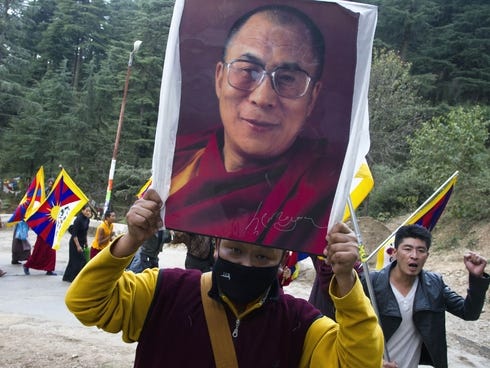
CHENGDU, China – A Chinese court in Sichuan province handed down severe sentences to two men who have been linked to 3 cases of self-immolation by Tibetans calling for the return of the Dalai Lama, their exiled spiritual leader.

A Tibetan monk holds up a picture of the Dalai Lama in protest of their lack of religious freedom. (Photo Courtesy of Northern Kentucky News)

Lorang Konchok, age 40, and his nephew Lorang Tsering, age 31, were found guilty of intentional homicide by an Aba prefecture court located in Sichuan province.  Konchok was given the death penalty with a two-year reprieve on his sentence.  In practice, this sentence is usually reduced to life imprisonment.

Konchok has also been stripped of all political rights for life.  Lorang Tsering has been sentenced to 10 years in prison and will be stripped of all political rights for 3 years.  Both men were charged because authorities say the two attempted to coerce at least 8 individuals into self-immolating.

Out of the 8 individuals the pair allegedly attempted to coerce into committing the self-sacrificing act, only 3 went through with the act.  Tibetan activists are protesting the sentences and believe that Chinese officials forced confessions out of the two men during detainment.

Local Chinese news sources reported that Lorang Konchok was detained by authorities last August and confessed that his actions were a result of him following orders from the Dalai Lama and his followers.

There was also evidence of Konchok and Tsering passing along information regarding the self-immolations, including pictures, to contacts abroad that were a part of the Tibetan independence organization.

Lorang Konchok is based out of the Kirti monastery in Aba prefecture, Sichuan Province that borders the Tibet Autonomous Region.  This area of Sichuan province has been a hot bed for unrest and has played host to dozens of self-immolations.

After several failed security measures attempting to deter protest, the Chinese government promised to start prosecuting individuals linked to the Tibetan self-immolations.  The Lorang pair is part of the first wave to face the wrath of the Chinese government in this crackdown on Tibetan protest.

Another six Tibetans were sentenced by a court in Gansu province to prison terms ranging from 3 to 12 years for their roles in self-immolations at a shopping center in Xiahe.  The convicted six were reportedly based out of the Labrang Monastery, a key center for Tibetan Buddhism.

Tibetans have expressed outrage and sorrow for all the deaths, but they also reject the course of action the Chinese government has taken in response to the protests.  Tibetans express that they understand the self-immolations because they share the sense of frustration due to a lack of religious freedom and yearn for the return of the Dalai Lama to his rightful place in Tibet.


For further information, please see:

BBC – Tibetans guilty of murder for ‘inciting immolations’ – 31 January 2013

The Guardian – Chinese court convicts two Tibetans for ‘encouraging self-immolation’ – 31 January 2013

Northern Kentucky News – China jails 8 Tibetans in self-immolation cases – 31 January 2013

Reuters – China sentences two Tibetans for “inciting” self-immolations – 31 January 2013

British Prime Minister Visits Algeria for Security Talks

By Heba Girgis
Impunity Watch Reporter, Africa

ALGIERS, Algeria—David Cameron, the British Prime Minister arrived in Algeria today for security talks and negotiations only two weeks after a hostage crisis that took place at a gas plant in the Sahara on January 16. 2013.

Prime Minister Cameron arrives in Algeria for security talks with Algerian President Bouteflika. (Photo Courtesy of The Washington Post)

Following their discussion, Cameron led a press conference where he stressed the importance of a “tough and intelligent” response to the growing threat of Islamist militants in that region of Africa.

He said, “Both Britain and Algeria are countries that have suffered from terrorism and we understand each others’ suffering. What we have agreed to is a strengthened partnership that looks at how we combat terrorism and how we improve security of this region. This should be about our perspectives, about the risks and dangers that there are, but also sharing expertise,” he continued.

The United Kingdom, specifically Britain, was among several other countries with citizens held hostage in the crisis in the Ain Amenas that also was not told in advance that Algeria planned to storm the gas plant. The new security partnership created today, Wednesday January 30,2013, between Cameron and Algeria’s President Abdelaziz Bouteflika, now focuses on cooperation between the two countries and working together for a common goal. Together, they will look more broadly at threats in North Africa and the region known as the Sahel, the region stretching across the Sahara Desert.

British soldiers will also come together with the Algerian army on a certain limited number of operations. Potentially, these operations could include training of the Algerian special forces by Britain’s special forces. This however, has not yet been confirmed by the British government. Cameron commented further that his aim was to help the country “help itself” amid and amongst the ever-growing threat from al-Qaida linked groups in that region of Africa.

Cameron also stressed, “the greatest threat of terrorism in this region is to the countries of this region. Of course there are potential threats to the UK, but the focus is very much on helping these countries to protect their security and protect British people in this region. It is very much about helping the region help themselves,” he added.

At the end of Cameron’s trip, he made a special visit to the monument of the martyrs of the Algerian war of independence. He placed flowers at the monument, showing respect and the growing relationship and link between the two countries.


For further information, please see:

Algeria Press Service – Algeria, UK “United” in Fight Against Terrorism Says David Cameron – 30 January 2013

Al Jazeera – UK’s Cameron in Algeria for Security Talks – 30 January 2013

The Independent – Britain Forges New Algeria Alliance to Fight Terrorism – 30 January 2013

The Washington Post – UK’s Cameron Visits Algeria – 30 January 2013

Israel Boycotts UN Human Rights Council Review

By Ali Al-Bassam
Impunity Watch Reporter, Middle East

JERUSALEM, Israel — Last Tuesday, Israel became the first country ever to boycott the United Nations’ human rights forum, which had allegedly planned to scrutinize Israel’s record.

Israel became the first country ever to boycott the U.N. Human Rights Council’s Universal Periodic Review. (Photo Courtesy of Jerusalem Post)

The United Nation’s Human Rights Council (UNHRC) was set to conduct a Universal Periodic Review (UPR), which in every four years reviews the human rights record of the 193 U.N. member states. Israel stopped cooperating with the council after it comprised a committee to review Israeli settlements and their effect on Palestinian human rights. The last time Israel cooperated with the council was in 2008. It is not a member of the 47 member state council.

“I see that Israel is not in the room,” said Council President Remigiusz Henczel to delegates present at the United Nations in Geneva. Henczel was urged by the council to encourage Israel’s participation in the rights review.

Earlier on Tuesday, Israeli Foreign Ministry Spokesman Yigal Palmor made it clear that Israel intended to boycott the review. “We cut all our contacts with the council last March, including the current activity,” said Palmor. “Our policy has not changed.”

Arab states specifically were set to criticize Israel for its naval blockage and settlement expansion of the Gaza Strip. Palestinians see these acts as collective punishment, yet Israel finds them vital for security.

Pakistan’s Ambassador Zamir Akram, speaking on behalf of the Organization of Islamic Cooperation, said the group is concerned that Israel was creating an “unhealthy precedent” which other countries would follow in boycotting the UPR process. “What is surprising for us, is the level of leverage and understanding that is being extended to Israel by some countries for its behavior in violation of all its international obligations,” Akram said.

Ireland’s representative, speaking on behalf of the European Union said it appealed to Israel to join the review, saying that a phone conversation held earlier with Israel on calling of the boycott was a “positive signal.”

Eileen Chamberlain Donahoe, Ambassador to the UNHRC, addressed the council on the matter last Tuesday. She avoided naming Israel, but stressed how essential it is for Washington to ensure that all countries’ human rights records are examined. “The Universal Periodic Review has been a valuable mechanism both becasue it is universally applicable to all U.N. member states on equal terms and because it is conducted in a cooperative and collaborative manner.”

Eight Israeli human rights groups called on Israel to reverse its decision and participate in the UPR. However, United Nations Watch Director Hillel Neuer said that Israel is justified in its boycott, saying that the council had a history of signaling out Israel, and that it had passed more resolutions against Israel then all other countries combined.

For further information, please see:

Israel Hayom — Israel First Country Ever to Boycott UN Human Rights Review — 30 January 2013

Al Jazeera — Israel Boycotts UN Human Rights Council — 29 January 2013

Jerusalem Post — UN Avoids Israel Showdown, Delays Rights Review — 29 January 2013

JTA — Israel Boycotts Scheduled U.N. Review of Human Rights Practices — 29 January 2013


Syria Revolution Digest: 29 January 2013

The White House Riddler!

Syrian Revolution Digest – January 29, 2013 

President Obama is right: the United States has given more than any other country to help mitigate the humanitarian crisis unfolding in Syria. For that he deserves our gratitude. But what he remains unwilling to consider, it seems, is that the United States has several options, not to mention a moral obligation, to actually stop this disaster in track before it mushrooms into a regional meltdown. This will be the biggest humanitarian aid package of all. His reiterated commitment to Assad’s removal and to supporting the transition to democratic rule is laudable, but his failure to explain how this could be accomplished and what the U.S. intends to do to achieve this 18-month old objective continues to puzzle.


Tuesday January 29, 2013


Today’s Death Toll: 228 martyrs (including 13 children and 7 women): 118 in Aleppo (80 of them in Bustan Al-Qasr), 37 in Damascus and Sububs, 25 in Daraa, 23 in Homs, 11 in Hama, 7 in Idlib and 7 in Deir Ezzor (LCCs).


Points of Random Shelling: 424 points: 14 points were shelled by warplanes, 4 points by Thermobaric Bombs, 3 points by Cluster Bombs and 1 point by Phosphorus Bombs. The mortar shelling was reported in 187 points, the artillery shelling in 145 points and the missile shelling in 70 points (LCCs).


Clashes: FSA rebels clashed with regime forces and its Shabiha in 142 locations. Successful operations included downing a warplane and destroying a loyalist military convoy in Sfeira in Aleppo, liberating Political Security Department in Deir Ezzor City and freeing all detainees and taking control of the Idlib Central Prison (LCCs).


News

Dozens of People Are Reported Bound and Shot in Syria Muddied and waterlogged bodies of scores of people, most of them men in their 20s and 30s, have been found in a suburb of Syria’s contested northern city of Aleppo, activists and insurgent fighters reported Tuesday. Videos posted by opponents of President Bashar al-Assad seemed to show that many had been shot in the back of the head while their hands were bound.

Obama Delivers Video Message to Syria as Death Toll Rises “He’s clearly trying to show and tell the people of the Arab world the U.S. is very involved in delivering assistance to Syria,” Danin said. “It may not be lethal, it may not be military, but he went out of his way to point out the U.S. is the single largest contributor of assistance. ‘‘He’s also trying to beat back criticism,’’ Danin said. ‘‘He’s trying to get in front of the story rather than have the story be ‘The United States is standing by while Syrians suffer.’’’

Hillary Clinton: US set up credible opposition in Syria The outgoing Secretary of State Hillary Clinton said the US has played an indispensable role in working to establish a credible opposition coalition in Syria.

Syria “breaking up before everyone’s eyes:” envoy tells U.N. U.N.-Arab League mediator Lakhdar Brahimi warned the U.N. Security Council on Tuesday that Syrian President Bashar al-Assad may be able to cling to power for now but the country is “breaking up before everyone’s eyes,” diplomats told Reuters. Brahimi appealed to the 15-nation council to overcome its deadlock and take action to help put an end to the Syrian civil war. However, it was not clear whether his latest report – one of his bleakest since his appointment last year – would persuade Russia to agree to support concrete U.N. steps to try to halt the bloodshed.

Palestinian commander who once tried to challenge Arafat dies in Damascus, aged 86 Maragha rebelled against Arafat in 1982, after Israel invaded southern Lebanon and bombed the capital, Beirut, pushing out Palestinian fighters. Arafat and much of the Palestinian leadership fled to establish a base in Tunisia. Other fighters fled to Algeria and Yemen. Maragha wanted Arafat to hold military commanders accountable for fleeing from the fighting. He argued against leaving Beirut, wanting to stay as close as possible to Israel’s borders. A year later, he established a rival group, called “Fatah Uprising.” The group received the backing of the Assad regime in Syria, which sought to weaken Arafat. He ultimately left to Damascus, where he joined the Syria-allied Palestinian National Alliance, a group that rejected negotiations with Israel.

Former US Official: Syria Faces Unclear Future Brent Scowcroft views the two-year Syrian uprising as much more complex than the Arab Spring uprising in Libya. “In Libya, you could see the alternatives if you throw out [Moammar] Ghadafi,” Scowcroft said in an interview with VOA. “[In] Syria, the alternatives are not so clear.”

UN Seeks Major Aid Boost For Syrian `Catastrophe’ The urgency for a dramatic increase in international relief funds for Syria – seeking total pledges of $1.5 billion – will be the central message Wednesday in Kuwait from U.N. Secretary-General Ban Ki-moon and other leaders such as Jordan’s King Abdullah II, whose nation is struggling with more than 320,000 refugees and more arriving every day. The meeting also seeks to reorient some of the political calculations among Western nations and allies supporting the Syrian rebels. With the civil war nearing its two-year mark and no end in sight, U.N. officials and others are pressing governments to recognize the potential long-term humanitarian burdens and spread resources and support to both the Syrian opposition and the millions of people caught in the conflict.


Special Reports

Syria War-Wounded Flee Across Border To Treatment In Turkey

Syrians are fleeing in record numbers to neighboring countries, and the injured can’t rely on Syrian hospitals because they have often been targeted by the regime’s fighter jets. Targeting civilians, or hospitals, is a war crime under international law. “In Syria, hospitals are sometimes targeted with rockets and shelling and any doctor that they catch treating casualties they immediately execute him and they tell Syrians those are terrorists and you are helping terrorists,” says Yasir Alsyed, the manager of the rehab center.

A Tale of Iran, Syria and a Busy Oil Tanker

Although sanctions have forced Iran to cut back dramatically on its shipping traffic, some Iranian-linked vessels continue to slip through the net. For a brazen example, take the case of an Iranian-flagged oil tanker named the Tour 2, currently off Cyprus, which earlier this month paid a call at the Syrian port of Tartous. The Tour 2 is not on the U.S. sanctions list, though if sanctions are to be the U.S. tool of choice for dealing with Syria and Iran, the Tour 2 comes with a record that should transfix any dedicated sanctions enforcer. Over the past year, it has made at least three circuits between U.S.-sanctioned Iran and U.S.-sanctioned Syria, calling at Syria last March, July and just this month. These trips appear to be part of Iran’s effort to bolster Syria’s regime against the uprising in which more than 60,000 people so far have died. While Iran’s Islamic Revolutionary Guard Corps has abetted the Assad regime in the killing, Iranian-controlled tankers have helped the Syrian regime defy U.S. and European Union embargoes on its oil sales by sending ships to pick up Syrian crude, for onward sale that benefits Iran’s embattled ally, President Bashar Assad. The Tour 2 has been one of these ships.

From Aleppo, An Artifact Of A Calmer Age

Aleppo’s present belies a much richer past. It’s Syria’s largest city, and one of the world’s oldest continually inhabited urban areas. Over the centuries, it has served as a major crossroads for trade and commerce. At The Textile Museum in Washington, D.C., there is moving evidence of an earlier, more peaceful time in that now-beleaguered Syrian hub: photographs of 19th century women in gold-trimmed velvet jackets, flowing pants and, on their heads, finely woven skull caps. One such small and brimless cap, made in 1800, is on display at the museum.

The American Surrender on Syria

America’s fears of heavily armed jihadists overrunning the country is already coming to pass, Azm says—a result, in his opinion, of the lack of international support for more moderate and organized rebel factions. “No one supported them,” he says. “Then you had these Islamist groups come in, and they had weapons, and they had guns, and they had money—and people started to drift toward them. And they’re on the loose now anyway.”


Has Obama administration gone wobbly on Syria?


As the Syrian Tragedy continues to unfold, it is proven much more of a serious challenge to lawmakers all over the world than many of us had expected. It is denuding us all, and revealing weaknesses not just in the structure of decision-making in the UN, but also in several important countries around the world, including the United States, as we can deduce from this article by Bennett Ramberg:


Congress should reconvene the hearings begun last session. This time, however, it must press for details about the administration’s assumptions about intervening or not. In addition, all the hearings should be public – not secret, as the administration prefers. This will give the American people confidence in the decision-making. Among the broad questions the hearings should explore:


•          Why should Syria’s use of chemical weapons be more concerning than the conventional arms that have killed many tens of thousands and wounded countless others?

•          Have policymakers exaggerated chemical weapons’ effectiveness to kill, injure and terrorize?

•          Given concerns that terrorists could get hold of these weapons, what challenges would they confront to transport and detonate the toxic material in and out of Syria?

•          Why can’t Syria’s neighbors, Turkey, Jordan and Israel – all substantial military powers in the region – deal with this challenge?

•          How many and what kinds of U.S. forces would operations require –with and without allies – to lock down the Syrian chemical arsenal? Would air power be enough? Would boots on the ground be required to secure secret sites? Could rebel militias serve this purpose?

•          If the United States intervenes, what is the game plan and exit strategy to prevent another quagmire?


Congress should mold its findings into a joint House and Senate resolution – still plausible on national security issues even as legislators divide on budgetary matters – unblemished by executive branch drum-beating or quaking.


If Congress does this, it won’t just be addressing the Syrian challenge. It will finally begin to right the imbalance of power between the executive and lawmakers that for too long has dominated American war deciding.


This will begin to fulfill what the War Powers Resolution intended – to “insure that the collective judgment of both the Congress and the president will apply to the introduction of United States Armed Forces into hostilities.”


Frederick C. Hoff – Syria: Transitional Government and US Choices


What makes these points particularly important is that they are made by someone who used to be the Obama Administration’s point man on Syria just until the end of last year:


Indeed, the United States’ recognition of the Syrian Opposition Coalition in December 2012 as “the legitimate representative of the Syrian people” would be meaningless without the implicit understanding that those who legitimately represent 22.5 million Syrians have the right to constitute a government. And yet, were such a government to establish itself on liberated Syrian territory, would the United States recognize it as the Syrian government? Would it help to defend that government against the Assad regime’s likely efforts to strangle it in the cradle? Would it enter into a security assistance relationship with the new Syrian government? Would it organize an international effort to fund the new government at levels that would enable it to meet the humanitarian, essential services, and law-and-order needs of its constituents? These questions must be answered—and answered definitively—before the Syrian Opposition Coalition can reasonably undertake the establishment of such a government…


The possibility of the Syrian opposition forming an alternative government offers the Obama administration a choice it does not welcome: either reconsider its basic strategy or tell the opposition (and our allies and friends) not to count on the United States to do the things that would give a new government the chance to succeed.  The former could be wrenching, as key administration officials see Syria as a beckoning morass: the mother of all distractions for a second Obama term dedicated to accomplishing an ambitious agenda at home and creating a sustainable and stable security architecture in Asia. Yet the latter could be disastrous; given enough rope Assad will take Syria straight to the gallows, and the consequences of that hanging will be felt by 22.5 million Syrians and all of their neighbors for decades to come.  Will the United States be able to avert its glance as the tsunami of Syrian state failure washes refugees, terrorists, and weapons of mass destruction over the region?


The Syrian revolution is not America’s to win or lose. The American Revolution was not France’s to win or lose. Yet without the support of France, American independence could have been deferred indefinitely and disastrously. Without American support, the uprising of Syrians against a regime willing to assault their dignity and take their lives in addition to picking their pockets, might have died an early death. Yet now a point of decision has arrived. For the Syrian opposition to form a government offering all Syrians a credible and convincing alternative to the Assad-Makhluf family clique, the United States will have to step up its game. Reluctance to do so is understandable. Failure to do so could be disastrous.


Video Highlights


Video of President Obama’s message to the Syrian people http://youtu.be/15Ldu9dZKHY


Videos from the massacre at Boustan Al-Qasr, Aleppo City: activists found dozens of bodies of people who seem to have been summarily executed by pro-Assad militias – The moment of discovery http://youtu.be/mlOSRzKNhZI Pulling the bodies from the river banks http://youtu.be/2inMpA_h6lY , http://youtu.be/O-YtyxA3zxo Collecting the bodies http://youtu.be/KuOTQxd84VQ , http://youtu.be/O4y8gQV4DO8 Angry Locals http://youtu.be/YqyccUDdlCo , http://youtu.be/1mCSVNbijRs Impromptu funeral for one of the over 80 victims http://youtu.be/NDTgCMEV-Mg Bodies lined up in rows http://youtu.be/AfqHEQQuuGs


The Massacre in pictures.


Rebels in Sfeirah, Aleppo, repel an attack on their town by loyalist militias http://youtu.be/YNoRW9RLVHQ destroying a number of vehicles http://youtu.be/AfqHEQQuuGs


Hundreds of defected soldiers arrive in Idlib http://youtu.be/pHn0aqLHWIU


Video produced by the Islamist Ahrar Al-Sham Brigades showing their participation in the liberation of the Central Prison of Idlib http://youtu.be/iI_j-u_PTrc A tour of the compound http://youtu.be/_-Gtr9EY9N8


In Deir Ezzor City, rebels take over the local branch of the political security and free the prisoners http://youtu.be/ZJvRIH4FuKc , http://youtu.be/u–S4nilBAs , http://youtu.be/v3ELTMnBj7E , http://youtu.be/APYr5JZiBtY , http://youtu.be/fYWayv25WLk The dead in here are pro-Assad militias who were killed during the operations http://youtu.be/HWPwHtPn950 And the clashes continue: Destroying a tank http://youtu.be/IPpDIF2j-zE , http://youtu.be/UGMnfRBfkiA Rebels take control of a tank http://youtu.be/zBVoVrhWR9I


Rebels have managed to confiscate some formidable rockets from certain regime storage facilities, especially in Aleppo, but they don’t have any launchers http://youtu.be/7wtVi0KN4yw


A Russian journalist is hit by a sniper and rescued and treated by locals http://youtu.be/VDN0qkJGVPg


Rebels in Karnaz, Hama, use improvised rockets to attack loyalist positions http://youtu.be/vRYV5Girsk0 As the clashes continue http://youtu.be/G_fbsagHnDk and the aerial bombardment http://youtu.be/B12BxJOtptE Regime forces respond with tanks http://youtu.be/-HQ6QIr6t00 , http://youtu.be/pHnQsBn4Pgc


In Damascus, the pounding of the town of Daraya continues http://youtu.be/2TW8BVtaIQU , http://youtu.be/zWws2H9tplA , http://youtu.be/XvCZa8eUa_U